
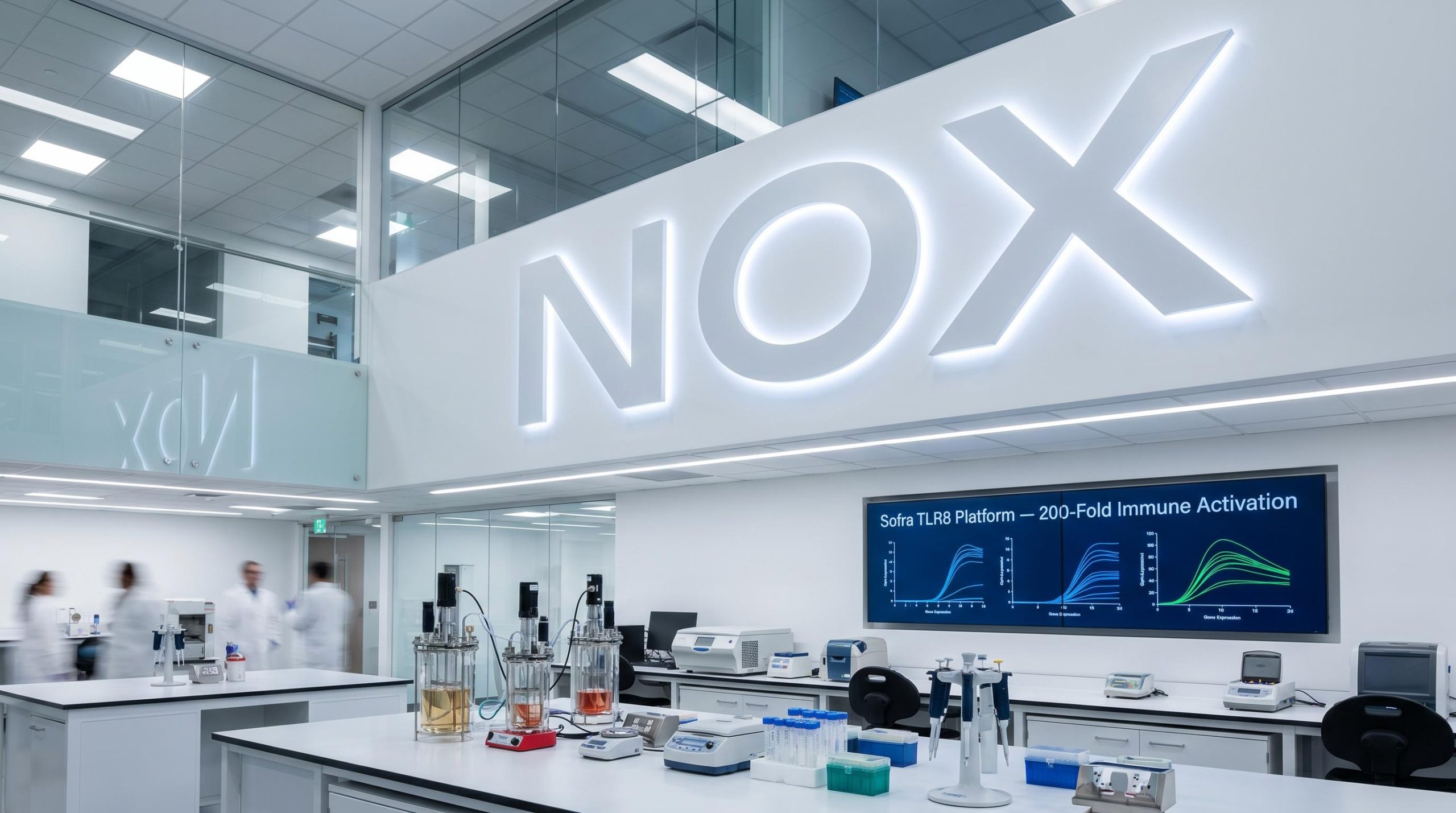
New Sofra data shows 200-fold boost in immune activation against cancer
Noxopharm Limited (ASX: NOX) has released new preclinical data showing its proprietary Sofra TLR8-amplifying oligonucleotide boosted immune activation by more than 200-fold in human skin biopsies when combined with a clinical-stage TLR8 agonist, Motolimod. A second experiment demonstrated that a TLR8-amplifying oligonucleotide increased TLR8-driven immune response almost 3-fold in transgenic mice expressing human TLR8. The findings, which build on research published in Nature Immunology, validate the Sofra platform’s cancer-fighting potential across both human and animal systems.
When big ASX news breaks, our subscribers know first
What is TLR8 and why does it matter in cancer treatment?
Toll-like receptors (TLRs) are sensors within the human immune system that detect potential threats and trigger immune responses. TLR8 is a specific receptor with well-established relevance in anti-cancer immunity, and it is already the target of multiple pharmaceutical development programmes, with approved agents now in use.
Immuno-oncology is the field that harnesses the body’s own immune system to destroy cancer cells. It has become one of the most active areas of cancer research, yet response rates for existing immunotherapies remain limited, sustaining ongoing demand for new approaches.
Key market context:
- The immuno-oncology market is estimated at US$35 billion in 2025, projected to reach US$185 billion by 2035
- Multiple pharmaceutical companies are advancing TLR8-based anti-cancer agents, with approvals already granted
- Noxopharm’s oligonucleotides are designed to greatly amplify TLR8 activity compared to current best-in-class drugs in clinical development, via a novel amplification mechanism
This commercial backdrop positions the Sofra data as more than a scientific milestone. For investors, the scale of the addressable market gives the platform’s early-stage results tangible strategic context.
What the new data shows — and what comes next
Two experiments, two systems validated
The new dataset comprises two distinct experiments conducted across human and animal systems.
In the first study, human skin biopsies were cultured ex vivo. An immune response was induced using Motolimod, a clinical-stage TLR8 agonist. When a Sofra TLR8-amplifying oligonucleotide (Nox-oligo) was added, the level of the immune activation biomarker increased by more than 200-fold compared to the agonist alone.
In the second study, transgenic mice expressing human TLR8 were used. The agonist R848, a TLR7/8 agonist, was administered, followed by a systemically delivered Sofra oligonucleotide. Gene expression analysis of three TLR8-responsive biomarkers showed that immune response in the spleen increased almost 3-fold versus the agonist alone.
| Model | System | Agonist Used | Key Result | Status |
|---|---|---|---|---|
| Human skin biopsy | Ex vivo (human) | Motolimod (TLR8 agonist) | Immune activation biomarker increased >200-fold vs agonist alone | Validated |
| Transgenic mouse | In vivo (humanised TLR8) | R848 (TLR7/8 agonist) | TLR8-driven immune response in spleen increased ~3-fold vs agonist alone | Validated |
The combinatorial approach, pairing a Sofra oligonucleotide with an existing agonist, is the core mechanism being validated. It is designed to enhance standard-of-care therapies such as chemotherapy and radiotherapy. The technology is protected by a granted US patent.
Professor Seija Lehnardt, Group Leader, Charité – Universitätsmedizin Berlin
“The Noxopharm results demonstrate that these short oligonucleotides possess the potential to significantly enhance the therapeutic efficacy of TLR8 sensing, both in vitro and in vivo, and I look forward to seeing how this progresses in the months ahead.”
The road ahead for Sofra in oncology
With validation achieved across both human and animal systems, Noxopharm has outlined the following next steps for the programme:
- Scaling up to test TLR8-amplifying oligonucleotides in humanised TLR8 mice
- Testing in various cancer models
- Timeline: in the months ahead, per the company’s disclosure
While the Sofra platform also has potential applications in autoimmune diseases and mRNA enhancement, the oncology programme is the focus of this data release.
Dr Olivier Laczka, Chief Executive Officer, Noxopharm
“We are very encouraged by these results and the potential of the Sofra platform in the cancer space. Our deep and novel understanding of how innate immune receptors such as TLR8 are naturally regulated provides a unique advantage in targeting them.”
The investment case for Noxopharm’s Sofra platform
The new data supports three pillars relevant to the investment case:
- Novel mechanism validated in both human (ex vivo) and animal (in vivo) systems
- US patent protection granted, providing intellectual property coverage for the technology
- Platform positioned against a large market, with immuno-oncology projected to reach US$185 billion by 2035
Beyond oncology, Sofra’s dual-track relevance extends to the autoimmune disease therapeutics market, valued at US$163.2 billion in 2024 and projected to reach US$219.6 billion by 2035. Cancer model testing is expected in the months ahead, representing the next material programme milestone. Investors should note that the platform remains at the preclinical and ex vivo stage, with clinical translation still ahead.
Don’t Miss the Next Healthcare Breakthrough on ASX
Big News Blast delivers FREE breaking ASX healthcare and biotech news directly to your inbox within minutes of release, complete with in-depth analysis already done for you. Join 20,000+ subscribers who stay ahead of the market the moment news breaks. Click the “Free Alerts” button at StockWire X to get started today.