
Noxopharm builds world’s most human-relevant TLR8 model to fast-track cancer program
Noxopharm (ASX:NOX) has created a highly advanced animal model designed to accelerate its immuno-oncology program, developed in close collaboration with strategic partner Hudson Institute of Medical Research.
The model is believed to be the most human-relevant TLR8 model currently available anywhere in the world. In early validation, the company’s TLR8-potentiating oligonucleotide amplified the immune signal a further 11-fold, contributing to a 66-fold increase in TLR8 activation compared to the untreated baseline. A more human-relevant research model raises the probability of successful drug development outcomes, an important consideration for a clinical-stage biotech advancing novel cancer therapeutics.
When big ASX news breaks, our subscribers know first
Why the TLR8 model matters: solving a global research barrier
Developing animal models that accurately reflect human biology has been a longstanding challenge in cancer research, owing to well-recognised differences between the human and animal immune systems. This problem is particularly acute for Toll-like receptor 8 (TLR8), Noxopharm’s key innate immune system target for its cancer program.
TLR8 does not play an active role in the immune system of mice. This places it among the most difficult targets to examine in conventional models and has made it a recognised global barrier in TLR8 drug development “until now,” according to the company.
The new model closely replicates key features of human TLR8 biology that were absent in earlier models, enabling more accurate evaluation of TLR8-targeted therapeutics and supporting faster, more reliable proof-of-concept studies.
Key distinguishing features of the model include:
-
Incorporates the human TLR8 receptor
-
Reproduces where and how human TLR8 is active in the body
-
Believed to be the most human-relevant TLR8 model available globally
-
Developed with Hudson Institute of Medical Research
Validation data: an 11-fold amplification signal
To demonstrate the model’s potential, Noxopharm validated it in ex vivo studies using a commercially available TLR8 agonist (TL8-506) to show successful induction of immune activation. Immune cells isolated from the human-relevant TLR8 mice were treated with the agonist, producing a measurable rise in an immune activation biomarker.
A 6-fold increase in the TLR8-driven immune response was observed from the agonist alone. Addition of Noxopharm’s TLR8-potentiating oligonucleotide amplified this signal a further 11-fold, achieving a combined 66-fold increase in TLR8 activation compared to the untreated control.
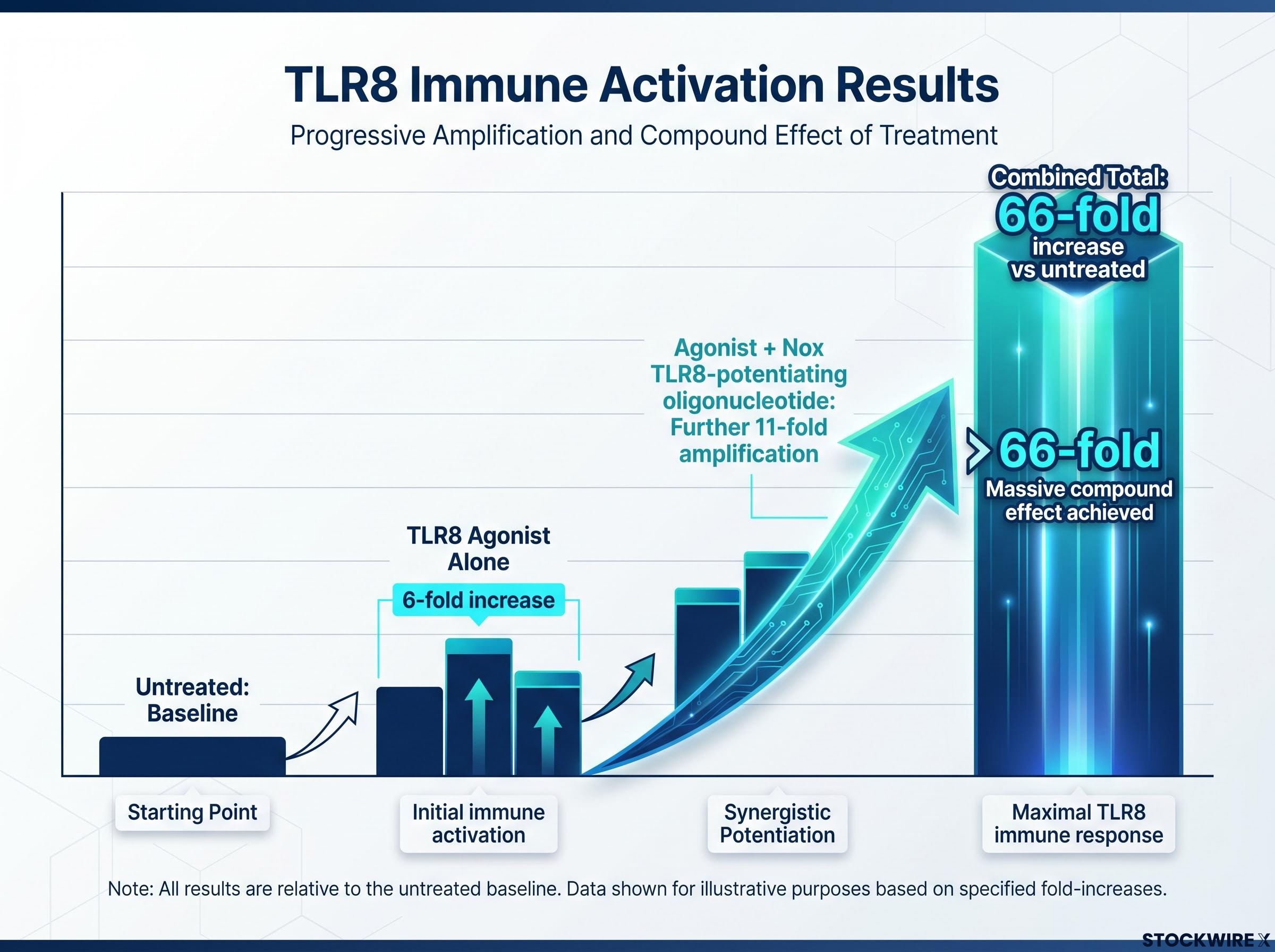
| Condition | Effect observed (immune activation biomarker, fold vs untreated) |
|---|---|
| Untreated | Baseline |
| TLR8 agonist alone | 6-fold increase |
| Agonist + Nox TLR8-potentiating oligonucleotide | Further 11-fold amplification |
| Combined total | 66-fold increase vs untreated |
The result demonstrates both that the model works and that Noxopharm’s Sofra oligonucleotide can meaningfully boost the immune response in a human-relevant setting.
Earlier Sofra cancer data recorded 200-fold immune activation in human skin biopsies when the TLR8-amplifying oligonucleotide was combined with clinical-stage agonist Motolimod, establishing a benchmark that the new human-relevant mouse model is now designed to replicate and extend across in vivo cancer settings.
What is the Sofra platform?
The Sofra technology platform is based on the use of synthetic nucleic acids, known as oligonucleotides, to mimic natural regulators of the body’s defence system.
According to the company, the approach enables “selective and modular tuning of immune sensors,” reducing or stimulating their associated biological responses to address a broad range of diseases. Sofra is focused on inflammatory and autoimmune diseases such as rheumatoid arthritis, lupus and diabetes, as well as immuno-oncology for cancer treatment.
The Sofra platform’s underlying science received independent validation through a Nature Immunology publication earlier in 2026, with world-leading expert Professor Arthur Krieg endorsing the anti-inflammatory mechanism that now underpins both the autoimmune and immuno-oncology programs.
These applications sit within two large and growing markets:
-
Global autoimmune disease therapeutics market: US$163.2B (2024), projected to reach US$219.6B by 2035
-
Worldwide immuno-oncology market: US$43B (2023), projected to reach US$284B by 2033
The dual focus positions Noxopharm across two sizeable therapeutic areas as it advances its pipeline.
Next steps and the investment angle
Building on recent encouraging data, Noxopharm intends to use the new model to establish advanced cancer models for evaluating its TLR8 drug leads. The stated strategic intent is to improve how proof-of-concept preclinical studies are conducted, with the aim of increasing the probability of successful outcomes.
Dr Olivier Laczka, CEO
“This new model changes the game because it is much closer to human biology, which will enable us to be more accurate and significantly accelerate our research.”
Dr Laczka also pointed to the company’s ambition to build a “truly disruptive immuno-oncology program” based on its discovery of novel natural immune regulators in the body.
Don’t Miss the Next Healthcare Breakthrough
Big News Blast delivers FREE breaking ASX healthcare and biotech news directly to your inbox within minutes of release, with in-depth analysis already done. Join 20,000+ subscribers staying ahead of market-moving developments. Click the “Free Alerts” button at StockWire X to start receiving real-time alerts the moment ASX announcements drop.