

IMP761 late-breaking data shows exposure-dependent T-cell suppression at ACR Convergence 2026
Immutep (ASX: IMM; NASDAQ: IMMP) announced positive Phase I data on IMP761, its first-in-class LAG-3 agonist antibody, from a late-breaking abstract at ACR Convergence 2026 in Orlando, Florida. The data showed statistically significant, exposure-dependent inhibition of T-cell-driven immune responses in healthy volunteers, with greater pharmacodynamic effects at higher IMP761 exposure.
The results build on the positive first-in-human results presented at EULAR 2026. ACR Convergence is the annual scientific meeting of the American College of Rheumatology.
The EULAR 2026 debut also carried commentary from CEO Marc Voigt on potential strategic collaboration tied to IMP761, a commercial angle that sits alongside the clinical readout.
Key highlights from the readout:
- Statistically significant and exposure-dependent inhibition of T-cell-driven immune responses in healthy volunteers
- Well tolerated across all seven dose levels, with a pharmacokinetic (PK) profile supporting a four-week dosing interval
- The multiple ascending dose (MAD) portion of the study is ongoing, with no new safety signals observed to date
The readout is a proof-of-concept step for Immutep’s autoimmune program.
When big ASX news breaks, our subscribers know first
Inside the Phase I study and what it showed
How the KLH challenge model works
Volunteers are first immunised with keyhole limpet haemocyanin (KLH) three times. They then receive small injections of KLH into the dermis, which produce a measurable, T-cell-driven local immune reaction.
The model is an established way to test whether a drug can dampen a strong tissue T-cell-driven immune response to a foreign antigen. It therefore has the potential to silence T-cell responses to self-peptides in patients with autoimmunity. For investors, it is an established test of IMP761’s mechanism.
Study design and safety
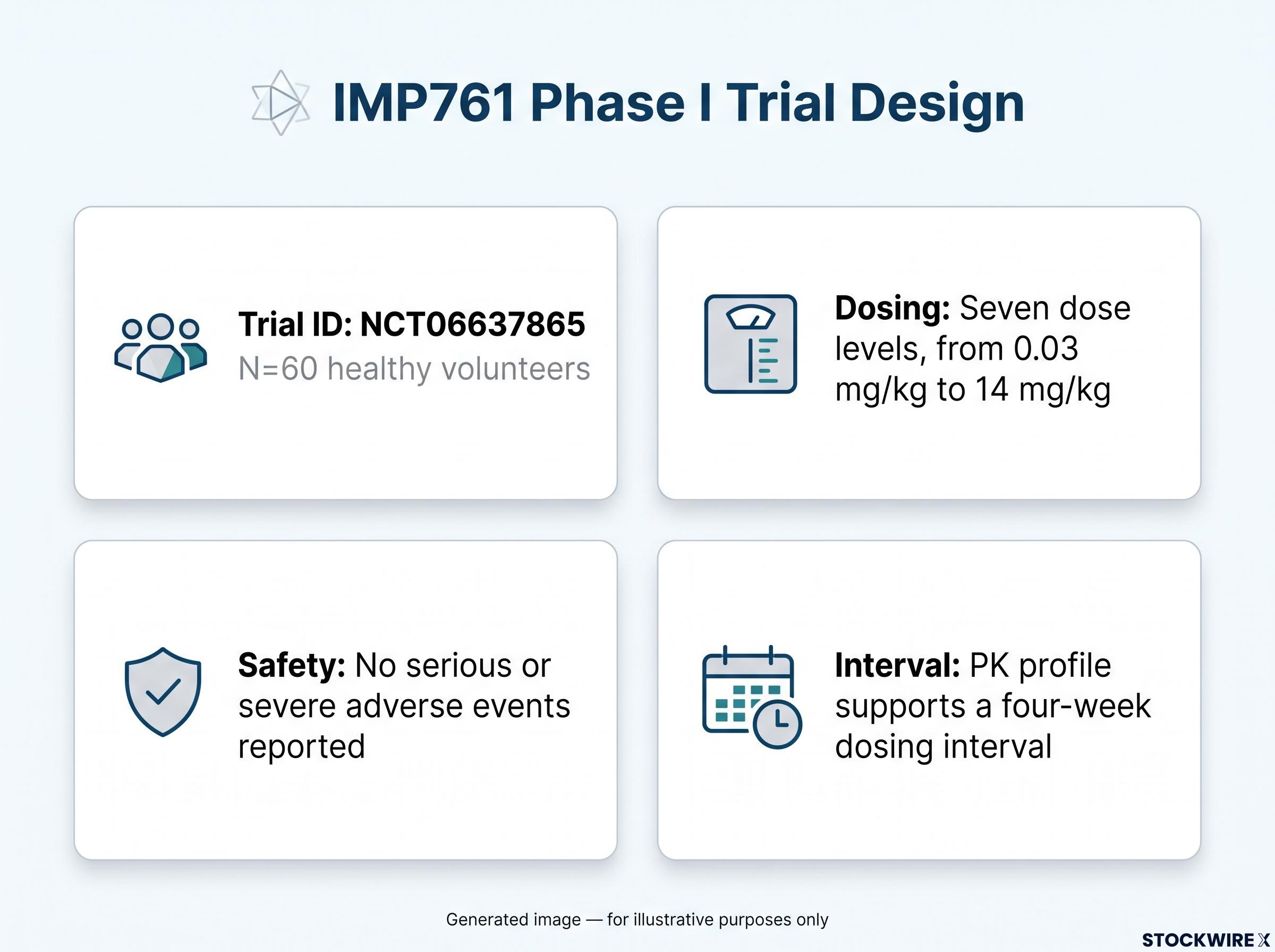
- Randomised, placebo-controlled, double-blind first-in-human study (NCT06637865)
- Conducted by the Centre for Human Drug Research (CHDR) in Leiden, the Netherlands
- Healthy volunteers (N=60)
- Seven dose levels, from 0.03 mg/kg to 14 mg/kg
- No serious or severe adverse events reported
- PK profile supports a four-week dosing interval for the MAD portion
Pre-clinical support
In complementary pre-clinical studies using samples from rheumatoid arthritis patients, IMP761 demonstrated statistically significant reductions in T-cell activation and proliferation. The findings provide additional support for the potential application of LAG-3 agonism in autoimmune diseases driven by pathogenic T-cell responses.
Dr. Frédéric Triebel, CSO of Immutep
“These results derived from a large double-blinded trial clearly show the immunosuppressive effect of IMP761 on a strong antigen-driven T-cell response in tissues, without safety concerns…”
Why IMP761 matters for Immutep’s autoimmune strategy
IMP761 is an agonist IgG4 monoclonal antibody targeting LAG-3. It is designed to enhance LAG-3’s natural inhibitory function on the chronically activated, self-reactive T cells that drive many autoimmune diseases.
“To the Company’s knowledge,” IMP761 is the only LAG-3 agonist antibody currently in clinical development. Immutep is a clinical-stage biotechnology company targeting cancer and autoimmune diseases.
Dose-response and safety data from a placebo-controlled trial strengthen the case for moving into patient studies.
What happens next for IMP761
The source states the following next steps:
- Analysis of the MAD portion of the Phase I study, with a focus on PK, is ongoing, with no new safety signals observed to date.
- Results from the MAD portion are anticipated to be reported in H1 CY2027 and are expected to inform dose selection for a potential future Phase II program.
Progress into a Phase II program will depend on balance sheet capacity, and recent non-dilutive funding from French and Australian R&D incentives has pushed management’s expected cash reach into the first half of CY2028.
The data from the poster presentation is available on the Posters & Publications page of Immutep’s website.
Don’t Miss the Next Healthcare Breakout
Join 20,000+ investors getting FREE breaking ASX healthcare news in their inbox within minutes of release, complete with in-depth analysis and the full announcement. Click the “Free Alerts” button at Big News Blast to receive alerts the moment market-moving news breaks, and stay ahead of the market.