
Quality of life data presented at ESMO 2026
Immutep (ASX: IMM; NASDAQ: IMMP) announced health-related quality of life (HRQoL) data from the investigator-initiated EFTISARC-NEO Phase II trial on 23 October 2026. The data are being presented as an ePoster (number 3788eP) at the European Society for Medical Oncology (ESMO) Congress 2026 in Madrid, Spain, running 23 to 27 October 2026.
Quality of life remained stable during neoadjuvant treatment with eftilagimod alfa (efti), pembrolizumab and radiotherapy, with a statistically significant improvement after surgery. The findings add tolerability data to the previously reported primary endpoint result in patients with resectable soft tissue sarcoma (STS).
When big ASX news breaks, our subscribers know first
Key findings: stable during treatment, better after surgery
Headline results
The announcement reported four key findings from the HRQoL analysis:
- General health status remained stable throughout the observation period, with no statistically significant deterioration in any measured scale during treatment.
- The QLQ-C30 summary score improved by 6.0 points after surgery (95% CI: 1.80 to 10.19; p=0.008).
- Role functioning improved by 12.7 points (p=0.02) and social functioning by 8.1 points (p=0.02) after surgery.
- Patient-reported fatigue was statistically significantly lower than at baseline after surgery, by up to 14.2 points (p=0.001).
| Measure | Change after surgery | 95% CI | p-value |
|---|---|---|---|
| QLQ-C30 summary score | 6.0 points | 1.80 to 10.19 | 0.008 |
| Role functioning | 12.7 points | 2.31 to 23.09 | 0.02 |
| Social functioning | 8.1 points | 1.63 to 14.56 | 0.02 |
| Fatigue (lower than baseline) | By up to 14.2 points | 6.16 to 22.23 | 0.001 |
The investigators concluded that the regimen demonstrated:
Investigator conclusion
“no significant detriment to overall QoL during treatment”
Marc Voigt, CEO of Immutep
“…These results suggest that patients receiving efti with pembrolizumab and radiotherapy maintained their quality of life during treatment, and after surgery reported less fatigue and better role and social functioning…”
Study design
Patient-reported outcomes were assessed using the European Organisation for Research and Treatment of Cancer Quality of Life Questionnaire Core 30 (EORTC QLQ-C30). Assessments took place at baseline, every 6 weeks during treatment and every 12 weeks after treatment.
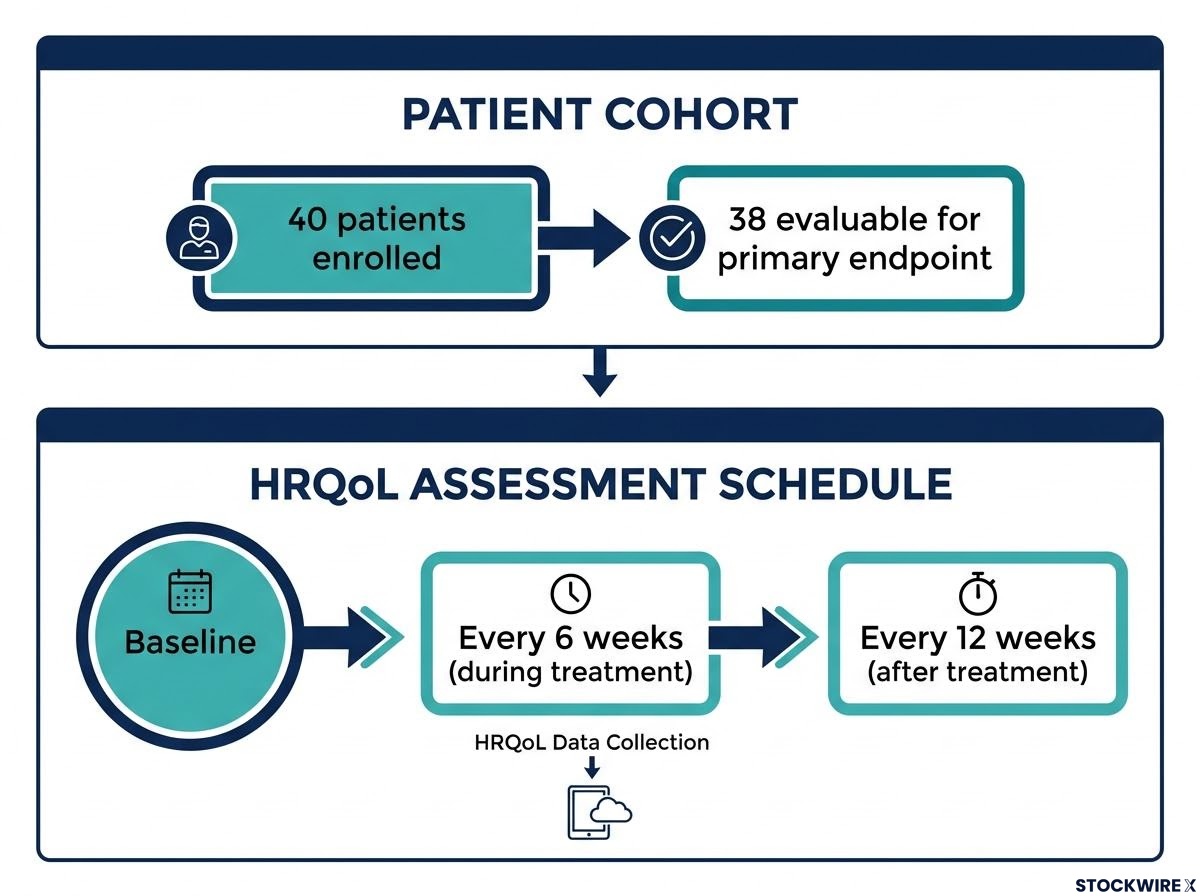
The trial enrolled 40 patients, of whom 38 were evaluable for the primary endpoint. All patients completed the questionnaire at baseline, and between 29 and 38 patients completed it at each subsequent assessment.
HRQoL is a secondary endpoint of the trial. EFTISARC-NEO is led by the Maria Skłodowska-Curie National Research Institute of Oncology in Warsaw, Poland, and the first author of the ePoster is Paweł Teterycz, M.D.
Why quality of life matters in neoadjuvant sarcoma treatment
Neoadjuvant treatment is therapy given before surgery. HRQoL measures how patients feel and function in day-to-day life, including factors such as fatigue and the ability to carry out normal roles.
For investors, tolerability data can matter because it may support patient and physician adoption and shape the overall profile of a combination therapy.
Efti is an MHC Class II agonist that activates antigen-presenting cells (APCs), which engage the adaptive and innate immune system. According to the company, its favourable safety profile has enabled combinations with anti-PD-[L]1 immunotherapy, radiotherapy, and/or chemotherapy.
Building on the primary endpoint and regulatory progress
The HRQoL results build on the primary endpoint, announced in October 2025. The combination achieved a median 51.5% tumour hyalinization/fibrosis in the evaluable population (N=38), significantly exceeding the prespecified 35% target (p<0.001).
In April 2026, efti received Orphan Drug Designation in STS from the U.S. Food and Drug Administration (FDA). Efti also holds Fast Track designation in 1st line head and neck squamous cell carcinoma (HNSCC) and 1st line non-small cell lung cancer (NSCLC).
The trial is primarily funded by a grant from the Polish Medical Research Agency (clinicaltrials.gov: NCT06128863).
Taken together, the efficacy result, the tolerability findings and the FDA Orphan Drug Designation now sit alongside each other in the STS programme. The announcement does not outline next steps, trial timelines or development plans beyond these results.
The company has since outlined registration-directed development focused on two indications, first-line HNSCC and neoadjuvant soft tissue sarcoma, with study starts targeted for the second half of calendar 2027.
The ePoster is available on the Posters & Publications page of Immutep’s website.
Don’t Miss the Next Biotech Breakthrough
Join 20,000+ investors receiving FREE breaking ASX news within minutes of release, complete with in-depth analysis. Click the “Free Alerts” button at Big News Blast to get healthcare and biotech updates the moment market-moving announcements land in your inbox.