

Carnegie outlines six objectives for its 80 kW ACHIEVE CETO demonstrator
In its investor presentation, Carnegie Clean Energy detailed the six objectives of its 80 kW rated, ½ physical scale ACHIEVE CETO demonstrator, which the presentation describes as a first-of-a-kind offshore demonstration. The programme is aimed at validating next-generation CETO wave energy technology and its commercial potential.
Carnegie outlined the aim as safe deployment and valuable real-world data from the demonstration at sea. According to the presentation, extra time is going into engineering validation, operational readiness, installation planning and integration to ensure a strong result.
The presentation set out six objectives:
- Commercial objectives: modular, scalable and accepted due to fully submerged design.
- Energy capture: capacity factors and spatial density.
- Control system: AI-enabled algorithms working in real conditions.
- Survivability and reliability: active and passive mitigation strategies in extreme seas.
- Operations and maintenance: rapid generator module swaps with minimal offshore work.
- Technology development: multi moorings, continuous depth control, rotary power conversion.
For investors, the demonstrator is the step that validates commercial-scale CETO.
When big ASX news breaks, our subscribers know first
What ACHIEVE will test on energy, control and survivability
Capacity factor and spatial density
Carnegie pointed to an expected capacity factor range of 30-50% for future commercial scale deployments. Capacity factor is average production divided by capacity.
ACHIEVE will test the power production of CETO, validating models showing commercial deployments can achieve capacity factors consistent with pre-deployment modelling. The range applies to selected sites in Spain, Portugal, France, the UK, Ireland, Australia, the United States and other comparable wave resources, and higher capacity factors are possible as control algorithms improve.
On spatial density, the presentation compared the forecast for CETO against typical offshore wind, noting the fully submerged design is hidden from view. ACHIEVE energy production data will support validation of the spatial density forecasts.
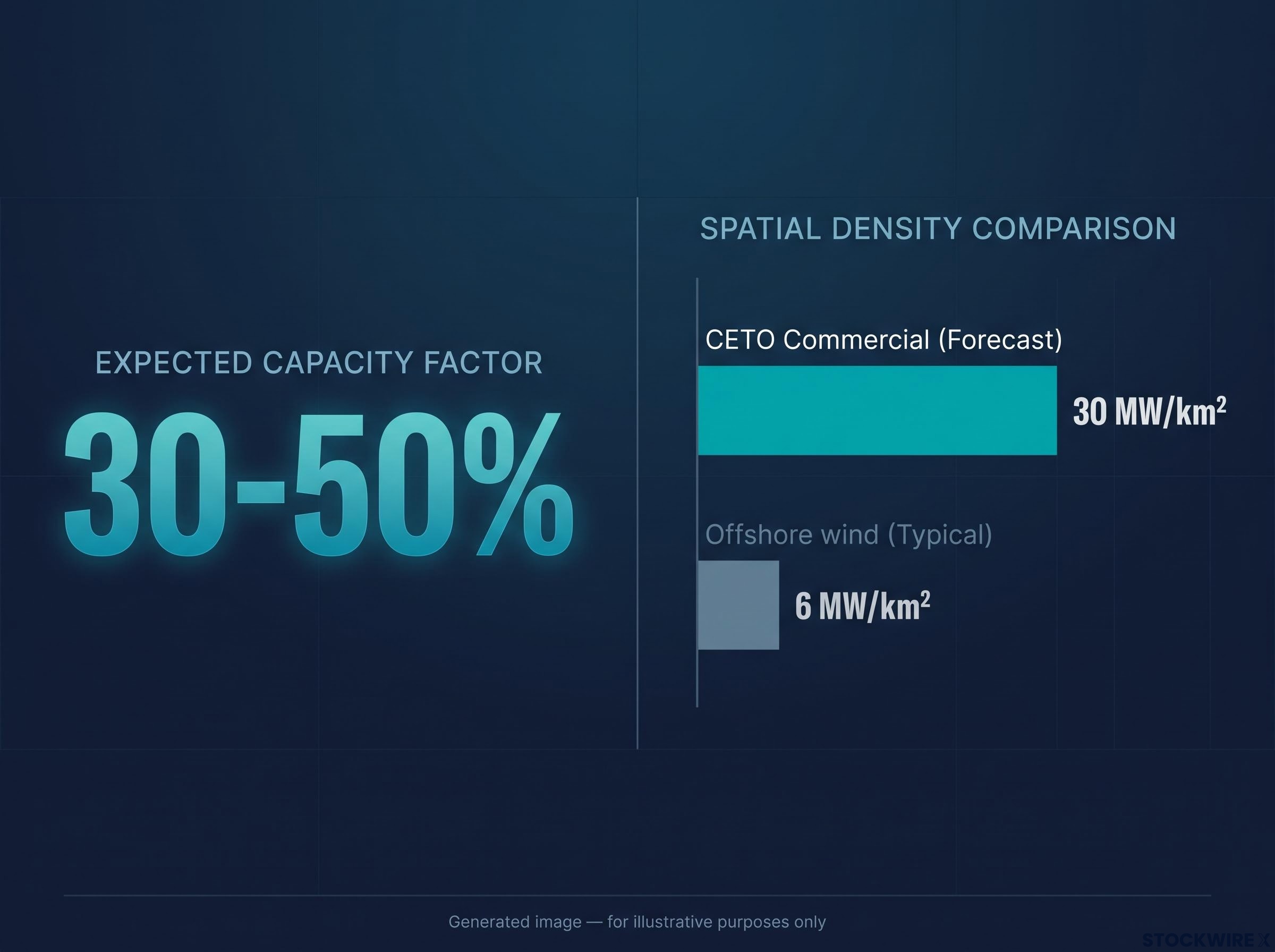
| Technology | Spatial density | Status |
|---|---|---|
| CETO Commercial | 30 MW/km² | Forecast |
| Offshore wind | 6 MW/km² | Typical |
Control system and survivability
The presentation detailed algorithms designed to optimise power capture while managing structural and operational loads, to be tested in the real ocean. Joint work with HPE shaped the control algorithm design, and the AI elements include reinforcement learning and machine learning, with a controller that learns and a wave predictor demonstrated.
Carnegie also noted that valuable, hard-to-attain data will be collected and analysed.
On survivability, a range of active and passive strategies are built into the CETO design and will be demonstrated. The sequence in extreme seas runs as follows:
- Survivability strategies come into play in extreme seas.
- The system moves within the water column as its position adjusts.
- Integrity is maintained while the system continues generating electricity.
Managing the power of the ocean has been part of CETO’s core architecture since inception, and it has shaped design, control and operations and maintenance strategies.
Commercial design, maintenance and technology progress
On commercial objectives, the modular architecture aims to ease fabrication, transport, assembly and integration using existing industrial supply chains and port infrastructure. The presentation cited potential for scalable manufacturing, flexible logistics and simpler installation with smaller vessels.
Fully submerged operation is designed to enhance safety in storms and avoid visual impact from shore, minimising the social licence impediment seen in offshore wind.
For operations and maintenance, the presentation described maintenance within existing port infrastructure with minimal offshore intervention:
- Quayside PTO swaps: power take-off (PTO) and electrical modules are rapidly removed and installed at the quay.
- Structure stays put: the primary structure remains in the water, avoiding big lifts.
- Fewer offshore needs: reduced reliance on large, specialised vessels and no divers.
The goal is to show that rapid and low-cost maintenance is feasible, reducing downtime and improving operational availability.
The technology development timeline in the presentation was:
- 2015: earlier CETO generations; prior deployments reached TRL 7/8.
- 2019: Digital Development pathway, a strategic step back in TRL that delivered step-change improvements.
- 2026: ACHIEVE Programme, demonstrating multiple moorings, rotary PTO and advanced control.
TRL stands for technology readiness level, a scale that measures how mature a technology is. A step back in TRL can matter to investors because, in this case, the presentation says it delivered step-change improvements.
Funding pathway and the European market opportunity
Carnegie stated that design advances developed during the Digital Development Pathway unlocked CETO’s top ranking in the EuropeWave programme and the cornerstone funding for ACHIEVE. ACHIEVE is generating data for cost of energy assessments, and the initial economic modelling was reviewed and verified by an independent expert to win EuropeWave funding.
Spanish authority approvals for the CETO device at the BiMEP test site triggered an earlier EuropeWave milestone payment, showing how the layered public funding behind ACHIEVE is released against formally approved deliverables.
Europe remains the primary target market, and Carnegie also actively engages with other jurisdictions with suitable wave resources, energy market conditions and customer requirements. The EU ocean energy goals cited were:
- 1 GW of installed EU ocean energy capacity by 2030.
- 40 GW of installed EU ocean energy capacity by 2050.
Carnegie is developing plans for a 6MW project at BIMEP in Spain. The presentation states the business model demonstrates revenues 3-4 years prior to commercial project commissioning, with additional opportunities with Defence and Data Centres.
ACHIEVE data underpins the capacity factor, cost and survivability claims that support commercial projects.
Investors tracking delivery risk can read our detailed coverage of the latest ACHIEVE schedule update, which explains the manufacturing and supply chain delays, the revised November ocean deployment and the spring 2027 grid connection timing.
Get Clean Energy News Before the Market Moves
Join 20,000+ investors receiving FREE breaking ASX news within minutes of release, complete with in-depth analysis. Click the “Free Alerts” button at Big News Blast to get market-moving announcements the moment they break and stay ahead of the crowd.