
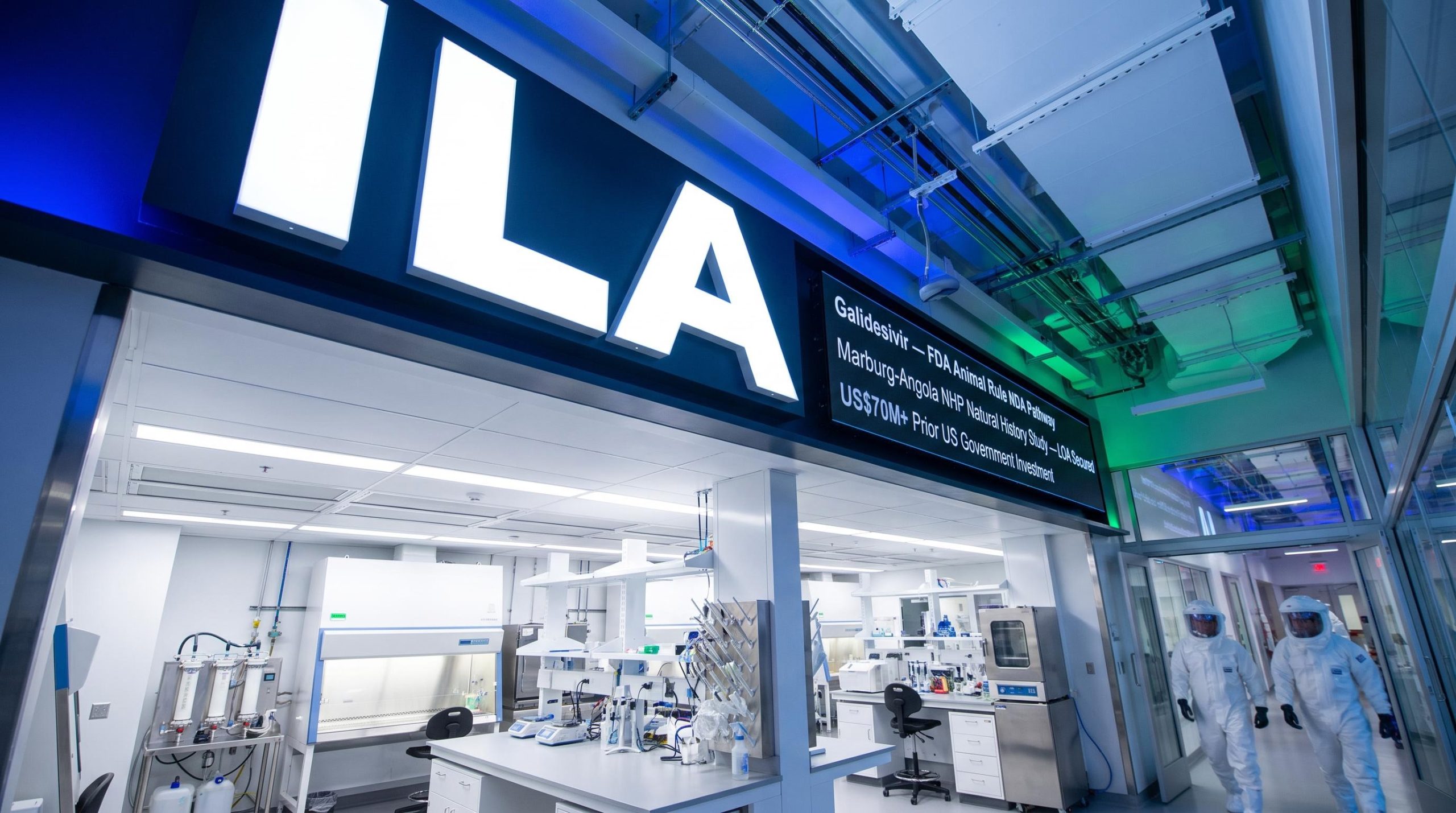
Island Pharmaceuticals secures pivotal Marburg data for Galidesivir’s FDA pathway
Island Pharmaceuticals (ASX: ILA) has secured a signed Letter of Authorisation (“LOA”) granting the regulatory right to cross-reference a detailed non-human primate (“NHP”) natural history study of Marburg-Angola virus in submissions to the US Food and Drug Administration (FDA).
The milestone directly addresses specific FDA feedback and forms an integral component of the FDA Animal Rule evidence package required to support a potential New Drug Application (“NDA”) for Galidesivir. The signed LOA follows over six months of negotiations to secure access to the original and fully complete natural history study.
For investors, the development de-risks Galidesivir’s regulatory pathway. By leveraging an established dataset rather than recreating it, Island can direct development time and capital towards generating the drug-specific efficacy data needed to advance the program.
When big ASX news breaks, our subscribers know first
Why the Letter of Authorisation matters
The LOA delivers the regulatory right to cross-reference the detailed non-human primate natural history study of Marburg-Angola virus in Island’s FDA submissions. This is not a routine procedural step. It resolves a specific information requirement raised by the regulator.
Following Type C meeting interactions regarding the Galidesivir development program, the FDA advised that the published information available on the proposed NHP model was not sufficiently detailed for the regulator to determine whether the model was adequately characterised to support a potential Animal Rule filing. The FDA indicated that the full natural history study report was required to facilitate its further regulatory review.
Securing access avoids the need to independently recreate an equivalent Marburg natural history program. Replicating such work would demand significant specialist infrastructure and expertise, specifically:
-
Highly specialised Biosafety Level 4 (“BSL-4”) facilities
-
Appropriate NHP models
-
Extensive virological, clinical and pathological assessments
-
Considerable additional time, capital and specialist resources
By obtaining the LOA, Island can instead redirect its resources towards generating the Galidesivir-specific efficacy, dose-response, treatment-timing and pharmacokinetic data required to further advance the program.
Understanding the FDA Animal Rule pathway
The FDA Animal Rule provides a pathway for the approval of medical countermeasures where human efficacy trials are unethical or infeasible. This applies to deadly viruses such as Marburg, where deliberately exposing human subjects would not be possible.
Under the pathway, efficacy can be established through adequate and well-controlled animal studies where the disease model is sufficiently characterised and the resulting data can support a reasonable prediction of clinical benefit in humans.
Natural history data play a foundational role within this framework. These studies characterise the progression of disease in the absence of treatment, establishing the underlying disease model and the baseline against which a therapeutic candidate’s efficacy can subsequently be assessed.
Why does this matter to investors? Without this dataset, Island could not advance the NHP efficacy studies that support a potential NDA. It is a regulatory building block that underpins every efficacy study to follow.
The clear sequence of studies ahead
With the natural history foundation now in place, Island is progressing a coordinated development strategy designed to build on the substantial body of existing Galidesivir data. The natural history dataset provides the regulatory foundation underpinning both upcoming studies, establishing the disease course against which treatment outcomes can be evaluated.
The table below summarises the two upcoming NHP efficacy studies.
| Study | Partner | Size | Timing | Purpose |
|---|---|---|---|---|
| USAMRIID study | US Army Medical Research Institute of Infectious Diseases (under existing CRADA) | 20-NHP | Commencing next quarter | Dose optimisation; assess Galidesivir following Marburg infection at defined post-infection timepoints; characterise therapeutic window |
| Texas Biomed study | Texas Biomedical Research Institute | 12-NHP | Planned Q1 CY27 | Evaluate Galidesivir when treatment initiated following onset of clinical signs, a later and potentially more clinically relevant stage |
The USAMRIID program, conducted under Island’s existing Cooperative Research and Development Agreement (“CRADA”), is intended to provide additional efficacy data and further characterise the therapeutic window for Galidesivir. The planned Texas Biomed study evaluates efficacy at a later stage of disease. Together, these programs are designed to assess Galidesivir across complementary treatment settings and progressively expand its efficacy dataset.
Building the case: the investment thesis
The signed LOA strengthens the broader Galidesivir investment case by removing a key regulatory hurdle and preserving capital for value-generating efficacy work. Several factors support the wider thesis:
-
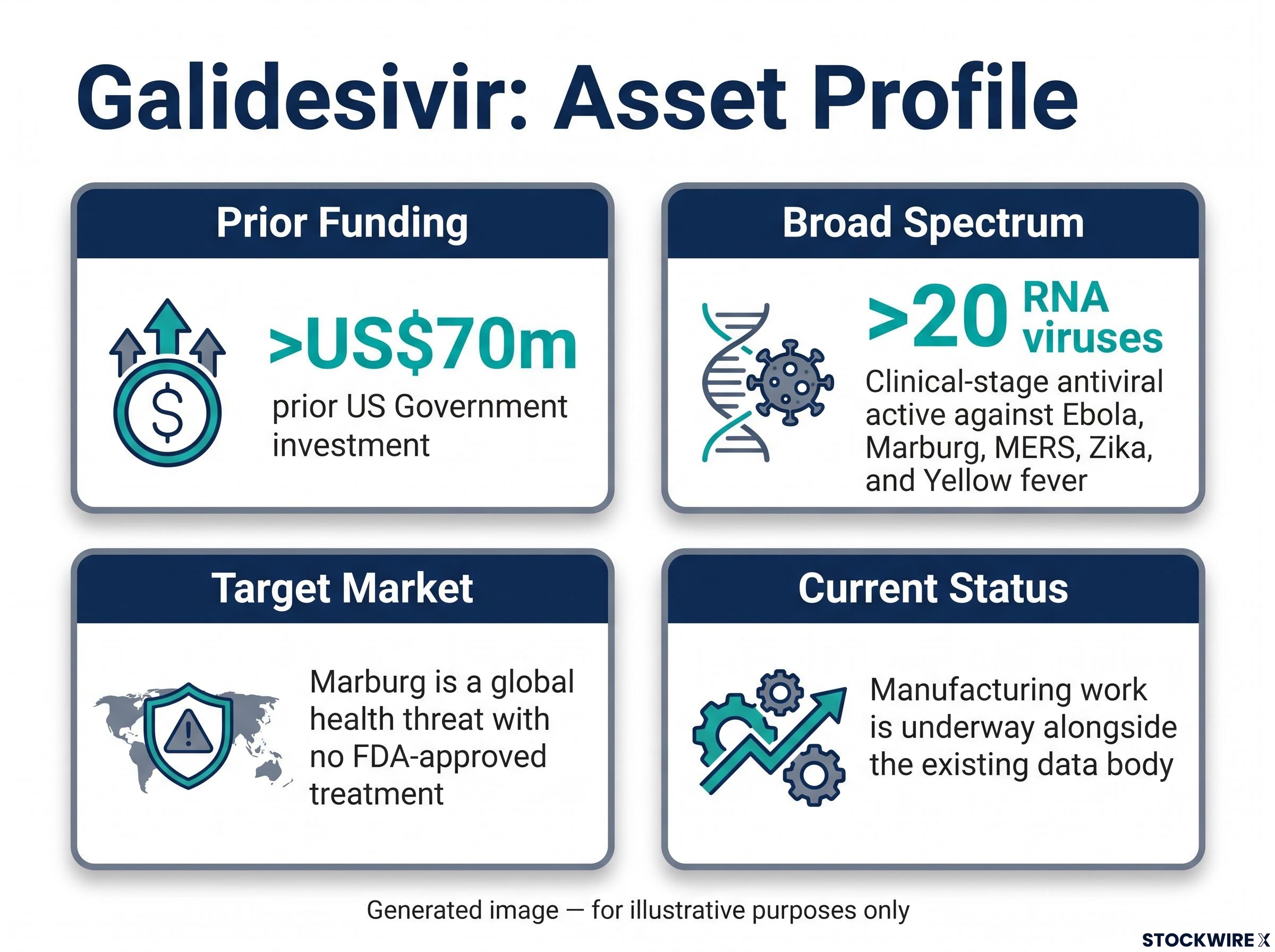
Marburg remains a significant global health and biodefence threat with no FDA-approved treatment.
-
Galidesivir is a clinical-stage antiviral molecule with a broad spectrum of activity across over 20 RNA viruses, including Ebola, Marburg, MERS, Zika and Yellow fever.
-
Over US$70m of prior US Government investment supports the molecule.
-
Manufacturing work is underway, alongside the existing body of Galidesivir data.
GMP manufacturing of Galidesivir is already underway with global CRDMO PI Health Sciences, with GMP-grade product earmarked specifically for the pivotal efficacy study required for a potential FDA submission under the Animal Rule.
Taken together, Island is progressively assembling the regulatory, efficacy and manufacturing package required to advance Galidesivir under a potential Animal Rule NDA, while strengthening the program’s relevance to US Government and other biodefence stakeholders.
CEO and Managing Director, Dr David Foster
“Securing the right to cross-reference this natural history dataset is an important step in Galidesivir’s development and directly addresses feedback from the FDA. … Marburg remains a significant global health and biodefence threat with no FDA-approved treatment and we believe Galidesivir is increasingly well positioned as a medical countermeasure.”
What comes next
The near-term catalysts for investors to watch are clear. The USAMRIID 20-NHP dose optimisation study is expected to commence next quarter, followed by the planned Texas Biomed 12-NHP study in Q1 CY27.
With the natural history foundation now secured, Island is positioned to advance Galidesivir through pivotal animal studies towards a potential NDA submission and FDA approval under the Animal Rule pathway.
Don’t Miss the Next ASX Biotech Breakthrough
Get FREE breaking ASX healthcare news delivered to your inbox within minutes of release, complete with in-depth analysis already done for you. Join 20,000+ investors who stay ahead of market-moving developments the moment they happen. Click the “Free Alerts” button at StockWire X to start receiving alerts straight away.