

Cleo Diagnostics ovarian cancer screening test clears first proof-of-concept hurdle
Cleo Diagnostics (ASX:COV) announced on 21 October 2026 that its prototype ovarian cancer screening test met or exceeded all pre-defined performance targets in its first proof-of-concept study. The result marks the first stage of the company’s screening development program.
The retrospective study covered 247 women: 87 healthy individuals, 67 with benign gynaecological disease and 93 with ovarian cancer. The cancer group included 62 Stage I cases.
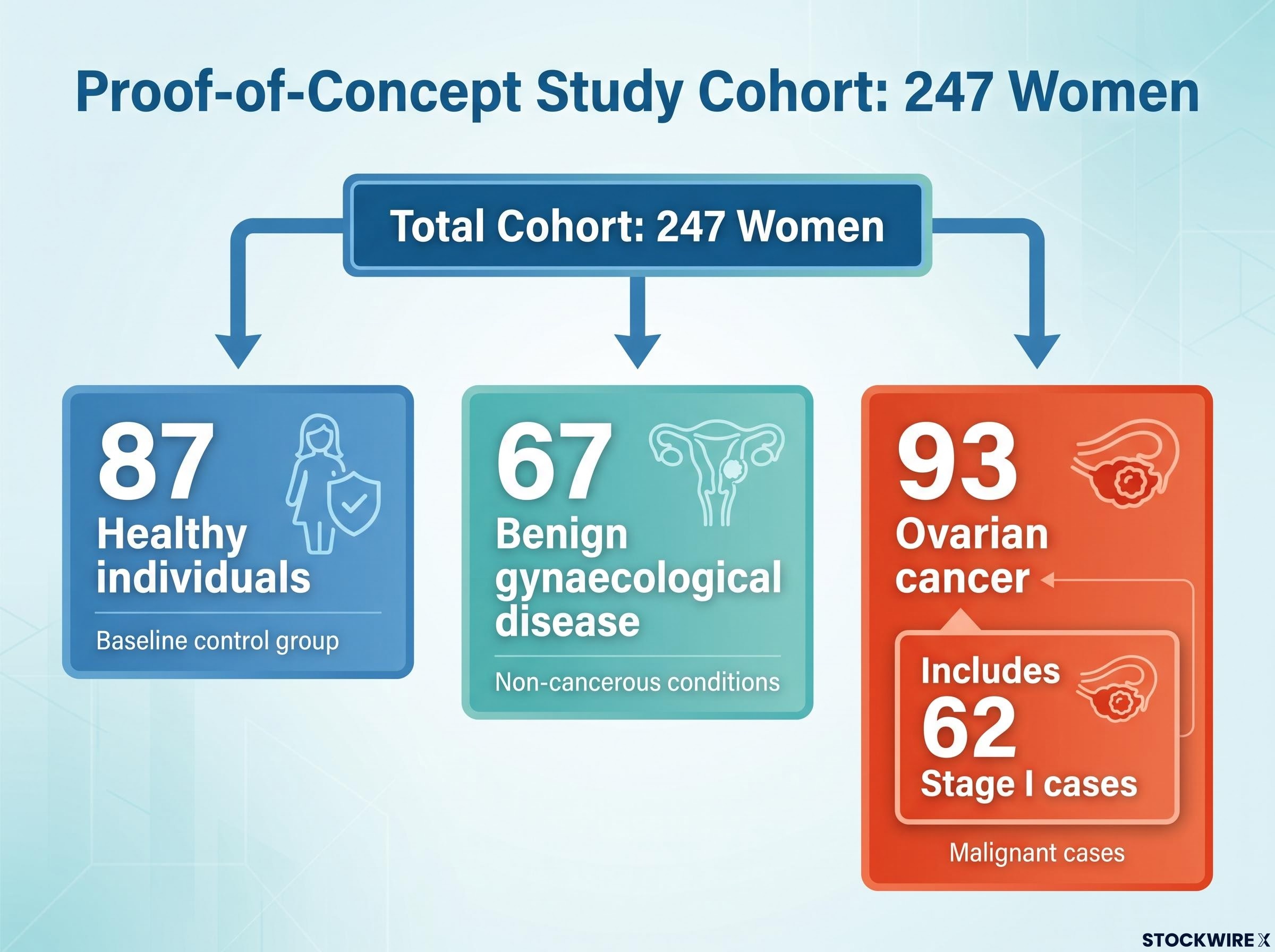
The result completes the first stage of the screening program referenced in the company’s 24 September 2026 announcement. It also forms part of CLEO’s strategy to expand its ovarian cancer detection technology beyond pre-surgical triage and into screening.
The company noted that there is currently no clinically adopted screening test for ovarian cancer. The result is a first-stage retrospective finding, and further validation is planned.
When big ASX news breaks, our subscribers know first
Sensitivity and specificity measured against pre-set benchmarks
CLEO set minimum performance benchmarks informed by best practice for two intended-use cases. The high-risk benchmark targets women with hereditary or genetic factors that predispose to ovarian cancer development, while the general population benchmark targets asymptomatic women within the broader population.
Results against minimum targets
The high-risk minimum was 90% sensitivity and 90% specificity. The general population minimum was 75% sensitivity and 99.6% specificity. Results below are shown as sensitivity / specificity.
| Measure | High-risk population (sensitivity / specificity) | General population (sensitivity / specificity) |
|---|---|---|
| Minimum requirement | 90% / 90% | 75.0% / 99.6% |
| Stage I cancer detection | 92.2% / 98.7% | 75.0% / 100.0% |
| All-stage cancer detection | 90.2% / 97.4% | 75.8% / 100.0% |
The company stated that the prototype met the benchmarks for both high-risk and general population screening, including for Stage I cancers. Per the Table 1 footnote, the results are estimates from a retrospective proof-of-concept cohort and require confirmation in larger, independent and intended-use populations.
Outperforming CA125
The announcement compared the prototype (STP-1) with CA125, which it describes as the current clinical gold-standard biomarker. Performance was measured using Area Under the Curve (AUC), with 95% confidence intervals in brackets.
| Comparison | CLEO STP-1 AUC (95% CI) | CA125 AUC (95% CI) |
|---|---|---|
| Early (Stage I) cancer vs control | 0.99 (0.98 – 1.00) | 0.83 (0.76 – 0.90) |
| All-stage cancer vs control | 0.98 (0.96 – 1.00) | 0.87 (0.84 – 0.92) |
Why early-stage ovarian cancer screening matters
Three statistical terms underpin the results. In brief:
- Sensitivity: the share of women with cancer whom the test correctly identifies.
- Specificity: the share of women without cancer whom the test correctly identifies as clear.
- AUC: a single score between 0 and 1 summarising how well a test separates cancer cases from controls, where higher is better.
Stage I cancers were described by the company as the most challenging target, representing the stage at which diagnosis has the greatest survival benefit. The announcement also describes Stage I detection as the key clinical target for a viable screening test.
The general population benchmark demands 99.6% specificity. CLEO noted that general population screening takes place in a low-prevalence setting, and the next study stage is intended to test performance in that setting.
According to the company, ovarian cancer is the most lethal gynaecological cancer, with 51% of patients dying within five years, primarily due to late diagnosis and the lack of effective screening tools.
From an investment perspective, the announcement states that screening addresses asymptomatic women, a substantially larger population than pre-surgical triage. It adds that this strategically positions CLEO across the ovarian cancer screening, triage and recurrence monitoring space.
Two provisional patents covering candidate biomarker combinations were filed before this data entered the public domain, with a PCT international filing to follow within 12 months.
Next steps for the screening program
CLEO outlined three staged analyses:
- Initial proof-of-concept studies: COMPLETED.
- Bridging and expanded cohort studies: next-stage testing in a larger independent cohort to confirm initial performance estimates, improve statistical power and assess reproducibility across broader patient populations. The stage also aims to establish that sample collection, processing and storage conditions do not affect assay performance.
- Prospective intended-use population evaluation: evaluation using prospectively collected samples to assess performance representative of real-world screening applications. These samples have already been collected and include those from the UK Collaborative Trial of Ovarian Cancer Screening (UKCTOCS) and Prostate, Lung, Colorectal and Ovarian (PLCO) Cancer Screening Trial cohorts.
CLEO also intends to submit the results of its screening development program for publication in peer-reviewed scientific and clinical literature.
Dr Richard Allman, Chief Executive Officer
“…Triage remains our near-term priority and our path to market. Screening is the larger long-term opportunity, and this encouraging result is the first step towards it…”
Screening development will proceed in parallel with the company’s near-term FDA submission for its pre-surgical Triage test. That lead Pre-Surgical Ovarian Cancer Test is currently progressing towards FDA submission early next year, and the company’s profile states that FDA submission and commercial launch are expected in CY2027.
The staged structure leaves the next catalysts clear: bridging and expanded cohort results, followed by evaluation in prospectively collected intended-use populations, alongside the Triage test’s progress towards FDA submission.
For readers wanting to follow the lead Triage test in more detail, our detailed coverage of Analytical Validation for the Triage test explains the three-batch testing plan on Bio-Techne’s Ella platform and the five milestones remaining before FDA submission.
Don’t Miss the Next Healthcare Breakthrough
Join 20,000+ investors getting FREE breaking ASX news delivered to their inbox within minutes of release, complete with in-depth analysis. Click the “Free Alerts” button at Big News Blast to receive healthcare and diagnostics updates the moment market-moving news breaks.