
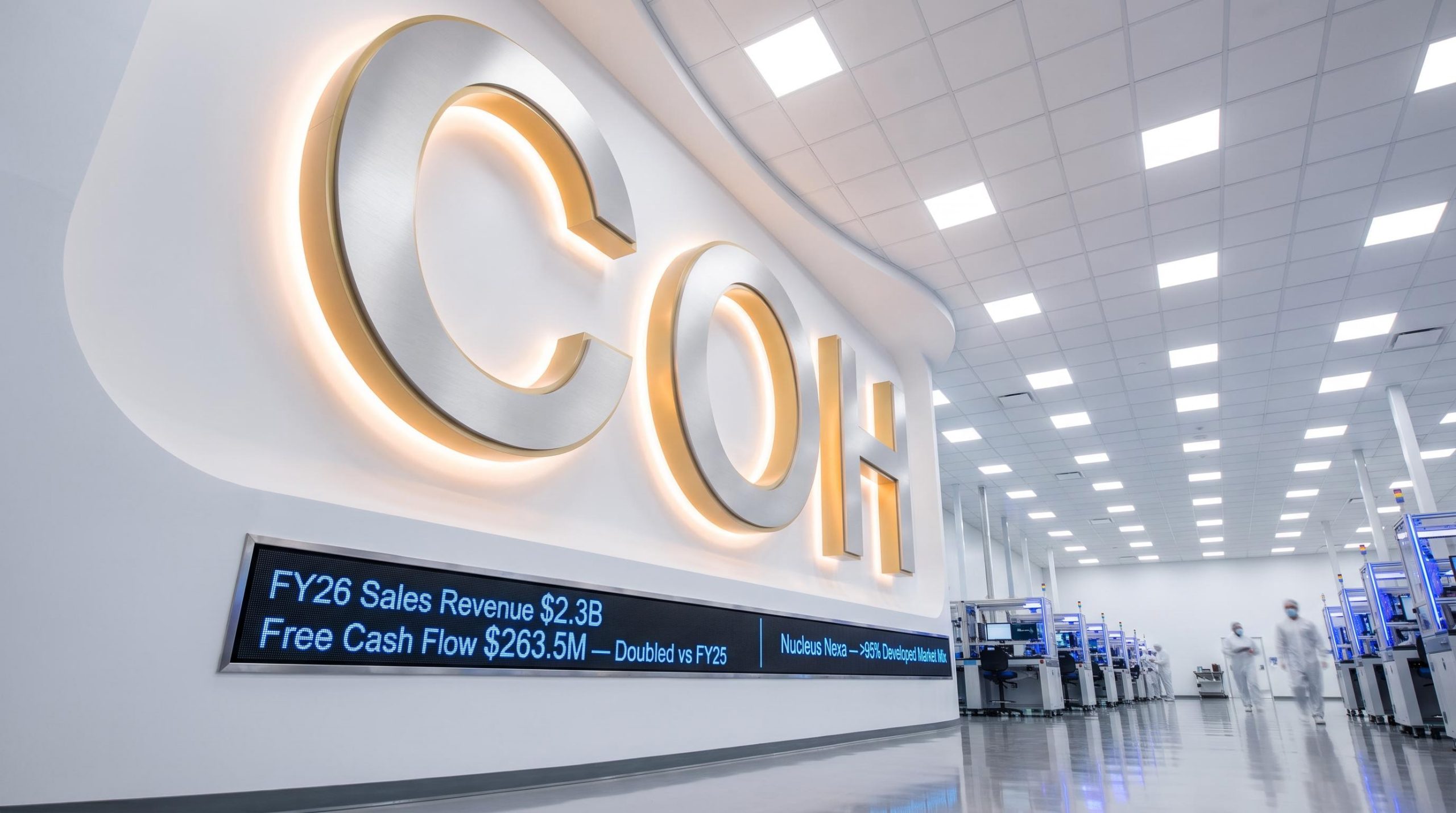
FY26 result meets revised guidance as Cochlear resets for growth
In its FY26 results presentation delivered on 18 August 2026, Cochlear outlined a full-year performance that landed at the upper end of the revised guidance issued in April, alongside a strategic reset designed to reinvest in long-term market growth.
The global hearing implant company reported sales revenue of $2.3 billion, up 2% in constant currency (down 1% on a reported basis), with a notably stronger second half where revenue rose 6%. Underlying net profit of $322.4 million met the revised guidance range.
Management presented FY26 as a transition year. Underlying net profit fell 22% and the full-year dividend was cut 20% to $3.45 per share, yet the presentation framed these declines against a deliberate reshaping of the cost base intended to fund future growth initiatives and margin recovery.
For investors, the update centres on a clear tension: near-term earnings pressure versus a longer-term strategy targeting a vastly under-penetrated adult hearing market.
When big ASX news breaks, our subscribers know first
FY26 result snapshot
The following summary captures the headline financial movements across the reporting period.
| Metric | FY26 | FY25 | Change |
|---|---|---|---|
| Sales revenue | $2,343.4m | $2,355.8m | +2% CC |
| Underlying net profit | $322.4m | $414.5m | (22)% |
| Statutory net profit | $147.3m | $388.9m | (62)% |
| Gross margin | 71% | 74% | (3) pts |
| R&D expense | $323.2m (14% of sales) | $281.2m (12%) | +15% |
| Dividend per share | $3.45 | — | (20)% |
The steep drop in statutory net profit was driven largely by a non-cash write-down relating to the company’s Epiminder investment, together with cloud expenses. Both items were treated as significant items and excluded from the underlying result.
Segment performance across the FY26 period
Cochlear implants (61% of revenue)
Implant revenue was flat in constant currency at $1,435 million, though implant units sold rose 5%. The presentation noted strong uptake of the Nucleus Nexa platform, which represented more than 95% of the developed-market implant mix by June, alongside an average 3% price increase.
Regional performance varied considerably:
- US: revenue up 4%, including 10% growth in direct-to-consumer surgeries, with softer underlying market growth.
Cochlear’s US tariff exemption, confirmed under the Section 301 ruling in July 2026, removed a cost risk that had weighed on investor sentiment heading into the result, preserving duty-free import access for hearing implant systems under the Harmonized Tariff Schedule.
-
Western Europe: revenue down 8%, reflecting UK elective surgery backlogs, industrial action in Spain, and share loss in Germany.
-
Asia Pacific: revenue up 7%, supported by share gains, mature Australian referral paths and Nexa momentum in Korea.
-
Emerging markets: revenue down 2%, as Middle East conflict and China VBP and reimbursement reductions offset growth in Latin America and Eastern Europe.
Services (27% of revenue)
Services revenue increased 6% in constant currency to $635 million, with developed markets up 13% on strong US demand for the Nucleus 8 Sound Processor following retirement of the prior-generation processor.
Acoustics (12% of revenue)
Acoustics revenue rose 1% in constant currency to $273 million. The Cochlear Osia Implant launched in Japan in June, though the segment faced competitive pressure in the US and UK during the first half.
What “medicalisation” means and why it matters to investors
A central theme of the presentation was the strategy Cochlear terms “medicalisation” of adult hearing loss. Understanding it explains the longer-term investment thesis.
Despite holding more than 60% global market share of the cochlear implant market, only around 4% of people with severe or higher hearing loss who could benefit currently have an implant. The addressable adult and senior market in developed countries exceeds 6 million people, at roughly 3% penetration.
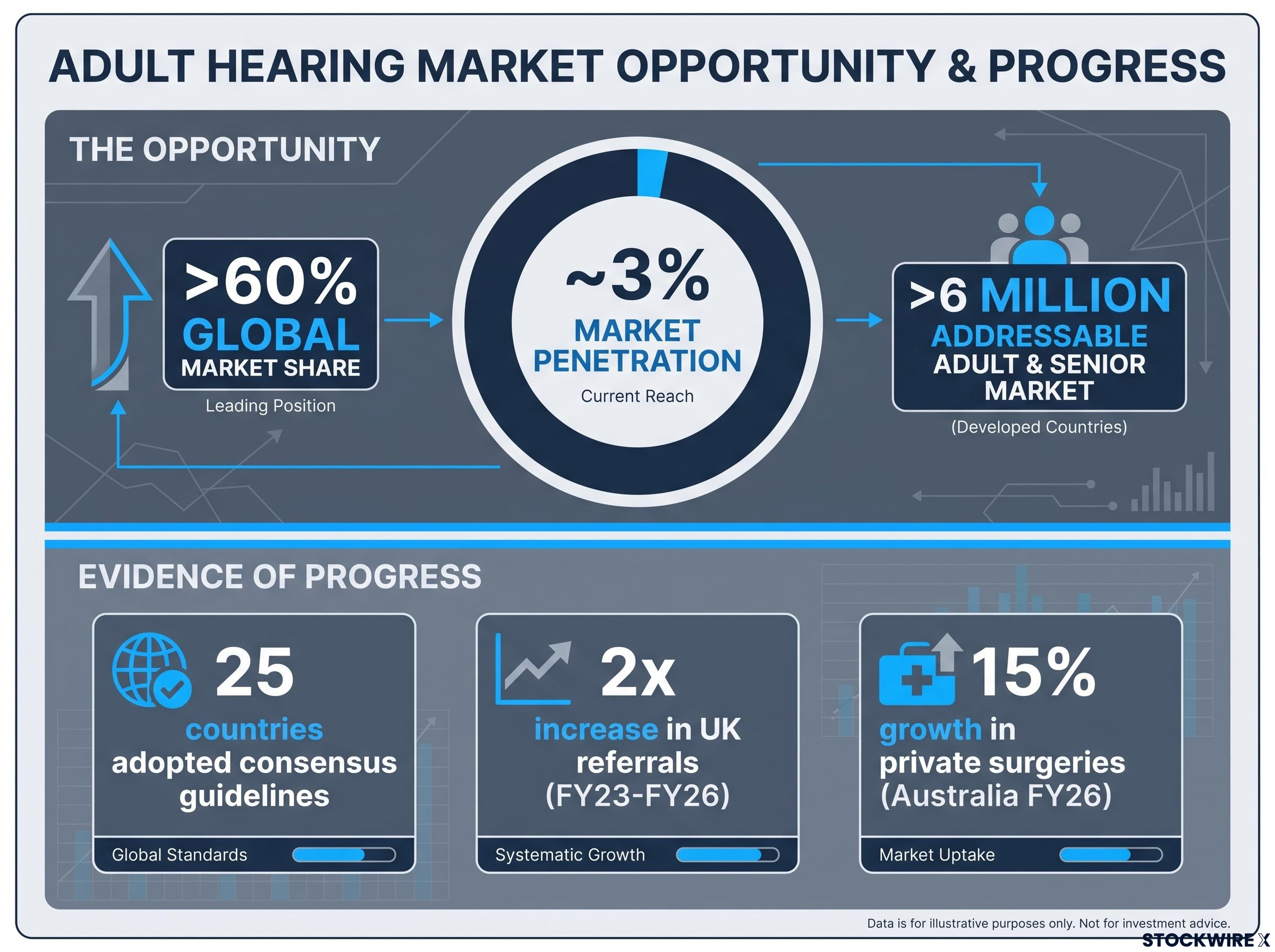
Medicalisation refers to recognising severe hearing loss as a chronic disease, similar to how conditions such as obesity are managed, with standardised screening, severity staging, referral triggers and reimbursement. The aim is to make implants the standard of care for adults, as they already are for children.
For investors, this is the mechanism intended to unlock that under-penetrated market. The presentation pointed to evidence of progress:
-
Consensus guidelines for adult implantation adopted in 25 countries.
-
A 2x increase in referrals in the UK across FY23 to FY26.
-
15% growth in private surgeries in Australia during FY26.
-
ACHIEVE trial evidence linking hearing intervention to cognition and falls outcomes.
Management commentary
Management outlined that accelerating the medicalisation of hearing loss, alongside reducing fixed costs and building on the Nexa platform, forms the core of the actions being taken to support more consistent long-term growth.
Cost discipline and a stronger cash position
The financial reset was a defining feature of the FY26 result. While comparable operating expenses fell 1%, reported opex rose 5%, reflecting transitional costs including a $32 million Q4 restructuring charge and a $37 million short-term incentive provision replenishment following the low FY25 payout.
Three highlights framed the cost and cash story:
-
Fixed cost as a proportion of revenue improved by 2 percentage points, with $25 million reallocated to growth initiatives.
-
Operating cash flow rose to $368 million, up from $237.6 million in FY25.
-
Free cash flow more than doubled to $263.5 million, from $122.4 million, driven by working-capital discipline including a 13% H2 inventory reduction following the Nexa launch stock build.
Net cash stood at $187.7 million at period end. The on-market share buyback remained inactive, as net cash sat below the target level of around $200 million.
The Nexa platform and innovation pipeline
The presentation positioned the Nexa System as a “smart implant” platform delivering better hearing and smaller external devices, while providing a foundation for future innovation.
The technology roadmap outlined three stages:
-
Nexa: smart implants with active intelligence in the implant.
-
DEE: Drug Eluting Electrodes to advance long-term cochlea health.
-
TICI: Totally Implantable CI, offering external-free hearing powered by the smart implant platform.
Several Nexa feature enhancements referenced in the presentation, including new stimulation modes and enhanced diagnostics, were flagged as currently under investigation and not available for general use.
FY27 outlook
For the year ahead, Cochlear expects low single-digit constant currency sales revenue growth and underlying net profit of $330–350 million.
Key assumptions provided by management include:
-
Gross margin of 70–71%.
-
R&D investment at approximately 13% of sales.
-
A slight decline in operating expenditure.
-
Cloud investment completing in FY27, with a balance of around $60 million post-tax to be reported as a significant item.
-
Acoustics growth supported by the launch of the Osia 3 Sound Processor, following FDA and CE Mark approval.
Management flagged a clear currency headwind. Guidance is based on a 70c AUD/USD and 61c AUD/EUR rate, at which the stronger Australian dollar is expected to reduce underlying net profit by approximately 10% relative to FY26 average rates, partly offset by foreign exchange contract gains.
The presentation was candid on trading conditions, noting these “remain mixed” and that referral-pathway actions “will take time to translate into more consistent growth.”
FY26 stands as a reset year for Cochlear. The longer-term investment case rests on the company leveraging its more than 60% market leadership and its medicalisation strategy to grow a substantially under-penetrated adult market, consistent with management’s stated targets of around 10% annual revenue growth and an 18% net profit margin.
Don’t Miss the Next Healthcare Breakthrough
Big News Blast delivers FREE breaking ASX healthcare news directly to your inbox within minutes of release, complete with in-depth analysis. Join 20,000+ subscribers already staying ahead of the market. Click the “Free Alerts” button at Big News Blast to receive the latest ASX healthcare updates the moment they drop.