

US market access cleared: Control Bionics secures Medicare billing code for NextLevel speech devices
Control Bionics has cleared the final US market access prerequisite for its speech generating device range, with its US subsidiary, Control Bionics Inc., receiving Medicare PDAC coding verification for the UnoTouch Omni range. First revenue is targeted for September 2026.
The verification confirms that two UnoTouch Omni models qualify for reimbursement under Medicare billing code E2510, carrying a fee schedule allowable of up to US$9,645.69 per new device. The devices are commercialised under the Company’s exclusive licence agreement with NextLevel Assistive Technology, announced on 26 February 2026.
This clearance removes the last regulatory barrier between the product and the US reimbursement system, positioning the Company to commence US sales.
When big ASX news breaks, our subscribers know first
What the coding verification unlocks
The Pricing, Data Analysis and Coding (PDAC) Contractor issues written coding verification that allows a device to be billed to Medicare and, by extension, commercial insurers. Without it, any claim submitted under code E2510 is denied as incorrectly coded.
With verification granted, the UnoTouch Omni range is confirmed on the Product Classification List, enabling distribution partners to submit claims through their existing billing workflows.
Key points from the verification include:
-
PDAC coding verification granted for two UnoTouch Omni models
-
Control Bionics Inc. named as manufacturer
-
Devices assigned HCPCS code E2510, the highest allowable among Medicare’s speech generating device base codes
-
Claims now billable to all four Durable Medical Equipment Medicare Administrative Contractors (DME MACs)
The devices are commercialised under the Company’s exclusive licence agreement with NextLevel Assistive Technology. Distribution partners can now bill for the UnoTouch Omni range in the same way they already do for the Company’s NeuroNode product.

How speech generating devices are funded in the US
Speech generating devices (SGDs) restore a voice to people living with conditions that impair or take away speech, including motor neurone disease (ALS), cerebral palsy, autism and stroke. These devices allow users to construct and deliver spoken messages through synthesised speech.
Code E2510 is defined as a speech generating device with synthesised speech, permitting multiple methods of message formulation and multiple methods of device access. It is the broadest and highest-value code in the SGD family. Since 1 June 2016, only PDAC-verified products appearing on the Product Classification List may be billed under it.
Funding for SGDs flows through several established channels in the United States:
-
Medicare Part B
-
State Medicaid programs, including as a mandatory benefit for eligible children
-
Private insurance
-
Education agencies
-
The Veterans Health Administration
With verification granted, the UnoTouch Omni range can now flow through this reimbursement infrastructure.
The revenue model: what Control Bionics actually earns
A critical distinction applies to the reimbursement figure. The US$9,645.69 national allowable is the amount payable to the accredited durable medical equipment supplier that dispenses the device to the patient. It is not Control Bionics’ revenue per unit.
Under the NextLevel licence, Control Bionics sells to its distribution partners on wholesale terms and receives a fixed per-device contribution margin. NextLevel funds all device tooling and manufacturing.
The NextLevel licence agreement, announced in February 2026, established the capital-light structure that underpins this commercialisation pathway, with NextLevel funding all device tooling and manufacturing while Control Bionics retains a fixed per-device margin on wholesale sales.
This structure keeps the model capital-light, requiring no incremental capital investment or manufacturing risk from Control Bionics.
| Metric | Detail |
|---|---|
| HCPCS Code | E2510 (highest-value SGD code) |
| Medicare allowable (to supplier) | Up to US$9,645.69 per new device |
| CBL revenue model | Wholesale, fixed per-device margin |
| Launch LOI | Up to 1,000 devices in first 12 months (non-binding) |
| Advance payment received | US$100,000 |
Launch customer and the addressable market
Control Bionics has a non-binding Letter of Intent in place with a US launch customer for up to 1,000 devices in the first 12 months, with a US$100,000 advance payment received. The non-binding nature of the arrangement means conversion into firm orders remains subject to distributor purchasing decisions.
The LOI carries a US$2.5-3.5 million annual revenue projection for Control Bionics once commercial supply commences, a figure that contextualises the significance of the September 2026 first-revenue target relative to the company’s current scale.
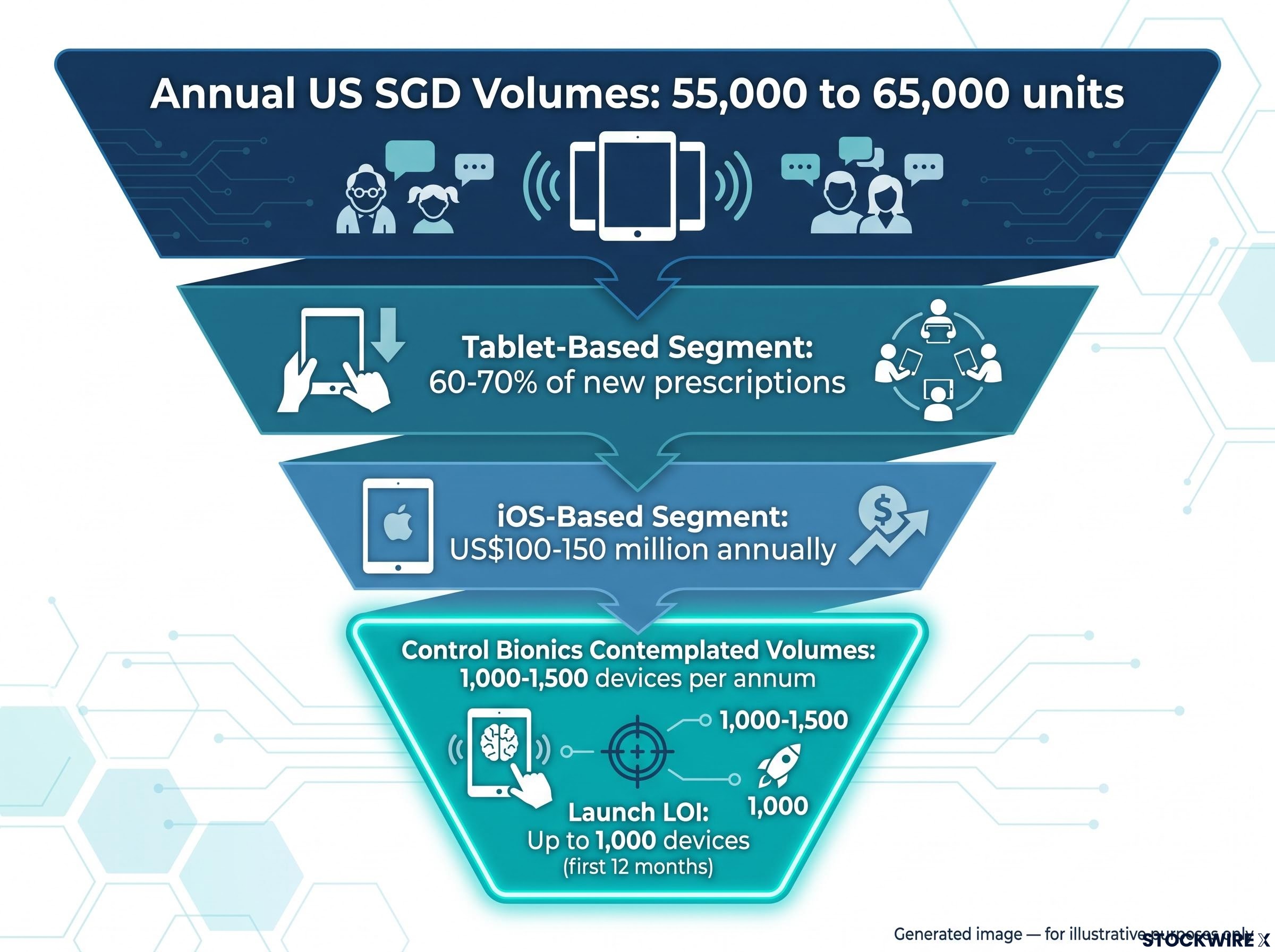
The Company has previously outlined the scale of the opportunity it is targeting:
-
Estimated annual US SGD volumes of approximately 55,000 to 65,000 units
-
Tablet-based devices accounting for 60–70% of new prescriptions
-
An iOS-based segment estimated at US$100–150 million annually
-
Control Bionics’ initial contemplated volumes of 1,000–1,500 devices per annum
The Company’s contemplated volumes represent a small share of that addressable market, which it views as offering runway for further market share growth.
Route to market
Consistent with the strategy set out when the NextLevel licence was announced, Control Bionics will not pursue a direct-to-consumer or retail model for the UnoTouch Omni range. The devices will be supplied wholesale to established US distribution partners who hold the payer contracts, accreditation and clinical service infrastructure required to dispense funded devices at scale.
This approach reinforces the capital-light positioning, requiring no incremental capital investment or manufacturing risk from the Company.
CEO Commentary
“PDAC coding verification is the gate every speech generating device must pass before it can be funded in the US. Our distribution partners can bill these devices through the workflows they already run every day. More Americans who cannot speak will have access to a proven device that helps give them a voice.”
“With coding now resolved, our focus is on supporting our launch customer’s rollout plans, with first revenue targeted for September,” said Jeremy Steele, Chief Executive Officer and Managing Director.
What comes next
The immediate catalyst for investors is first revenue, which the Company has targeted for September 2026. Beyond that, attention turns to converting the non-binding Letter of Intent into binding orders and supporting the launch customer’s rollout.
Control Bionics has flagged that the timing of first revenue, contemplated device volumes and market size remain forward-looking. These outcomes are subject to conversion of the non-binding Letter of Intent into binding orders, distributor purchasing decisions, payer coverage and claims adjudication, and manufacturing and supply timing.
For investors, the September revenue target stands as the immediate proof point that will demonstrate the Company’s ability to translate US market access into commercial traction.
Don’t Miss the Next Healthcare Breakout on the ASX
Big News Blast delivers FREE breaking ASX healthcare news straight to your inbox within minutes of release, complete with in-depth analysis already done. Join 20,000+ subscribers who stay ahead of the market the moment announcements drop. Click the “Free Alerts” button at Big News Blast to start receiving real-time alerts today.