

XanaMIA database lock achieved, topline results now expected mid-November
Actinogen Medical (ASX: ACW) has confirmed that the XanaMIA phase 2b/3 Alzheimer’s disease (AD) trial of oral Xanamem (emestedastat) reached its database lock milestone late on 20 October 2026. The Company has narrowed its topline results guidance to mid-November 2026, previously “November”.
For investors following the Xanamem Alzheimer’s trial, the pivotal readout is now weeks away, making it a near-term catalyst for the stock.
Dr Steven Gourlay, CEO & MD
“Positive results in November would clearly establish brain cortisol control as an important and treatable part of the biology of Alzheimer’s disease.”
When big ASX news breaks, our subscribers know first
What database lock means for the readout
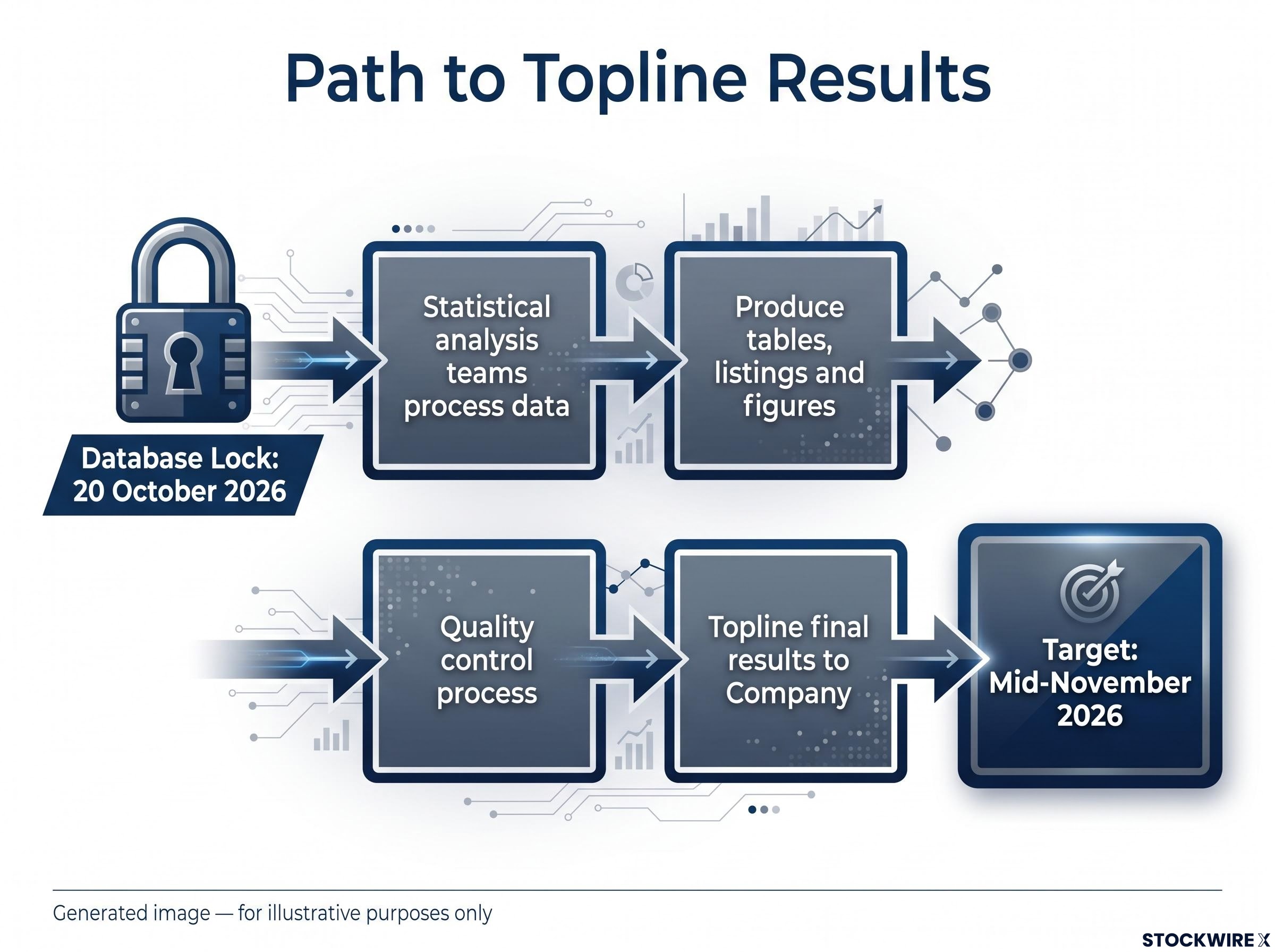
From locked data to topline results
Database lock is the point at which trial data is deemed entirely final, clean and locked to further changes. In plain terms, nothing in the dataset can be altered after this stage.
According to the announcement, the final dataset then moves through four steps:
- Statistical analysis teams process the data according to the pre-specified analysis plans.
- They produce a set of tables, listings and figures.
- These outputs are closely checked in a quality control process.
- Results are passed to the Company as “topline final results”.
Because the analysis plans were pre-specified and the data can no longer change, the path to the readout is more defined, which narrows uncertainty around timing. The announcement does not indicate what the results will show.
Why the Xanamem mechanism matters
Xanamem is an oral enzyme inhibitor designed to control elevated levels of cortisol, often called the “stress hormone”, in the brain. Elevated brain cortisol is associated with the onset and progression of AD.
The drug works by inhibiting the cortisol synthesis enzyme 11β-HSD1, without affecting cortisol production by the adrenal glands, which the Company describes as essential for the body’s normal functioning. Actinogen describes Xanamem as a first-in-class, once-a-day pill.
Xanamem is an investigational product and is not approved for use outside of a clinical trial by the FDA or by any global regulatory authority.
XanaMIA trial design at a glance
The table below summarises the trial structure as described by the Company.
| Feature | Detail |
|---|---|
| Design | Randomised (1:1), double-blind, placebo-controlled |
| Dose | Xanamem 10 mg once daily vs placebo |
| Duration | 36 weeks |
| Participants | 247 (Australia 45%, US 55%) |
| Primary endpoint | CDR-SB (Clinical Dementia Rating scale – Sum of Boxes) |
| Status | All patient visits completed, closed to recruitment, database locked |
Key supporting features of the design include:
- Participants were selected using elevated pTau181, via a clinically validated blood test rather than amyloid brain scans or cerebrospinal fluid biomarkers.
- Elevated pTau181 selects for a more progressive disease course, which increases the trial’s power to detect a treatment effect for Xanamem over 36 weeks.
- The approach replicates the diagnostic profile of the phase 2a patient population, where a large treatment benefit for Xanamem was seen (Taylor et al. 2024).
- The trial has passed an independent Data Monitoring Committee safety and efficacy futility review.
The pTau181 pre-screening approach also had an operational payoff, with a two-stage blood test process avoiding hundreds of full screening visits and cutting estimated screening costs by roughly 43% compared with a single-visit method.
An open-label extension, XanaMIA-OLE, commenced in March 2026. It runs for up to 25 months, with all participants receiving Xanamem 10 mg once daily, and is open to all former and current XanaMIA participants.
For readers wanting the wider picture behind the trial, our full explainer on the XanaMIA trial completion and baseline characteristics covers the final patient visit, the ApoE4 and CDR-SB profile of the cohort, and regulatory pathway planning ahead of the readout.
Investment thesis and what comes next
The announcement points to several features relevant to investors:
- A near-term catalyst with a narrowed timeframe of mid-November 2026.
- A biomarker-enriched design that replicates the diagnostic profile of the earlier phase 2a population.
- A safety profile the Company describes as “promising”, based on studies in more than 500 volunteers and patients across eight clinical trials.
- High levels of brain target engagement demonstrated at doses as low as 5 mg daily in a human PET imaging study.
The Company also reported results from its XanaCIDD phase 2a depression trial in August 2024, involving 167 patients. It showed benefits on the MADRS and PGI-S measures, although cognition improved to a similar extent in both the Xanamem and placebo groups.
The announcement discloses no financial, cash or commercial figures. The next step is the delivery of topline final results, expected in mid-November 2026, which will show how XanaMIA performed against its primary endpoint.
Don’t Miss the Next Biotech Breakout
Join 20,000+ investors getting FREE breaking ASX news delivered to their inbox within minutes of release, complete with in-depth analysis. Click the “Free Alerts” button at Big News Blast to receive healthcare and biotech alerts the moment market-moving announcements land, so you stay ahead of the market.