How $4B in Fuel Costs Erased American Airlines’ Record Q1
18 mins ago

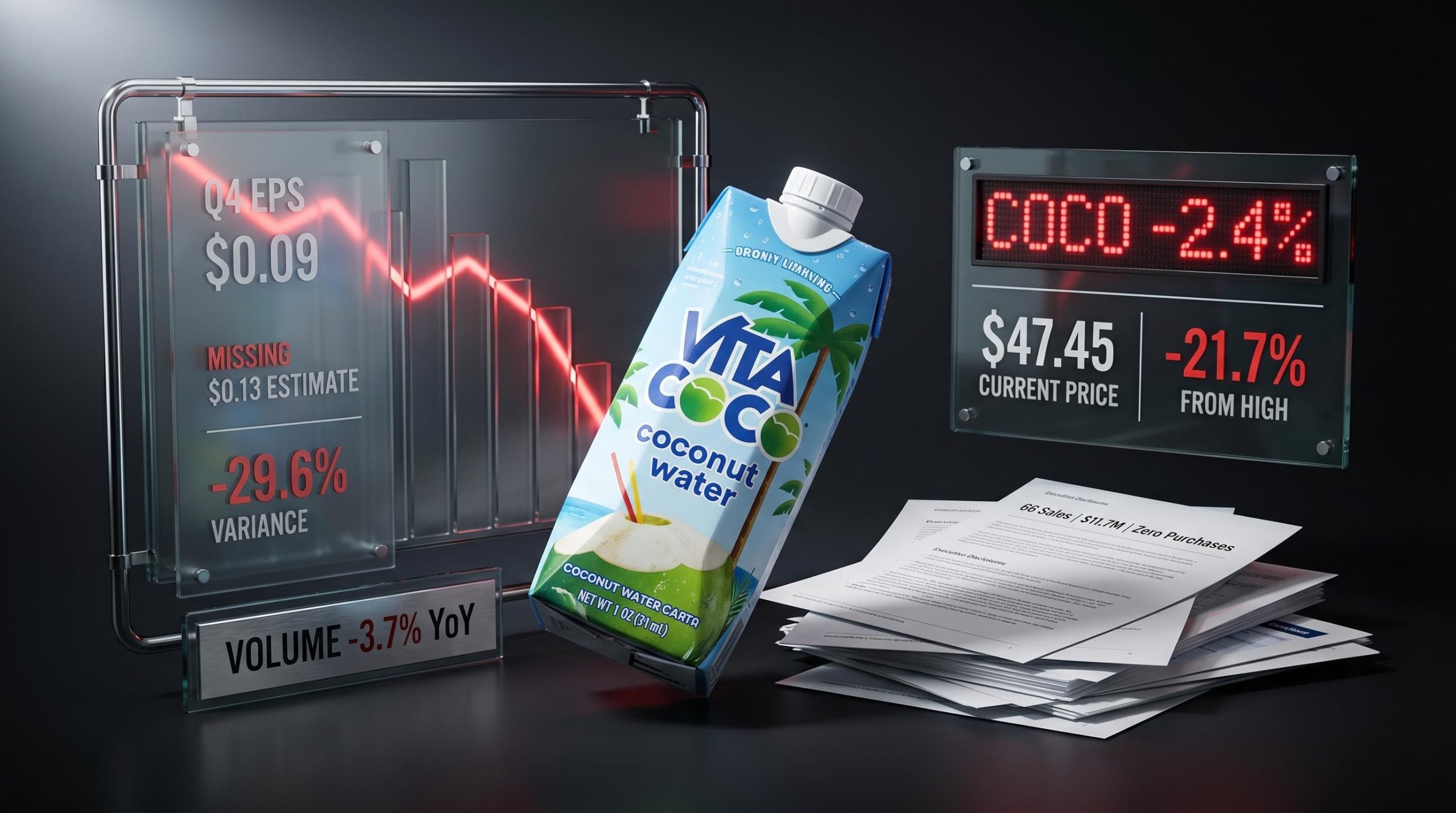
A $1.25 million stock sale by a CEO rarely moves markets on its own, but when Vita Coco shares dropped 2.4% within hours of the disclosure, investors signalled they are reading the transaction as more than routine housekeeping. The sale arrives roughly two months after COCO posted a mixed Q4 2025 report that saw shares tumble 9.7% on an earnings miss despite revenue and guidance beats. With the stock already down 11.2% year to date and trading 21.7% below its March 2026 high, the timing of CEO Martin Roper’s disposal amplifies existing questions about the company’s near-term trajectory.
This analysis breaks down what the insider sale reveals about management’s confidence, how it connects to the unresolved concerns from Q4, and what investors should watch heading into the April 29 earnings release.
The sale occurred under a pre-established 10b5-1 trading plan, which provides legal cover but does not eliminate informational content. Roper’s transaction is part of a structured programme designed to avoid accusations of trading on material non-public information, yet the pattern beneath the paperwork is harder to dismiss.
The asymmetry is stark. Roper has executed 66 sales totalling $11.7 million with zero recorded purchases. Other major insiders show the same pattern: Ira Liran has completed 16 sales totalling $18 million, whilst Verlinvest Beverages SA sold 3 million shares for $122 million. No insider purchases are recorded across these major holders.
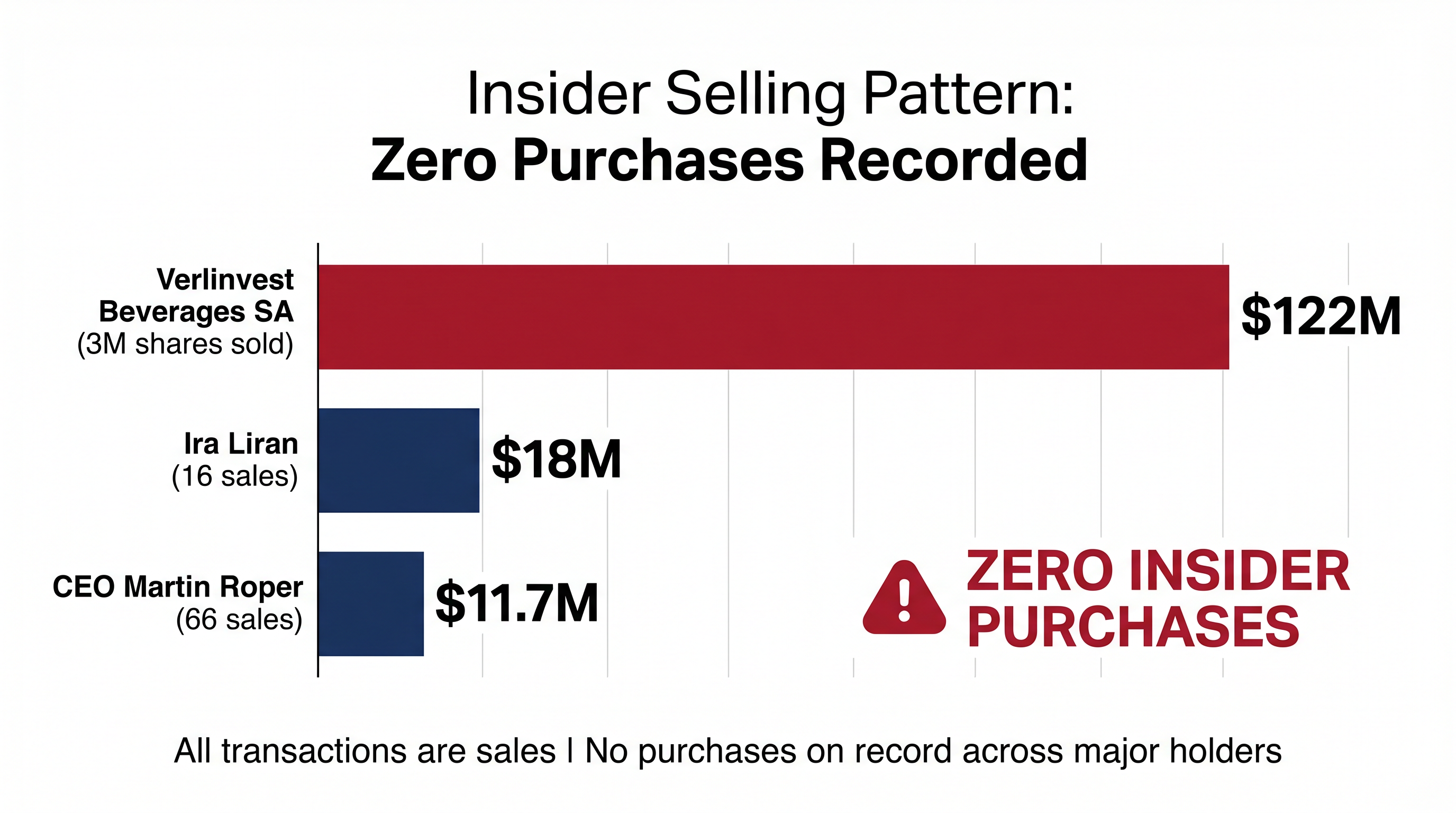
When executives consistently reduce exposure rather than add to positions, it suggests they see better risk-adjusted opportunities elsewhere. The 10b5-1 plan may remove discretion on timing, but it does not remove the decision to establish a sell-only plan in the first place.
Pattern of One-Way Selling CEO Martin Roper: 66 sales, $11.7M total | Ira Liran: 16 sales, $18M total | Verlinvest Beverages SA: 3M shares sold for $122M | Zero insider purchases on record
Investors often dismiss 10b5-1 sales as mechanical, but the absence of any insider buying across multiple executives over an extended period is a meaningful data point. It suggests management is not using personal capital to signal conviction in the stock at current valuations.
The February earnings event delivered a textbook case in how the market weighs beats versus misses. Revenue came in at $127.8 million, beating estimates but flat year over year. EPS of $0.09 missed the $0.13 consensus by 29.6%. The stock sold off 9.7% on the day.
The market punished the stock despite the revenue beat because volume declines of 3.7% signalled potential demand weakness. Flat sales growth in a growth-priced stock raised multiple compression risk, and investors were not willing to look past immediate concerns to the longer-term guidance.
| Metric | Actual | Estimate | Variance |
|---|---|---|---|
| Q4 Revenue | $127.8M | Estimate beat | +6.2% |
| Q4 EPS | $0.09 | $0.13 | -29.6% |
| Q4 Volume Growth | -3.7% YoY | N/A | Decline |
| Stock Reaction | -9.7% | N/A | Sell-off |
Management provided 2026 guidance of $690 million revenue and $125 million EBITDA, both above consensus. The guidance beat failed to offset immediate concerns. COCO is valued as a growth story; when volume contracts and sales stagnate, investors question whether the premium multiple is justified regardless of near-term profit guidance.
The Q4 COCO reaction mirrors market dynamics where guidance beats fail to offset immediate execution concerns, a pattern that has emerged repeatedly across growth-priced consumer names in 2026 as investors prioritise near-term volume and margin trends over forward projections.
Understanding why the market sold off despite headline beats is essential. Volume is the leading indicator of demand health in consumer staples, and a 3.7% decline, even if improved from the prior year’s 19.3% drop, suggests the company has not yet stabilised its core growth engine.
Consumer staples companies typically offer lower volatility and steadier cash flows, meaning insider selling here is less common than in high-growth sectors where executives regularly diversify. When insiders do sell in this category, the market tends to read it more carefully.
The Vita Coco pattern is heavy, sustained selling without offsetting purchases in a stable-demand category. This suggests insiders may view the current valuation as full or the growth runway as shorter than the market assumes. Historical context sharpens the reading: the company posted 9.9% average quarterly volume growth over two years prior to recent declines, a period during which insiders were also net sellers.
The counterargument is that diversification is rational, and 10b5-1 plans remove timing discretion, so any single sale should not be over-interpreted. Yet the pattern’s duration and one-way nature weakens that defence.
Three key interpretation factors:
This section provides the analytical framework to evaluate insider transactions rather than react emotionally. Readers gain a reusable lens for assessing future insider disclosures in COCO and similar holdings.
For investors exploring COCO or similar names through social media discussions and online forums, our dedicated guide to evaluating investment information sources walks through the specific verification steps and red flags to check before acting on stock commentary, with particular focus on distinguishing analysis from promotion.
COCO has recorded more than 15 price moves exceeding 5% in the past twelve months, indicating the market has not reached consensus on the stock’s intrinsic value. For a consumer staples name, this level of volatility is unusual and signals active debate rather than settled conviction.
The sustained selling pressure and elevated volatility in COCO shares align with broader market uncertainty in 2026, making strategies for managing portfolio volatility in 2026 particularly relevant for investors navigating both macro headwinds and company-specific execution risks.
The volatility connects to mixed fundamental signals. Strong brand position and EBITDA guidance offset volume declines and tariff uncertainty. The current price of $47.45, 21.7% below the March 2026 high of $60.60, reflects unresolved questions rather than a definitive verdict.
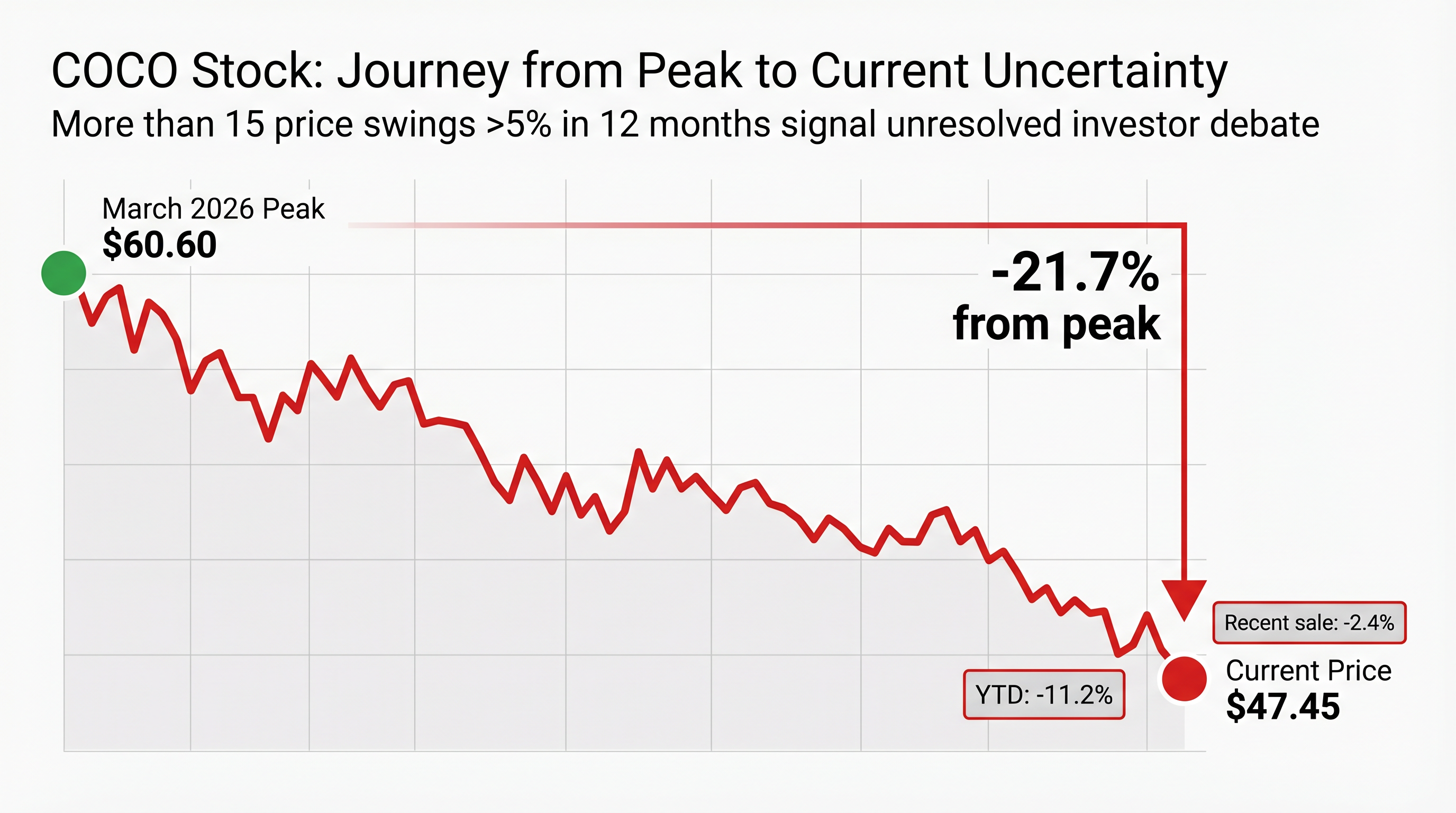
Key price metrics:
Long-term context $1,000 invested at the October 2021 IPO would be worth approximately $3,509 as of April 2026, reflecting strong cumulative returns despite recent volatility.
High volatility in a consumer staples name is unusual and signals that the market is actively debating whether COCO is a growth story worth a premium or a maturing brand facing structural headwinds. Investors should calibrate position sizes accordingly, recognising that the stock’s price action reflects uncertainty rather than consensus.
Three specific data points will resolve or deepen the current uncertainty when Vita Coco reports Q1 2026 results on April 29.
1. Volume trends: If Q1 2026 volumes stabilise or grow, it undermines the demand-weakness thesis. Continued declines would validate bearish concerns and raise questions about whether the $690 million revenue guidance for 2026 is achievable without pricing increases that could pressure volumes further.
2. Tariff and margin commentary: Management has cited relief and reinvestment plans, so any update on realised savings versus promotional spending will affect margin expectations. The company’s ability to convert tariff relief into EBITDA expansion rather than reinvesting all savings into promotions will determine whether the $125 million EBITDA target is conservative or optimistic.
3. International expansion and U.S. distribution progress: The earnings call tone on international expansion and U.S. distribution gains will signal whether management sees the current softness as temporary or structural. Specific metrics on distribution points gained or international revenue growth rates will provide evidence beyond guidance reiteration.
Investors can use this section as a pre-earnings checklist. Knowing which data points matter most allows for faster, more informed reactions when results are released.
For readers wanting to understand the operational mechanics behind guidance revisions, our full explainer on how delayed programs and trading weakness force guidance cuts examines the specific thresholds and disclosure triggers that lead companies to revise forward estimates mid-year, with case studies across consumer and fintech sectors.
The CEO sale is not a smoking gun, but it adds to a pattern of one-way insider activity that, combined with Q4’s volume miss and elevated stock volatility, suggests management is not signalling strong conviction at current prices. Investors should weigh the positive 2026 guidance and tariff relief potential against the lack of insider buying and unresolved questions about demand trajectory. Watch the April 29 Q1 release closely, with particular attention to volume trends and margin commentary, before making allocation decisions in either direction.
This article is for informational purposes only and should not be considered financial advice. Investors should conduct their own research and consult with financial professionals before making investment decisions.
Roper's $1.25 million sale is part of a pattern of one-way insider selling, with 66 sales totalling $11.7 million and zero recorded purchases, suggesting management may not view current valuations as a buying opportunity.
Despite beating revenue estimates with $127.8 million and providing 2026 guidance above consensus, COCO shares dropped 9.7% because EPS of $0.09 missed the $0.13 estimate by 29.6% and volume declined 3.7% year over year.
Investors should focus on Q1 2026 volume trends, management commentary on tariff relief and margin conversion, and updates on international expansion and U.S. distribution progress to assess whether 2026 guidance remains achievable.
A 10b5-1 plan removes timing discretion from individual sales, but it does not change the fact that management chose to establish a sell-only plan, and a sustained pattern of zero insider purchases across multiple executives remains a meaningful signal.
As of the time of analysis, COCO is trading at $47.45, which is 21.7% below its March 2026 high of $60.60 and down 11.2% year to date.