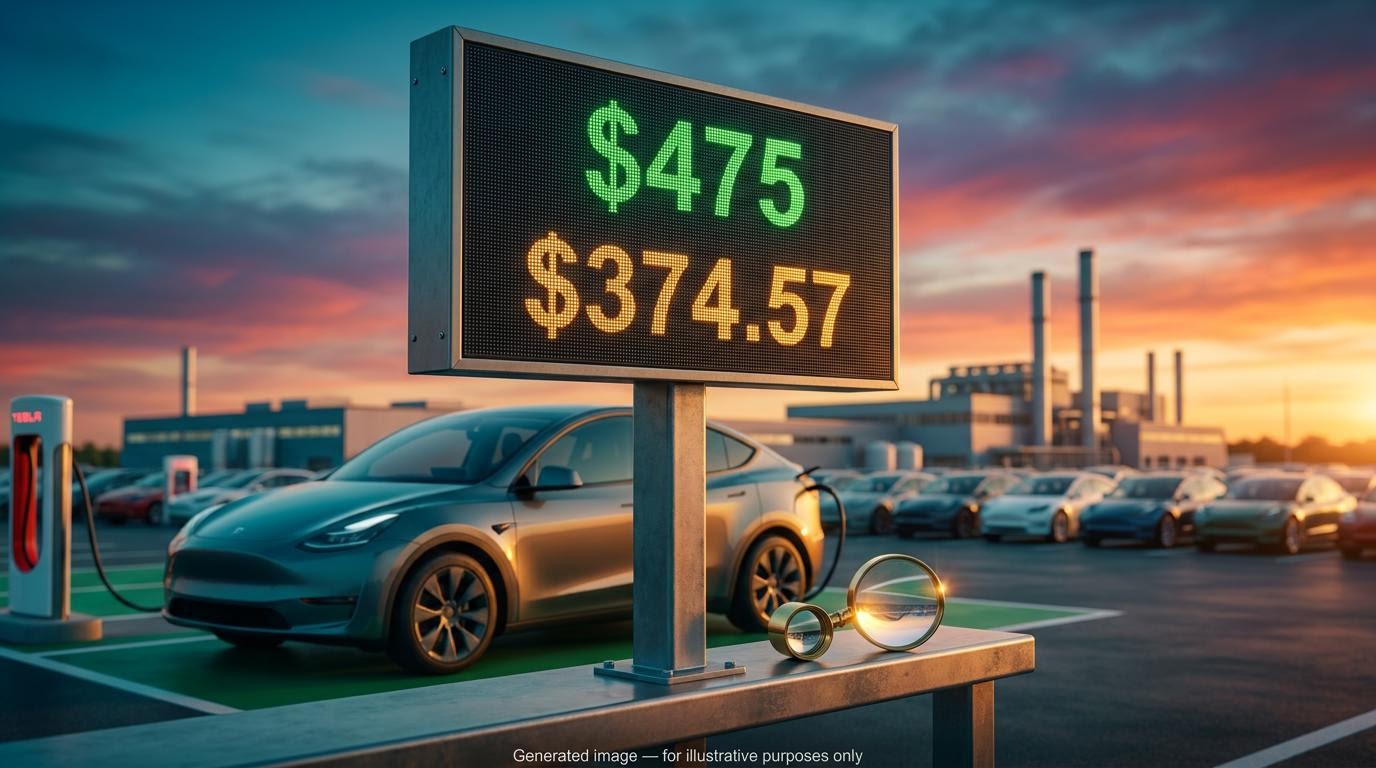
Tesla beat Wall Street on both revenue and earnings, and the shares fell anyway. The company reported $28.046 billion in third-quarter revenue and adjusted earnings per share (EPS) of $0.48, ahead of the $0.43-$0.45 consensus. Two days later the stock had slipped about 3% to roughly $374.57, just as Morningstar lifted its fair value estimate for Tesla from $450 to $475.
That gap between price and value is the real story. The market is pricing production limits and a heavy spending bill. Morningstar is pricing faster Full Self-Driving (FSD) adoption and lower capital needs.
Both readings rest on the same quarter, which means one of them is leaning harder on assumptions than the other. The analysis reflects data available as of late October 2026.
Here is how to judge whether a discount of more than 20% to Morningstar’s number is an opportunity or a warning, using its rating system and a component-by-component framework you can reuse on the next update.
Why did Tesla shares fall after a beat?
On paper, the quarter reported on 21 October 2026 was clean. Revenue came in about $130 million above consensus. Automotive gross margin, the share of car sales revenue left after production costs, improved sharply from the prior quarter.
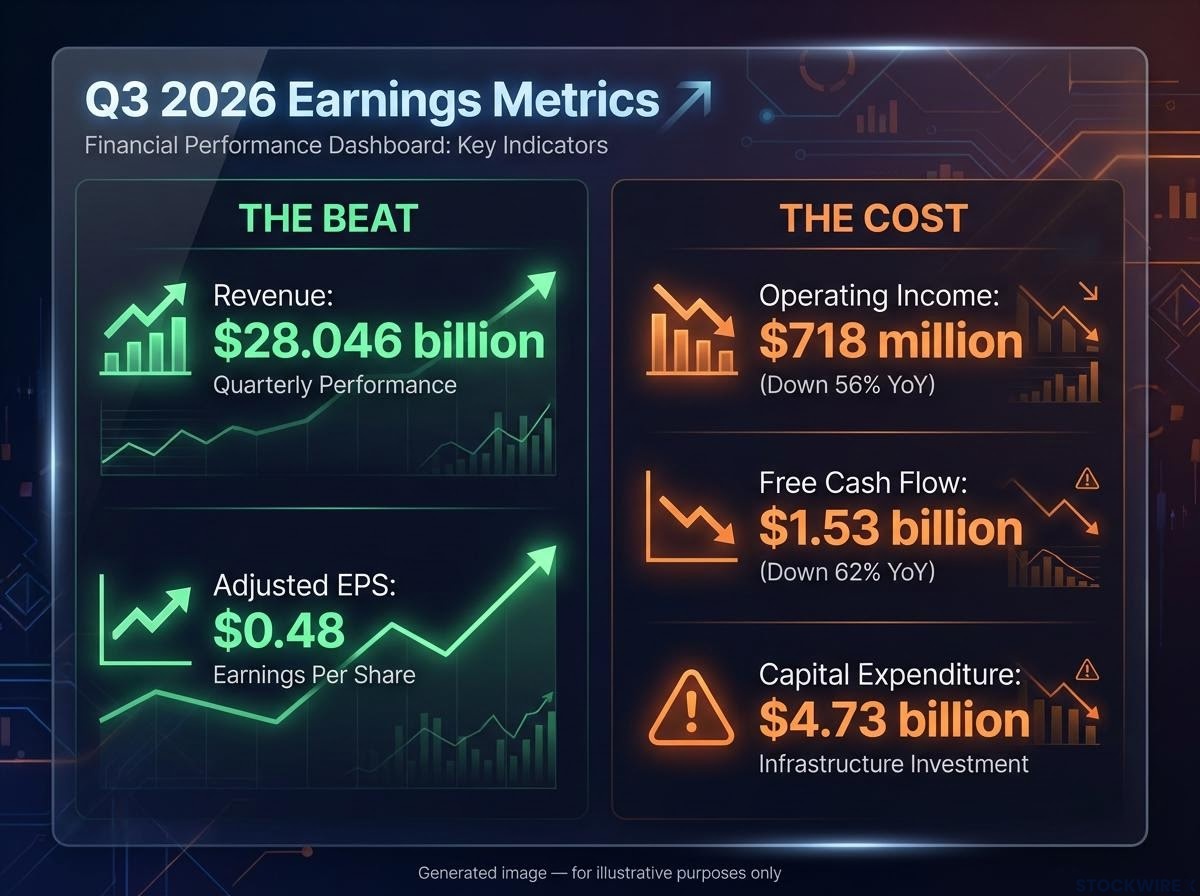
Then came the operating line. Operating income, the profit left after running costs but before interest and tax, fell 56% year over year to $718 million. Spending on artificial intelligence (AI), autonomy and robotics swallowed most of the margin gain.
| Metric | Reported result | Comparison |
|---|---|---|
| Revenue | $28.046B | $27.9B-$27.92B consensus |
| Adjusted EPS | $0.48 | $0.43-$0.45 consensus |
| GAAP diluted EPS | $0.22 | No consensus found |
| Auto gross margin | 18.5% (18.1% ex-credits) | 16.3% ex-credits prior quarter |
| Operating income | $718M | Down 56% year over year |
| Free cash flow | $1.53B | Down 62% year over year |
| Capital expenditure | $4.73B | $2.25B a year earlier |
Shares fell about 2.22% to $377.88 after hours, then closed on 22 October at roughly $374.57, down about 3.1% from $386.47. Free cash flow, the cash left after capital spending, stayed positive at $1.53 billion. But capital expenditure (capex) of $4.73 billion more than doubled the year-earlier figure (some early reports cited $3.73 billion; the filing-based number is used here).
Capacity, not demand, is the constraint
Tesla delivered 486,532 vehicles against production of 464,391, and exited the quarter with its highest backlog in four years. Battery availability, not buyer interest, capped volumes. Morningstar expects Tesla to expand capacity at every factory, which should support deliveries in coming years.
The cut to full-year capex guidance, to about $20 billion from more than $25 billion, reads two ways. Management framed it as more efficient deployment funded from operating cash flow. Sceptics see deferred investment.
What this tells you is that the beat came from pricing and credits while core profit shrank. If you are judging the stock on this quarter’s EPS, you are judging the wrong thing: the market is paying for future capacity and autonomy.
When big ASX news breaks, our subscribers know first
Reading the valuation: price, competitive advantage and risk
Morningstar rates Tesla as having a narrow moat and very high uncertainty. That looks contradictory until you see that each rating answers a different question.
What each rating actually measures
- Star rating (4 stars): compares the share price with Morningstar’s fair value. A price/fair value ratio of 0.81 puts Tesla more than 20% below its estimate.
- Moat rating (narrow): measures how durable a company’s competitive advantages are. Morningstar points to Tesla’s installed fleet, data and software, manufacturing integration, charging network and brand.
- Uncertainty rating (very high): measures how wide the range of plausible outcomes is. For Tesla it is exceptionally wide, because value depends on FSD, robotaxi and Optimus economics rather than today’s car earnings.
Moat is not predictability A narrow moat says Tesla has advantages worth defending. It says nothing about how reliably those advantages turn into earnings.
Analyst Seth Goldstein, CFA, raised the estimate on three mechanics:
- Higher FSD adoption: more than 75% of North American deliveries came with a paid FSD signup, about 20 points above Q2, and Tesla reported over 1.7 million paid global customers, about half on subscription. Software carries far higher incremental margins than hardware.
- Lower capex: less capital for similar milestones means more free cash flow and less external funding.
- AI-heavy weighting: earlier Morningstar commentary reportedly put robotaxi at more than 30% of its valuation, FSD about 20% and Optimus about 30%, though this has not been independently confirmed. Small assumption changes there move the whole number.
Read together, a 4-star label is a statement about price against a highly uncertain estimate. Treat the $475 as a probability-weighted anchor, not a target.
Where analysts disagree: Optimus, robotaxi and the value of optionality
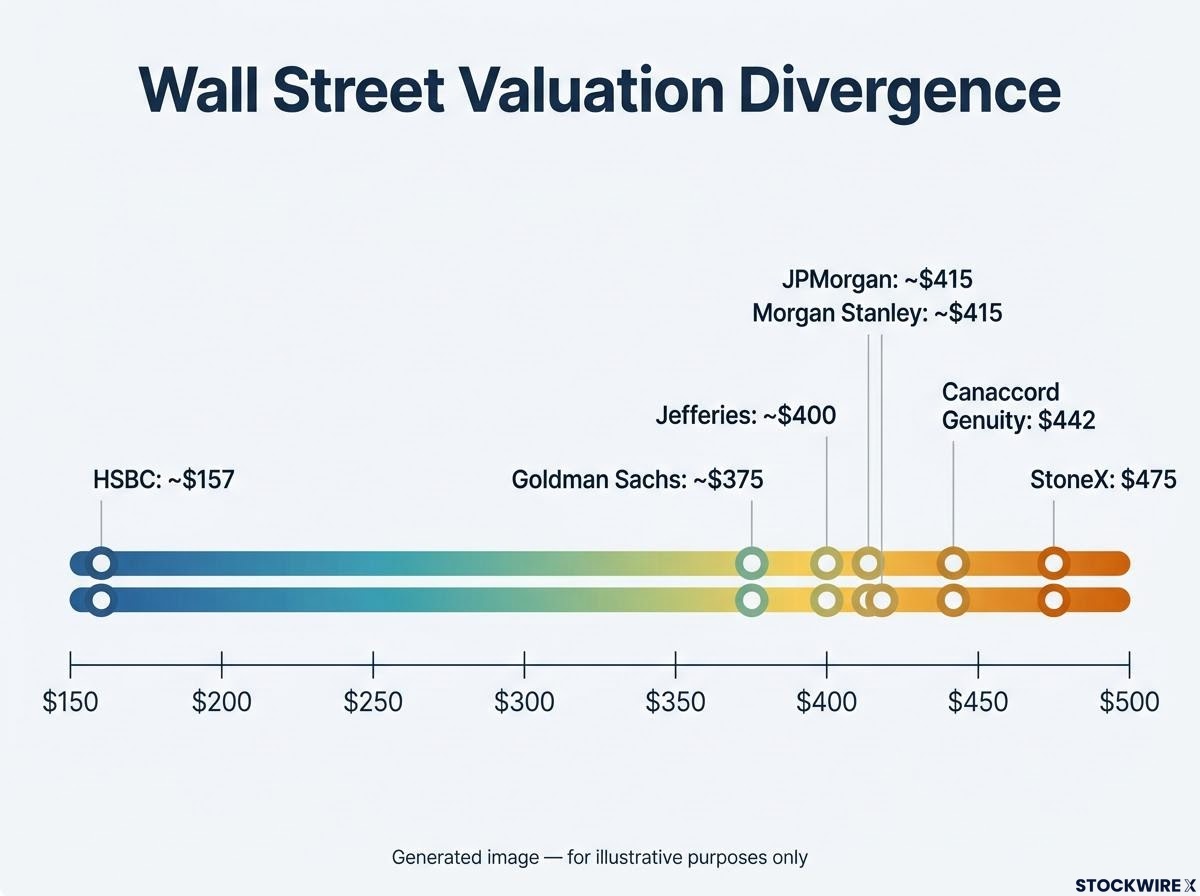
Nobody on Wall Street disputes the beat. The argument is over how much to pay for businesses that have not yet produced material profit.
| Firm | Position | Reasoning |
|---|---|---|
| StoneX | Buy, $475 | Reads lower capex as deferral, not abandonment |
| Canaccord Genuity | $442 | Positive on earnings and technology roadmap |
| JPMorgan | Neutral, about $415 | Questions whether the capex cut delays AI investment |
| Morgan Stanley (Andrew Percoco) | Equal Weight, about $415 (pre-results) | Upside capped while physical-AI programmes move slowly |
| Jefferies (Philippe Houchois) | Hold, about $400 | Credits robotaxi commentary; cautious on valuation |
| Goldman Sachs (Mark Delaney) | Neutral, about $375 | Wants proof robotaxi can scale |
| HSBC | About $157 | Spending, margins and premium unresolved |
| Wedbush (Dan Ives) | Bullish | FSD becoming a major demand driver |
The two camps are betting on different assumptions:
- Bull case: FSD adoption is accelerating with software-like margins, robotaxi utilisation can scale quickly, and Optimus opens a large new market.
- Bear case: the car business is mature or capacity-constrained, operating costs are outrunning revenue, capex stays structurally high, and autonomy and robotics remain unproven.
Robotaxi shows why. Unsupervised miles rose about eightfold to nearly 2 million cumulative, but service remains centred on Austin, and CFO Vaibhav Taneja said revenue would not be significant until about 2027. Reporting also suggests Tesla missed a 2024 claim of one million robotaxis by 2025, a record with limited independent verification. An NHTSA inquiry into reported school-zone speeding is similarly unconfirmed.
Optimus: management’s clock versus Morningstar’s
Elon Musk said Tesla aims to start external Optimus deliveries around the end of 2027, with its AI5 chip integrated around April 2027. He also listed unresolved issues: the hands, AI, electromechanical design, reliability and operating life.
Morningstar calls the timetable possibly too optimistic and expects commercial sales closer to the end of the decade. Reports that Tesla missed a 2025 target of about 10,000 robots, though not independently confirmed, help explain the discount. Working hands, external deployments and repeat orders would close the gap.
A range from roughly $157 to $475 tells you there is no consensus on the optionality. Expect volatility and size your position for it.
A framework for judging the gap between price and fair value
Rather than argue with a single number, break Tesla into parts and ask what evidence each one has earned:
- Automotive and energy: watch deliveries, pricing, gross margin and battery availability. Auto revenue fell about 3% this quarter.
- FSD: watch retention, not just attach rate. Delivery-time signups do not prove ongoing payment, and Musk’s call comments reportedly implied a lower paid basis (unverified).
- Robotaxi: value approved cities, active fleet, paid rides and contribution margin, not addressable market size.
- Optimus: score milestones, from internal production to external deployment, repeat orders and unit cost.
- Capital intensity: deduct the spending needed for each milestone. Free cash flow fell 62% year over year.
- Timeline discount: mark down distant or repeatedly delayed cash flows more heavily than today’s car profits.
Waymo and other autonomous programmes offer the lesson for step three: separate miles driven, paid rides, driverless rides, city approvals and contribution margin. Demonstrations do not automatically become a profitable network.
The risks that would break the thesis:
- FSD attach failing to translate into retention
- Regulatory or safety scrutiny slowing deployment
- European approval slipping beyond a possible EU-wide Q1 2027 timeline, which depends on regulators
- The capex cut proving to be deferral rather than efficiency
The core read The beat supports the cash-generative core. It does not prove robotaxi or Optimus can deliver the profits built into the most bullish valuations.
Most of the value gap sits in components with no profit yet. Decide how much probability you will assign to each before calling the discount a bargain.
What the beat changes, and what it leaves unresolved
The quarter strengthened Tesla’s cash-generative core and showed FSD attach rising fast. Yet Morningstar’s $475 still rests largely on businesses that have not earned material profit.
That is why the narrow-moat, very-high-uncertainty pairing matters for you. Real advantages may exist, but outcomes hinge on execution, regulation and capital allocation, so position sizing discipline counts for more than the headline discount.
Four signposts will test the thesis: robotaxi expansion beyond Austin, European FSD approval, Optimus milestones, and capex against the $20 billion guide.
This article is for informational purposes only and should not be considered financial advice. Investors should conduct their own research and consult with financial professionals before making investment decisions. Past performance does not guarantee future results. Financial projections are subject to market conditions and various risk factors, and forward-looking statements are speculative and subject to change.