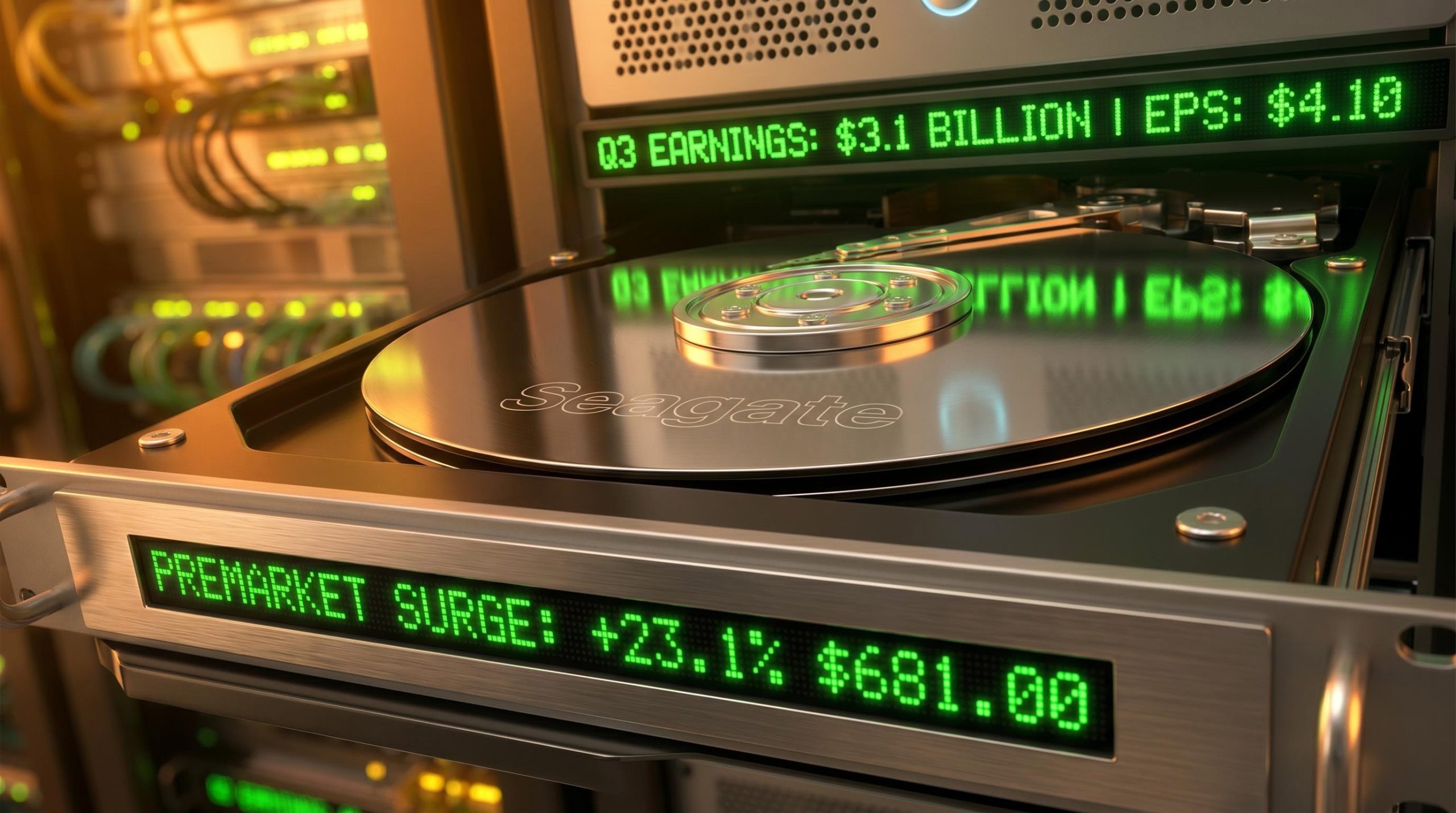
Shares in data storage manufacturer Seagate surged in early premarket trading on 29 April 2026, following a third-quarter earnings release that shattered Wall Street expectations. Initial market indications showed the equity climbing up to 23.1% to reach $681.00 before standard trading hours commenced.
This immediate price movement adds to a staggering year-on-year appreciation for Seagate stock, reflecting aggressive recalibrations of the company’s forward value. Investors are currently pricing in a fundamental shift in how the technology sector manages physical infrastructure.
What follows is an examination of the specific financial metrics from the 28 April 2026 report and the artificial intelligence catalysts driving major institutions to drastically revise their valuation models overnight. The data reveals a company transitioning from cyclical hardware supplier to a foundational infrastructure provider.
Unpacking the Third Quarter Earnings Surprise
The third-quarter financials reveal a substantial outperformance across all critical reporting categories. Wall Street had positioned for moderate growth, but the actual figures demonstrated a structural acceleration in core business operations.
The company reported revenue of $3.1 billion for the quarter, representing a 44% year-over-year increase. This figure easily cleared pre-earnings consensus expectations of $2.95 billion, delivering a $160 million beat on the top line.
The company’s official SEC Form 8-K filing confirms these top-line figures alongside broader operational data, highlighting the sheer scale of execution required to capture this level of market demand.
Profitability metrics showed even stronger momentum as the manufacturer capitalised on favourable pricing dynamics. Non-GAAP diluted earnings per share reached $4.10, comfortably surpassing the $3.48 to $3.50 consensus estimates. Furthermore, non-GAAP gross margins expanded to 47.0%, indicating that the revenue growth is falling directly to the bottom line rather than being absorbed by production costs.
This was not a marginal beat but a complete recalibration of the company’s baseline earning power. Investors require these specific comparative metrics to understand why the premarket reaction has been so historically aggressive.
| Financial Metric | Q3 2026 Consensus Estimate | Q3 2026 Actual Result |
|---|---|---|
| Revenue | $2.95 billion | $3.1 billion |
| Non-GAAP Diluted EPS | $3.48 to $3.50 | $4.10 |
| Gross Margin | Not Specified | 47.0% |
When big ASX news breaks, our subscribers know first
Wall Street Analysts Trigger Massive Upgrades
The magnitude of the earnings surprise forced immediate recalibrations across major financial institutions. Analysts moved swiftly to adjust their forward models, recognising that previously optimistic bull case scenarios have now become baseline expectations.
This overnight reassessment highlights a broader realisation regarding the sheer scale of projected earnings multiples being applied to calendar year 2027 forecasts.
The following specific price target adjustments reflect the aggressive bullishness currently gripping the analyst community:
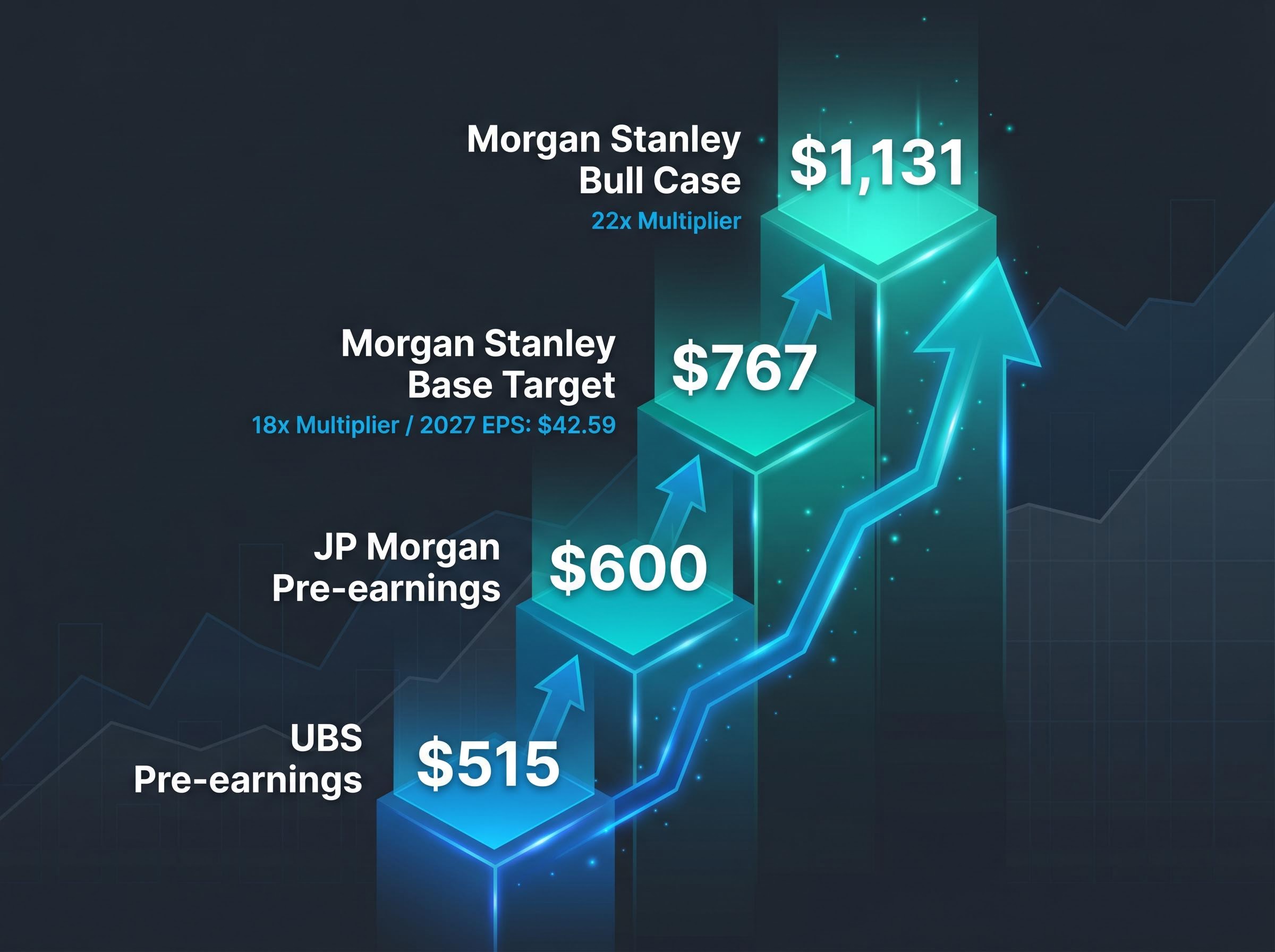
* Pre-earnings coverage from institutions like UBS and JP Morgan, which had previously set targets at $515 and $600 respectively, now face immediate pressure to revise their models upward.
Some boutique investment banks have moved even higher, releasing revised price target projections that push well past the eight hundred dollar mark based on constrained supply dynamics.
Morgan Stanley details aggressive valuation metrics
The updated Morgan Stanley valuation model provides a clear window into how institutional capital is currently assessing the manufacturer. According to unverified reports, their analysts anchored the new $767 base target to an 18x forward earnings multiplier applied against an updated 2027 calendar year EPS projection of $42.59.
According to unverified reports, the firm’s ultimate bull case valuation now reaches $1,131 based on a 22x multiplier. This aggressive modelling stems from their identification of the company as a primary preference within the broader information technology hardware sector. Retail and institutional investors rely on these institutional shifts to gauge where capital is flowing, providing a forward-looking roadmap for the equity.
How Artificial Intelligence is Rewriting the Rules of Physical Storage
The financial outperformance is anchored by a fundamental shift in cloud computing architecture. Artificial intelligence infrastructure is currently transitioning from periodic training models to continuous inference engines.
This transition means compute infrastructure must continuously generate and store mass capacity data rather than simply processing episodic training runs. While solid-state technologies command attention for high-speed processing, traditional magnetic storage devices remain critical for holding this massive volume of generated data.
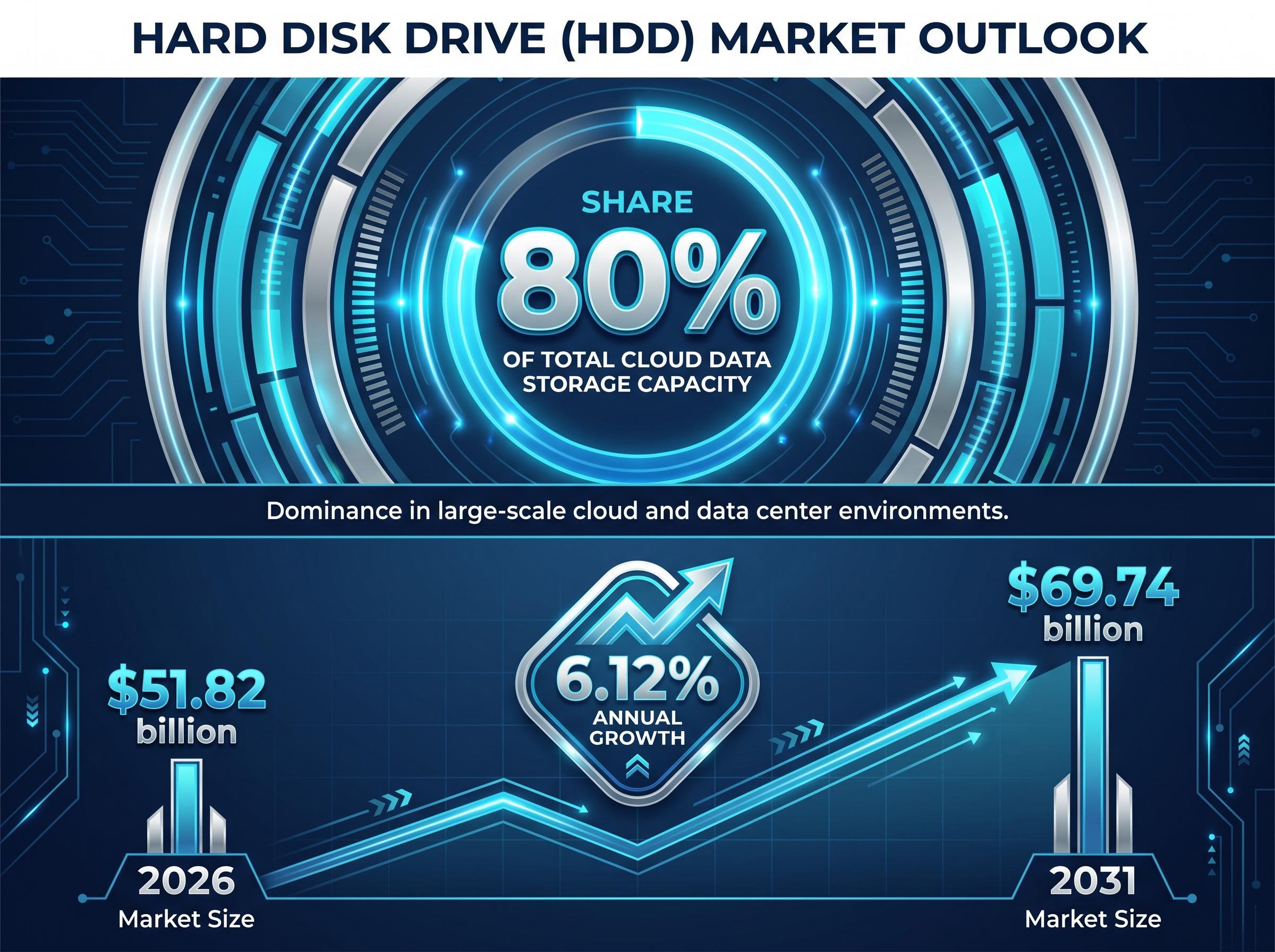
According to industry reports, hard disk drives currently fulfill approximately 80% of total cloud data storage capacity requirements due to their unmatched cost and energy efficiency at scale. This dynamic represents a structural shift in global data retention rather than a temporary cyclical peak. The overall hard disk drive market is projected to grow from $51.82 billion in 2026 to $69.74 billion by 2031, representing a steady expansion pathway of 6.12% annually.
CEO Commentary “Today, AI sits at the centre of nearly all customer demand conversations. We are in the midst of an inference inflection where compute infrastructure is shifting from periodic training to becoming engines that continually generate mass capacity data,” said William Mosley, Chief Executive Officer.
This technological reality educates the market on the macroeconomic thesis behind the manufacturer’s resurgence. The requirement to store exabytes of machine-generated data ensures physical hard drives will remain the foundational layer of modern data centre architectures.
For investors wanting to explore the proprietary technology capturing this demand, our deep-dive into Seagate’s AI storage moat details how their HAMR drives deliver a significant cost advantage over competitors.
Long-Term Capacity Contracts Solidify Future Financial Growth
This theoretical structural demand is already converting into tangible contracts that lock in future revenue. The company now holds a distinct operational advantage, creating a sense of inevitability about their near-term supply chain dominance.
Management confirmed that exabyte-scale supply agreements are currently in place with nearly all major cloud and hyperscale customers. These agreements have resulted in nearline capacity being almost fully allocated through the entirety of calendar 2027.
Chief Financial Officer Gianluca Romano explicitly confirmed this allocation profile, noting it provides highly predictable revenue streams for the next four quarters. By tightly controlling inventory levels, concentrated market suppliers have established significant leverage over the world’s largest cloud operators.
This capacity allocation translates directly into immediate financial growth, as evidenced by the updated forward guidance for the fourth quarter of 2026:
Targeted revenue of $3.45 billion, with a variance margin of $100 million. Non-GAAP diluted EPS projected at $5.00, with a variance margin of $0.20.
Knowing that production capacity is spoken for through 2027 heavily de-risks the investment thesis. It offers a protective buffer against near-term macroeconomic volatility for investors assessing the stock at its current valuation.
Evaluating whether this HDD upcycle is fully priced into the shares requires balancing remarkable revenue predictability against potential geopolitical headwinds and the looming threat of enterprise SSD substitution.
Supply constraints bolster long-term manufacturer dominance
The combination of surging artificial intelligence demand and constrained supply has handed permanent pricing power back to hardware manufacturers. This specific corporate turnaround reflects a broader renaissance for physical infrastructure providers operating in the modern data era.
Recent market data confirms that the company’s pricing strategy is working exactly as intended. Hard disk drive prices recently rebounded past $110 per terabyte following strategic manufacturer production cuts. Furthermore, according to unverified reports, the average cost per terabyte increased by 5% sequentially during the first calendar quarter, easily beating initial industry estimates of a 1% rise.
This momentum aligns with broader hardware price surges across the industry, as major suppliers completely sell out their production capacity for the remainder of the year.
Romano stated there are absolutely no changes to the company pricing strategy amidst this strong demand environment. This sustained market leverage ensures that the record margins achieved in the third quarter are likely a new operational baseline rather than an isolated anomaly.
This article is for informational purposes only and should not be considered financial advice. Investors should conduct their own research and consult with financial professionals before making investment decisions.
Past performance does not guarantee future results. Financial projections and forward-looking statements regarding capacity allocation and market growth are subject to market conditions and various risk factors.