Fifty-four of the 154 largest ASX-listed reporters put Scope 3 emissions into their first mandatory climate reports, even though nothing required them to. That is 35% of the cohort volunteering the hardest number in climate accounting. The flip side matters more for your super: roughly two-thirds of those big listed investees have not published the category that makes up most of a fund’s financed emissions, the biggest gap in Scope 3 disclosure in Australia right now.
The findings come from a report by Chartered Accountants Australia and New Zealand (CA ANZ), Purpose Bureau and Monash Business School, published on 29 September 2026. It lands at a busy moment for climate reporting.
The first mandatory reports are in. Treasury’s consultation on assurance closed in early October. A legal shield called modified liability has a hard end date in 2028. How those three pieces fit together will decide how much you can trust the emissions numbers attached to your portfolio.
Here is what the early data signals about where climate reporting is heading, and the specific dates worth watching.
What did the first mandatory reports actually reveal about Scope 3?
Start with the headline. The report, titled ASRS State of the Market: ASX-listed Group 1 Cohort Report, assessed 154 Group 1 entities, the largest reporters brought into the regime first. 54 disclosed at least some Scope 3 emissions, which are the indirect emissions produced across a company’s value chain, from suppliers to customers.
The voluntary signal 35% of large ASX-listed reporters disclosed Scope 3 despite a first-year exemption that let them skip it.
The deeper figures tell a more uneven story.
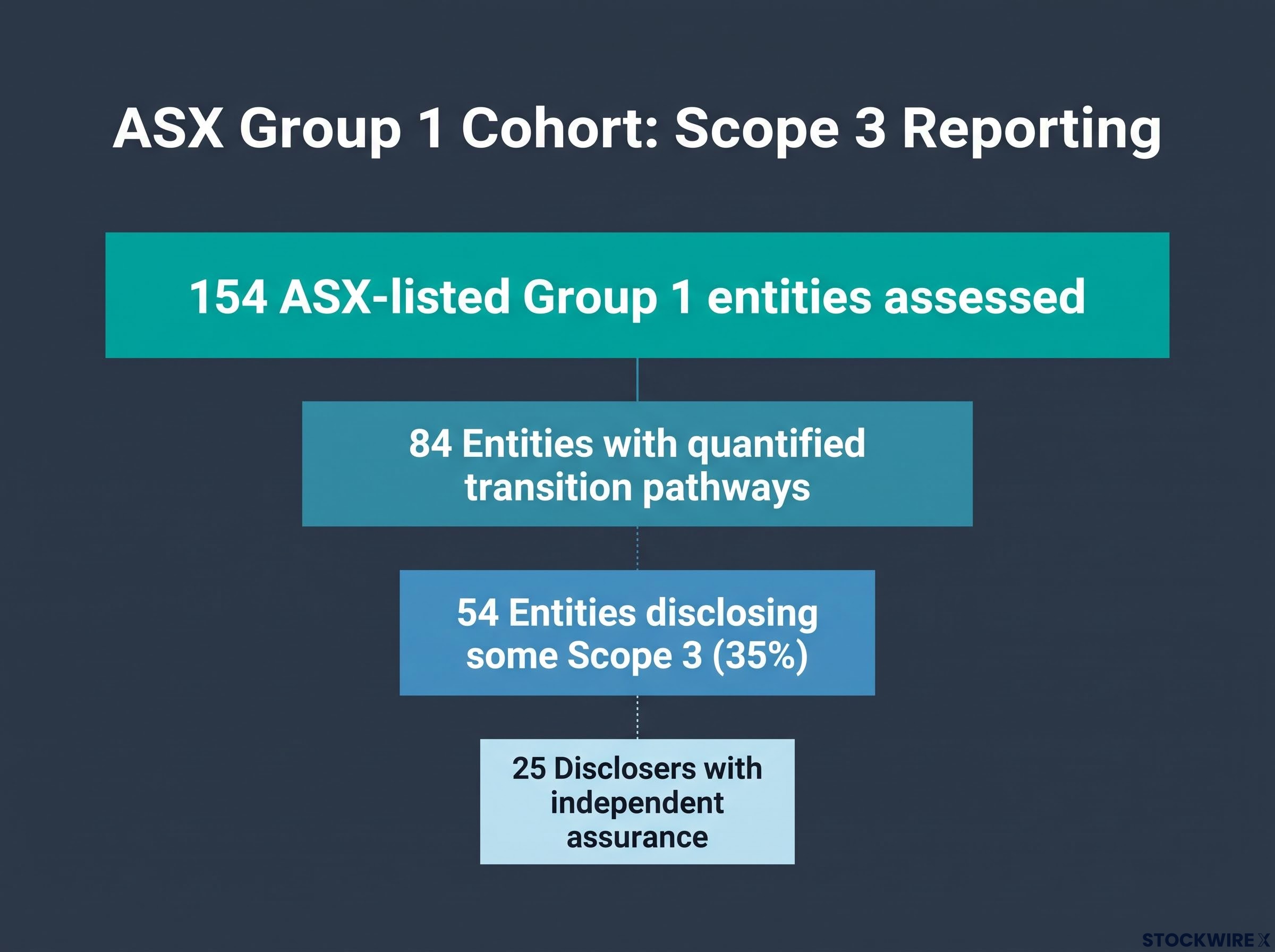
From the 154 ASX-listed Group 1 entities assessed, only 54 are disclosing some Scope 3 (35%), and just 25 have independent assurance.
| Metric | Result |
|---|---|
| ASX-listed Group 1 entities assessed | 154 |
| Entities disclosing some Scope 3 | 54 (35%) |
| Disclosers with independent assurance | 25 |
| Entities with quantified transition pathways | 84 |
| Purpose Bureau dataset to date | Nearly 500 reporters |
Only 25 of the 54 had their Scope 3 figures independently checked. Meanwhile 84 entities published transition plans with quantified emissions-reduction pathways, more than half the cohort.
Why volunteer at all? ASIC observed in August 2025 that large companies were already assembling value-chain data from suppliers, customers and industry averages. Investors and lenders ask for it, and a transition plan carries more weight with numbers behind it. CA ANZ takes the result as a sign that firms view the regime as a tool beyond box-ticking, while Purpose Bureau’s Max Van Biene expects the share to rise as supply chain data improves.
Quality, though, is mixed. ASIC’s review of 31 reports on 21 September 2026 found 82.5% relied on the first-year relief, and it warned that any voluntary Scope 3 must be clearly labelled. For you, a disclosed figure is only as useful as its basis: check whether it rests on primary data or estimates, and whether anyone assured it.
ASIC’s separate publication of REP 839 named eight action items for reporters, including incomplete emissions scope coverage, which now serve as the minimum standard that later reports will be measured against.
When big ASX news breaks, our subscribers know first
Why does investee Scope 3 matter so much to super funds?
You might assume a super fund simply adds up the emissions of everything it owns. The reality is messier, and it explains why the missing two-thirds is a structural problem.
For an asset owner, nearly all of Scope 3 takes the form of financed emissions, which are the emissions produced by the companies and assets that the fund puts money into. Registrable superannuation entities with $5 billion or more in assets enter the regime as Group 2 reporters for financial years starting on or after 1 July 2026, with Scope 3 required from their second year.
How financed emissions are calculated
The method commonly follows the Partnership for Carbon Accounting Financials (PCAF), a global standard for measuring the emissions linked to loans and investments. A fund counts only its proportional share, not the investee’s whole footprint.
- Identify holdings and exposure at the reporting date.
- Obtain investee Scope 1 and 2 emissions, meaning direct emissions and those from purchased energy.
- Attribute a share to the fund using ownership or financing-share methods.
- Aggregate across asset classes.
- Disclose data coverage, estimation methods, exclusions and limitations.
Adding investee Scope 3 on top brings extra data gaps and double-counting risk. Funds’ early disclosures show how each has handled it.
| Fund | Approach | Stated difficulty |
|---|---|---|
| UniSuper | Investee Scope 1 and 2; investee Scope 3 excluded | Estimation and double-counting risk, unavailable data, mapping group companies to parents |
| Rest | Investee Scope 1 and 2 only | Mix of reported and estimated data |
| Cbus | PCAF-informed attribution | Significant variation in Scope 2 data quality |
| Aware Super | Relies on companies, providers and managers | Estimates used where reported data are unavailable |
Writer Matt Sainsbury frames the 25 assured disclosers as a starter dataset and the roughly hundred non-disclosers as a stewardship target list. He also questions whether a fund still in its first year can live up to the bar it will set for the companies it holds. If you hold super, expect your fund’s first financed-emissions figure to lean heavily on estimates, so read the coverage and method notes before comparing funds.
What happens when modified liability ends in 2028?
Right now, the riskiest climate numbers sit behind a shield. Modified liability covers Scope 3 (including financed emissions), scenario analysis and transition plans for reports on financial years commencing 1 January 2025 to 31 December 2027. During that window, private parties generally cannot sue over misleading statements in those areas.
From 2028, ordinary liability applies. The shield never covered everything, either:
- ASIC enforcement action
- Reputational damage and investor backlash
- Contractual claims and securities-law exposure outside protected categories
- Allegations that transition plans or net-zero claims mislead
ASIC has already shown what that exposure looks like. It secured penalties against Mercer Superannuation ($11.3 million, August 2024), Vanguard Investments Australia ($12.9 million, September 2024) and Active Super ($10.5 million, March 2025).
Greenwashing penalties to date $34.7 million combined across three cases, according to ASIC’s 8 August 2025 reporting and audit update.
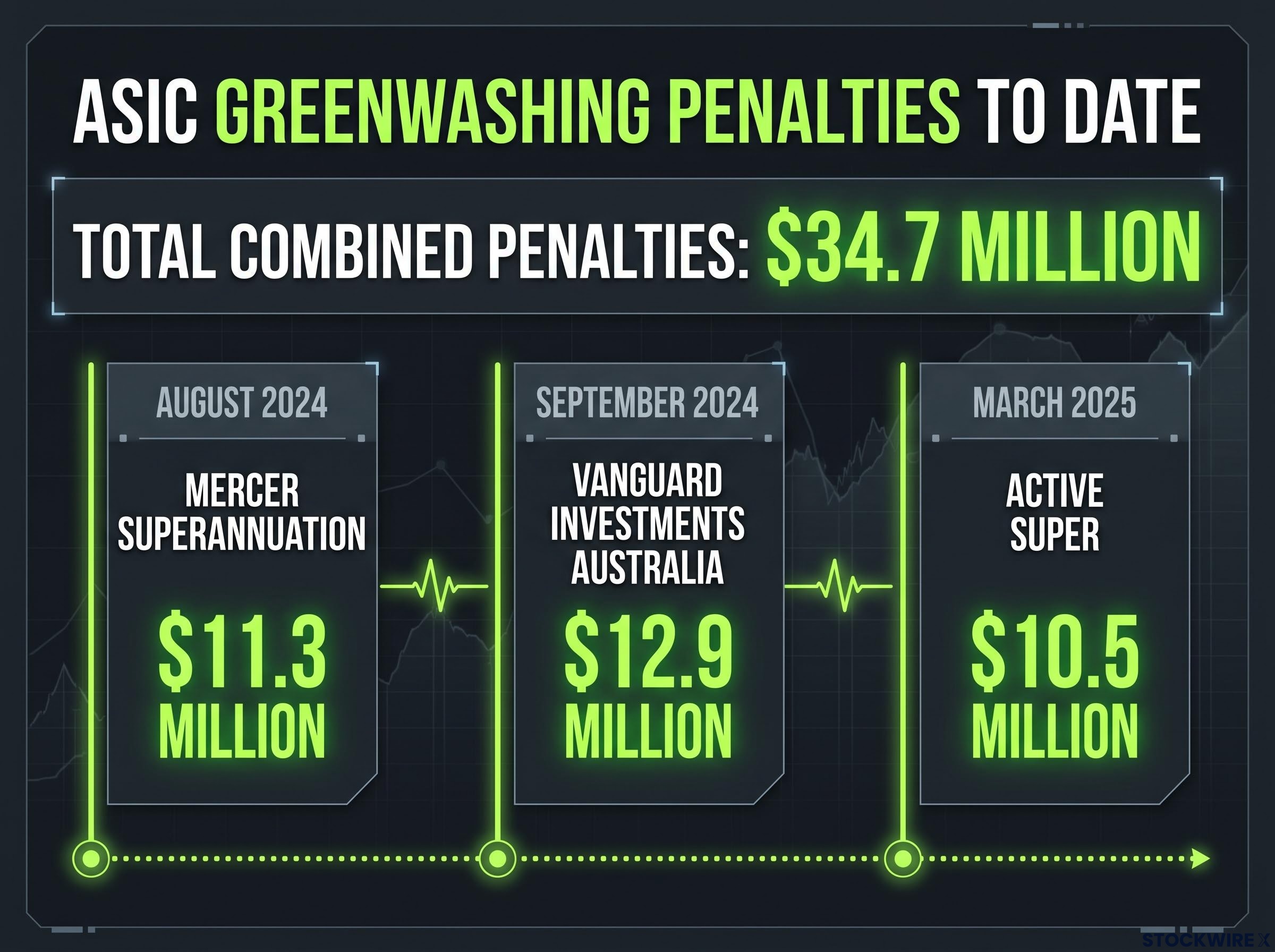
ASIC Greenwashing Penalties to Date have reached Total Combined Penalties: $34.7 million, including $11.3 million for Mercer Superannuation in August 2024.
ASIC has also warned that presenting estimated voluntary Scope 3 as mandatory, assured or comparable can itself create risk.
Penalties are only one form of exposure. Greenwashing litigation exposure also runs through the energy sector, where a Scope 3 category covering most of a company’s footprint has already been tested in court.
That puts the 84 quantified transition pathways in a new light. Published comfortably in 2026, they become testable without protection once 2028 arrives.
The read you should take: 2026 and 2027 are the years when disclosure quality, not volume, gets set, because that quality is what will be judged later.
Could Treasury’s consultation leave financed emissions on limited assurance for good?
The liability clock is fixed. The assurance standard is not. Treasury’s consultation, Improving the efficiency of climate-related financial disclosures, ran from late August to early October 2026 and put three options on the table.
Limited assurance means an auditor runs narrower checks and confirms nothing looks wrong. Reasonable assurance demands far more extensive testing and stronger evidence, the standard applied to financial statements.
| Option | Substance | What it means for Scope 3 |
|---|---|---|
| Permanent limited | Remove the legislated move to reasonable assurance | Never tested beyond limited assurance |
| Delayed reasonable | Move from 2030 to 2035 | Reasonable assurance arrives five years later |
| Tiered | Reasonable for mature metrics such as Scope 1 and 2 | Limited assurance retained indefinitely |
The tiered option sounds like a middle path. Under it, though, financed emissions would carry limited assurance permanently, which settles the most consequential question for super funds quietly.
Treasury also sought views on supplier data guidance, a bigger government role in domestic emissions factors, and clearer boundaries for value-chain requests.
The case for relief versus the case against
Supporters of relief point to Scope 3’s dependence on third parties, high costs, the false precision of estimates and limited assurance capacity. The Australian Institute of Company Directors (AICD) backed limited assurance until 2035 in its 9 October 2026 submission.
Investor groups, lenders and prudential supervisors counter that permanent relief obscures transition risk, flatters companies with large value-chain emissions and weakens comparison. As at 11 November 2026, no final decision has been located; all three remain proposals.
For you, the choice decides whether the Scope 3 numbers behind your fund or portfolio will ever face the testing already planned for Scope 1 and 2.
Is Australia softening alone, or following a wider pattern?
Australia is not debating this in isolation. Comparable markets have eased Scope 3 rules too, but mostly with an end date attached.
| Jurisdiction | Relief | Consequence |
|---|---|---|
| Australia | First-year Group 1 exemption; modified liability to periods commencing 31 December 2027 | Funds rely on estimates while corporate Scope 3 stays incomplete |
| United Kingdom | FCA PS26/19: comply-or-explain from 1 January 2027; one year of Scope 3 relief | Issuers can explain non-disclosure; the explanation becomes accountable |
| European Union | CSRD scope cut; Council proposed a threshold above 1,000 employees | ECB warned data for banks and investors could fall sharply |
The UK’s Financial Conduct Authority finalised its rules on 30 September 2026, with first reports due in 2028. In Europe, the reasonable-assurance timetable is the very benchmark Treasury cited for its 2035 option.
The strongest pushback came from European supervisors. In February 2026 they objected to permanent waivers, and the European Banking Authority recommended Scope 3 relief be time-limited through financial year 2029, because banks need corporate emissions data for their own obligations.
The pattern is staged relief, not permanent exemption. Use that as your yardstick: a permanent Scope 3 carve-out here would sit at the weaker end of what peers are doing.
What to watch as Scope 3 reporting matures
The first year proved voluntary Scope 3 reporting is feasible for a substantial minority. Super funds’ experience shows why consistent production remains hard, and policy has not yet settled how reliable the numbers must become.
Four markers will shape the next stage:
- Treasury’s decision on assurance
- CA ANZ’s quarterly updates as June year-end reporters and Group 2 arrive
- Super funds’ first Group 2 reports in 2027
- The shift to ordinary liability in 2028
For investors and finance professionals, the practical move is clear. Treat the 25 assured disclosers as your most usable data and the non-disclosers as engagement priorities.
This article is for informational purposes only and should not be considered financial advice. Investors should conduct their own research and consult with financial professionals before making investment decisions.