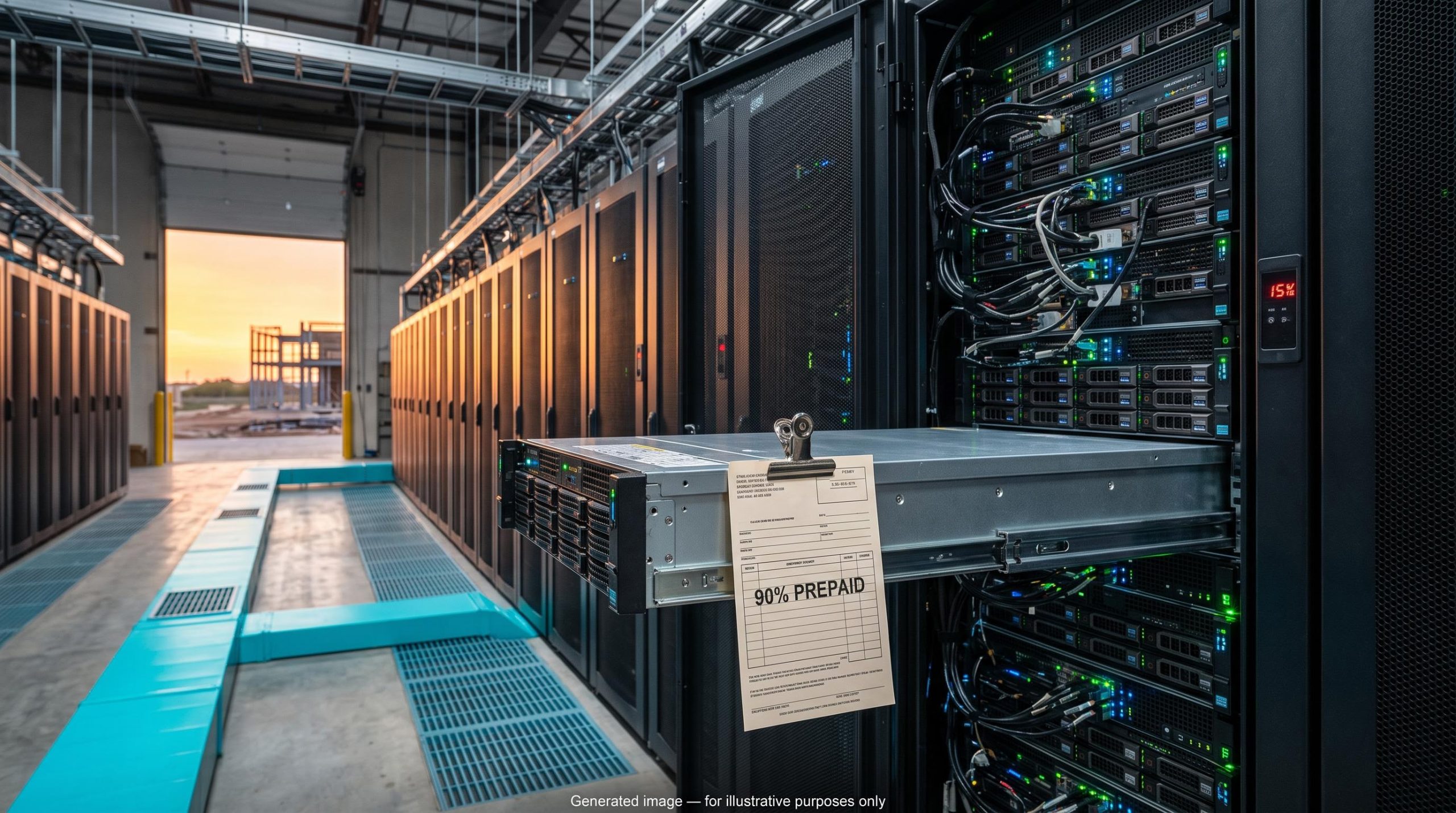
CoreWeave reported quarterly revenue of US$3.661 billion on 10 November 2026, up 168% on a year earlier, alongside a revenue backlog of roughly US$132.5 billion. Some of its bonds still trade near a 15% yield, a level usually reserved for companies the market doubts. That raises a fair question: how can a company with this much contracted demand still face distressed borrowing costs?
Part of the answer sits inside the neocloud model itself. CoreWeave and IREN are increasingly asking customers to pay for a share of the chips upfront. That cuts the amount they need to borrow at punishing rates.
The timing matters. Microsoft has trimmed capital spending and blamed delayed third-party capacity. Meanwhile, a shifting US political backdrop is raising questions about the cost, speed and location of data centre construction.
This analysis gives you a way to judge whether customer prepayments are a lasting financing fix or a temporary bridge. It also sets out the signals that will decide which it turns out to be.
How the neocloud model works and why chips create a funding gap
Picture a company spending billions of dollars before it earns a single one. That is the starting point for every neocloud, a specialist cloud provider that rents out artificial intelligence computing power.
Neoclouds buy graphics processing units (GPUs), the chips that train and run AI models. They secure power and data centre space, then rent the computing capacity to hyperscalers and large tech firms. Hyperscalers are the giant cloud operators such as Microsoft. The money goes out first, on GPUs, networking, land, power and cooling. Revenue is generally recognised only once that capacity is in service.
That delay creates the funding gap. A neocloud can close it in three ways, and each one carries a different cost.
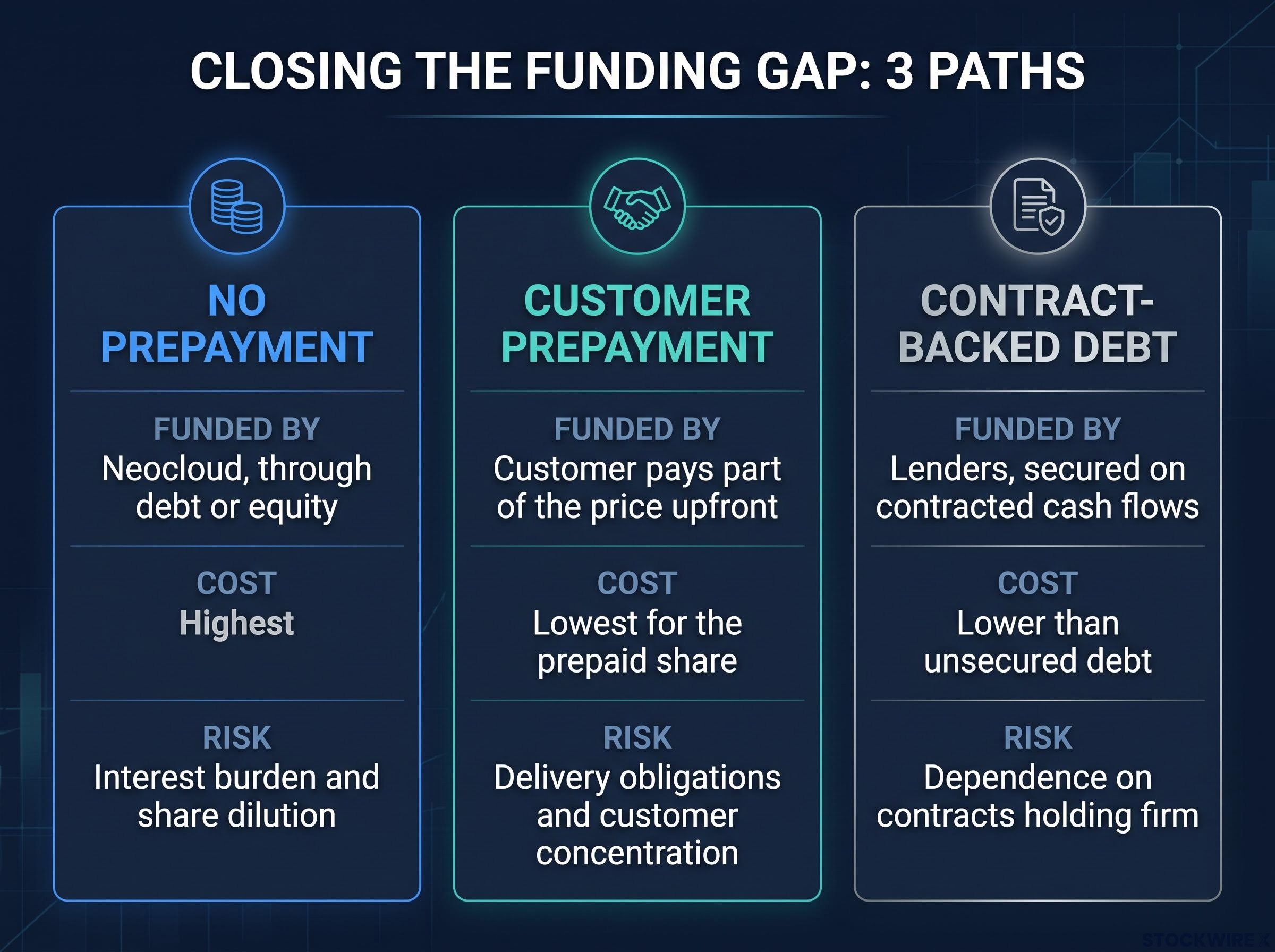
The 3 paths to closing the neocloud funding gap include No Prepayment, Customer Prepayment, and Contract-backed debt, each with different costs and risks.
| Funding path | Who funds the chips | Relative cost | Main risk |
|---|---|---|---|
| No prepayment | Neocloud, through debt or equity | Highest | Interest burden and share dilution |
| Customer prepayment | Customer pays part of the price upfront | Lowest for the prepaid share | Delivery obligations and customer concentration |
| Contract-backed debt | Lenders, secured on contracted cash flows | Lower than unsecured debt | Dependence on contracts holding firm |
Contract-backed debt is cheaper because lenders underwrite the customer contracts rather than the neocloud alone. That supports lower rates and higher advance rates. An advance rate is the share of an asset’s cost that a lender will finance.
The scale is large. Morningstar analysts Luke Yang and Javier Correonero estimated in October 2026 that CoreWeave’s debt could exceed US$100 billion by 2030.
Nvidia’s own NeoCloud backstop programmes add another layer to the financing picture, with an estimated $175 billion of contingent exposure by 2028 tied to underwriting GPU demand from independent data centre operators.
What this tells you is that demand alone is not the variable to watch. The key question is who carries the cost of the chips during the months before revenue starts.
When big ASX news breaks, our subscribers know first
What CoreWeave’s results and bond yields reveal about the cost of capital
Start with the growth numbers. Then set them beside the bond market, because the two tell very different stories.
| Metric | Q3 2026 | Comparison |
|---|---|---|
| Revenue | $3.661B | $1.365B a year earlier |
| Net loss | $709M | $110M a year earlier |
| Operating income | $207M | Not available |
| Revenue backlog | ~$132.5B | $104.2B at 30 June |
| Q3 capex | $14.511B | $30.650B over nine months |
Management guided to FY2026 revenue of US$13.0-13.3 billion and capital expenditure (capex), meaning spending on long-term assets, of US$37-39 billion. Debt totals are reported at about US$47 billion or US$51.6 billion, depending on the definition and reporting date used.
The bond market reads all of this differently. According to Reuters, CoreWeave’s 2030 bonds yielded about 15.2% on 10 November, and its five-year credit default swaps traded near 1,135 basis points. A credit default swap is a contract that pays out if a borrower defaults, so a higher price signals greater perceived default risk. The company’s June unsecured notes carry a 9.625% coupon.
The gap in one comparison Some unsecured CoreWeave bonds yield around 15% in the secondary market. The company’s weighted-average cost of debt was 7.9% at the end of Q3, down 250 basis points year on year.
Both numbers are true at once. The weighted average blends in cheaper secured and contract-linked financing, while the 15% yield prices only the unsecured debt, which has no specific assets or contracts standing behind it.
Shares sent mixed signals too. Reports put the after-hours move at anywhere from about 2% to about 5.7%, and Reuters noted the stock had fallen more than 40% in the month before results. Truist argued that sentiment has disconnected from improving economics.
What this tells you is that the market is pricing CoreWeave’s unsecured risk, not its contracted demand. The type of debt matters more than the headline debt figure.
Can prepayments replace debt? The IREN payback math
IREN’s disclosures turn the prepayment question into arithmetic. The payback period is the time it takes for revenue to recover the upfront GPU spend. That period shrinks sharply as customers fund more of the chips.
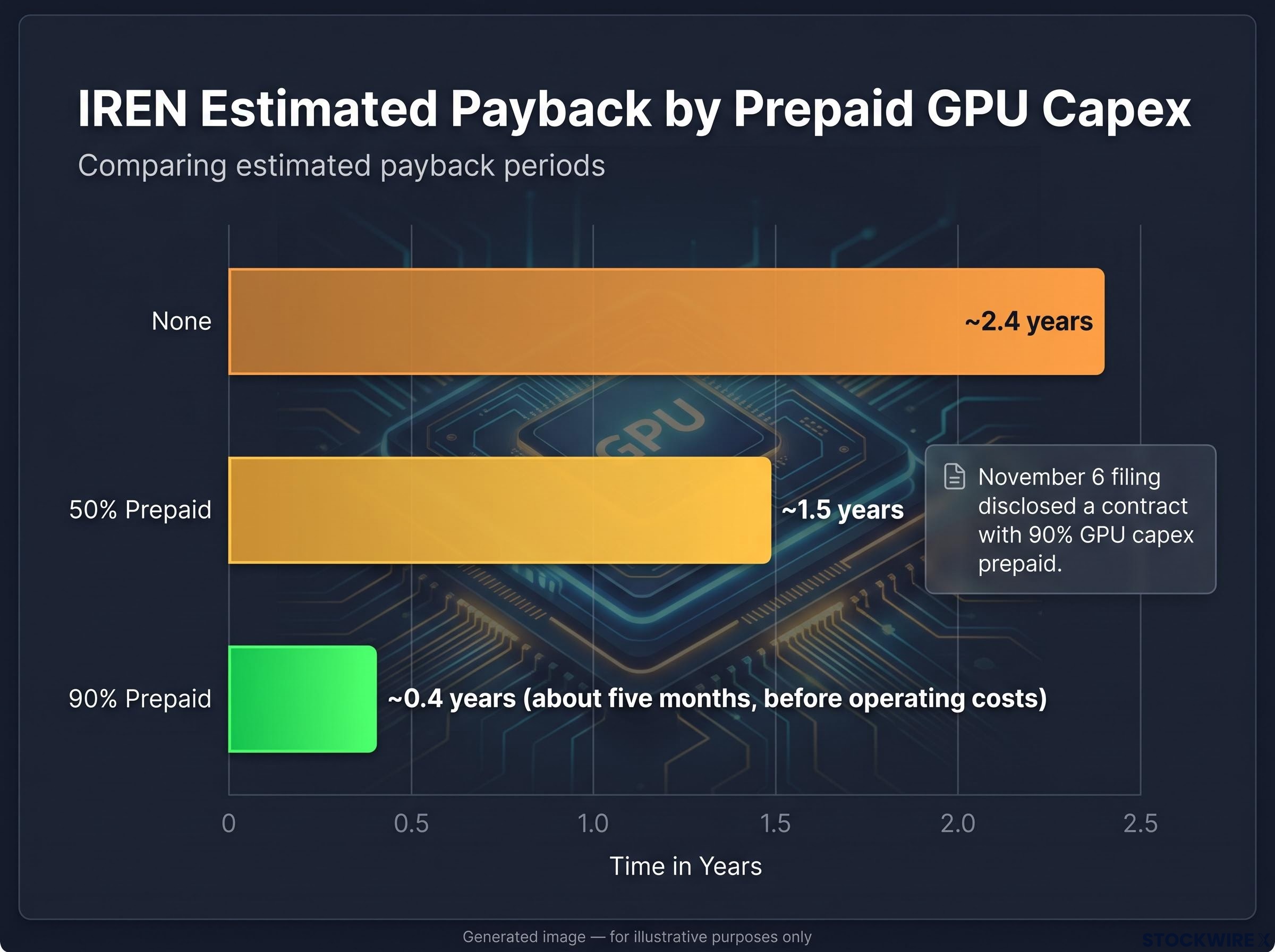
IREN’s estimated payback drops from ~2.4 years to ~0.4 years when 90% of GPU capex is prepaid.
| Share of GPU capex prepaid | Estimated payback |
|---|---|
| None | ~2.4 years |
| 50% | ~1.5 years |
| 90% | ~0.4 years (about five months, before operating costs) |
Those are not hypothetical levels. IREN’s recent contracts carried prepayments of 45-55% of GPU capex. An SEC filing on 6 November disclosed a new five-year contract at about US$22 million per megawatt, with 90% of GPU capex prepaid.
At that level, the customer is effectively buying the chips.
CoreWeave shows the same mechanism at a much larger scale. Management expects about US$9 billion of customer prepayments and deposits over the next three months. CEO Mike Intrator said the company would raise only a “limited amount” of additional capital. Nebius expects more than US$9 billion of prepayments in 2026, which suggests the approach extends well beyond one company.
The remaining capex can also be financed cheaply. A prospective CoreWeave delayed-draw facility, a loan drawn down in stages as capacity is built, could price at a 7-7.5% yield and fund more than 90% of associated capex.
Rental pricing supports the economics. AI Multiple data puts H100 chips at about US$3.92 per GPU-hour and B300 chips at about US$9.32 on demand. A separate index puts the B300 reserved median near US$5.02. These indexes use different providers and contract types, so treat them as directional rather than directly comparable.
Prepayments still leave several costs uncovered:
- Buildings and site construction
- Power supply and grid connection
- Networking equipment
- Working capital to run operations
What this tells you is that prepayments can genuinely replace expensive debt on chip purchases. That holds only where the customer has strong credit and the contract is firm.
What happens if hyperscalers pull back? Microsoft, Childress and concentration risk
The reassuring part comes first. Microsoft has not walked away from neoclouds.
In its late-October earnings, Microsoft said it was lowering capital spending, and it gave delivery timing as the reason.
Microsoft on third-party capacity Microsoft said capacity it had expected from third-party providers in the September quarter was delayed, and it cited timing and changing requirements rather than a retreat from neocloud capacity.
Delay alone, though, can undermine the prepayment logic. IREN’s roughly US$9.7 billion, five-year Microsoft contract at Childress, Texas, carries a 20% prepayment and would generate about US$1.94 billion a year at full operation. Microsoft accepted Horizon 1 in August. Horizons 2-4 are targeted for Q4 2026, with possible slippage into Q1 2027 and contractual extensions potentially to Q2.
IREN pointed to an out-of-scope network-design change requested by Microsoft, along with supplier timing. The Information reported a roughly US$5 billion Microsoft capacity shortfall linked in part to neocloud delays, including Childress.
Wider AI infrastructure bottlenecks, from interconnection queues to sold-out transformers, help explain why delivery dates for new capacity keep drifting, and why prepaid contracts carry real execution risk for the builder.
Prepayments come with obligations attached. When delivery slips, the risk moves through a chain:
- Delay: capacity misses its commissioning date.
- Deferred revenue: income starts later than planned.
- Credits or refunds: the customer may claim delay credits or seek renegotiation.
- Refinancing pressure: debt maturities can arrive before the cash does.
Seaport’s Jay Goldberg has flagged reliance on a few large customers and on their credit guarantees. Obsolescence adds another layer, because newer chip generations can erode the value of older GPUs financed with long-dated debt.
What this tells you is that a large backlog is only as valuable as the ability to deliver it on schedule to a handful of customers.
The political and policy overlay
The US midterm results add a second source of timing risk. Bloomberg Intelligence pointed to state and local moratoriums, permitting limits and utility rate changes. Large-load tariffs, which are special electricity rates for very large power users, are pending or in place in 36 states, according to the Smart Electric Power Alliance.
In Texas, governor-elect Gina Hinojosa has reportedly proposed a moratorium on new data centre permits, with projects already under construction exempt. Raymond James frames the risk as a repricing of cost, timing and location rather than a collapse in capex. No specific estimate of tariff costs for neocloud capex has emerged.
What the neocloud model’s financing signals mean for AI infrastructure investors
The same prepayment data supports two opposite readings. The useful step is to treat each reading as a claim you can test.
| Signal | Bull reading | Bear reading |
|---|---|---|
| Prepayments | Proof of demand and shared capex | A sign cheap financing is unavailable |
| Backlog | Contracted future revenue | Delivery obligations to a few customers |
| Bond yields | Sentiment lagging economics | Leverage propping up the balance sheet |
| Microsoft | Delays, not a retreat | Early sign of hyperscaler pullback |
History offers a warning and a nuance. During the telecom and fibre overbuild, heavy borrowing against future demand led to distress when that demand lagged. Assets backed by strong contracts held their value, however. JPMorgan Asset Management notes that hyperscalers have stronger internal cash flow than neoclouds, which leaves the neoclouds more exposed to borrowing costs and refinancing.
The bull and bear readings ultimately depend on AI lab revenue, since an annualised run rate of $105 billion across the two leading labs is the demand floor from which backlog assumptions are extrapolated.
Five signals will decide which reading wins:
- Contract quality: firm terms and contract length
- Refund terms: what happens if delivery slips
- Customer credit: the strength of the counterparty
- Margins: whether pricing covers the full cost base
- Prepayment coverage: whether prepayments exceed chip capex
What this tells you is to judge each neocloud by contract quality and refinancing timeline, not by the size of its backlog.
Prepayments ease the funding strain, but delivery decides the outcome
The evidence points one way on chips. Prepayments can replace expensive unsecured debt for GPU purchases, and IREN’s 90%-prepaid contract shows how far that can go. They do not fund buildings, power or the refinancing of debt already on the books.
Four markers will show whether the model holds. Watch whether CoreWeave collects its expected US$9 billion of prepayments, whether Childress Horizons 2-4 reach completion, whether unsecured bond yields ease from about 15%, and what Nebius reports on its own prepayment pipeline.
If those markers move in the right direction, the bull reading strengthens. If deliveries slip and yields hold, the bridge looks shorter. This analysis draws on reported figures and is not a recommendation.
Forward-looking statements and guidance cited here are speculative and subject to change based on market developments and company performance. Past performance does not guarantee future results.
This article is for informational purposes only and should not be considered financial advice. Investors should conduct their own research and consult with financial professionals before making investment decisions.