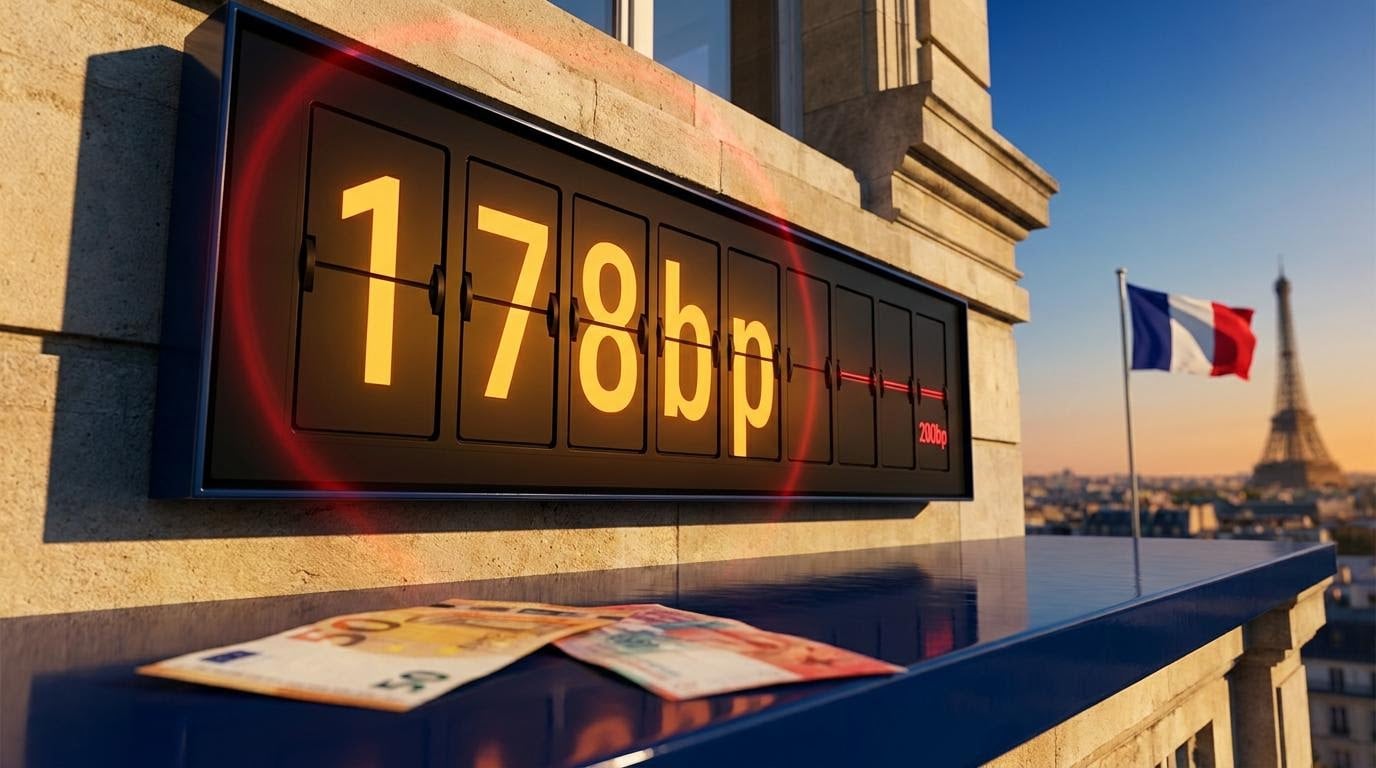
The French government now pays close to 5% to borrow for ten years, and the gap over German debt touched roughly 178 basis points this week, a level last seen during the euro crisis. On that evidence alone, you would expect the euro to be under heavy pressure. It has barely moved.
That gap, known as the OAT-Bund spread, usually works as a warning light for euro-area stress. Francesco Pesole of ING argued on 23 October 2026 that the warning has only been switched off temporarily. He identifies a “pain level” near 200bp, beyond which the link between French bonds and the euro could return quickly.
For anyone connecting rates markets to currency positioning, that matters. A quiet euro may simply mean the threshold has not been reached yet.
Here is a working framework for judging when French bond stress starts to matter for the euro, which currency pair shows it most clearly, and what would need to happen for EUR/USD to retest its 14 October low.
Why has a record-wide OAT-Bund spread barely moved the euro?
Start with how quickly the numbers rose. In early October, Reuters recorded the spread at 158.67bp, the widest since November 2011, with the French 10-year yield at 4.9937%, its highest since July 2002. By 20 October the spread had briefly eased to 152.5bp. Then the weekend riots of 17-18 October pushed it higher again.
ING puts the close at 174bp on 23 October, after a 178bp peak the previous day. Other reports place the high at about 177-178bp, so treat the exact figure with some caution. The 10-year OAT (the French government bond) closed near 5.04-5.05%.
For comparison, earlier political scares that rattled markets looked small.
| Episode | Spread level | Euro reaction |
|---|---|---|
| 2017 presidential election | Up to 78bp | Le Pen win risk linked to sharp euro fall |
| June 2024 snap election | 82-84bp | Euro weakened, but in an orderly way |
| December 2024 Barnier crisis | About 90bp | EUR/USD driven largely by US yields |
| October 2025 | About 88bp | No proportional euro collapse |
| October 2026 | 174-178bp | Limited; euro kept pace with G10 peers |
The pressure has come from several directions. Moody’s kept France at Aa3 with a negative outlook on 23 October, the 2027 budget faces a difficult path through parliament, and the unrest added a social risk premium. Even so, EUR/USD sat near 1.12 on 23 October, and the euro did not materially lag the other G10 currencies (the ten most heavily traded developed-market currencies).
ING’s read Despite the spread move, the euro’s link to France has weakened for now, according to Francesco Pesole.
ING’s argument is that the link is dormant rather than broken. The relationship is nonlinear, which means little reaction up to a threshold and a sharp repricing after it.
The headline number also exaggerates French deterioration. Bund yields fell 9bp while OAT yields rose 6bp, so a large share of the widening came from investors buying German debt as a safe haven. ING attributes part of the move to OATs’ higher sensitivity to global factors and to energy prices. Reuters, Moody’s and JPMorgan place more weight on the budget and on political fragmentation.
Analysts increasingly frame the premium as political-execution risk rather than default risk, since a stalled budget and heavy supply, not insolvency fears, explain why France now pays more than Italy despite carrying higher ratings.
For you, the point is that a wide spread on its own is not a signal to sell the euro. Before acting, ask what is actually driving the number.
When big ASX news breaks, our subscribers know first
How do sovereign spreads reach the currency market?
Asking that question requires a clear picture of what the spread measures and how it travels into currencies.
What a spread measures
A spread is the extra yield investors demand for holding one government’s debt instead of another’s. One basis point (bp) is one-hundredth of a percentage point, so 178bp means France pays about 1.78 percentage points more than Germany. German Bunds serve as the benchmark because the market treats them as the safest euro-area debt.
That makes the spread a price for risk. It can widen because French bonds sell off, or because Bunds rally while French bonds stay roughly where they were. This month brought some of both.
The five channels
Bond stress can reach the euro through five routes:
- Risk premium: higher French borrowing costs can weaken confidence in euro-area fiscal cohesion.
- Capital flows: money moves into Bunds, Treasuries, Swiss francs or dollars, weakening the euro.
- Bank-sovereign feedback: falling bond prices erode banks’ holdings and raise funding costs, which hurts growth and fiscal expectations.
- ECB policy: disorderly divergence makes it harder for a single interest-rate stance to work evenly across member states.
- Safe-haven demand: the Swiss franc and Bunds tend to gain together when European risk rises.
These channels can switch on and off. OMFIF data shows the average spread rose from 53bp before the June 2024 election to 74bp through October 2025, a persistent increase that never turned into a currency crisis. In November 2025, the ECB‘s Financial Stability Review found that spreads had widened on fiscal fundamentals while markets stayed liquid, with no clear contagion.
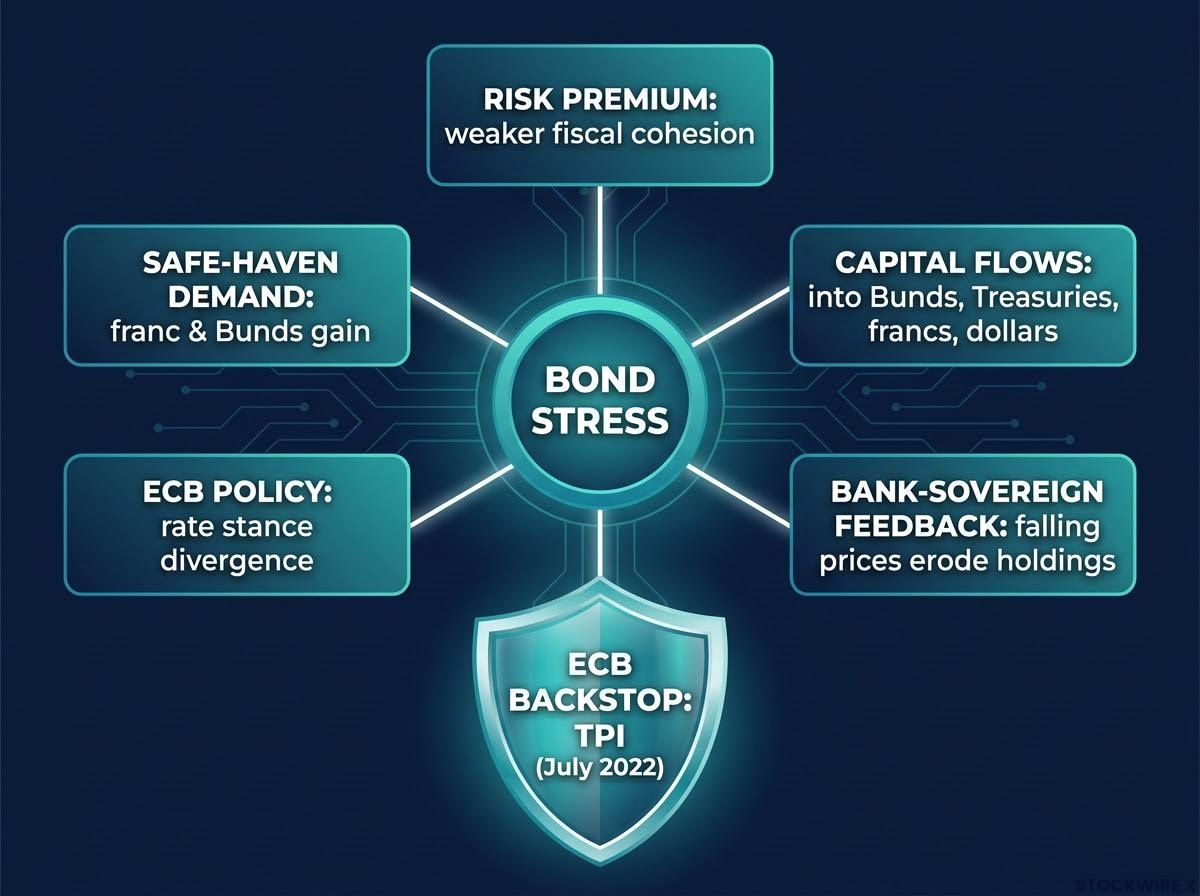
The reason is the ECB backstop. In July 2022 the central bank created the Transmission Protection Instrument (TPI), a tool that allows it to buy a country’s bonds in the secondary market when borrowing costs rise for reasons unrelated to that country’s fundamentals. It is not an unconditional guarantee, but it removes much of the fear of uncontrolled contagion. The 2017 episode shows the alternative: when an anti-euro outcome looked possible, spreads of only 78bp carried real currency risk.
Traders have already stripped roughly a quarter of a hike from ECB rate hike pricing since mid-September, showing that French stress is feeding into policy expectations even while the euro itself looks calm.
When reading any episode, identify which channel is active. Only some of them push the euro lower.
Why is EUR/CHF the cleanest read on European sovereign risk?
If the safe-haven channel is the one most likely to fire first, the instrument you watch matters.
EUR/USD responds to many inputs at once. US Treasury yields, Federal Reserve expectations, US inflation, global dollar demand and energy prices all move it. Reuters linked the pair’s slide around 14 October to US inflation expectations and the Fed’s rate path rather than to France, which shows how EUR/USD can fall while French risk stays stable.
EUR/CHF has fewer competing drivers. In European stress, the Swiss franc and Bunds usually benefit together, so the cross gauges sovereign anxiety more directly.
Swiss franc safe-haven status rests on deep FX liquidity and large SNB reserves, though EUR/CHF correlation with the euro means the franc hedges idiosyncratic European stress better than it hedges broad euro-area shocks.
| Feature | EUR/USD | EUR/CHF |
|---|---|---|
| Main drivers | US yields, Fed path, US inflation, dollar demand, energy | European risk appetite, safe-haven flows |
| Sensitivity to French stress | Indirect, often masked | Direct |
| Noise level | High | Lower |
ING describes EUR/CHF as the cleanest current expression of European sovereign risk. No verified EUR/CHF spot level was available for this week. The only directional evidence is a fall of about 0.49% over the week to 23 October, which points to euro weakness against the franc as the spread widened.
ING considers the euro unattractive overall, although it does not expect much further spread widening for now. In practice, EUR/CHF is the first place to look for French stress showing up in currency markets. EUR/USD gives a second, noisier read.
What would it take for EUR/USD to retest its 14 October low?
If EUR/CHF is the early warning, EUR/USD is where a wider move would appear. ING expects a quick retest of the 14 October low, which it rounds to 1.1120 (the intraday low was about 1.1113), if bond stress persists. With spot near 1.12, that leaves less than one cent of room.
The threshold ING’s Pesole flags a spread of roughly 200bp as the “pain level” at which the euro’s sensitivity to France could return quickly.
The conditions
A retest would most plausibly need these conditions, moving from French-specific to global:
- The spread pushing toward or through 200bp, with persistent or accelerating turmoil.
- Evidence that the 2027 budget cannot pass or cannot reduce the deficit credibly.
- Renewed social or political instability.
- A rating downgrade adding to that instability.
- Stable or rising US yields, firmer US inflation expectations, or renewed safe-haven demand for the dollar.
JPMorgan Asset Management argues that the main question is whether France can produce a credible 2027 budget before the elections, rather than the riots alone. The OAT-BTP spread, which compares French yields with Italian ones and reached 50bp, gives a secondary measure of how far France is being priced as a weaker credit.
A budget rollover is the outcome some analysts consider most probable, and it could push France’s 2027 deficit toward 6.0% of GDP, which would test the premise behind Moody’s current rating.
What could stop it
Several factors work against a retest. Moody’s held its rating on 23 October, which removed one immediate catalyst, although the negative outlook leaves the risk open. The agency’s rating assumes a deficit-reducing 2027 budget and some easing in funding costs and social tensions.
The TPI limits how far contagion can spread. Because Bund buying has exaggerated the spread, the headline figure overstates French stress. ABN AMRO said on 6 October that more than fundamental credit risk was already priced in, and it expected a 130-150bp range without a catalyst, narrowing to 120-130bp if uncertainty eases.
French stress alone has not been enough so far. A retest would most likely need it to coincide with a strong dollar, so you would need to track both together.
These statements are speculative and subject to change based on market developments. Past performance does not guarantee future results.
Reading bond stress and the euro together: what to monitor next
The framework has four parts. Check what is driving the spread, identify which transmission channel is active, use the right currency pair, and respect the 200bp threshold. A wide spread with Bunds doing most of the work and the ECB backstop in place is a very different signal from one driven by a failing budget.
Variables to watch:
- The spread relative to 200bp
- The direction of EUR/CHF
- Progress on the 2027 budget
- Moody’s negative outlook
- US yields and dollar demand
All data reflects conditions on 23-24 October 2026 and can change quickly. The decision is yours: either treat the euro’s calm as evidence of resilience, or treat it as a threshold that has not yet been tested.
This article is for informational purposes only and should not be considered financial advice. Investors should conduct their own research and consult with financial professionals before making investment decisions.