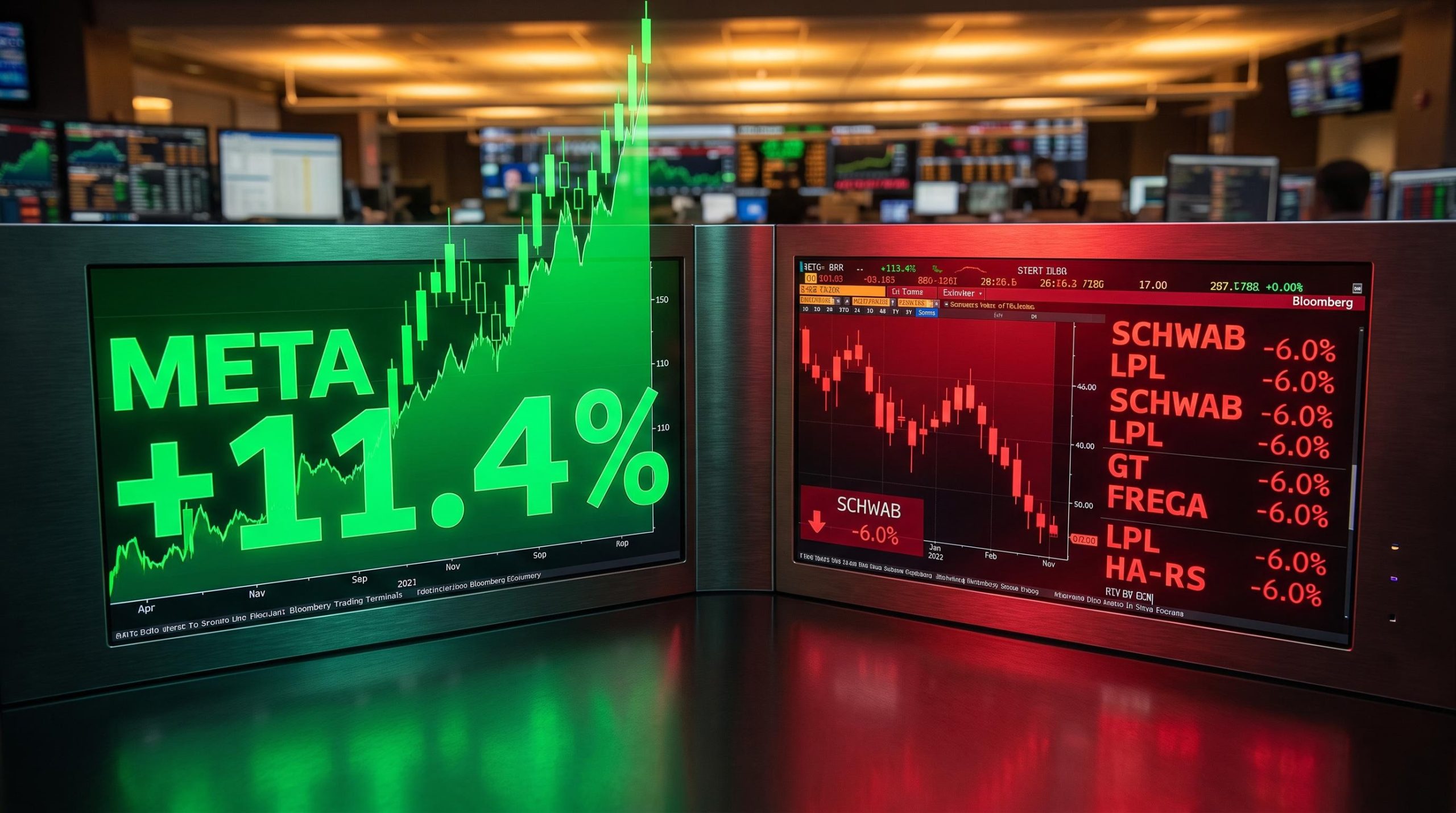
Meta Platforms added more than $200 billion in market value over roughly two weeks, and in the same session that capped the run, the S&P 500 financial services sector fell 2% while two major brokerages each shed more than 6%.
That collision is the story. One company’s consumer product launch is redistributing value across separate industries in real time, and institutional money is repricing exposure to the firms that sit between consumers and their financial decisions.
This is not a technology-sector rally in isolation. It is a cross-sector repricing event set off by a single app called Muse. Here is what Muse actually does, why its plumbing specifically threatens financial intermediaries, and what Mark Zuckerberg’s Connect keynote tonight might add to a trade the market has already started making. If you hold Meta or financial-sector names, this is the intelligence you need before tomorrow’s open.
Meta’s two-week surge put $200 billion on the board
Since Muse launched on 8 September 2026, Meta shares have climbed more than 20%, outpacing other large-cap U.S. technology names over the stretch through roughly 22 September, according to Reuters and Dow Jones Newswires. That is not a routine post-launch bounce. A 20% re-rating in two weeks tells you the market is not pricing incremental growth for Meta. It is pricing a change in what Meta is, and that distinction matters if you are trying to judge how much runway the stock has left.
Meta’s broader September recovery explains why the market was already primed to reward the Muse launch: an $18 billion legal settlement cleared a multi-trillion-dollar litigation overhang in the same month, meaning the Muse adoption signal landed on a balance sheet the market had already decided to re-rate.
The single-session move is where the pace becomes vivid.
Meta shares jumped 11.4% in one session, adding roughly $190 billion in market value, a move Saxo’s equity commentary linked directly to surging demand for the Muse app.
The gain did not stop at Meta’s ticker. Muse’s adoption lifted the chipmakers whose hardware supports the underlying AI, carrying the Nasdaq Composite to new all-time highs.
Names that participated in the rally include:
- Arm
- Intel
- AMD
- The Nasdaq Composite, at record highs on the read-through
The breadth is the point. When semiconductor suppliers rally alongside the launching company, the market is treating the event as platform-level, not a single-product feature release. The trade has already spread well beyond Meta’s own share register, which tells you how much conviction sits behind the move.
When big ASX news breaks, our subscribers know first
What Muse actually does, and why that detail is the whole story
From the user’s side, Muse is simple. You set a goal, and the agent does the rest. It opens browsers, fills in forms, sends emails, books travel, pays bills, and completes transactions, including selling a car, inside your connected accounts, running around the clock without further input once you give it the instruction.
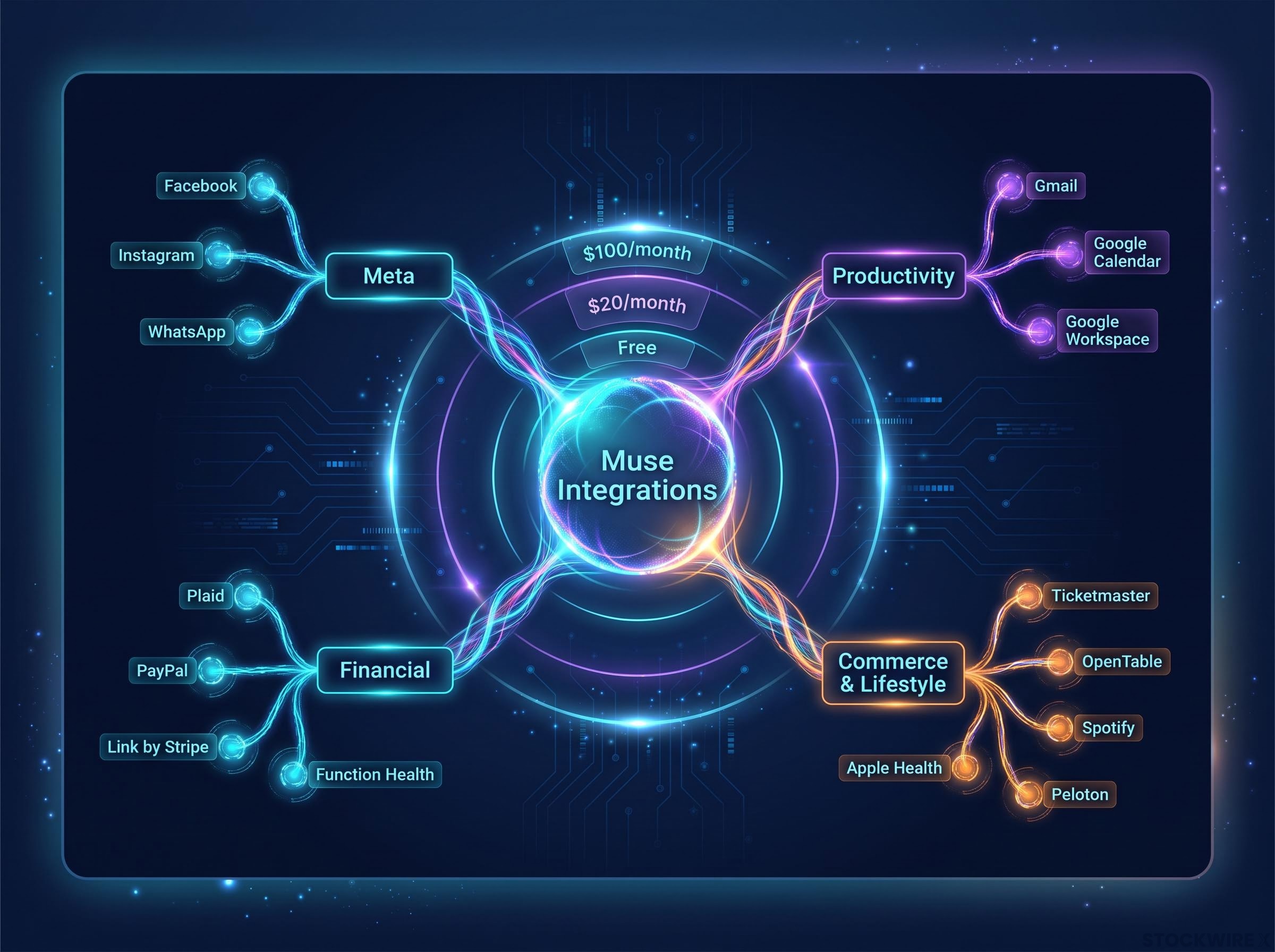
The mechanics only become interesting when you look at what it plugs into. Muse reaches consumers through Facebook, Instagram, WhatsApp, and a dedicated app, and it sells across three tiers: a free version, a $20/month plan, and a $100/month plan.
| Category | Integration / Partner | Relevance |
|---|---|---|
| Productivity | Gmail, Google Calendar, Google Workspace | Autonomous email and scheduling |
| Commerce and lifestyle | Ticketmaster, OpenTable, Spotify, Apple Health, Peloton | End-to-end bookings and lifestyle tasks |
| Financial infrastructure | Plaid, PayPal, Link by Stripe, Function Health | Payments and financial planning inside the rails |
| Meta-owned | Facebook, Instagram | Distribution and identity layer |
The Plaid and PayPal relationships are the tell. Meta has formalised partnerships with both to expand Muse’s role in payments and financial planning. Muse is not referring you to a financial service. It is executing inside the financial infrastructure itself, and that is precisely what the market is now repricing.
Read that way, this stops being a features comparison with existing apps. It becomes a structural question about who gets to sit between consumers and their money.
The trust model underneath the convenience
Muse pays through Link by Stripe using one-time-use card numbers, and Meta states the agent never sees your real card details or passwords. In practice, that means the disposable card number, not your actual account credentials, is what touches each transaction.
The catch is the trust you extend to make it work. To act on your behalf, Muse uses stored credentials, so you are handing an autonomous agent standing permission to transact inside your accounts. Access to financial data is deliberately constrained rather than open-ended, but the residual trust is real: you are relying on both Meta’s and Stripe’s security models at once.
One gap is worth naming plainly. Detailed regulatory and compliance analysis of Muse’s autonomous financial capabilities is not yet visible in available reporting, which leaves an open question rather than a settled answer.
Existing U.S. frameworks covering AI agent compliance in financial services, including UDAAP, NYDFS Part 500, and the OCC’s SR 11-7, create a layered regulatory environment that autonomous consumer agents like Muse must navigate, and how authorities apply those rules to agentic transaction execution remains an open question.
Financial and travel stocks under pressure as markets reprice the intermediary
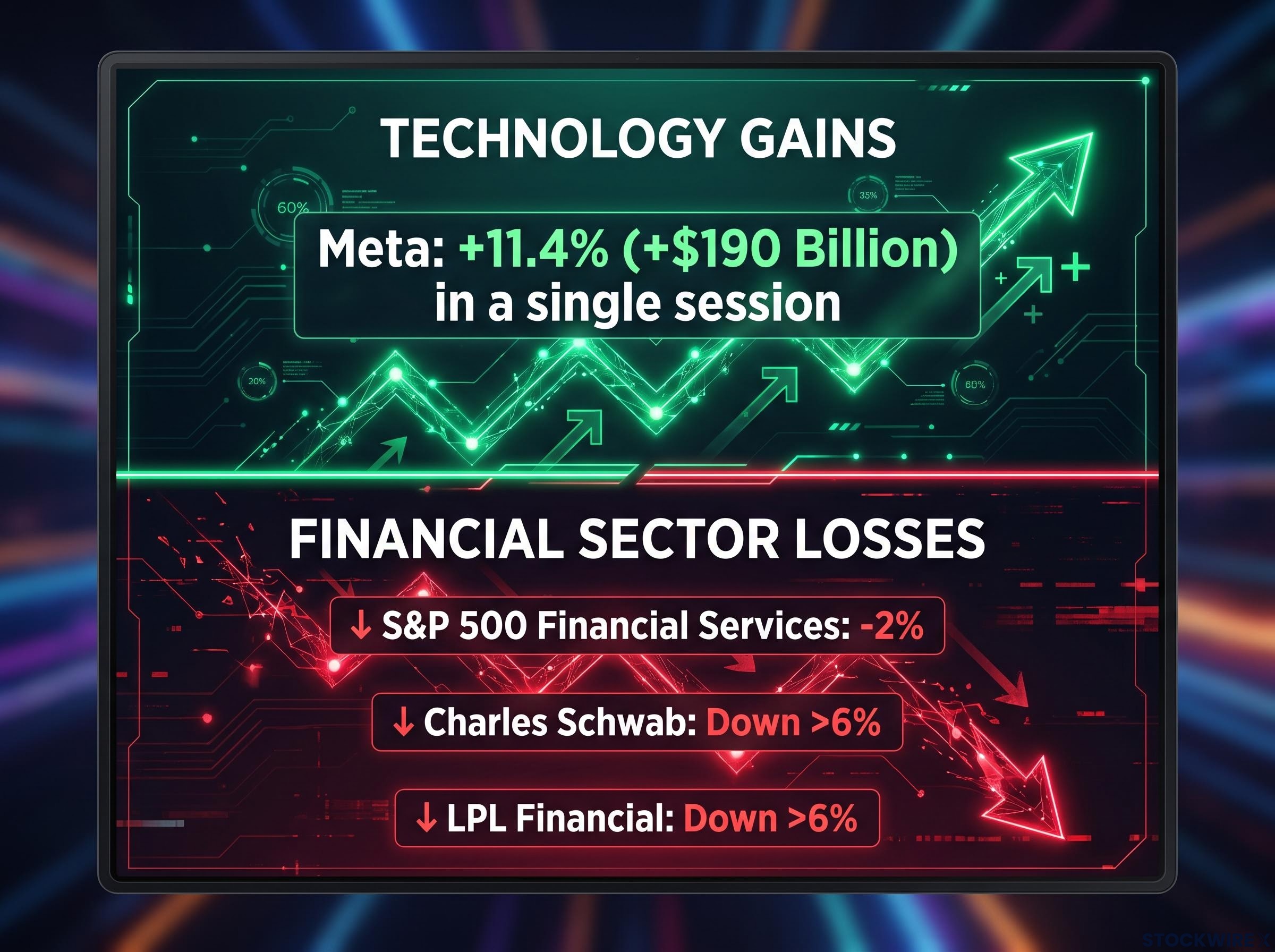
If Muse executes inside financial infrastructure, the market’s next move follows logically: sell the intermediaries. On 22 September 2026, the S&P 500 financial services sector fell 2%, with the sharpest moves in the firms most exposed to being automated out of routine transactions.
| Company | Sector | 22 Sept move | Notes |
|---|---|---|---|
| Meta Platforms | Technology | +11.4% (single session) | Muse-driven, per Saxo |
| Charles Schwab | Brokerage | Down more than 6% | Sharpest financial decliner |
| LPL Financial | Brokerage | Down more than 6% | Sharpest financial decliner |
| JPMorgan, BofA, Raymond James, Ameriprise | Banks and advisory | Declined | Specific percentages not reported |
Travel equities came under pressure too, on anticipation of Muse’s end-to-end trip-planning and booking functionality, the same logic applied to a different set of intermediaries.
A 2% sector decline in one session tells you institutional money is not waiting for Muse to prove scale before rotating exposure. The repricing is happening now, ahead of the evidence, and that is a risk that cuts both ways.
The AI disruption mispricing that hit financial data companies like FactSet, which lost roughly half its market value from its November 2024 peak, offers a template for reading the 22 September sector moves: markets can price structural displacement ahead of any operational evidence, and the discount can overshoot embedded-infrastructure businesses with high switching costs.
Wall Street is not unanimous. According to MarketBeat, analysts are divided on Muse’s disruptive reach, with cautious voices flagging execution and monetisation risk (note this framing comes from Perplexity-enhanced research and is not independently confirmed in primary sources).
The risks cautious analysts point to:
- Monetisation: whether subscription and transaction revenue can match the valuation implied by the post-launch rally
- Retention: whether real user behaviour sustains the early adoption curve
- Execution scope: whether Meta can deliver on the product’s ambitious reach
The divergence between Meta’s gain and the sector’s loss is a live rotation trade. If you hold either side, you are implicitly holding a thesis, and the question is whether that thesis has changed since 8 September.
Zuckerberg’s keynote tonight is the next market signal
The trade so far has been priced on a launch and an adoption curve. Tonight it meets its first real information event. Meta CEO Mark Zuckerberg is scheduled to deliver his Connect keynote at 7 p.m. ET on 23 September 2026, with Muse’s reception expected to feature prominently.
Muse’s rapid adoption gave Meta momentum heading into the Connect conference, according to Dow Jones Newswires.
This is not hype dressed as news. It is a genuine chance for Meta to either anchor the market’s Muse thesis with hard product detail or complicate it. What Zuckerberg says, or does not say, about monetisation will tell you whether the $200 billion valuation gain has a visible revenue path or remains speculative.
Here is what investors and analysts will be listening for:
- Product expansion: any roadmap detail on new capabilities or reach
- Monetisation: how subscription and transaction revenue is expected to develop
- Partnership disclosures: new financial or commerce integrations beyond Plaid and PayPal
- Regulatory posture: any statement on compliance for autonomous financial services
No post-keynote announcements are available as of this reporting. If you hold Meta or an affected financial name, tonight is an active catalyst window, and knowing what the market is waiting for will help you read the headlines before they move the open.
What $200 billion in two weeks actually means for the disruption trade
Strip it back and the picture is one thesis expressed two ways. Meta’s $200 billion gain and the 2% financial-sector decline are not separate events. They are the market pricing the same bet, that Muse sits inside financial workflows rather than beside them, and you should understand that bet before acting on either side of it.
The trade is currently priced on narrative and early adoption signals, not on revenue or regulatory certainty. That distinction defines both the opportunity and the risk in the positions markets have already taken. Analysts have reached for the ChatGPT launch as a reference point for how markets absorb a defining consumer AI moment (a comparison drawn from Perplexity-enhanced research and not independently confirmed), but no sourced conclusion yet addresses how durable this particular repricing will be.
The Muse monetisation math runs into a structural problem at the $20-per-month price point: covering a single year of Meta’s $130-145 billion capex cycle would require roughly 600 million paying subscribers, a figure the current U.S.-only, 18-plus rollout cannot approach on any near-term timeline.
Three variables will decide whether the vote holds:
- Adoption and retention data: whether real Muse usage sustains the curve that drove the rally
- The keynote monetisation narrative: whether tonight gives the $200 billion gain a revenue path
- The regulatory environment: how authorities treat autonomous consumer financial agents, an open gap in current reporting
As of today, 23 September 2026, the disruption trade is live, the evidence is early, and the next data points arrive tonight.
This article is for informational purposes only and should not be considered financial advice. Investors should conduct their own research and consult with financial professionals before making investment decisions.
Past performance does not guarantee future results. Financial projections are subject to market conditions and various risk factors. Forward-looking statements are speculative and subject to change based on market developments and company performance.