The Czech koruna has weakened this month, and the loudest political fight in Prague looks like the obvious explanation. The economist most closely quoted on the issue disagrees. Commerzbank’s Tatha Ghose says the immediate effect of the public-media funding dispute on the currency should be small, even as protests fill city squares.
That tension matters. On 24 October 2026, the Chamber of Deputies passed the first reading of a bill to scrap television and radio licence fees and fund the public broadcasters from the state budget instead. The vote came in an overnight sitting. Demonstrations followed in Prague and Brno.
More is on the way: a broadcaster strike on 3 November and a larger Prague demonstration on 15 November. If you track Central and Eastern European (CEE) currencies, you need a way to separate political noise from market signal.
This piece gives you a working test for when domestic politics starts to price into a currency, applied to the Czech case. It also flags the triggers that would turn a small koruna risk premium into a larger one.
What the Czech media funding bill actually changes, and where it stands
The procedure drew the crowds. The money involved is modest.
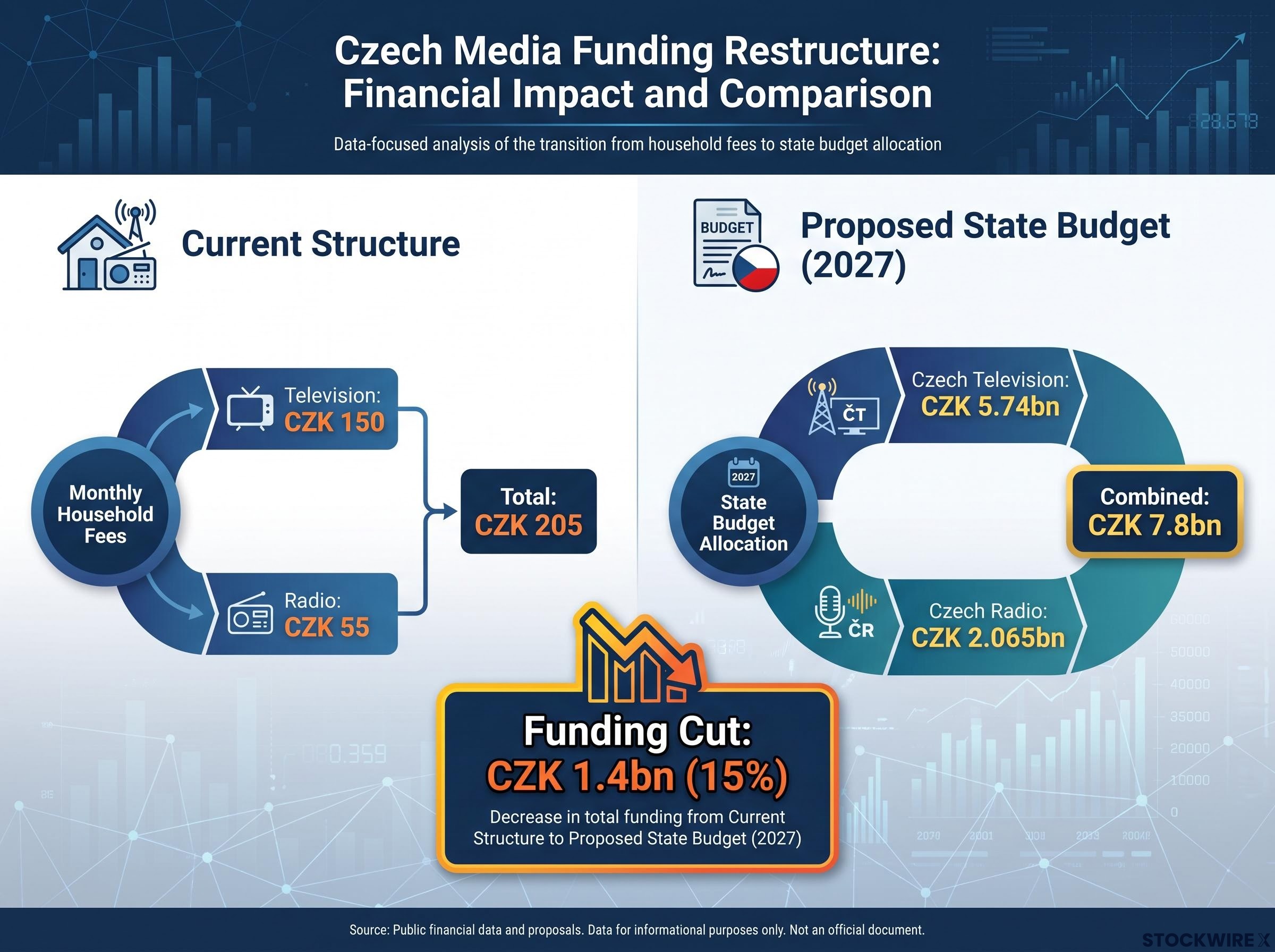
Czech households currently pay CZK 205 a month: CZK 150 for television and CZK 55 for radio. The bill abolishes that fee and funds both broadcasters directly from the state budget. Czech Television would receive about CZK 5.74bn and Czech Radio CZK 2.065bn, a combined CZK 7.8bn. That total sits roughly CZK 1.4bn (15%) below the comparison funding level, with the cut expected from 2027.
The cut alone would not have triggered street protests. The process did. The coalition gave the bill priority on 23 October and pushed the first reading through under an urgent procedure in the early hours of Saturday 24 October, with little warning and limited debate.
| Government position | Critics’ position |
|---|---|
| Removes a recurring household charge and places financing under normal budget accountability | State-budget dependence hands the governing majority leverage over funding |
| The EU does not require any single funding model | IPI and EBU cite Article 5(3) of the European Media Freedom Act, which requires predictable, adequate funding |
| Legal guarantees protect editorial independence | A 15% annual cut could impair journalism and new services |
| A cost and accountability reform, not media control | The overnight procedure limited scrutiny and consultation |
The protest calendar so far:
- 23-24 October: several hundred outside Parliament overnight
- 24 October: thousands in Brno
- 25 October: several thousand in Prague’s Old Town Square
- 3 November: full-day strike by Czech Television and Czech Radio staff
- 15 November: larger Prague demonstration announced
That calendar is the point. The political tension has fixed dates, so you should expect fresh headlines to keep arriving whether or not the currency reacts.
Where the legislative process goes next
The bill still needs further Chamber of Deputies votes and Senate approval, and the opposition says it will keep challenging it. As of today, no date for the second reading or final Chamber vote has been reported.
When big ASX news breaks, our subscribers know first
What is a koruna risk premium, and how does domestic politics build one?
A political risk premium is the extra return investors demand for holding a country’s assets because of domestic political or institutional uncertainty. For the koruna, it shows up as investors wanting more compensation to own Czech bonds or hold the currency itself.
The FXStreet report on Commerzbank’s view notes that the proposed abolition of licence fees and the fast-tracked passage of the bill could lift the koruna’s risk premium gradually, not through an immediate shock.
A CZK 1.4bn funding change can matter even though it is fiscally small, because it can shift how investors judge institutions. The research points to four channels:
- Institutional credibility: investors treat a normal funding change differently from one rushed through that weakens an institution’s predictable financing.
- Fiscal credibility: earmarked fees give way to annual discretionary allocations, making funding depend on yearly government decisions.
- EU-law and EU-funds risk: a clash with Brussels under the European Media Freedom Act would matter as evidence of wider governance slippage, not because of the fee’s size.
- Broader confidence: politics matters more if it persists long enough to alter capital flows or fiscal expectations.
Ghose’s assessment, reported by FXStreet on 28 October, sets the baseline.
Commerzbank’s read The immediate koruna effect should be small, but continued protests, institutional conflict and doubts over media independence could gradually add to the domestic political risk premium over coming quarters.
The International Monetary Fund’s (IMF) 2026 Article IV assessment offers a general backdrop: political interference in independent institutions can undermine confidence and raise the risk of policy mistakes. That was not a verdict on this bill.
Why the effect is cumulative, not mechanical
A one-off funding change does not move a currency much. A pattern does. Commerzbank’s logic is that rushed procedure, demonstrations and an institutional confrontation can together raise the compensation foreign investors demand, and that the long-run effect depends on how freely Prime Minister Babiš can carry out the plan.
The scale caveat holds. The direct fiscal sum is modest relative to Czech GDP and sovereign-market liquidity, so the likely outcome is a marginal premium, not a crisis.
Note the thin evidence base too. Ghose’s view is the principal bank assessment available; ING, Erste and ČSOB had no accessible quantified notes by 28 October. A premium builds through accumulated signals about policy predictability, so judge this dispute by its trajectory, not by any single headline.
Why the koruna’s recent slide looks like a EUR/USD story
If the media fight is only a slow-burn factor, what has moved the koruna this month? Check the euro first.
Two separate stories are running at once: the koruna weakening against the euro, and the euro weakening against the dollar. Ghose reads the recent koruna move as mostly the second, with EUR/USD falling to its lowest level since mid-2025.
The policy-rate gap helps explain the euro weakness against the dollar: a 125-150 basis point spread favouring US assets, plus stagflation risk in the Eurozone, keeps EUR/USD suppressed and drags on EUR-linked currencies such as the koruna.
| Measure | Level | Source and date |
|---|---|---|
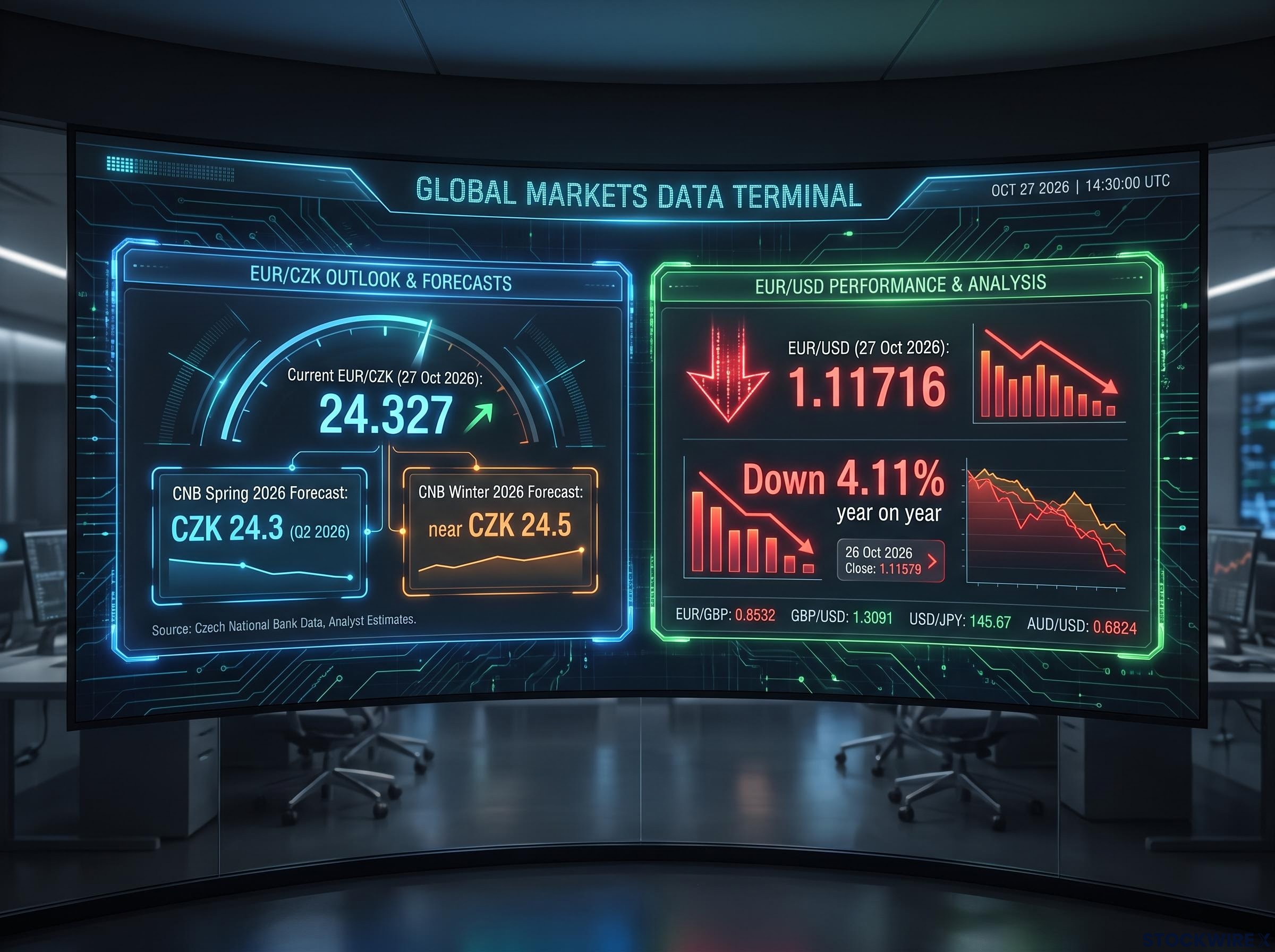
| EUR/CZK | 24.327 | EU Official Journal reference rate, 27 Oct 2026 |
| EUR/USD | 1.11716 (down 4.11% year on year) | Trading Economics, 27 Oct 2026 |
| EUR/USD close | 1.11579 | XE, 26 Oct 2026 |
The Czech National Bank’s (CNB) own forecasts frame the level. Its Spring 2026 report put the koruna around CZK 24.3 per euro in Q2 2026, and its Winter 2026 report said it could weaken slightly and stay near CZK 24.5. The current reading of 24.327 sits inside that range.
The CNB’s driver list also leaves the dispute out:
- Global uncertainty
- Energy-import costs
- External demand
- Inflation
- Interest-rate differentials
- The external balance
The media dispute does not appear. For you, the lesson is that pinning a currency move on the loudest local story is a risk. Checking the dollar and euro backdrop first is the sounder habit.
When does institutional friction start to move a currency? Lessons from Hungary and Poland
Regional history suggests institutional disputes become market events when they touch money, specifically EU money and fiscal credibility.
Regional context matters here, because the CEE currency outlook shows the koruna, zloty and forint each responding to different mixes of energy exposure, policy divergence and fiscal trajectory, which is why a single local headline rarely explains a move.
- Hungary, December 2022: the European Commission moved to withhold about €7.5bn, and the forint weakened, according to Reuters.
- Hungary, 2026: hopes of improved fiscal credibility and an EU and euro roadmap helped the forint, with ten-year yields falling from 7.52% to 6.21% in the week Euronews described.
- Poland: the Commission and Reuters linked rule-of-law and media pluralism concerns to uncertainty over EU recovery funds.
- Slovakia: no specific precedent tying a public-media dispute to a measurable currency move was found.
The Hungarian pair is the instructive one. Markets punished an EU-funds freeze and later rewarded institutional and fiscal repair, which shows the premium can move in both directions. Neither episode was a standalone broadcaster-financing row.
The general lesson Institutional conflict alone rarely moves a currency much. Effects grow when it links to EU-fund suspensions, fiscal deterioration, central-bank credibility, rating concerns or a sustained loss of investor confidence.
That gives you a checklist. These signals would turn Czech friction into a larger premium:
- EU-funds action or formal EU proceedings tied to the bill
- Signs of broader fiscal deterioration
- Concerns over CNB credibility
- Rating agency commentary citing governance
- Sustained protests combined with further procedural confrontation
Without a link to EU money or fiscal credibility, a media dispute rarely moves a currency much. That is the line to watch.
Reading the koruna through the November calendar and beyond
The evidence so far points in one direction: a small immediate effect, with EUR/USD driving the near-term moves. A gradual premium could build over coming quarters if the friction persists.
Your watch list is concrete: the 3 November strike, the 15 November demonstration, the second-reading date, Senate handling, any EU response under the European Media Freedom Act, and the next CNB report. Bear in mind that no quantified bank estimates beyond Commerzbank’s are currently available.
The practical step is to separate dollar-driven koruna moves from politics-driven ones, then revisit the assessment as evidence builds. If EU funds or fiscal credibility enter the story, the calculation changes.
These statements are speculative and subject to change based on market and political developments. Past performance does not guarantee future results.
This article is for informational purposes only and should not be considered financial advice. Investors should conduct their own research and consult with financial professionals before making investment decisions.