When AI stocks tumbled last week, the expected reflexes did not play out. Some commentators assumed a tech rout would send investors running to the greenback as a haven. Others assumed foreign selling of US shares would drag the currency down. Instead, Treasuries rallied and the US Dollar Index (DXY) slipped below 102, even after a hot September inflation print that should have helped it.
That gap has split currency strategists. Brown Brothers Harriman’s (BBH) Elias Haddad expects the dollar to recover, arguing that a dollar AI stock sell-off can push foreign money into Treasuries rather than out of the US. ING’s Francesco Pesole counters that the dollar’s haven appeal has taken real damage.
The calendar will test both views quickly. October flash PMIs land on Friday, and futures markets price a Federal Reserve pause on 28 October and a hike on 9 December.
Here is which flow actually moves the dollar, why the early evidence leans one way, and which data this week could settle the argument.
Why does the dollar follow Treasury flows rather than equity flows?
Haddad’s core claim runs against intuition. Selling US stocks does not automatically weaken the dollar.
BBH’s historical read According to Haddad, the US dollar has historically moved with net foreign purchases of US Treasuries and opposite to net foreign purchases of US equities.
If that pattern holds, the size of foreign equity selling matters less than where the proceeds go next. Four mechanics explain why:
The scale of foreign ownership of US equities, now more than half of foreign portfolios, means any sentiment reversal hits stock prices harder than in past cycles, which raises the stakes for where the proceeds go.
- Embedded dollar exposure. A foreign investor buying an unhedged US stock usually buys dollars to do it. Selling and sending the money home means selling those dollars.
- Rotation keeps money in dollars. If the investor sells shares and buys Treasuries, the cash never leaves dollar assets, and the equity outflow can be offset or exceeded.
- Hedging mutes the spot effect. Investors who hedge their currency exposure through forwards or swaps (contracts that lock in a future exchange rate) never created much spot dollar demand on the way in, so selling may not create much dollar selling on the way out.
- The shock’s source decides haven status. A global growth scare tends to lift demand for US liquidity. A shock rooted in US assets or US credibility can produce Treasury buying while the dollar falls.
That last point draws the line between a Treasury haven and a dollar haven. They often coincide, but they do not have to.
The most recent Treasury International Capital (TIC) data, released by the US Treasury on 16 October, shows the scale of foreign appetite in August. These figures are reported but not independently confirmed.
| August 2026 net foreign purchases | Amount |
|---|---|
| US Treasuries | $108.9bn |
| US equities | $131.9bn (vs -$10.6bn in July) |
| All long-term US securities | $300.7bn |
| Total net TIC inflow | $199.8bn |
The caveat matters: August predates the sell-off, so it cannot show how foreigners behaved during it. Structural hedging also complicates the picture. Reuters reported in September 2025 that international investors were raising hedge ratios on US holdings, while JPMorgan strategists said allocations persisted for liquidity and benchmark reasons.
If you hold or track dollar exposure, the lesson is to watch where foreign money lands after it sells equities, not simply whether it leaves.
When big ASX news breaks, our subscribers know first
What did markets actually do during the AI rout?
The sequence started in equities and spread to bonds and currencies within days.
The market moves
AI-linked shares sold off as investors questioned the circular financing behind data-centre construction and whether heavily leveraged operators could earn enough to service their debt. The knock-on moves, as reported and not independently confirmed, looked like this:
- 10-year Treasury yield: down about 12.6bp to 5.064% on 15 October, with another Reuters report citing a roughly 10bp fall to 5.08%
- DXY: down 0.17% to 101.87 on 16 October, about 0.35% lower on the week, retreating from an 18-month high after briefly trading near 103 following the CPI release
- September Consumer Price Index (CPI): headline up 0.6% month on month and 3.7% year on year; core up 0.3% against a 0.2% consensus, and 2.6% year on year
Bond buyers showed up in force. The dollar did not benefit, despite inflation data that strengthened the case for Fed tightening.
The dollar fell while Treasuries rose, which tells you the rate channel overwhelmed the safe-haven channel this time. You should not assume the two move together.
The competing readings
Strategists read the same moves very differently.
| Analyst | View | Reasoning |
|---|---|---|
| Francesco Pesole, ING | Dollar vulnerable | AI volatility drove a sharp fall in front-end US rates; the dollar could lag other G10 currencies if instability starts in US tech |
| Reuters currency commentators | Dollar vulnerable | Lower rate expectations outweighed the usual haven bid, producing Treasury buying and dollar selling |
| Elias Haddad, BBH | Dollar supported | US growth outperformance and returning Treasury inflows could outweigh weaker equity demand |
Pesole’s warning came with a limit. ING did not see the start of a major structural dollar bear trend, only a dent in haven performance. For now, the early evidence favours the sceptics, which keeps the BBH call honest.
How do history and Fed expectations test Haddad’s call?
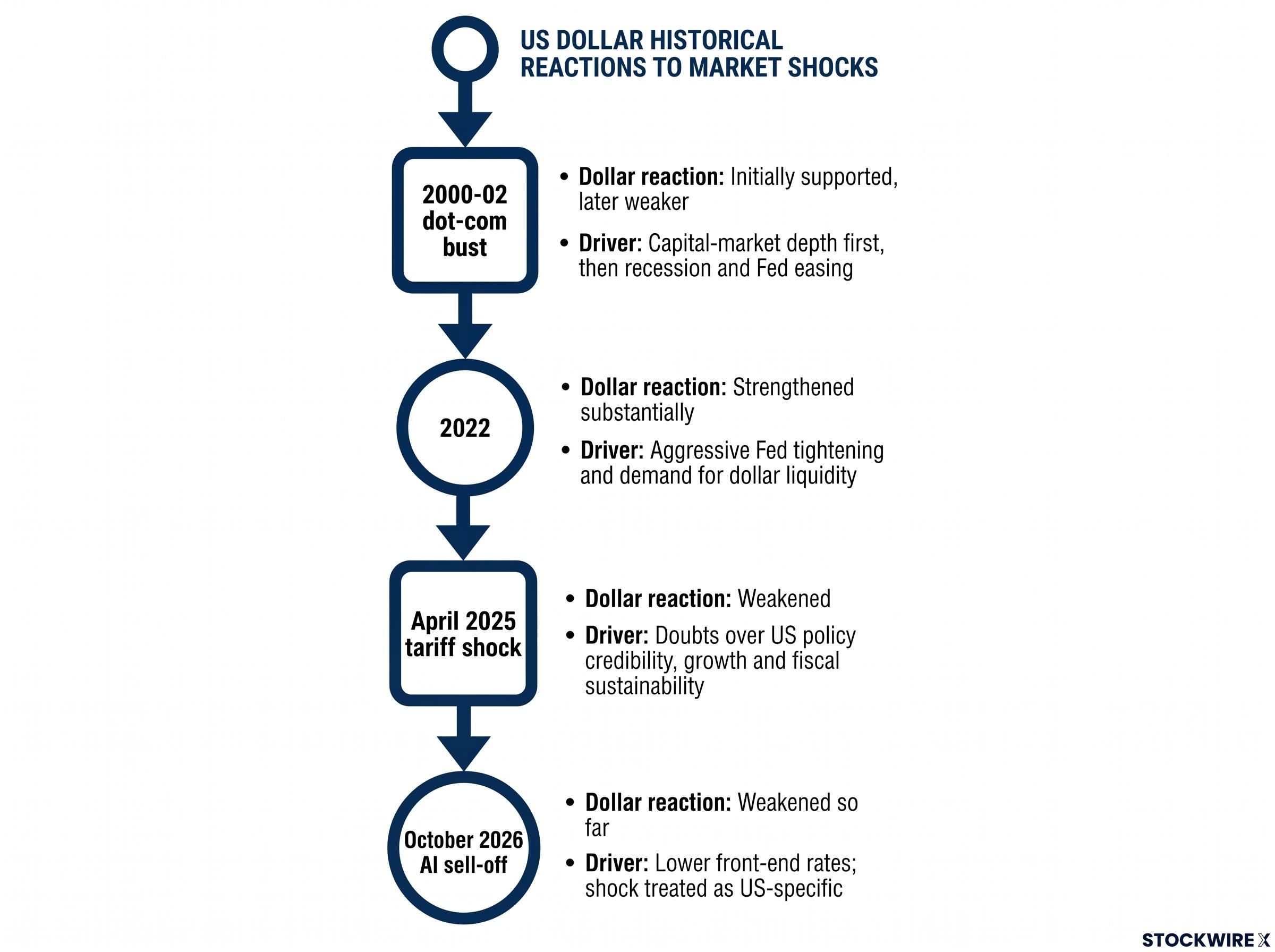
Precedent offers both camps something to point at.
| Episode | Dollar reaction | Driver |
|---|---|---|
| 2000-02 dot-com bust | Initially supported, later weaker | Capital-market depth first, then recession and Fed easing |
| 2022 | Strengthened substantially | Aggressive Fed tightening and demand for dollar liquidity |
| April 2025 tariff shock | Weakened | Doubts over US policy credibility, growth and fiscal sustainability |
| October 2026 AI sell-off | Weakened so far | Lower front-end rates; shock treated as US-specific |
The current episode so far rhymes with April 2025 more than 2022. In 2022, rising US yields carried the dollar. Last week, yields fell and markets treated the shock as a US problem, which is the template Haddad needs to break.
In 2022, rising US yields carried the dollar because rate differentials, growth outperformance and reserve-currency demand all pointed the same way, a combination that was missing last week when front-end yields dropped.
That makes the Fed path the swing factor. CME-based reporting put October hike odds near 54% right after the CPI release, up from about 22% before, according to unconfirmed figures. Four officials then pulled that back below 20%:
- Michelle Bowman, Vice Chair for Supervision: no urgent need to move again; time is needed to assess the last action
- John Williams, New York Fed: one more hike this year could be appropriate and might be sufficient
- Christopher Waller, Fed governor: more hikes likely needed, but flexible on timing
- Mary Daly, San Francisco Fed: no urgency in October, with a stable jobs market giving room to focus on inflation
Reuters summarised the comments as largely washing out October pricing while cementing December. A 25bp hike on 9 December, taking the target range to 4.00%-4.25%, remains fully priced.
BBH’s interpretation Patient Fed officials and a still-strong US economy make an October hike less likely, while a firm October PMI could reinforce the December path and support a dollar recovery.
A firm December hike path is what keeps yields supportive for the dollar. Treat Fed pricing as the second leg of Haddad’s argument, not an aside.
Past performance does not guarantee future results. Market pricing and analyst projections are subject to change with economic data and policy developments.
What could break the rotation thesis, and what to watch this week?
Haddad’s case has several pressure points. The strongest objections are:
- Faster Fed easing. If the sell-off becomes a growth scare, lower front-end yields would erode the dollar’s carry advantage even as Treasuries rally.
- Term-premium and fiscal worries. If the AI boom is tied to heavy corporate borrowing or deficit concerns, investors could sell both stocks and long-dated Treasuries, weakening the rotation channel.
- Structural hedging. Selling equities while closing a currency hedge is not a straightforward spot dollar sale, so old correlations may no longer hold.
- Fed independence. If political pressure is seen to weaken the Fed, the dollar can fall even while yields rise, one reason April 2025 broke the usual pattern.
- US-specific shocks. A shock centred on US tech, policy or fiscal credibility can favour the yen, Swiss franc, euro or gold over the dollar.
The upside case is simpler. If markets read the slide as a valuation correction without wider economic damage, sticky inflation could keep the Fed hawkish and support the dollar through higher yields.
Friday’s flash Purchasing Managers’ Index (PMI) data, a survey-based gauge where readings above 50 signal expansion, is the first real test. Consensus figures from CME Group/Econoday are reported but unconfirmed.
| Measure | October consensus | September final |
|---|---|---|
| Composite | 57.6 | 58.4 |
| Manufacturing | 55.5 | 57.0 |
| Services | 58.0 | 58.7 |
A print near consensus keeps the growth-advantage leg of the BBH call intact. A sharp miss tells you the Fed-easing channel is gaining ground. The watch calendar runs in this order:
- Friday 23 October: October flash PMIs
- 28 October: Federal Open Market Committee (FOMC) decision, with hike odds below 20%
- Ongoing: whether foreign Treasury inflows return in coming TIC releases
- 9 December: FOMC decision, with a 25bp hike fully priced
These scenarios are speculative and subject to change based on market developments.
Reading the dollar through the next Fed and flow signals
The dollar’s response to the tech slide comes down to three questions. Do foreign sellers of US shares become buyers of Treasuries? Does the Fed hold its December hike path? And do markets see the shock as a US problem or a global one?
So far, the evidence leans against Haddad. Yields fell, the dollar softened, and the reaction resembled April 2025 rather than 2022. Yet the thesis remains testable, and this week supplies the first verdict.
Rather than picking a side, track three signals: foreign flows into Treasuries, front-end yields as Fed pricing shifts, and Friday’s PMIs against consensus. If all three firm up, the rotation case strengthens. If they weaken together, the sceptics hold the argument.
Investors exploring whether foreign inflows can keep absorbing supply will find our full explainer on who buys US debt, including the record role of domestic banks.
This article is for informational purposes only and should not be considered financial advice. Investors should conduct their own research and consult with financial professionals before making investment decisions.