China’s economy grew 4.5% in the third quarter, a touch ahead of the 4.4% consensus. Yet urban fixed-asset investment is down 7.2% for the year so far, and retail sales adjusted for inflation have barely moved. What kind of growth sits comfortably alongside numbers like those, and what does it mean for the yuan outlook?
The figures landed on 19 October 2026, and they matter beyond China’s borders. How you read them shapes two judgements: whether Beijing will reach for a large stimulus package, and how quickly the yuan can climb against the dollar and the currencies of China’s trading partners.
The headline and the detail point in different directions. That gap is where the useful information sits.
Here is a way to test any growth headline against the domestic indicators beneath it, and a reasoned case for why the yuan’s gains are likely to stay gradual rather than sudden.
Why does 4.5% growth sit so uneasily with weak investment and flat retail sales?
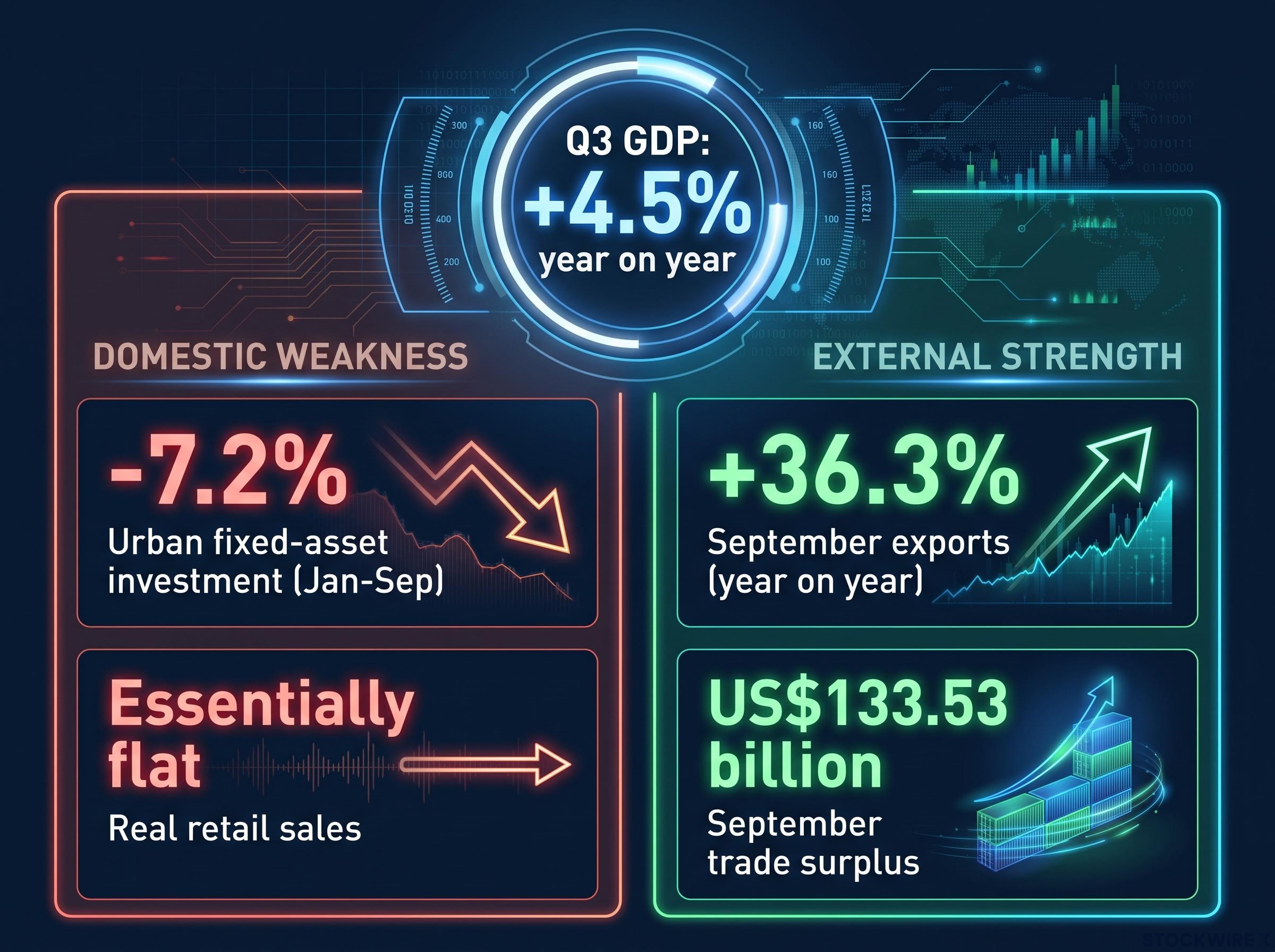
Start with the headline. Real GDP rose 4.5% year on year in Q3, up from 4.3% in Q2, taking growth for the first nine months to 4.6%.
Now add the domestic side. Urban fixed-asset investment, which tracks spending on factories, infrastructure and property, fell 7.2% from January to September, the same pace of decline recorded through August. Nominal retail sales rose 1.1% in September (from 0.4% in August) and 2.6% across the nine months, but once prices are stripped out, real retail sales are essentially flat.
Investment shrinking. Shoppers standing still. Growth accelerating.
| Indicator | Figure | What it signals |
|---|---|---|
| Q3 GDP (y/y) | +4.5% | Headline beat versus 4.4% consensus |
| Urban fixed-asset investment (Jan-Sep) | -7.2% | Ongoing contraction in capital spending |
| Nominal retail sales | +1.1% Sep; +2.6% Jan-Sep | Soft household spending |
| Real retail sales | Essentially flat | No volume growth in consumption |
| September trade surplus | US$133.53 billion | External demand carrying the economy |
Volkmar Baur of Commerzbank openly asked where the growth came from. Reuters offered the most direct answer: mainly exports, with consumers still hesitant. September exports jumped 36.3% year on year while imports rose 31.0%, leaving a surplus large enough to lift the whole economy’s arithmetic.
The IMF’s warning Krishna Srinivasan of the International Monetary Fund (IMF) described China as “teetering on deflation” on 15 October 2026.
So the puzzle is less about fabricated output and more about composition. An export surge, falling prices and timing effects can produce a respectable GDP figure while households and builders stay cautious. What this tells you is that the 4.5% is a reading on factories and trade, not on domestic strength.
When big ASX news breaks, our subscribers know first
Why Beijing is unlikely to add major stimulus
The natural assumption is that weak domestic demand forces a big response. Baur draws the opposite inference: Beijing appears content with the headline result, so large additional stimulus looks improbable, and he treats the growth data as of secondary relevance for the near-term currency view.
Several factors support that restraint:
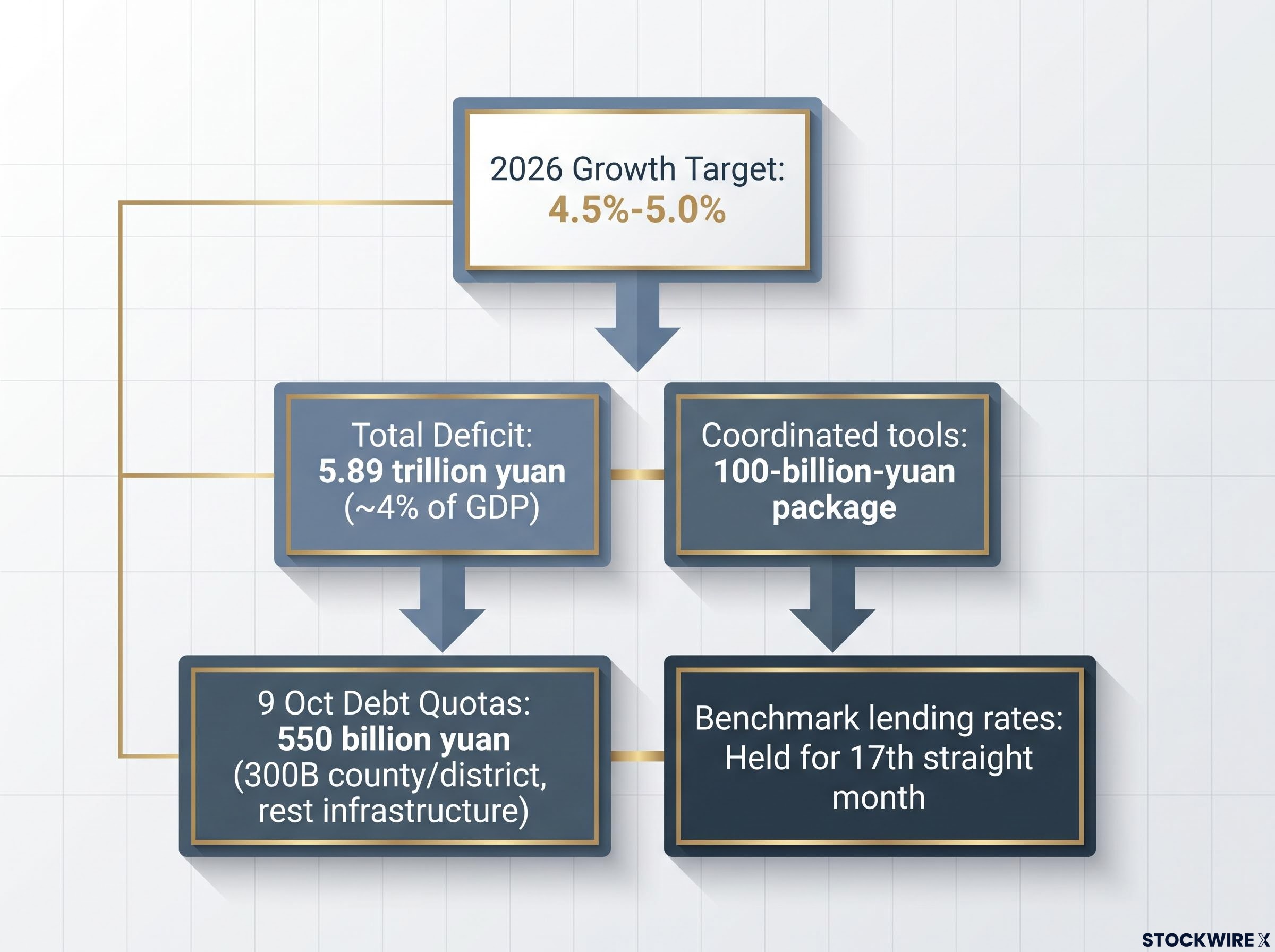
- The 2026 growth target of 4.5%-5.0% now looks reachable.
- Targeted support is already in place, including 550 billion yuan of unused debt quotas allocated on 9 October (300 billion for county and district operations, the rest for infrastructure).
- The 2026 framework already includes a deficit of about 4% of GDP, 5.89 trillion yuan in total, plus a 100-billion-yuan package of coordinated tools.
- Rate cuts gain little traction when prices are falling and credit demand is weak; markets expected benchmark lending rates to be held for a 17th straight month.
- Strong exports buy policymakers time.
On 10 October, the Finance Ministry pledged “more proactive fiscal policy”, but scale and timing remain discretionary. For you, this means the stronger print removed the main trigger for broad easing, so expectations of a stimulus-driven jolt to China’s rates or currency deserve tempering.
The case for more support
Not everyone accepts that calm. The IMF said on 15 October that support was “quite limited in size and scope” and that substantially more was needed to counter deflation.
| Analyst/institution | View | Date |
|---|---|---|
| Volkmar Baur, Commerzbank | Beijing content; large stimulus improbable | 19 Oct 2026 |
| Goldman Sachs | A second sub-4.5% quarter would raise pressure; local-government finances constrain delivery | 18 Oct 2026 |
| ING, Lynn Song | Weak data could prompt consumption support and faster special-bond issuance | 15 Jul 2026 |
| IMF, Krishna Srinivasan | Support too limited; deflation risk | 15 Oct 2026 |
Goldman’s trigger was not met this quarter, which weakens the urgency. Beijing may also weigh debt and property imbalances against further spending, making this a judgement call rather than a settled outcome.
How to read a data gap: what macro discrepancies mean for currency traders
GDP, investment and consumption can diverge because GDP adds everything together. If exports surge, they can offset weak spending at home, leaving a solid headline that hides soft components. That divergence matters more for policy than for a currency’s direct valuation.
Three questions help with any growth print:
- What is driving growth? Exports and industry, or household demand?
- How will policymakers respond? Does the result remove or create pressure to act?
- Which channel reaches the currency? Rates, capital flows, or exporter competitiveness?
For China, the third question leads straight to exporters. They earn foreign currency, so a faster-rising yuan shrinks the renminbi value of their revenues. An economy leaning on exports has a built-in reason to slow appreciation.
Analysts have long compared strong official growth with weaker property, price and household indicators. The useful question is not whether the headline is “true”, but what is driving it and how Beijing will react.
Three episodes that show how Beijing manages the yuan
- 2015: The People’s Bank of China (PBOC) cut its daily midpoint by about 2%, sparking outflows and roughly US$1 trillion of reserve spending. Lesson: small fixing changes can shift expectations abruptly.
- 2022: The yuan weakened as US-China interest rate differentials turned adverse. Lesson: domestic easing can pressure the currency even when stability is the goal.
- 2023: State-bank buying and informal guidance steadied the yuan. Lesson: today’s trend is likely managed through quiet signals, not dramatic intervention.
Why yuan gains are slowing and what the yuan outlook means for FX investors
Commerzbank still regards the yuan as significantly undervalued. Yet it is appreciating more slowly. That apparent contradiction is the key to the current setup.
Baur traces the 2026 path: early weakness in March after the Iran conflict broke out, average appreciation against the dollar through the first five months, then slower monthly gains from June. Over the 12 months to 7 July 2026, the yuan rose about 5.4% against the dollar.
The explanation lies in the China Foreign Exchange Trade System (CFETS) index, which measures the yuan against a basket of trading-partner currencies. It reached 103.73 on 15 October, a more-than-four-year high and up 5.75% this year. While the dollar stays strong on a trade-weighted basis, faster gains against it would push the yuan even higher against the euro, yen and won, tightening conditions for exporters.
The daily fixing, the PBOC’s official reference rate, shows that restraint in action.
The fixing gap The PBOC set its midpoint at 6.7208 per dollar on 19 October (from 6.7220 on 16 October), weaker than the 6.6897 market-implied estimate from Reuters.
| View | Support | Caveat |
|---|---|---|
| Gradual appreciation | HSBC year-end forecast 6.65; Deutsche Bank 6.55 | Forecasts from 18 May 2026 predate latest data |
| Yuan undervalued | Commerzbank; surplus of US$938.11 billion Jan-Sep | Capital controls and fixing can keep prices from valuations |
| Appreciation restrained | Export dependence; high CFETS index | Surplus near US$1 trillion may intensify trade criticism |
Three risks could change the pace:
- A sharp dollar decline, which could make the yuan a key adjustment channel.
- A policy shift towards faster appreciation, possibly in response to trade pressure.
- Middle East escalation lifting oil and the dollar, though Goldman sees energy-security investment supporting exports over the medium term.
For you, the implication is that a managed, steady climb is the base case. Positioning for a sharp revaluation carries more risk than positioning for gradual gains, and the trade-weighted index deserves as much attention as USD/CNY.
What the data gap changes for the yuan, and what it does not
The 4.5% print and a near-record surplus ease the pressure for a big stimulus package. They do not remove the domestic fragility visible in falling investment, flat real spending and the IMF’s deflation warning. Beijing has reason to support activity selectively while capping how fast the yuan rises.
That leaves gradual appreciation within a currency many still see as undervalued, though no outcome is certain.
Three variables would shift the picture. A sharply weaker dollar would argue for faster gains. A fixing set closer to market-implied levels would signal Beijing loosening its grip. New fiscal measures or a rate move would suggest officials see more weakness than the headline admits.
Watch those signals, not the GDP headline, for the next turn.
Past performance does not guarantee future results. Financial projections and forecasts are subject to market conditions and various risk factors, and forward-looking views are speculative and subject to change.
This article is for informational purposes only and should not be considered financial advice. Investors should conduct their own research and consult with financial professionals before making investment decisions.