
A rule that cut retail losses by 91% sounds like a problem solved. Yet under Australia’s CFD product intervention order, 68% of retail investors trading contracts for difference still lost money in FY2024, with aggregate net losses above $458 million.
Both numbers are true, and the gap between them matters. The order is scheduled to expire on 23 May 2027 unless it is remade. On 20 January 2026, the Australian Securities and Investments Commission (ASIC) said it would engage with industry during 2026 on its proposed way forward.
As of October 2026, no detailed proposal has been published. This is an analysis of the evidence ASIC will weigh, not a report on a decision it has made.
Here is what that evidence says about why the regulator is likely to keep a close eye on this product, and how to think about CFD risk whatever comes next.
What the four protections do, and why they exist
What a CFD is and why leverage matters
A contract for difference (CFD) is a derivative, meaning its value comes from something else. It lets you speculate on whether the price of an underlying asset will rise or fall without owning that asset. The underlying asset might be a currency pair, a share index, a single stock, a commodity or a crypto asset.
CFDs are traded over the counter, which means directly with the issuer rather than on an exchange. They are also leveraged: you put up a small deposit, called margin, to control a much larger position. A small price move against you can therefore consume your whole deposit, while financing fees for holding the position keep adding to the cost.
The leverage and margin mechanics behind these losses are mathematical: a 5% margin requirement equals 20:1 leverage, so a 5% adverse move erases the whole deposit, which is why caps and close-out rules matter.
That combination is how retail clients were losing heavily before the order existed.
The four protections
Each condition in the order targets a specific way those losses happened:
- Leverage limits: Caps how large a position you can open relative to your deposit, so small price moves do less damage.
- Standardised margin close-out: Requires positions to be closed once your account equity falls to a set level, stopping losses before they spiral.
- Negative balance protection: Ensures you cannot lose more than the money in your account.
- A ban on certain inducements: Stops issuers offering incentives that encourage people to trade more or open accounts they might not otherwise open.
The order has a defined life, which is why the 2027 date carries weight.
| Date | Event |
|---|---|
| October 2020 | ASIC announces the CFD product intervention order |
| 29 March 2021 | Order takes effect |
| 18 October 2021 | Consultation Paper 348 (CP 348) seeks feedback on an extension |
| 6 April 2022 | Order extended for five years (Instrument 2022/259) |
| 23 May 2027 | Scheduled expiry |
In ASIC’s own words, the order “will expire on 23 May 2027, unless it is remade.” For you, that means any change would not alter an abstract principle. It would alter one of four specific safeguards that sit between your deposit and a loss larger than you planned for.
When big ASX news breaks, our subscribers know first
How much did the order cut retail losses?
When ASIC extended the order in 2022, it leaned on a set of post-implementation figures published in media release 22-082MR. Taken one at a time, they show how sharply outcomes changed.
Start with losses. Within six months of the order taking effect, aggregate net retail client losses fell from an average of $372 million a quarter to $33 million, a drop of 91%.
Margin close-outs, where positions are shut because the account can no longer support them, fell 87% per quarter.
The number of active retail CFD accounts also shrank, falling 29% from 504,905 to 357,841.
| Metric | Before | After | Change |
|---|---|---|---|
| Average quarterly net retail losses | $372M | $33M | -91% |
| Margin close-outs per quarter | Not stated | Not stated | -87% |
| Active retail CFD accounts | 504,905 | 357,841 | -29% |
Those results formed ASIC’s stated basis for keeping the order in place.
ASIC’s assessment The regulator described the order as “effective in reducing the risk of significant detriment to retail clients resulting from CFDs”.
That is a strong evidentiary position for any regulator to hold heading into a remake decision. It also tells you why letting the order lapse without a replacement would amount to a meaningful policy reversal.
There is a caution, though. These figures describe the first six months after March 2021. The most recent active-account figure ASIC has published relates to that same period, and neither REP 828 nor media release 26-004MR gives a current count. Treat the table as a snapshot of early impact, not a live reading.
Why do most retail CFD traders still lose money?
The latest loss data
The more recent picture is less comfortable. ASIC’s Report 828 (REP 828), released in January 2026, covers the 2024 financial year (July 2023 to June 2024).
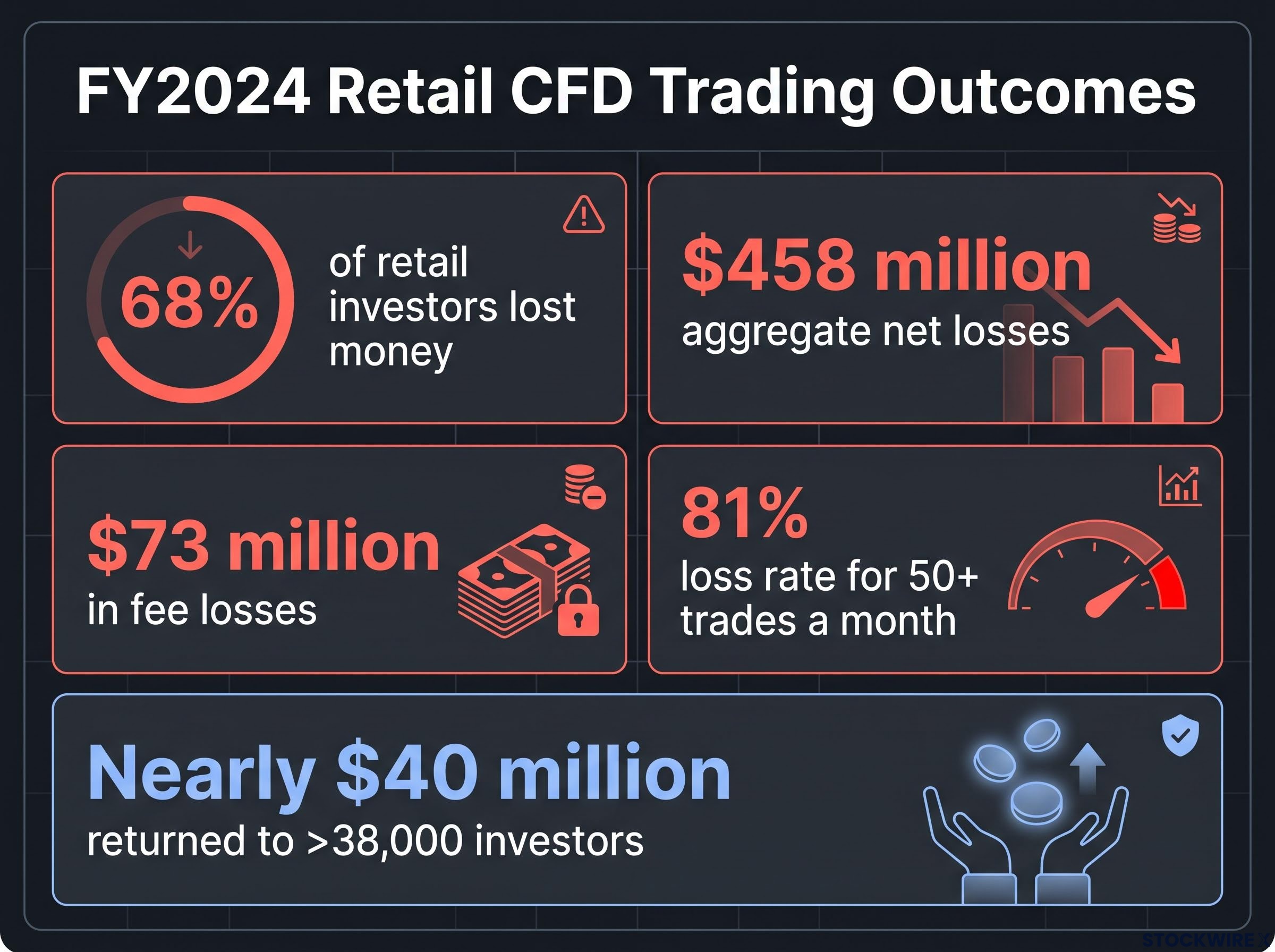
68% of retail CFD investors lost money in FY2024, under the protections designed to limit their losses.
The headline figures from the report:
- 68% of retail clients recorded a net loss
- Aggregate net losses exceeded $458 million
- Fees accounted for $73 million of those losses
Frequency made things worse. Secondary analysis by Stockwirex puts the loss rate for clients placing 50 or more trades a month at about 81%. That gap suggests trading behaviour, not just product design, drives outcomes even inside the rules.
The margin discount finding
The second channel of harm is rule-breaking. ASIC’s whole-of-industry review, running from October 2024 to December 2025, covered 52 licensed CFD issuers and found widespread weaknesses in compliance with design and distribution obligations (DDO), the order itself and regulatory reporting. DDO are the rules requiring issuers to define who a product suits and distribute it accordingly.
The largest single problem was the “margin discount”. More than half the issuers reviewed offered reduced margin to clients holding opposing positions on the same asset. Here is how that structure worked against the client:
- The client opened a long position (betting on a rise) and a short position (betting on a fall) on the same underlying asset.
- The issuer applied discounted margin to the pair, making it cheaper to hold.
- The client paid higher funding costs to keep both positions open.
- Any gain on one leg was cancelled by a loss on the other, so the client carried the cost with no realistic route to profit.
ASIC secured the return of nearly $40 million to more than 38,000 retail investors, mostly through issuer-run remediation programmes. Of that, 28 issuers refunded over $36 million specifically for margin discounts.
The review also recorded improvements in target market determinations, onboarding questionnaires, reporting and monitoring of client outcomes. Still, the lesson for you is twofold: a protective rule works only when issuers follow it, and even compliant CFD trading leaves most participants worse off.
Readers interested in the compliance failures behind these findings can read our deep-dive into ASIC’s CFD review, which breaks down how many issuers had to fix target market determinations and onboarding questionnaires.
What could ASIC do next, and what do we still not know?
The established facts are narrow. The order continues to apply, and in 26-004MR ASIC said: “in 2026, ASIC will engage with industry on our proposed way forward.” Extending or remaking the order requires appropriate approvals, and ASIC has invited input from issuers, industry bodies and consumer representatives.
No consultation paper since CP 348 has set out proposed changes, and no Treasury or ministerial statement has addressed the order’s future. Stockwirex commentary from July 2026 describes the order as “under consultation”, which is looser than ASIC’s own wording about planned engagement.
With that in mind, the three broad paths below are analysis, not prediction.
| Possible path | What it would mean | What the evidence suggests |
|---|---|---|
| Remake | The four protections continue largely as they are | Supported by the documented fall in losses after 2021 |
| Tighten | Stronger or additional conditions on issuers | Consistent with REP 828’s non-compliance and loss findings |
| Lapse | The order expires on 23 May 2027 with no replacement | Hard to reconcile with ASIC’s own published findings |
Read together, ASIC’s findings point towards continued or stronger protections rather than a rollback. Nothing is confirmed, and the months before May 2027 form the decision window. Several evidence gaps also remain:
- No published positions from consumer groups, issuers or industry bodies
- No data on retail traders shifting to offshore, non-ASIC-regulated providers
- No systematic Australian comparison with European or UK CFD regimes
- No confirmed timing or content for a consultation paper
Offshore broker risks are the largest unmeasured gap in the evidence: leverage of 200:1 or more, no statutory compensation scheme and unsecured creditor status if a provider fails, as the USGFX collapse showed.
Practical ways to think about CFD risk now
These points are general information drawn from the data, not personal financial advice:
- Assume the typical outcome is a loss. Roughly two in three retail clients lost money in FY2024.
- Treat funding costs and trade frequency as risk drivers. Fees made up $73 million of losses, and frequent traders fared worst.
- Check your issuer’s record. Ask how it handles margin and funding costs, and whether it was involved in remediation.
When a consultation paper appears, you can also make a submission and have your say.
What the evidence supports, and what remains undecided
The record is clear on two points. The order produced a large, documented fall in retail losses after 2021, and most retail traders still lose money, partly because more than half the sector breached it. That combination favours ongoing scrutiny rather than a quiet exit.
What happens after 23 May 2027 is undecided. ASIC’s industry engagement this year, and any consultation paper that follows, is the next signal worth watching.
Follow ASIC’s announcements as they arrive. Whether or not the order is remade, treat CFD risk with the same seriousness: the protections limit the worst outcomes, but they have not changed the typical one.
This article is for informational purposes only and should not be considered financial advice. Investors should conduct their own research and consult with financial professionals before making investment decisions. Past performance does not guarantee future results, and any discussion of possible regulatory outcomes is speculative and subject to change.