Bank Indonesia held its policy rate at 5.75% on 21 October 2026, the fourth straight meeting without a change. By the next day, the rupiah had slipped back above 18,000 per US dollar. If you read a held rate as a passive central bank, this decision suggests otherwise: Bank Indonesia was working hard to defend the rupiah, just not through its headline rate.
The market was divided going in. A Bloomberg survey found 19 of 38 economists expecting a hold, and a Reuters poll found 15 of 29, with the rest calling for a hike of at least 25 basis points (a basis point is one-hundredth of a percentage point).
The backdrop is uncomfortable. The rupiah is down roughly 8% this year, and index provider MSCI is weighing whether to move Indonesia out of its emerging-market category altogether.
Here is what each of Bank Indonesia’s tools does, why it chose them over a hike, and which risks could still force its hand.
What did Bank Indonesia actually do, and why not hike?
A weakening currency usually invites a rate hike. Bank Indonesia (BI) declined, and the reason becomes clearer when you look at the whole package rather than the headline rate.
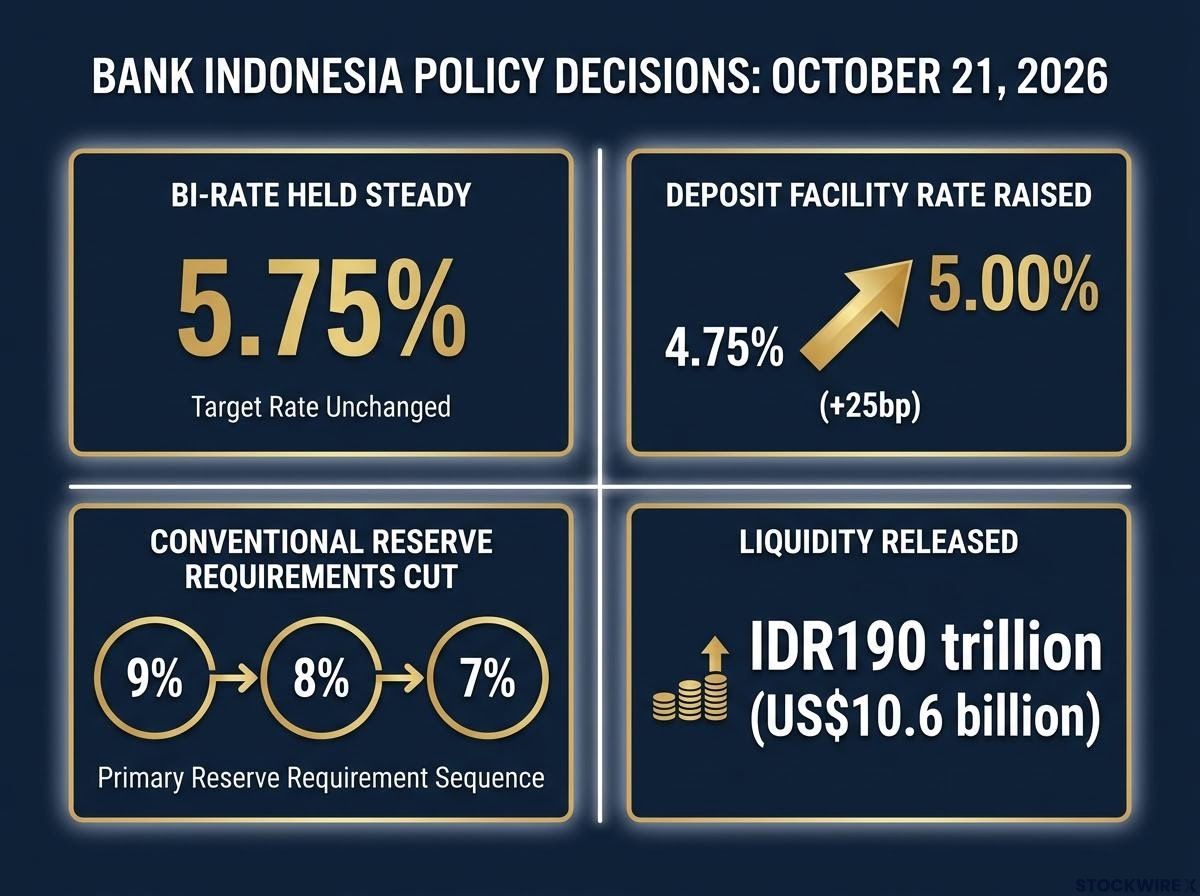
The BI-Rate stayed at 5.75%. The Deposit Facility rate, which is what banks earn when they park cash overnight at the central bank, rose 25bp to 5.00%. The Lending Facility rate held at 6.50%.
Then came the liquidity piece. Reserve requirements, the share of deposits banks must hold at the central bank rather than lend out, will fall 200bp in two steps. Governor Destry Damayanti put the liquidity released at about IDR190 trillion (about US$10.6 billion).
Bank Indonesia’s policy statement confirms the phased reserve requirement cuts for conventional banks, from 9% to 8% on 1 November and 7% on 1 December, alongside stronger incentives for DNDF hedging instruments.
| Instrument | Before | After | Timing |
|---|---|---|---|
| Deposit Facility rate | 4.75% | 5.00% | Announced 21 October 2026 |
| Reserve requirement (conventional banks) | 9% | 8%, then 7% | 1 November and 1 December 2026 |
| Reserve requirement (Islamic banks) | 7.5% | 6.5%, then 5.5% | 1 November and 1 December 2026 |
| DNDF premium reduction | 25% (6-month), 30% (12-month) | 40% (6-month), 45% (12-month) | Announced 21 October 2026 |
DNDF stands for domestic non-deliverable forward, a contract foreign investors use to lock in an exchange rate. A larger premium reduction makes that protection cheaper.
The hold reflects a trade-off. After 100bp of hikes in May and June, another increase would have lifted borrowing costs for households, companies and the government, and BI kept its 2026 growth forecast at 4.9%-5.7%.
Why the reserve cut, and why now Deputy Governor Solikin said the Deposit Facility increase supports market stability while the reserve cut gives banks more room to lend. OCBC senior economist Lavanya Venkateswaran read the cut as pre-emptive, a cushion against tighter conditions if foreign capital keeps leaving.
The read you should take from this: BI is treating the currency and domestic credit as two separate problems with two separate tools. A “hold” here is not inaction.
When big ASX news breaks, our subscribers know first
How can an emerging-market central bank defend its currency without raising rates?
Start with a simple principle. A currency holds up when people have a reason to keep owning it, and a high headline rate is only one such reason.
BI had already signalled this shift earlier in the year, with non-rate tools such as FX intervention across spot, DNDF and NDF markets, SRBI issuance and macroprudential incentives replacing further hikes as the main signals to watch.
BI’s package targets that reason from several angles. Here is how each mechanism works for you as an observer or holder of rupiah assets:
- Higher Deposit Facility rate. What it does: raises the return on rupiah cash held at BI, steadying money markets without pushing the full rise into loan rates. Its limit: it is a narrow lever and does not change the broader rate differential with the US.
- Lower reserve requirements. What it does: frees cash for lending and stops a market selloff turning into a domestic funding squeeze. Its limit: extra liquidity can drift into dollars.
- DNDF hedging incentives. What it does: if you are a foreign investor, cheaper hedging lets you keep Indonesian bonds or shares without selling rupiah just to escape currency risk. Its limit: it does nothing if you want out of the asset itself.
- FX intervention. What it does: BI sells dollars from reserves to slow the rupiah’s fall. Its limit: reserves are finite.
The hedging tool has a track record. According to Antara, the scheme drew US$9.9 billion of inflows through DNDF and FX-buy-swap instruments from its June launch to 20 October 2026.
What each tool cannot do
The reserve cut carries a leakage risk. Some of the IDR190 trillion could fund imports, foreign assets or plain dollar demand rather than productive lending, which is why BI paired it with a higher Deposit Facility rate and richer hedging incentives.
Intervention has its own ceiling. FX reserves stood at US$146.3 billion at end-September, about five months of imports and government external-debt payments; that is a large buffer, but not one built to absorb persistent outflows indefinitely.
What this tells you is that a central bank can steer capital through price signals and hedging costs. The real test is whether those tools hold when outflows are driven by index decisions rather than interest rates.
What is Commerzbank’s cautious view on the rupiah?
The policy mix looks coherent on paper. Commerzbank analysts Charlie Lay and Dr. Henry Hao accept that, then point to pressures BI cannot fix on its own.
Commerzbank’s conclusion In Lay and Hao’s assessment, BI’s steps help, but a lasting rupiah recovery depends on better global financial conditions and restored foreign investor confidence, not domestic policy alone.
Three external pressures sit behind that caution:
- The MSCI review. On 15 October 2026 (New York time), MSCI opened a consultation on moving Indonesia from Emerging Market to Standalone Market, citing accessibility, governance and market functioning. It remains a proposal, with feedback due by 30 April 2027 and a decision on or before 30 June 2027.
- The current account. Indonesia ran a deficit of US$12.49 billion in Q2 2026, or 3.3% of GDP, which leaves it reliant on foreign capital.
- Global yields. Elevated yields abroad make dollar assets more attractive than rupiah assets.
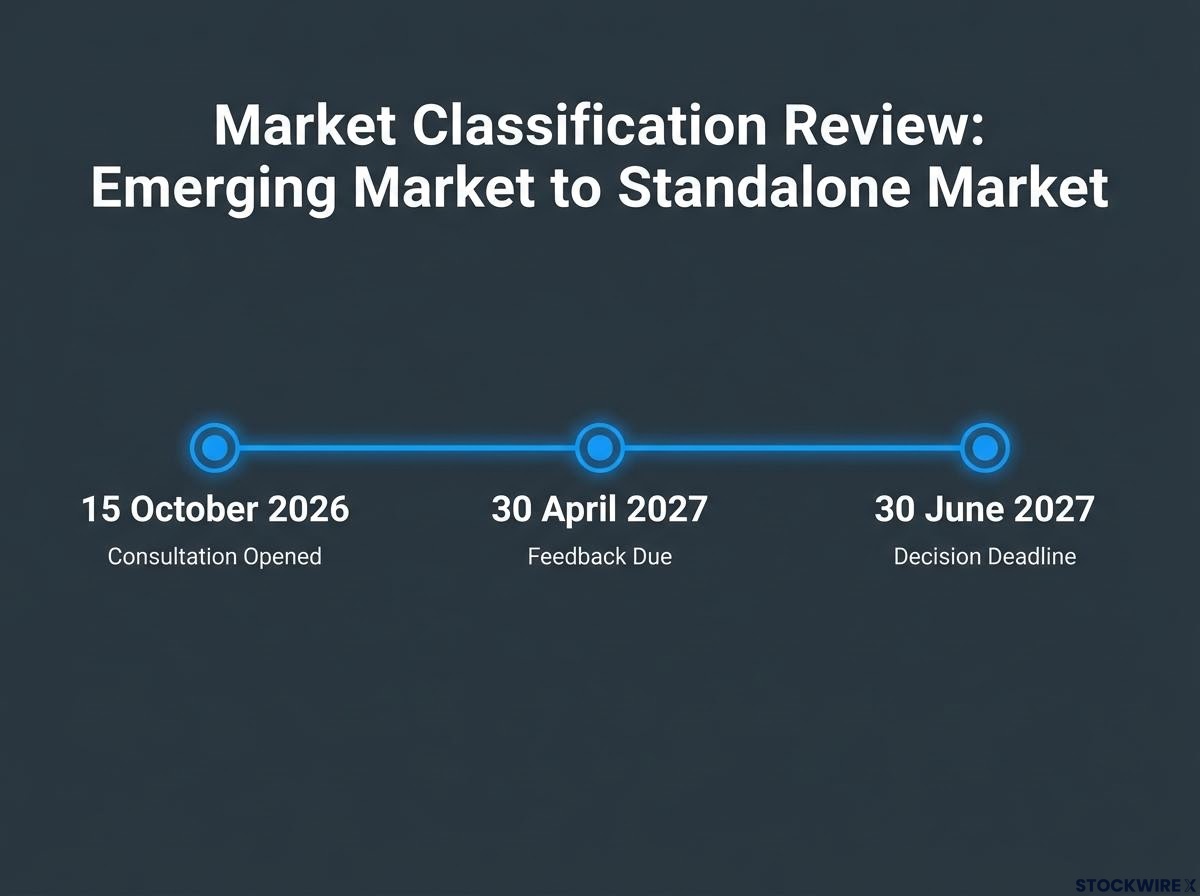
A standalone label could push index-linked funds to trim Indonesian equities. Commerzbank warns hedging incentives may not offset that kind of sustained portfolio selling.
MSCI’s standalone proposal centres on free float, with opaque beneficial ownership and suspected coordinated trading leaving the index provider unable to verify how much stock genuinely trades, a governance problem that no central bank tool can address directly.
The currency data reflects the strain. USD/IDR stood at 18,017.40 on 22 October, and Trading Economics puts the year-to-date fall at 8.52%; Commerzbank cited 7.3% and InvestorTrust 8.11% on 20 October, gaps that largely reflect different measurement dates.
In the near term, Commerzbank expects BI to lean on FX intervention, attractive short-term yields and hedging incentives.
For you, the implication is plain. The biggest swing factor for the rupiah is now a global index decision and foreign investor confidence, not BI’s next meeting.
Is another 25bp hike still on the table?
The hike camp did not go away on Wednesday. Its argument is that defending the currency, preserving the rate gap with the US and getting ahead of outflows justify the cost.
The hold camp counters that a hike would damage credit, consumption, investment and government financing, when targeted tools can do the currency work instead.
| View | Institution | Argument |
|---|---|---|
| Hike | Citigroup | Pre-emptive 50bp hike to 6.25% after the MSCI warning |
| Hike | Capital Economics (Jason Tuvey) | 25bp to 6.00%; not hiking risks disappointing investors |
| Hike | Permata Bank | 25bp to 6.00% to answer rupiah weakness |
| Hike | UOB (Enrico Tanuwidjaja) | Rapid depreciation could force a hike; 50bp not ruled out |
| Hike later | Bank Danamon (Irman Faiz) | BI-Rate could reach 6.25%, but not necessarily immediately |
| Hold | Bank Indonesia | Targeted tools stabilise the rupiah while supporting growth and credit |
Commerzbank sits between the two. It does not exclude another 25bp move if selling pressure returns strongly.
With the field this evenly split, the next move depends on data rather than any single forecast. Three signals matter most:
- MSCI-driven outflows. Any interim MSCI update, or heavy foreign selling of Indonesian equities, would raise pressure for a hike.
- Global yields and oil prices. Higher yields pull money toward dollars, and pricier energy widens the import bill.
- Fiscal and independence concerns. Investor worries about spending, fuel subsidies or growth targets constraining BI could erode confidence faster than hedging incentives can rebuild it.
Forecasts on a hike are speculative and subject to change as market conditions develop.
What the hold changes, and what it does not
BI has drawn a clear line between defending the currency and supporting credit, using a separate tool for each. That changes how you should read its rate decisions. It does not remove the external pressures, and the tools buy time rather than resolve them.
The checkpoints are now set. The second reserve requirement step lands on 1 December, BI meets again before year end, and MSCI’s process runs to the 30 April 2027 feedback deadline and a decision by 30 June 2027.
The question to keep in front of you is whether hedging inflows keep pace with any index-driven selling. If they do, the hold looks deliberate. If they fall behind, a hike is likely to return to the table.
This article is for informational purposes only and should not be considered financial advice. Investors should conduct their own research and consult with financial professionals before making investment decisions. Past performance does not guarantee future results. Financial projections are subject to market conditions and various risk factors.