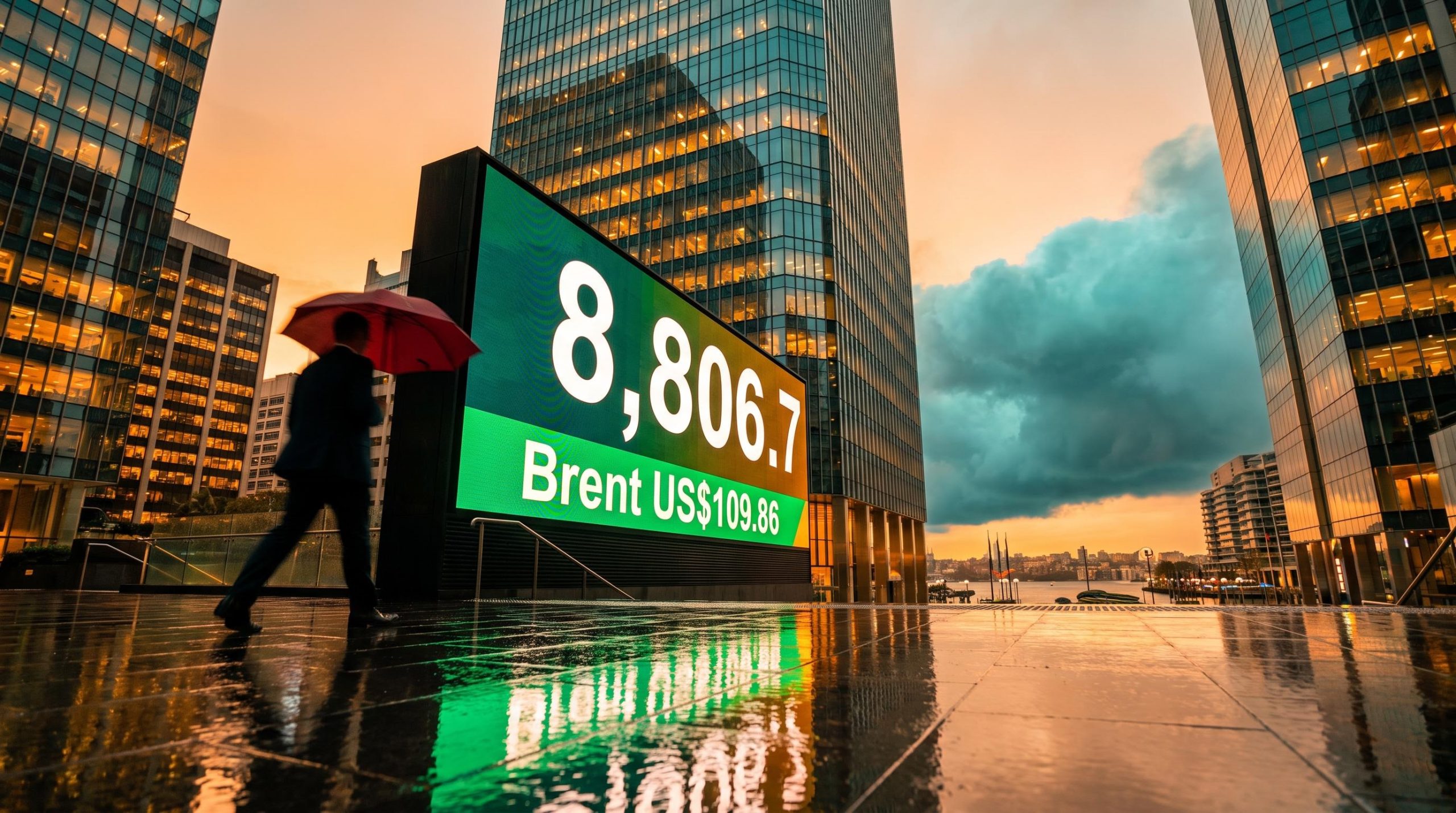
The S&P/ASX 200 closed Friday at 8,806.7, its best session since August. Futures are pointing to a softer start on Monday, and that gap is the first thing this week’s ASX 200 outlook has to explain.
Futures slipped about 0.1% early Monday because a fresh selloff in artificial intelligence (AI) stocks hit Wall Street after the local close. The rally looked convincing on Friday afternoon. It looks less settled now.
Three forces arrive together in the week beginning 19 October 2026. Brent crude is near US$110, a credit wobble is running through AI infrastructure, and three Reserve Bank of Australia (RBA) officials speak ahead of the 3 November rate decision. Read them separately and you may misjudge your exposure to rates and tech. Read them as one system and the risks become easier to size.
This briefing covers the three variables most likely to move your portfolio this week, and the signals that would change the picture.
Why did the ASX 200 rally into a weaker open?
Friday felt like a turning point. The index rose 1.0% to a 20-day high, led by tech, mining and healthcare, and South32 added 3.6%.
That optimism was borrowed. Local buyers were reacting to Thursday’s Wall Street recovery, and by the time Australia closed, the US session had started to undo it.
| Item | Level | Move or note |
|---|---|---|
| ASX 200 | 8,806.7 | +1.0% |
| Brent crude | US$109.86/bbl | +3.7% |
| Gold | about US$4,181/oz | -0.3% |
| Iron ore | US$90.90/t | +0.4% |
| US 10-year yield | about 5.07-5.08% | Varies by source timing |
| AUD/USD | about 69.4-69.7 US cents | Varies by source timing |
A 0.1% fall from Friday’s close implies an open near 8,798. Treat that as approximate, since futures readings ranged from 0.1-0.2% lower. The read you should take is that 8,806.7 is a level the market still has to test, not a floor it has earned.
Wall Street and Europe: a split finish
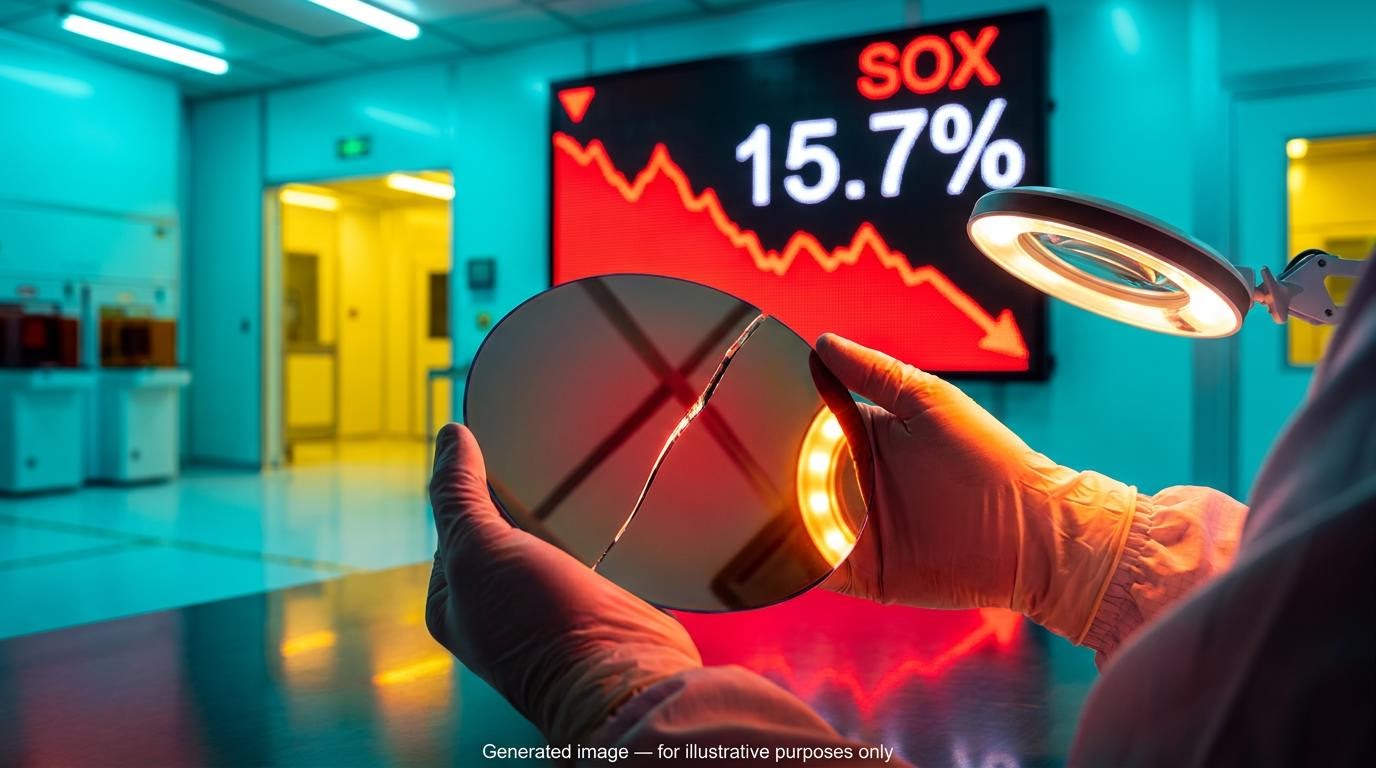
The US finish was tech-heavy and weak. The Dow lost 0.3%, the S&P 500 1.1% and the Nasdaq 2.1%, with communication services down 2.5% and information technology down 2.4%. The chip index fell 2.5%, its eighth straight daily decline, while Broadcom shed 3.6% and Tesla 2.5%.
Europe told a different story. The Euro First 300 rose 0.7% and the FTSE 100 0.4%, completing its strongest week since June as earnings outweighed the tech drag.
When big ASX news breaks, our subscribers know first
Is the AI selloff a credit problem rather than a valuation problem?
The headline move was in shares. CoreWeave, an AI data-centre operator, fell 12% on Friday and roughly 25% over five sessions.
The more telling move was in its debt. CoreWeave sold bonds in June at a 9.675% yield, and those bonds now trade at yields near or above 15%. Bond yields rise as prices fall, so that jump means lenders are demanding far more compensation to hold the debt.
CoreWeave’s bond stress, with its 2032 notes trading below 78 cents on the dollar, shows lenders repricing default risk well before equity holders did, which is why the credit signal deserves closer attention than the share price.
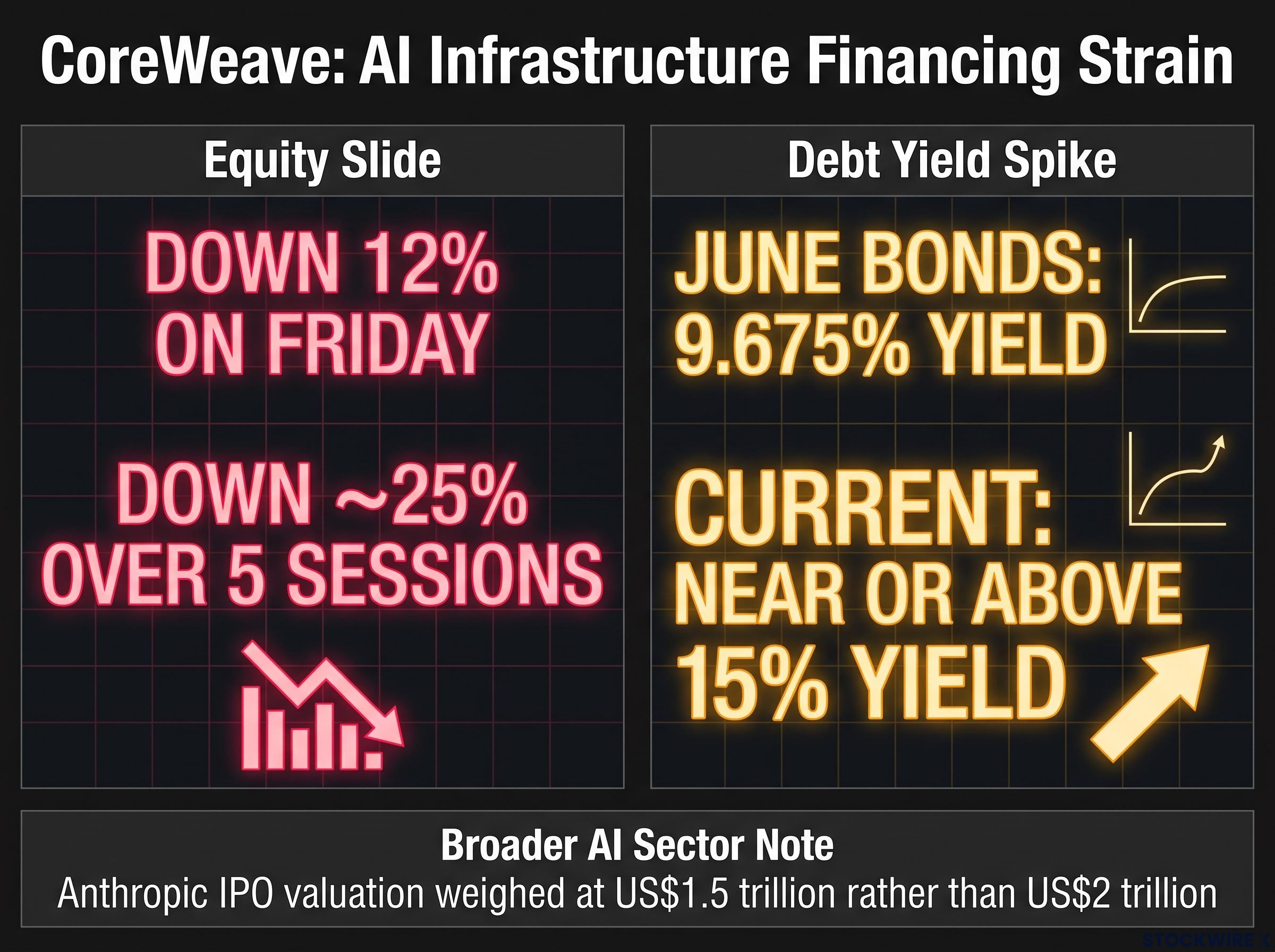
Signal worth watching Investors treated the slide in CoreWeave’s bonds as more significant than the fall in its shares, according to Reuters.
Credit-default-swap pricing also rose sharply. A credit-default swap is a contract that pays out if a borrower defaults, so a higher price means the market sees greater default risk. Reuters framed the episode as a test of whether investors will keep funding the AI buildout.
The strain comes from five sources: higher funding costs as Treasury yields climb, long payback periods on data centres, circular financing between chipmakers, cloud providers and AI developers, heavy reliance on a few customers, and slowing growth expectations. Reuters reported that some Anthropic investors are weighing an IPO valuation of about US$1.5 trillion rather than US$2 trillion.
| View | Source | Core argument |
|---|---|---|
| Contained correction | Dan Greenhaus, Solus Alternative Asset Management | CoreWeave may be a weak, highly leveraged corner, and higher rates expose such firms first |
| Manageable | Mike Intrator, CoreWeave CEO | Contract backlog supports debt obligations |
| Supportive | Jensen Huang, Nvidia CEO | CoreWeave needs no financial backstop |
| Broader warning | Reuters analysts and portfolio managers | Debt-funded projects must generate cash before refinancing pressure arrives |
The balanced read is a correction concentrated in leveraged AI infrastructure. It is a financing test, and it could still widen.
How the financing strain spreads to the ASX
The ASX has a far smaller direct AI complex than the Nasdaq. The exposure arrives through other routes:
- Tech valuations, which move with US peers
- Global risk appetite
- The Australian dollar
- Bond yields
- Long-duration growth stocks, whose value depends on profits far in the future
If you hold ASX tech or growth names, your exposure runs mostly through yields and sentiment, so watch credit spreads as closely as share prices. The selloff would turn broad if refinancing markets stay shut, a major borrower defaults, or hyperscaler spending returns are marked down.
How do oil at US$110 and the RBA fit together?
Higher yields are one route from Wall Street to your portfolio. Oil is the second, and for Australia it leads straight to the RBA.
Brent jumped 3.7% to US$109.86, near US$110 for the first time since May, on tensions around the Strait of Hormuz and doubts over how much Russian diesel can reach markets. The International Energy Agency (IEA) agreed to release more than 20 million barrels, yet the geopolitical premium held.
The Middle East energy shock has already shown how quickly crude feeds into Australian prices, with earlier modelling suggesting a prolonged Hormuz closure could add up to 1.5 percentage points to CPI.
The path from the barrel to your mortgage runs in steps:
- Oil prices rise.
- Petrol costs climb directly, while transport, freight and utilities follow indirectly.
- Those costs flow into the consumer price index (CPI), the main inflation gauge.
- The RBA judges whether the shock fades or spreads into wages, services and expectations.
- That judgement sets the rate path.
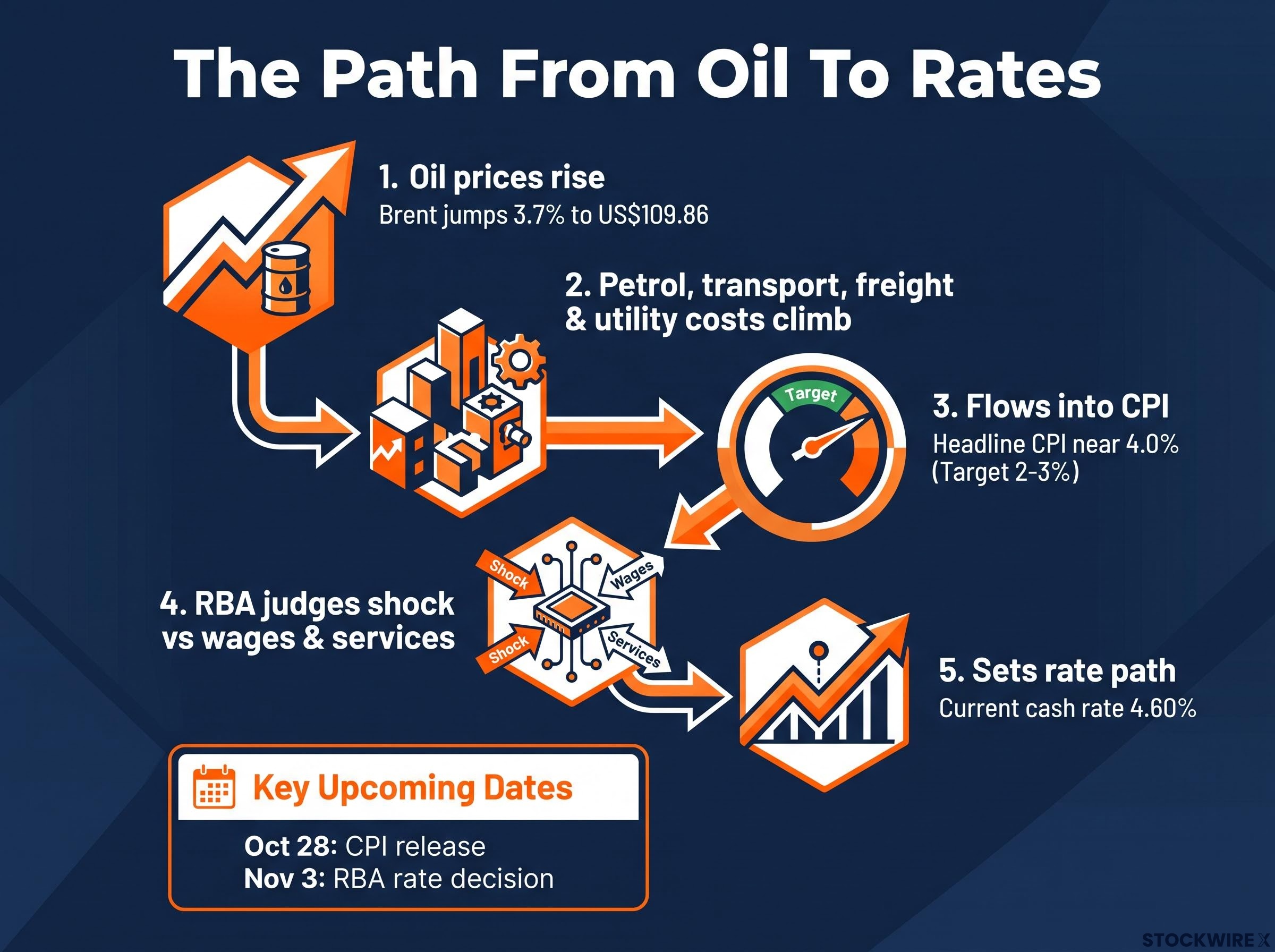
Monthly CPI already shows headline inflation near 4.0%, above the 2-3% target. The RBA lifted the cash rate to 4.60% at its 28-29 September meeting, and CBA said on 13 October that markets price about a 30% chance of another hike in November.
CBA expects trimmed-mean CPI, a measure that strips out the most extreme price moves, of about 1.0% for the September quarter. Goldman Sachs judged the RBA minutes more hawkish than the press conference and said the hurdle for a hike had fallen, while still forecasting a hold pending CPI. A hold is the base case, not a safe one, so if you carry a mortgage or business debt, the 28 October CPI release is your real decision point.
The US backdrop adds pressure. The US 10-year sits near 5.07%, the Australian 10-year at 5.23%, and gold traders are weighing further Federal Reserve hikes.
What the RBA speakers could tell you this week
- Christopher Kent, Assistant Governor (Financial Markets): Monday 19 October
- Ellis Connolly, Head of Payments Policy: Tuesday 20 October
- Andrew Hauser, Deputy Governor: Wednesday 21 October
Treat these as tone signals. Connolly’s payments brief makes him the least likely to hint at rates, while Hauser’s Citi conference appearance on Wednesday is the one markets will parse hardest. With the decision falling on Melbourne Cup Day, every phrase may draw extra scrutiny.
What should ASX investors watch on Monday, and what could go wrong?
Rates and credit set the backdrop. Monday’s calendar supplies the first hard numbers.
Monday’s company and data calendar
- South32: September-quarter update, with guidance including Worsley alumina near 3,750kt and Brazil aluminium cut to 135kt from 160kt
- Amplitude Energy: quarterly report following its decision on the East Coast Supply Project, targeting up to 90 TJ/day from 2028
- Stockland: AGM and first-quarter FY27 operational update, as AGM season gathers pace
- China: third-quarter GDP and September activity data
| Release | Expectation | Why it matters for the ASX |
|---|---|---|
| Q3 GDP | about 4.4% y/y (Q2: 4.3%) | Below an earlier Reuters poll of 4.6% |
| Industrial production | about 5.3-5.5% y/y | Supports bulk commodity demand |
| Retail sales | about 0.7% y/y | Signals soft consumption |
| Fixed-asset investment (Jan-Sep) | about -7.5% y/y | Weighs on iron ore, steel and aluminium |
The risk for miners is a resilient headline over a weak core. Whether you lean towards miners or property, check fixed-asset investment and retail sales, not just GDP.
A resilient headline can conceal a materials slump, as July showed when industrial output grew 4.5% while cement fell 11.6% and steel products dropped 4.1%, the kind of split that weighs on iron ore and aluminium demand.
Where the obvious trades can fail
- Energy: favoured by high oil, but exposed to government intervention, demand destruction or a sudden ceasefire
- Gold: supported by geopolitical risk, though pressured if hike expectations firm
- Base-metal miners: helped by strong industrial output, still tied to China’s property weakness
- Tech: hurt by higher yields, yet Friday showed buyers can return quickly if CoreWeave stays isolated
- Property: a hike to 4.85% would hit households, developers and listed names such as Stockland
History cuts both ways. Energy shocks tend to help producers first and damage demand later, and credit-led booms usually break the leveraged suppliers before anyone else. The crowded trade this week may also be the most reversible one.
What the week changes, and what it leaves open
AI credit stress, oil-driven inflation and RBA communication all point the same way: a volatile week, with modest rotation towards energy, gold and selected miners, and tech and property tied to bond yields.
The sequence matters. China data lands Monday, the RBA speakers follow from 19-21 October, and oil will keep reacting to the Middle East while CoreWeave’s bonds show whether the strain stays contained. The bigger tests come with CPI on 28 October and the decision on 3 November.
Before those dates, it is worth reviewing how much of your portfolio depends on lower rates or a tech rebound, and how you would respond if either fails to arrive.
This article is for informational purposes only and should not be considered financial advice. Investors should conduct their own research and consult with financial professionals before making investment decisions. Past performance does not guarantee future results. Financial projections are subject to market conditions and various risk factors.