Apple has just reported its biggest September quarter on record, and the share price barely moved. Revenue rose 12% to $114.48 billion, beating forecasts, yet Apple shares traded roughly flat after hours as investors worked through the detail.
That muted response is the real story. A record quarter has not settled the question of Apple stock valuation, because the debate has shifted. Demand is no longer in doubt. The questions now are how clean the growth is and what it will cost to sustain.
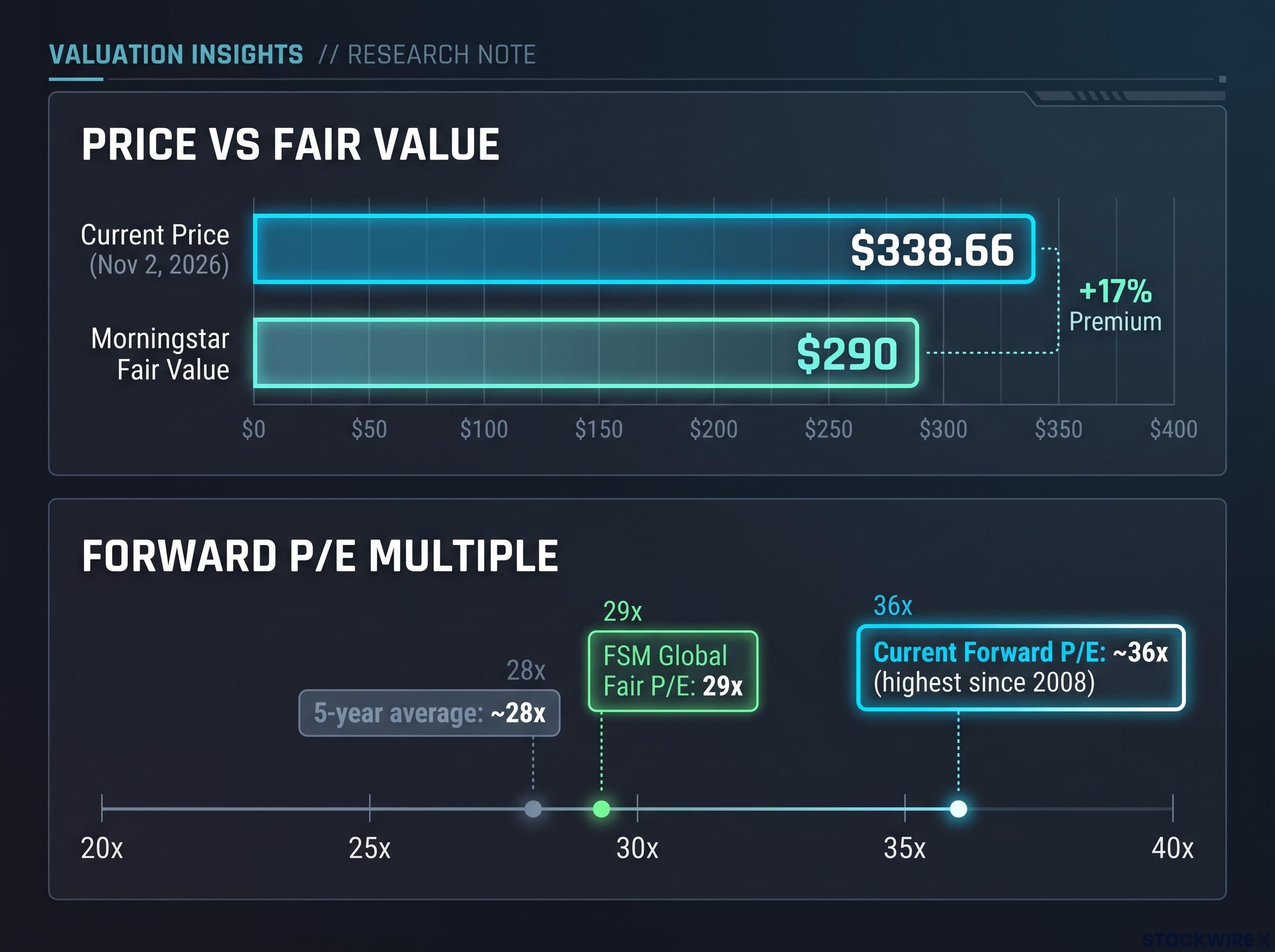
Those questions matter because of the price. Apple closed at $338.66 on 2 November 2026, well above Morningstar’s $290 fair value estimate. A fair value estimate is an analyst’s view of what a share is worth based on its expected future cash flows.
Here is a way to test whether the quarter’s strength justifies that price. It separates the one-off gains from the durable ones, explains the memory cost squeeze ahead, and sets out the assumptions you would be backing at today’s level.
What did Apple’s record September quarter actually deliver?
On the headline numbers, this was an emphatic beat. Revenue of $114.48 billion cleared both Apple’s own guidance and the LSEG consensus of about $113.39 billion for the quarter ended 26 September 2026.
The iPhone did the heavy lifting. iPhone revenue reached $57.58 billion, up about 17.5%, ahead of the roughly $56.54 billion analysts expected. Shares sit close to record highs, up about 27% this year (sources range from roughly 25% to 27% depending on timing conventions).
The muted reaction echoes Apple’s earlier quarterly beat in July, when EPS of $2.02 topped the $1.89 consensus yet shares fell nearly 4% after hours because a year-to-date rally had already priced in good news.
Then comes the gross margin, the share of revenue left after the direct cost of making products. Apple reported 47.9%, a strong figure. Part of it, though, came from somewhere other than the business.
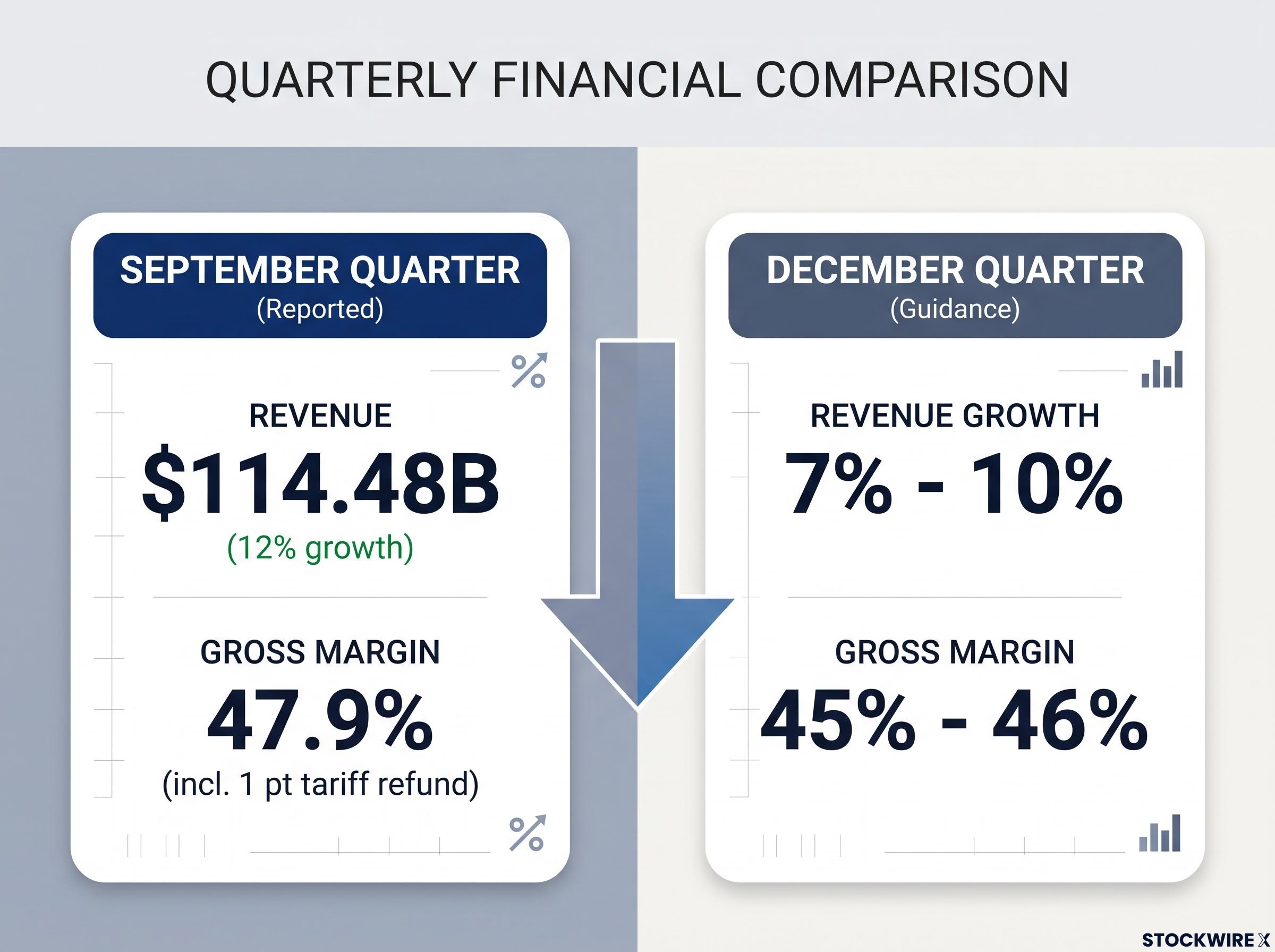
The tariff refund effect A one-time tariff refund added about 1 percentage point to gross margin and roughly $0.05 to diluted earnings per share. Strip it out and the underlying margin was about 46.9%.
| Metric | Reported | Consensus or guidance | Note |
|---|---|---|---|
| Revenue | $114.48B (up 12%) | About $113.39B (LSEG) | Beat guidance and consensus |
| iPhone revenue | $57.58B (up about 17.5%) | About $56.54B | Main driver of the beat |
| Gross margin | 47.9% | Above guidance | Includes about 1 point from a one-time tariff refund |
| December-quarter guidance | n/a | Revenue growth 7%-10%; gross margin 45%-46% | A step down on both measures |
That last row is the signal worth your attention. Growth slows to 7%-10% and margins drop to 45%-46% next quarter. Treat 47.9% as a peak, not a run rate, because any fair value comparison has to rest on earnings that repeat.
When big ASX news breaks, our subscribers know first
Why is memory inflation the biggest threat to Apple’s margins?
The guidance step-down has a cause, and it starts far from the iPhone. The boom in artificial intelligence data centres is pulling memory chips away from phones, and the chain reaction runs in four steps:
- AI servers absorb memory. They consume vast amounts of high-bandwidth memory (HBM), a fast type of memory built for AI workloads.
- Memory makers shift capacity. Wafer and packaging capacity moves toward higher-margin AI products.
- Consumer supply shrinks. Less DRAM and NAND (the memory and storage chips inside phones) is left for devices.
- Phone makers pay more. Contract prices rise and securing volume gets harder.
The numbers show how fast this has moved. Contract prices for LPDDR5X, the low-power memory used in phones, rose 78%-83% quarter over quarter in Q2 2026, according to TrendForce-related reporting. Morningstar estimates memory prices are up three- to fourfold from late-2024 levels and could make up about 10% of an iPhone’s cost.
The damage is already visible across the industry. IDC reported a 22% year-over-year fall in smartphone shipments in the September quarter, with Apple and Samsung insulated by their premium mix.
Morningstar has cut its fiscal 2027 gross margin estimate by about 100 basis points (a basis point is one-hundredth of a percentage point). It now expects margins to contract about 2 points, consistent with a roughly 200-basis-point memory headwind, while revenue grows in the low teens, led by price. Other analysts span a wide range:
| Analyst | Estimate | Implication |
|---|---|---|
| Bernstein (Mark Newman) | Next-iPhone component costs about 15% higher | Manageable EPS impact |
| Bank of America | iPhone memory cost from about $55 to $245 in 2027 | Price rises needed to protect margins |
| Oppenheimer (Martin Yang) | About 150 basis points product margin hit in the December quarter | Near-term margin pressure |
The gap between Bernstein’s manageable view and Bank of America’s near-fivefold cost jump tells you the margin outcome hinges on pricing. Watch what Apple charges, not just how many phones it sells. There is no firm date for relief either: conditions look tight through 2027, and some estimates stretch to 2028-2030.
Pricing momentum is already cooling elsewhere in the chain, and TrendForce projects DRAM contract growth of just 10-15% in Q4 2026, a late-cycle signal that may shape when memory cost pressure eases for device makers.
How much of the cost can Apple pass on?
Morningstar describes Apple’s demand as relatively inelastic, meaning buyers are not very sensitive to price. Relatively, though, is not perfectly. Price rises cluster in premium models and storage tiers, while memory costs hit every device, including entry models where Apple has less room to move.
Push too hard and the limits appear: buyers trade down to cheaper models, delay upgrades or switch to Android. That is why one quarter can look excellent and still cloud the outlook for fiscal 2027 earnings.
How far does $338 sit above a $290 fair value estimate?
At $338.66, Apple trades about 17% above Morningstar’s $290 fair value. Morningstar rates the stock 2-star and moderately overvalued, yet it also assigns a wide moat, its label for a durable competitive advantage.
That moat rests on an integrated ecosystem centred on the iPhone. Switching costs keep users in, network effects make the platform more useful as it grows, and in-house chips sharpen differentiation. Nobody in this debate disputes the franchise.
The disagreement is about inputs. Morningstar raised its fiscal 2027 revenue estimate by 4.5%, expecting flat iPhone units and high-single-digit iPhone revenue growth almost entirely from pricing, with about 10%-11% iPhone revenue growth over five years.
A fair value that moved, then moved back Morningstar cut fair value from $290 to $285 when it factored in supply constraints and memory pressure, then restored $290 after updating its pricing assumptions. Quality never changed; the inputs did.
The market is paying for more. Commentary puts Apple near 36x forward earnings, the highest since about 2008 in the cited coverage. FSM Global, which is constructive on the stock, assigns a fair price-to-earnings (P/E) ratio of 29x, against a roughly 28x five-year average.
Context helps on the 36x figure, since forward earnings multiples vary widely across hardware and chip names, and a name-by-name framework shows that a high multiple alone does not settle whether a premium is justified.
What could close the gap?
Three levers could push results past Morningstar’s assumptions, each with a catch:
- iPhone 18 pricing: GF Securities’ Jeff Pu estimates higher chip and memory costs could justify Pro price rises of about $250-$300. The catch is that Morningstar has already trimmed unit expectations for price resistance.
- The foldable: Reuters reported an expected launch price of about $1,999, with other reports near $2,199 for 256GB. It could lift average selling prices, but Morningstar sees it as a low-volume premium product.
- AI: It could sell higher-memory configurations. Ming-Chi Kuo expects lower-end iPhone 18 models to carry 9GB of DRAM against 12GB for Pro and foldable models, while Morningstar expects AI to aid retention rather than speed up upgrades.
Paying 17% above fair value means betting that at least one of these beats Morningstar’s view. Be clear which one you are relying on.
Bull case or bear case: which assumptions are you underwriting?
The two camps look at the same evidence and reach opposite conclusions. The split is sharpest on six issues.
The bull case
Bulls point to a premium ecosystem, a growing services business, in-house silicon and large buybacks. Bank of America argues the iPhone is price inelastic enough that high-end price and storage increases could offset memory inflation, and FSM Global’s 29x fair P/E backs a premium multiple.
The bear case
Bears start with the price. At about 36x forward earnings, Oppenheimer’s Martin Yang places Apple near the upper end of its 15-year forward P/E range, with slowing iPhone growth, services headwinds and memory inflation capping upside. Next quarter’s 45%-46% margin guidance gives that argument a date.
The same inputs drive the sharpest sceptics: Phillip Securities holds a Reduce rating with a $300 DCF-based target, arguing the AI upgrade payoff remains a projection rather than a confirmed revenue event, so the market’s premium depends on catalysts arriving on schedule.
| Issue | Bull view | Bear view |
|---|---|---|
| Ecosystem versus valuation | Switching costs and services justify a premium | Already priced in at about 36x |
| Pricing versus volume | Loyal buyers absorb price rises | Lost units and longer replacement cycles |
| AI | Drives upgrades and higher prices | Mostly aids retention; limited monetisation |
| Supply chain | Diversification into India and the US | China and Taiwan concentration; diversification may cost efficiency |
| Regulation | Morningstar expects no severe rulings | Medium-term headwinds to high-margin services |
| Buybacks | Lift per-share earnings | Less powerful when shares are expensive |
Buybacks deserve a closer look. Repurchasing shares lifts earnings per share, but each dollar buys fewer shares at 36x than at 28x, and buybacks cannot offset a sustained fall in margins.
Most rows trace back to one question. Whether you read this quarter as strength or a peak depends on whether you believe customers keep absorbing price rises, so settle that before you judge the price.
Weighing a strong quarter against a full price
Apple’s operations are strong and its moat is wide. The share price already reflects much of that, and fiscal 2027 margins face a memory headwind the record quarter does not erase.
Three variables will show which way the assumptions break:
- December-quarter gross margin: where it lands against the 45%-46% guidance.
- iPhone 18 pricing: how large the increases are and how unit sales respond.
- Memory contract prices: the trend, and any sign of a normalisation date.
Morningstar’s margin recovery from 2028 and every fiscal 2027 projection here are estimates subject to revision as these data points arrive.
Past performance does not guarantee future results. Financial projections are subject to market conditions and various risk factors.
This article is for informational purposes only and should not be considered financial advice. Investors should conduct their own research and consult with financial professionals before making investment decisions.