How $4B in Fuel Costs Erased American Airlines’ Record Q1
17 mins ago


Apple announced its first CEO change in nearly 15 years on 20 April 2026, with Tim Cook stepping aside for hardware chief John Ternus effective 1 September 2026. Cook’s tenure transformed Apple from a $350 billion company into a multi-trillion dollar behemoth, with shares appreciating approximately 2,000% since he took the helm in August 2011. A leadership change of this scale at the world’s most valuable technology company demands careful analysis. This analysis examines what the transition means for Apple’s strategic direction, what Ternus brings to the role, and how investors and stakeholders should interpret this changing of the guard.
The transition structure is deliberate and orderly. Ternus becomes CEO on 1 September 2026, while Cook moves to chairman rather than departing entirely. This is not an abrupt exit. It is a planned succession with overlapping leadership designed to preserve institutional knowledge and strategic oversight during the handover.
The chairman role is not ceremonial. Cook remains at the board level, providing continuity of vision and governance experience as Ternus assumes operational control. After-hours share movement was essentially flat following the announcement, suggesting the market either anticipated the news or accepted the transition structure as credible. Sophisticated investors appear reassured that Cook’s departure from the CEO role does not mean his departure from Apple’s strategic direction.
The transition structure reflects best practice in succession planning at major financial institutions, where outgoing leaders maintain strategic oversight through board roles while operational control transfers to successors with deep institutional knowledge.
Transition Structure Cook transitions to chairman on 1 September 2026, maintaining strategic oversight at the board level rather than exiting entirely.
The flat share price reaction signals this was not a surprise to those tracking Apple’s succession planning. The transition structure, with Cook remaining as chairman, is designed to reassure stakeholders that institutional knowledge and strategic oversight remain intact during the handover. For investors assessing transition risk, the market’s muted response reflects confidence in the process.
John Ternus is not a household name, but his 25 years at Apple tell a story of deep product expertise. He joined the company in 2001 as an engineer and rose to Senior Vice President of Hardware Engineering, the division responsible for iPhone, Mac, iPad, Apple Watch, and emerging product categories. That tenure makes him one of the longest-serving executives in Apple’s current leadership structure.
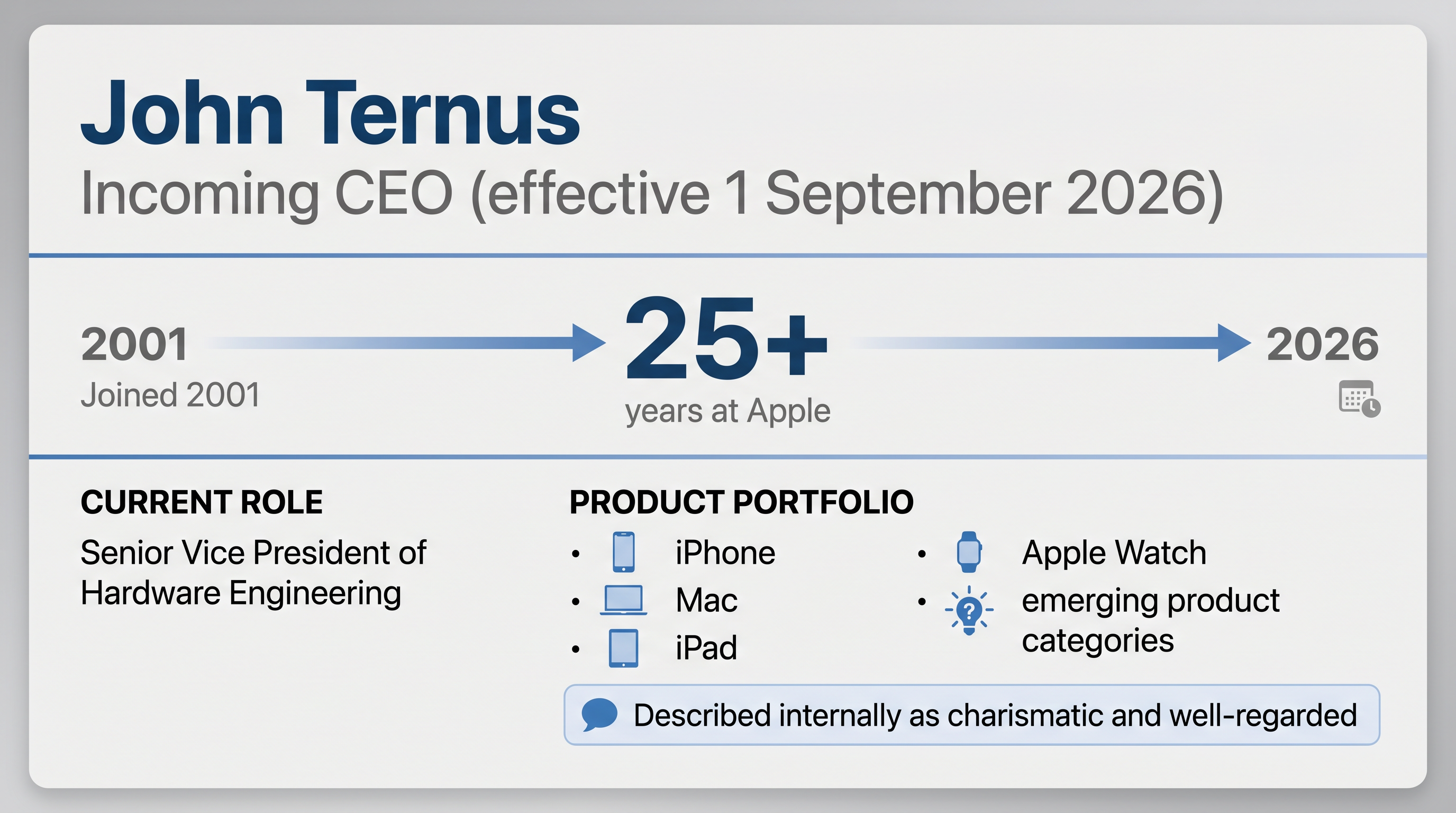
Hardware engineering leadership matters at Apple. This is the group that translates vision into physical products, navigates supply chain complexity, and manages the product development cycle that drives the company’s revenue base. Ternus has overseen this function through multiple product generations, giving him operational command of Apple’s core business.
Ternus’s key credentials:
Ternus’s selection signals Apple is prioritising product innovation continuity over, say, a services-focused leader or external hire. For investors, this suggests the hardware roadmap and product development culture that drove Apple’s growth under Cook will remain central to strategy under Ternus. The company is betting on product-first leadership rather than pivoting toward a services or software-centric executive profile.
The numbers tell the story of Cook’s tenure. Shares appreciated approximately 2,000% since he became CEO in August 2011. Over the 12 months leading into this transition announcement, shares climbed roughly 38%. Cook inherited a company still defined by Steve Jobs’s product genius and transformed it into a diversified technology and services powerhouse.
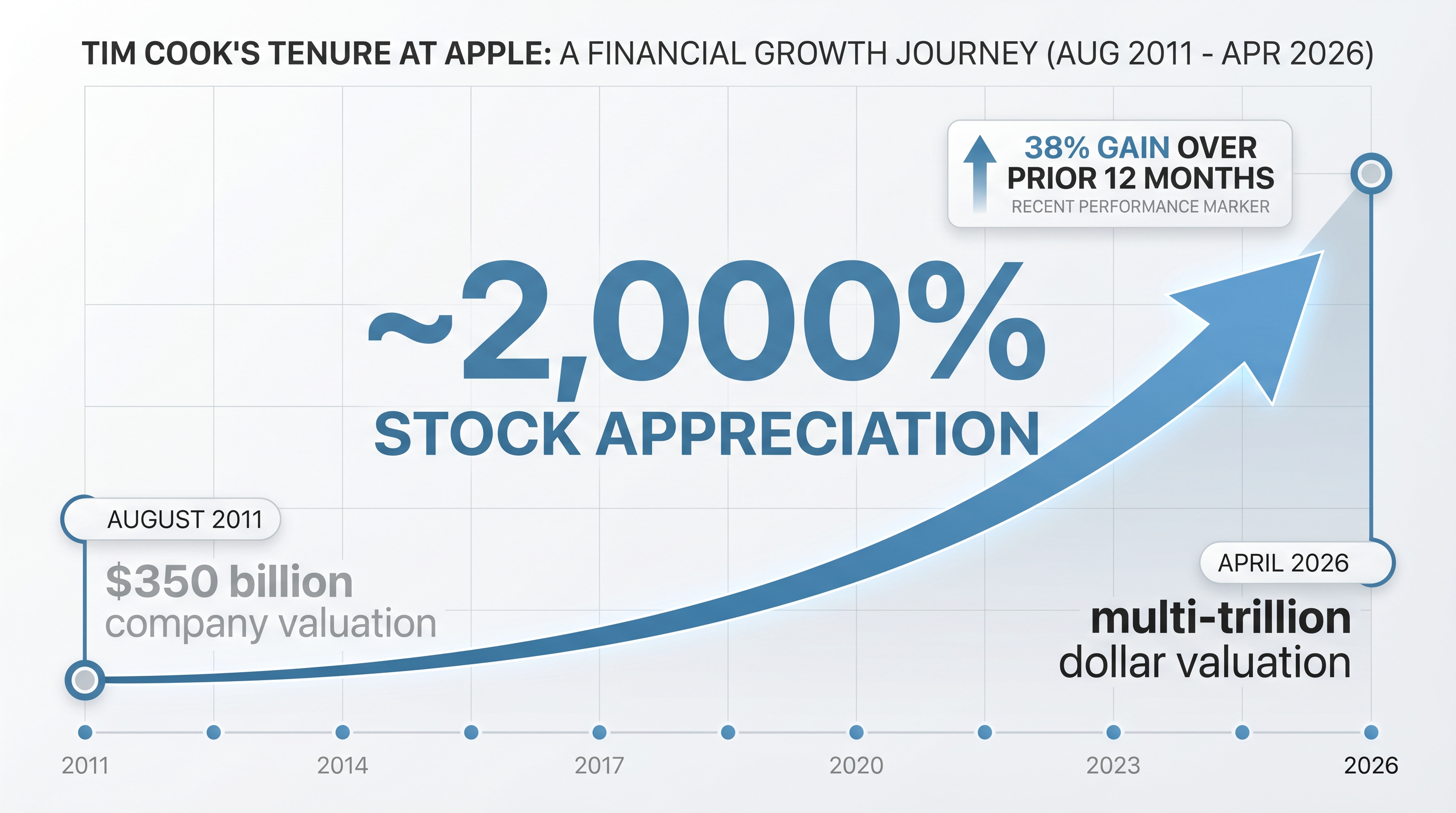
Value Creation Under Cook Approximately 2,000% stock appreciation since August 2011, representing one of the most successful CEO tenures in corporate history.
Cook’s financial legacy is one of sustained value creation at scale. He took a premium hardware company and expanded its revenue base through services, wearables, and ecosystem deepening. His move to chairman preserves this institutional wisdom at the board level, allowing Ternus to draw on Cook’s strategic judgment without the operational burden of the CEO role weighing on Cook’s schedule.
Cook’s tenure was marked by three major strategic pivots. Services revenue transformation turned Apple into a recurring revenue business, with subscription models and digital content creating predictable cash flow beyond hardware sales. Wearables category creation, through Apple Watch and AirPods, established entirely new product lines that now contribute materially to revenue. Ecosystem lock-in and customer retention strategy deepened the moat around Apple’s installed base, making switching costs prohibitively high for users embedded in the Apple ecosystem.
These shifts were less visible than product launches but more durable in their impact on Apple’s valuation. Cook understood that hardware alone could not sustain growth at Apple’s scale. The services and wearables expansions, combined with ecosystem reinforcement, are the strategic foundation Ternus inherits.
CEO transitions at mega-cap technology companies carry particular significance for global markets. These companies are often top holdings in major indices, and leadership uncertainty can trigger billions in market cap swings. Apple’s position as one of the world’s most valuable companies means this transition matters not just to Apple shareholders but to anyone with exposure to global equity markets.
Three factors typically influence market reaction to CEO transitions:
Apply these principles to the Apple situation. Ternus brings 25 years of product development expertise (strong credentials). Cook transitions to chairman rather than exiting entirely (structured continuity). The flat after-hours share movement suggests the market views these factors as reassuring. The muted reaction reflects either strong advance communication, confidence in Ternus, or faith in the Cook-as-chairman continuity structure. Investors should understand this dynamic when evaluating transition risk at any major holding in their portfolios.
Ternus inherits a company at peak valuation facing intensifying headwinds. Four major strategic challenges will define his early tenure.
Key strategic challenges:
Ternus inherits strong momentum in critical markets, with Apple’s China market performance showing 20% year-over-year shipment growth in Q1 2026 despite broader market contraction, though navigating ongoing geopolitical and regulatory complexities will test his strategic leadership.
Ternus’s hardware engineering background positions him well for product challenges but leaves open questions about services strategy, geopolitical navigation, and how Apple will compete in the AI race. His strategic vision remains largely unknown publicly.
Strategic Vision Unknown Ternus has not made public statements outlining his priorities or strategic approach as incoming CEO, leaving investors without clarity on how he will address these challenges.
The period between now and September 1, and the first two quarters under Ternus, will reveal whether his product-first background translates into strategic leadership across these broader challenges. Investors will be watching for early signals.
The September 1 effective date is the key timeline marker. Between now and then, and through Ternus’s first two quarters as CEO, investors should track specific signals that reveal his strategic direction.
Key monitoring points:
Cook’s continued presence as chairman provides a safety net during the transition period. This structure reduces the risk of strategic drift or governance gaps. However, investors should not assume continuity alone guarantees performance. Ternus will face scrutiny on execution, particularly around AI, China, and sustaining innovation momentum.
The current share performance context (38% gain over the prior 12 months) sets a high baseline. Ternus inherits strong market confidence. The question is whether he can maintain it.
For investors wanting to assess how the CEO transition might affect their Apple holdings, our dedicated guide to valuing Apple stock walks through the specific metrics, catalysts, and risk factors relevant to Apple’s current $3.9 trillion valuation, including how leadership transitions factor into institutional investor models.
Apple’s CEO transition is orderly and planned, with Cook moving to chairman rather than departing. Ternus’s 25-year tenure and hardware engineering background signal product continuity as the company’s strategic priority. The muted market reaction suggests confidence in the succession structure and Ternus’s credentials.
Significant strategic challenges await. AI integration, China market dynamics, regulatory pressure, and sustaining hardware innovation will test Ternus’s leadership. His vision for addressing these challenges remains to be articulated publicly. The September 1 transition date marks the beginning of a new chapter for Apple. Investors should focus on Ternus’s early strategic communications and any signals about AI, China, and product innovation priorities in the coming months.
This article is for informational purposes only and should not be considered financial advice. Investors should conduct their own research and consult with financial professionals before making investment decisions.
Apple announced on 20 April 2026 that Tim Cook will step down as CEO and be replaced by hardware chief John Ternus, with the change taking effect on 1 September 2026. Cook will remain at the company in a chairman role rather than departing entirely.
John Ternus joined Apple in 2001 as an engineer and rose to Senior Vice President of Hardware Engineering, giving him 25 years of experience overseeing the development of iPhone, Mac, iPad, Apple Watch, and other product categories. His selection signals Apple is prioritising product innovation continuity over a services-focused or externally hired successor.
After-hours share movement was essentially flat following the announcement, suggesting investors either anticipated the news or were reassured by the structured transition, which keeps Cook involved as chairman rather than removing him from Apple's strategic direction entirely.
Ternus inherits four major challenges: articulating a clear AI integration strategy, navigating China's geopolitical and regulatory risks, managing global antitrust and app store regulatory pressure, and sustaining hardware innovation at scale. His hardware engineering background positions him well for product challenges, but his broader strategic vision has not yet been publicly articulated.
Investors should track Ternus's first major public statements for strategic priorities, any changes to Apple's product roadmap, institutional investor positioning via 13F filings, and any senior leadership team changes that could signal whether Ternus is preserving continuity or reshaping Apple's executive structure.