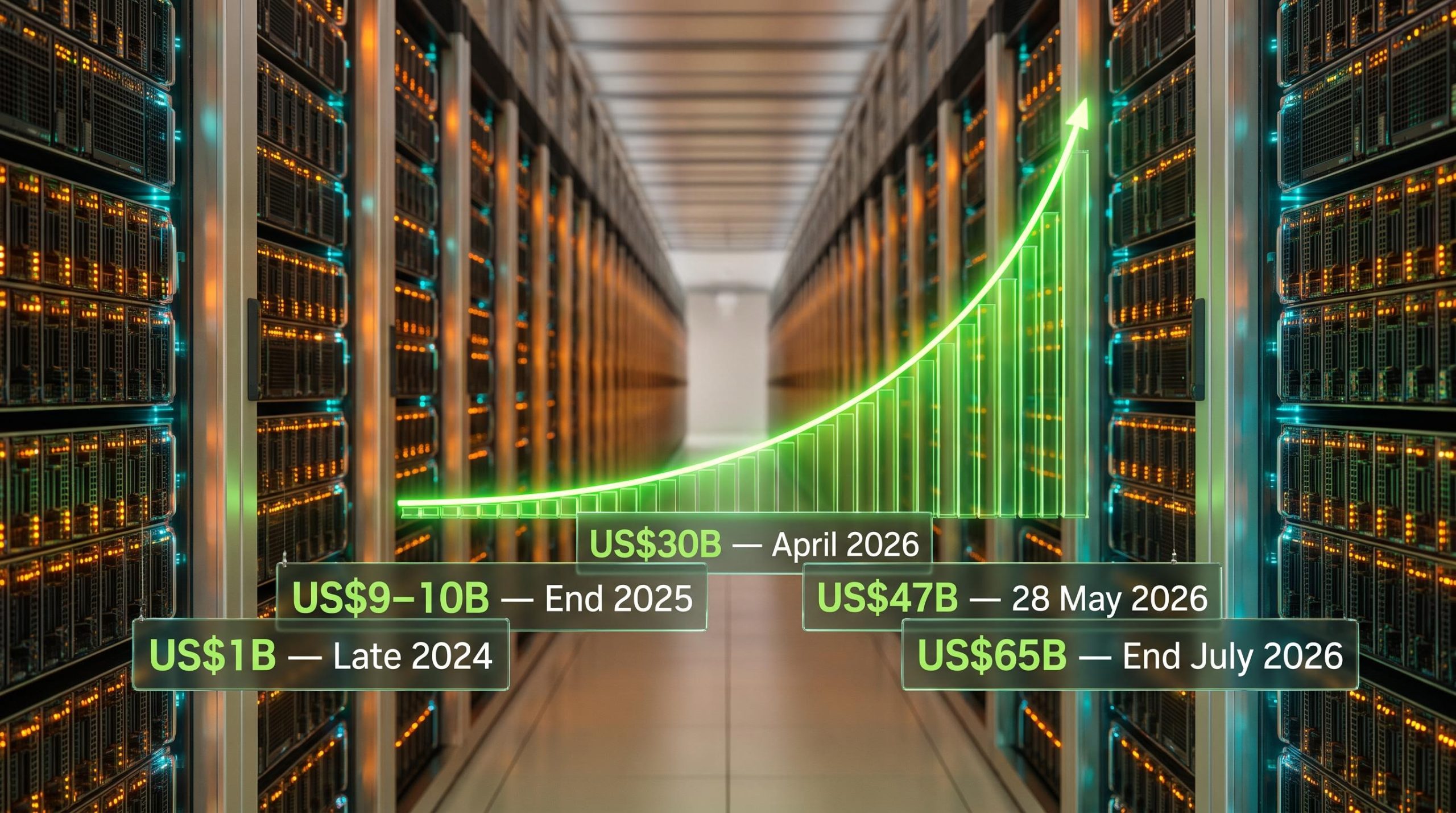
The overnight session delivered a split result: chipmakers pushed higher while broader indices slipped, and the driver had nothing to do with any semiconductor company. Anthropic, the privately held AI lab, disclosed an annualised revenue run rate that has now surpassed US$65 billion.
That figure is not a projection or a funding-round headline. It reflects actual billed usage of the Claude AI platform, compounding at a pace that has surprised even optimistic forecasters. For investors watching the AI theme, it functions as one of the clearest demand-side readings available on whether AI infrastructure spending is decelerating or still building momentum.
Here is what this milestone actually tells you about where the AI cycle sits right now, whether the semiconductor trade still has legs, and where Australian investors can access the theme through public markets.
From US$1 billion to US$65 billion in under two years: reading the run rate
The progression speaks for itself. Start at the beginning and watch the compounding accelerate:
- Late 2024: approximately US$1 billion run rate
- End of 2025: approximately US$9-10 billion run rate
- April 2026: approximately US$30 billion run rate
- 28 May 2026 (Series H announcement): US$47 billion run rate, officially disclosed
- End of July 2026: approximately US$65 billion run rate
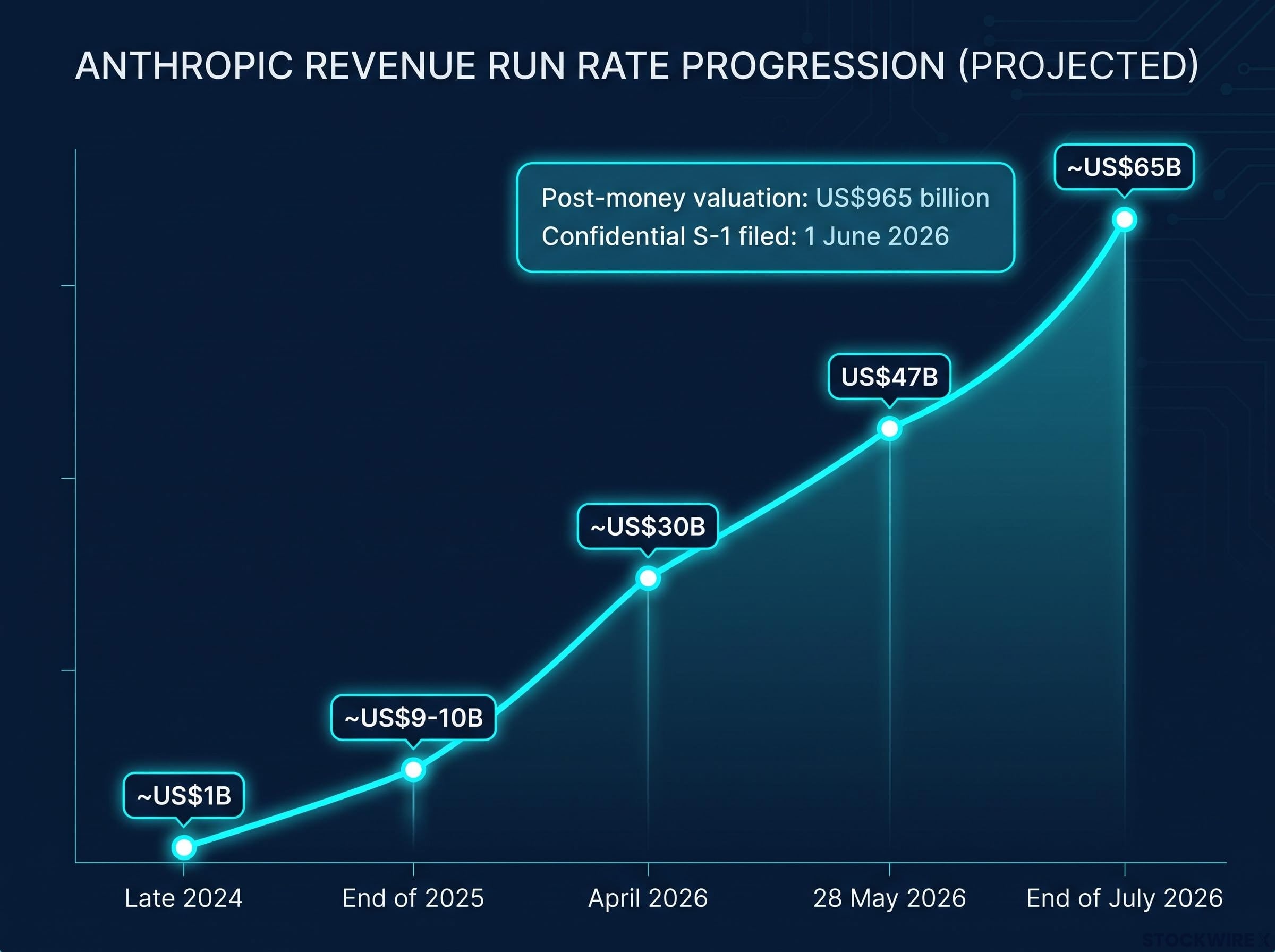
The Series H round raised US$65 billion at a US$965 billion post-money valuation. Anthropic filed a confidential S-1 on 1 June 2026, meaning these revenue figures now carry the weight of pre-IPO disclosure scrutiny.
The jump from US$47 billion to US$65 billion happened in a matter of weeks. That is the figure that recalibrated chipmaker sentiment overnight.
The speed of that May-to-July movement is where the signal sits. A growth curve that is still steepening at this scale tells you something different from one that is beginning to flatten. This one is steepening.
When big ASX news breaks, our subscribers know first
Why a private AI lab’s revenue growth moves chipmaker stocks
The connection between Anthropic’s revenue line and semiconductor order books is not sentiment. It is commercial plumbing.
How revenue becomes compute spend
AI platforms monetise usage. More paid queries and agent workflows mean more GPU hours. At the revenue levels Anthropic is now reporting, customers are running substantial volumes of inference and increasingly complex enterprise workloads, all of which require high-end accelerators. A large portion of the US$65 billion raised in Series H is earmarked for compute capacity expansion, not general operating expenditure. That capital flows directly to the hardware supply chain.
How compute spend becomes chip orders
The infrastructure categories that benefit are specific:
- GPU clusters and custom silicon
- High-bandwidth memory
- Networking hardware
- Advanced cooling and data-centre fit-out
Silicon providers participated as strategic investors in Anthropic’s Series H round. When memory and AI chip manufacturers invest directly in a customer growing at this rate, it signals long-term alignment rather than just a commercial relationship.
Hyperscaler capex flows into the AI hardware stack at a scale that gives Anthropic’s compute earmark real context: the four largest US cloud operators are collectively on track to spend between $630 billion and $725 billion on AI infrastructure in 2026 alone, a 62-77% increase over 2025 levels that structurally underpins near-term hardware pricing power.
The takeaway is that Anthropic’s revenue figure functions more like a forward order signal for chipmakers than a competitor’s earnings report. Understanding that transmission mechanism prevents you from treating the overnight semiconductor rally as speculative sentiment. There is direct commercial logic underpinning it.
Is this demand real, or are hyperscalers overbooking capacity?
The bear case deserves a fair hearing. The central sceptical argument is straightforward: hyperscalers may be over-ordering GPU capacity relative to actual workload demand, creating a future capex cliff that punishes chipmaker earnings when procurement pulls back.
Anthropic’s specific data complicates that argument on several fronts.
| Bear case assumption | Anthropic data point that challenges it |
|---|---|
| Demand is driven by consumer experimentation that could evaporate | Approximately 85% of revenue comes from enterprise customers on multi-year contracts |
| Growth is a one-off spike, not a durable trend | Revenue has compounded steadily from ~US$1B to ~US$65B over 20 months |
| Reported figures may overstate real demand | Confidential S-1 filing raises the legal and reputational cost of overstating metrics |
Approximately 85% enterprise revenue mix. Enterprise contracts do not disappear overnight the way consumer usage can.
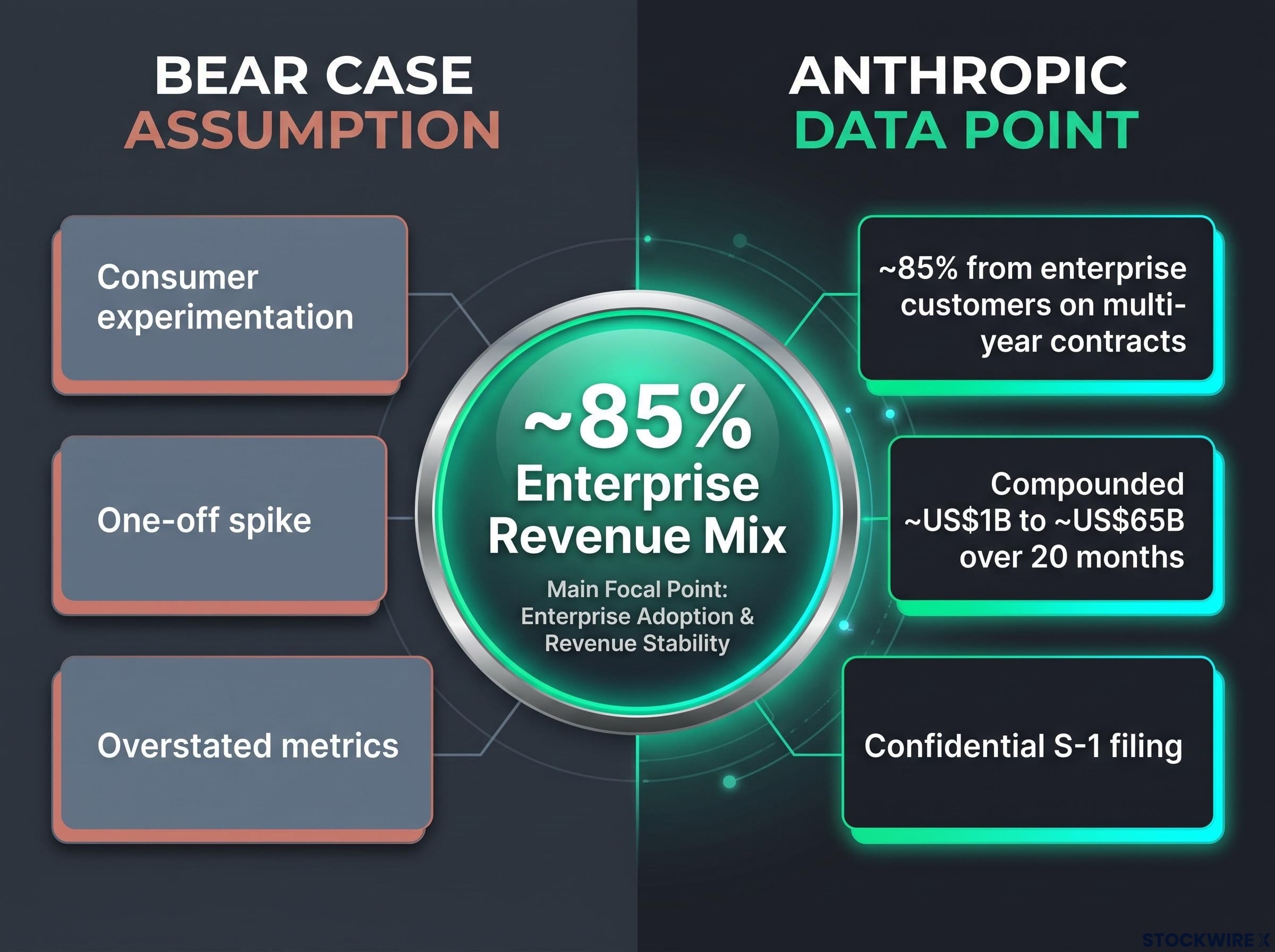
That enterprise mix figure is the most important single data point for evaluating demand durability. For Australian investors assessing whether the AI infrastructure trade still has legs, the distinction between enterprise-led and consumer-led demand is the difference between a durable structural position and a sentiment-driven trade.
The Stanford AI Index 2026 findings document accelerating enterprise AI adoption across regulated industries, providing independent corroboration that the shift from experimental to production workloads is broadening well beyond a handful of hyperscale customers.
This article is for informational purposes only and should not be considered financial advice. Investors should conduct their own research and consult with financial professionals before making investment decisions.
Where Australian investors can access this theme through public markets
Anthropic is privately held and not directly investable. The signal has to be translated into accessible vehicles, and the quality of that translation varies.
Three access routes, ranked by directness to the AI hardware theme:
- US-listed chipmakers via Australian brokerage platforms. Most Australian brokers now offer direct access to US-listed semiconductor names. This remains the most direct way to capture the demand signal that Anthropic’s growth represents.
- Technology ETFs and managed funds with semiconductor weighting. Some Australian-domiciled global equity funds carry meaningful exposure to AI chip beneficiaries. Check look-through holdings carefully; not all technology funds are meaningfully geared to AI hardware.
- Locally listed data-centre and network infrastructure operators. As Australian enterprises adopt AI, demand for domestic colocation rises, particularly where data residency rules apply. These operators are indirect beneficiaries as workloads are distributed and regionalised.
The practical implication is that the most direct exposure to Anthropic’s growth signal sits offshore in US-listed hardware names. The quality of indirect exposure through local vehicles varies significantly depending on fund composition, and that variation is worth checking before you allocate.
For Australian investors evaluating which access route best matches their risk tolerance, our full explainer on ASX AI ETF structures examines the fee, holdings, and concentration differences between IVV, NDQ, and GXAI with direct return comparisons.
Three risks that the Anthropic milestone does not resolve
Strong demand signals do not eliminate the variables that can break the trade. Three remain live:
- Concentration risk: A large share of AI semiconductor revenue flows through a small number of companies. Changes in hyperscaler procurement strategy have outsized effects on sector performance.
- Geopolitical and export control risk: Advanced chip regulations remain in active evolution as of mid-2026. Policy shifts can restrict market access or force costly product redesigns on short notice.
- Valuation risk: Anthropic’s US$965 billion post-money valuation and the re-rating of leading chipmakers already embed significant optimism about future AI demand.
Strong fundamentals reduce but do not eliminate the risk of over-discounting execution challenges. Paying for the right thesis at elevated multiples has historically been a reliable way to capture the trend and still underperform.
The durability of Anthropic’s enterprise revenue mix does not resolve a structural question that sits above it: foundation model economics may be inherently hostile to margin accumulation, with token price declines already compressing the monetisation window that justifies the capital intensity of frontier model development.
That valuation point is the most immediately relevant for Australian investors. These risks do not negate the thesis, but they define where it can break, and they should inform how you size the position rather than whether you take one.
Past performance does not guarantee future results. Financial projections are subject to market conditions and various risk factors.
What the milestone actually changes for the AI infrastructure thesis
Anthropic’s numbers confirm a transition that has been building for months. AI infrastructure spending is moving from a speculative build phase, where capital was deployed on the assumption that demand would arrive, into a demand-driven growth cycle where revenue is pulling the infrastructure forward. That is a meaningful shift.
What has changed is the confidence level in the demand signal. Enterprise-anchored, compounding revenue at this scale, disclosed under pre-IPO scrutiny, is a firmer foundation than forward capex guidance alone. What has not changed is the concentration, geopolitical, and valuation risk that sits around every name in the supply chain.
For Australian investors, the physical layer of AI, chips, memory, networking, and data centres, remains the most structurally supported part of the theme. The overnight chipmaker rally confirms that markets are pricing this signal in real time. The Anthropic milestone does not change the direction of the thesis. It raises the confidence level in the demand underpinning it, which is a meaningful but not uncritical upgrade to the investment case.
AI energy demand adds a further layer to the infrastructure investment thesis: AI accelerator racks draw 3-5 times more power per rack than traditional cloud workloads, which is driving hyperscalers toward long-duration firm power agreements with nuclear operators and renewable developers as a structural prerequisite for expanding the compute capacity that Anthropic’s growth is pulling forward.