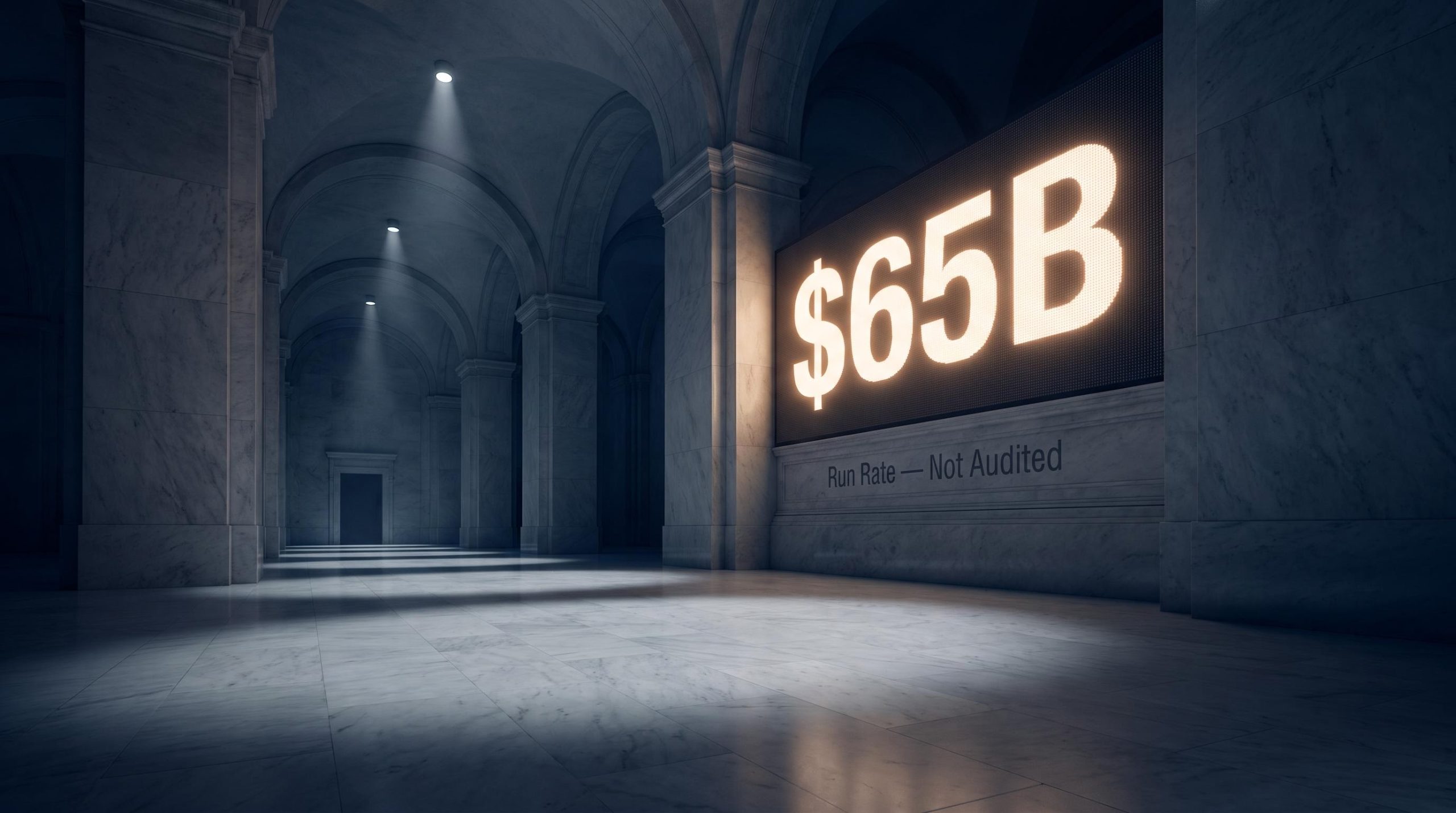
Anthropic reported an annualised revenue run rate exceeding $65 billion by the end of July 2026. That number is real. It is also not revenue, not audited, and not a guarantee that a public listing will happen on the timeline the market expects.
The distinction matters because Anthropic’s anticipated IPO is not just another tech offering. It is the event that will set valuation reference points for every frontier AI company seeking public capital, including OpenAI. The conditions required for this listing to succeed in a potential October window are specific, observable, and not yet aligned. Nvidia’s upcoming earnings call will shape the first and most important of those conditions before Anthropic can price a deal.
Here is the framework for evaluating whether those conditions will actually converge, what to watch in the next 60 days, and how to pre-define the decisions that will determine whether you participate wisely or reactively.
The $65 billion run rate is real, but it is not the same as $65 billion in revenue
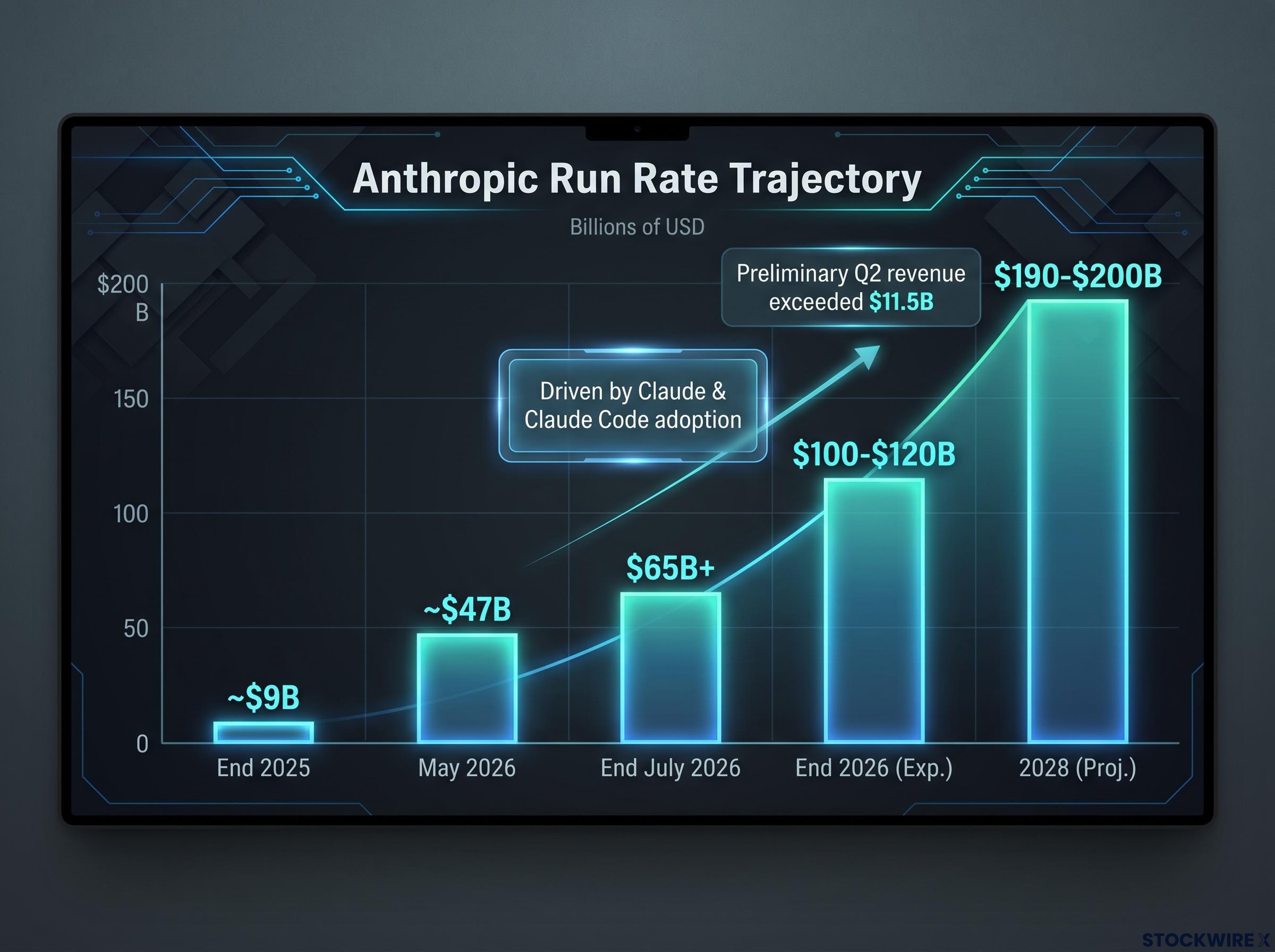
The trajectory is genuine and striking. Anthropic’s annualised revenue run rate grew from roughly $9 billion at the end of 2025 to $47 billion by May 2026 and past $65 billion by the end of July 2026. That is approximately 7x growth over roughly one year, driven by rapid enterprise adoption of Claude models and tools such as Claude Code. Preliminary second-quarter revenue exceeded $11.5 billion.
A run rate, though, is not trailing-twelve-month revenue. It is a simple annualisation: take the most recent month or quarter of revenue and extrapolate it over a full year. A run rate is a snapshot. It captures a moment. It does not account for contract expirations, seasonal variation in deal flow, pricing pressure, or customer concentration, all of which can cause actual booked revenue to land materially below what the run rate implied.
Anthropic’s consumption-based billing model, which underpins the run rate trajectory, means demand normalisation or pricing compression translates directly and immediately into revenue deceleration, with no contracted minimum revenue floor to buffer against a sudden change in enterprise deployment rates.
| Date | Reported Run Rate | Key Driver | Implied Annual Growth |
|---|---|---|---|
| End of 2025 | ~$9B | Early Claude enterprise contracts | Baseline |
| May 2026 | ~$47B | Claude model and Claude Code adoption | ~5x from baseline |
| End of July 2026 | $65B+ | Broadening enterprise demand | ~7x from baseline |
Investors expect the run rate to reach $100-$120 billion by end of 2026 if current trends hold.
Internal 2028 projection: Company disclosures shared with investors include a $190-$200 billion revenue projection for 2028. This figure has not been publicly filed or audited. It is best treated as scenario planning input, not guidance.
That figure is an extrapolation layered on top of already aggressive growth assumptions. Until the S-1 is filed, there is no independent verification of revenue recognition methodology, customer concentration, or contract durability behind any of these numbers. The gap between a run rate and audited revenue is precisely where investors have historically overpaid for high-growth technology companies.
What the near-trillion-dollar valuation implies about expected growth
Anthropic’s Series H round closed at a $965 billion post-money valuation after raising $65 billion in May 2026. Against the $65 billion run rate, that implies a mid-teens price-to-sales multiple, rich relative to most publicly traded large-cap software and cloud names even given the growth profile.
The question the market has not yet answered: what revenue and margin combination would Anthropic need to deliver by 2027-2028 to justify that multiple at a flat or modest premium to current private-market pricing? If the $190-$200 billion internal projection proves optimistic by even 20-30%, the valuation math tightens considerably. That reconciliation is exactly what the S-1 will force into public view.
When big ASX news breaks, our subscribers know first
Why Nvidia’s next earnings call matters more to Anthropic’s IPO than Anthropic’s own revenue
Nvidia is the primary barometer for AI infrastructure demand. Its dominance in GPU supply for training and inference across hyperscalers and leading AI labs, including Anthropic itself, means that each earnings report functions as a sector-wide health check. What Nvidia’s management says about capital expenditure, financing, and pipeline in the coming weeks will directly shape whether institutional investors are willing to price a frontier AI company at premium multiples.
Each Nvidia earnings cycle functions as a real-time audit of the AI spending cycle, with management commentary on Blackwell supply normalisation, guidance specificity, and hyperscaler demand confirmation carrying as much weight for sector positioning as the reported headline revenue figures.
The specific items to monitor on Nvidia’s earnings call:
- Hyperscaler demand visibility: colour on order pipelines, new cloud regions, or changes in deployment timelines
- Customer mix: whether AI spending is broadening beyond a few large buyers or remaining concentrated
- Financing arrangement language: comments on leases, vendor financing, or extended payment terms that reveal how much credit risk is embedded in the buildout
- Regulatory and export commentary: restrictions on advanced chips that could cap addressable demand globally
The technical setup adds context. Nvidia, currently valued at approximately $5.16 trillion, has remained in a broad trading range since April following an upward move around Liberation Day. Analysts suggest the stock could drift toward the lower portion of its range ahead of earnings.
Options market signal: Options pricing reflects an anticipated move of around 11 points into Nvidia’s earnings, which represents close to 5% of the share price. Should the stock fall by two standard deviations, it would arrive near the lower boundary of the trading range it has occupied since April.
One historical parallel is instructive: an earlier, extended period of sideways trading ultimately produced what appeared to be a downside break before the stock reversed and surged to a record high. That prior consolidation ran for approximately twice the duration of the current one, leaving open the possibility that the present range could hold well into the new year.
The short-term price move matters less than the fundamental signal. If Nvidia’s management signals capex moderation, tighter financing terms, or any softening in hyperscaler demand visibility, institutional investors will re-rate the entire AI stack before Anthropic’s deal is priced. That scenario is a concrete reason to reassess both the October window and your valuation assumptions for the listing.
The conditions framework: what has to go right before October
The Anthropic listing requires four conditions to align. These are independently necessary, not collectively sufficient. Partial alignment across all four is not enough; each one is a genuine gate.
Ordered by how directly you can monitor them right now:
- No major macro or credit shock. Equity volatility (VIX) and credit spreads need to remain within a range that allows large IPOs to price without steep discounts. This is the most observable condition. You can check it daily.
- AI demand narrative remains intact. Nvidia and hyperscaler commentary must continue supporting sustained or rising AI capex. The upcoming earnings cycle is the next checkpoint.
- Institutional valuation tolerance at near-trillion-dollar pricing. Public investors must accept a premium multiple for growth and perceived moat. If broader AI valuations compress before the deal, Anthropic faces pressure to adjust pricing or defer.
- Anthropic’s S-1 disclosures withstand scrutiny. The eventual S-1 must reconcile the $65 billion run rate with detailed revenue recognition, customer concentration, margins, and contract structures. This is the least observable condition because the document has not been publicly filed.
| Condition | Observable Signal | Downside Scenario |
|---|---|---|
| Macro stability | VIX, index drawdowns, yield-curve moves | Sharp equity selloff forces deal delay or steep discount |
| AI demand narrative | Nvidia/hyperscaler capex guidance | Capex moderation triggers re-rating across AI names |
| Valuation tolerance | AI sector multiple compression, rate expectations | Near-$1T pricing rejected; deal repriced or deferred |
| S-1 withstands scrutiny | Not yet observable (document unfiled) | Revenue recognition or concentration gaps shake confidence |
October is one plausible window among several. 2027 is a realistic alternative if conditions weaken.
Why the S-1 will matter more than any pre-IPO headline
An S-1 filing under SEC standards requires disclosure that private investor presentations do not: revenue recognition methodology (how and when revenue is booked), customer concentration by percentage of revenue, margin structure including cost of revenue and operating expenses, and material risk factor disclosure including contract terms and competitive threats.
When the S-1 is filed, here is what to look for: whether the reported revenue aligns with the run rate extrapolation, how concentrated revenue is among a small number of enterprise customers, what the gross and operating margin profile looks like, and whether the risk factors surface dependencies or contract structures not previously disclosed. The gap between private-market slide decks and a public filing under SEC standards is the single largest unquantifiable risk in Anthropic’s listing timeline.
What retail investors can realistically do before the IPO window opens
Retail allocation at IPO price in a deal of this profile will be minimal. Institutional and strategic investors will dominate the book. By the time shares are widely tradable, early euphoria may already be priced in. That is not pessimism; it is the structural reality of how marquee technology IPOs are distributed.
IPO share allocation mechanics systematically disadvantage retail participants: institutional and strategic investors receive preferential access at the offering price, while retail buyers typically enter only after the secondary market opens and the first-day price movement has already reflected institutional demand.
The preparation that matters happens before the S-1 is filed, not after the ticker starts trading. Three decisions to resolve now:
- Access method. Decide whether you will participate only via secondary market trading after shares begin trading publicly. Accept that the IPO price itself is likely inaccessible.
- Allocation cap. Set a maximum portfolio allocation to a single frontier AI name before the excitement of listing day overrides your judgement. Size positions assuming high volatility and the possibility that the stock trades below the IPO price at some point, even if the long-term thesis is intact.
- Entry and exit conditions. Pre-define the valuation at which you would buy, the conditions under which you would add or trim, and the scenario that would trigger an exit. Resolve these in advance.
Build a scenario-based valuation exercise now. Use base, high, and low cases for 2026-2028 revenue, apply a range of price-to-sales multiples calibrated against public comparables (Nvidia, major cloud hyperscalers, AI-exposed software names), and identify the combinations at which the stock would be attractive versus uninvestable. The $65 billion run rate is a data point, not a floor.
Historically, marquee tech IPOs frequently show strong early trading followed by multiple compression into or after lock-up expiration as early holders take profits and supply increases. Calendar the lock-up expiration date the moment it is disclosed.
Between now and October, monitor these catalysts:
- Nvidia earnings and forward guidance
- Hyperscaler capex commentary from major cloud providers
- Fed communications and rate expectations
- VIX levels and broad index stability
The core tension: The $65 billion run rate is both unprecedented in scale and inherently fragile relative to full-year booked revenue. Treat this as a high-opportunity, high-uncertainty situation, not a guaranteed path to outsized returns.
The investors most exposed to permanent capital loss in high-profile AI IPOs are those who size positions based on narrative momentum rather than a pre-defined entry condition. Leave this preparation phase with a specific valuation threshold, not a general inclination.
What a successful or failed Anthropic listing would actually signal
The Anthropic IPO is a price-discovery event for an entire category. The multiple at which it prices and where it trades in the first month will set comparables that institutional investors use to value OpenAI and every other frontier AI company seeking public capital. No comparable company has sought liquidity at this scale in the AI category.
A successful listing would validate institutional tolerance for high-multiple, pre-profitability AI companies at scale. It would signal that public markets are willing to extend on duration risk for frontier AI in a way that supports further listings and sustains private-market valuations across the sector.
A stumble or deferral would signal the opposite: a valuation ceiling for the category, repricing risk across both private and public AI names, and a materially harder path for OpenAI or any other frontier lab approaching public markets.
The AI IPO valuation framework that applies to Anthropic applies equally to OpenAI: neither company has filed public financials, and both carry private-market multiples that assume sustained revenue growth at a pace with no clear historical precedent in enterprise software.
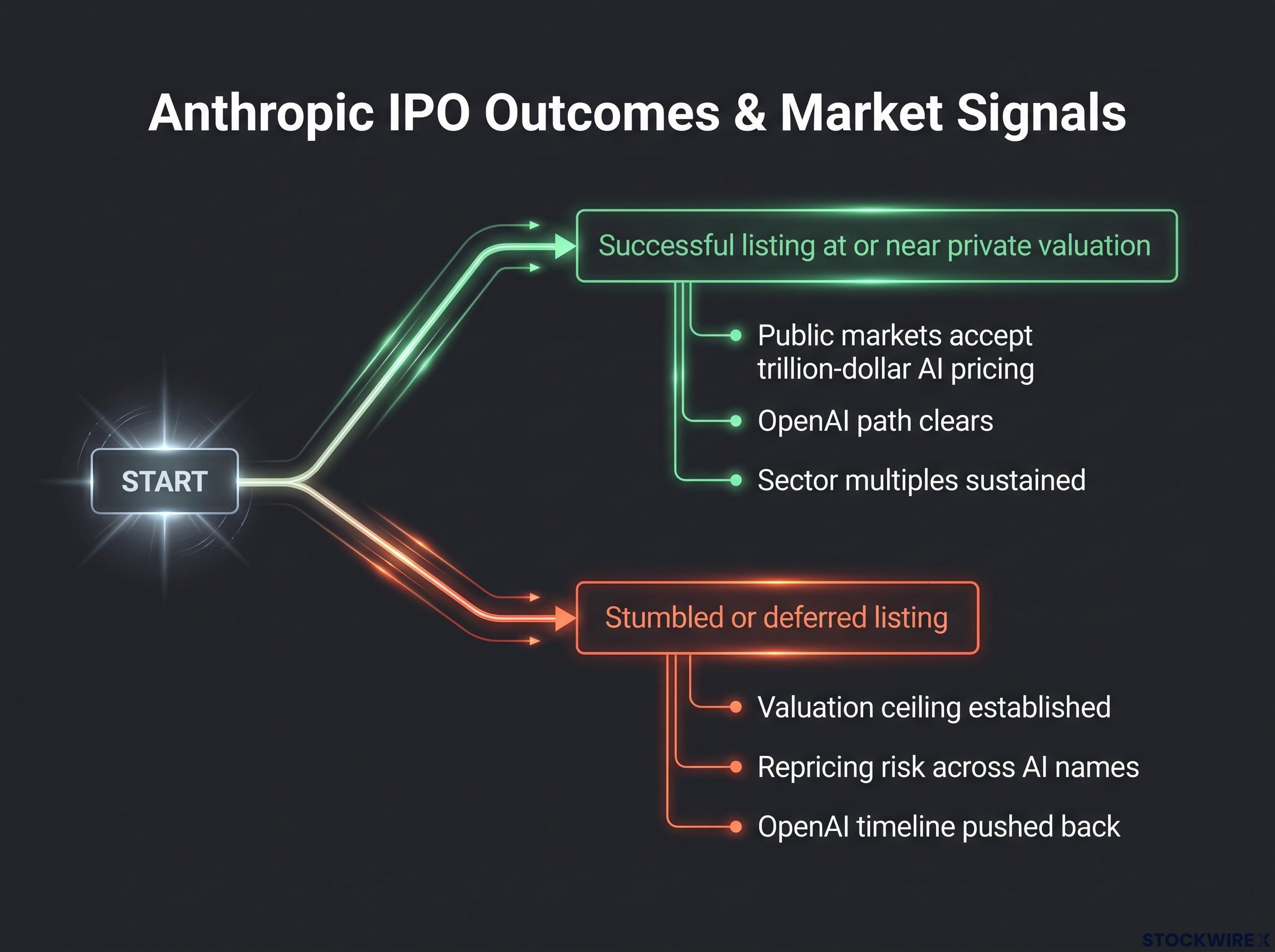
| Outcome | Market-Wide Signal |
|---|---|
| Successful listing at or near private valuation | Public markets accept trillion-dollar AI pricing; OpenAI path clears; sector multiples sustained |
| Stumbled or deferred listing | Valuation ceiling established; repricing risk across AI names; OpenAI timeline pushed back |
Whether or not you plan to participate, watching how institutional investors price Anthropic’s S-1 will provide the clearest real-time signal available about the market’s actual tolerance for AI company valuations at trillion-dollar scale. The information value of this process is high even if you never buy a single share.
This article is for informational purposes only and should not be considered financial advice. Investors should conduct their own research and consult with financial professionals before making investment decisions.
Making a disciplined call on the most consequential AI IPO of the decade
The $65 billion run rate is real but unaudited. The October window is plausible but contingent. Nvidia’s earnings are the first observable gate. The S-1 is the document that will determine whether private-market projections survive public scrutiny.
If you complete the valuation scenario exercise and pre-define your entry conditions before the S-1 is filed, you are in a categorically better position than investors who react to headlines.
The next 60 days will answer the question directly. Nvidia’s earnings, hyperscaler capex guidance, and the eventual S-1 filing form a sequenced information flow. Watch them as connected events, not isolated headlines.
Financial projections referenced in this article are subject to market conditions and various risk factors. Past performance does not guarantee future results.
—