Investors are sitting on roughly 22% of their total assets in cash or cash-equivalent instruments, according to a recent UBS Sentiment survey, even as major equity indices trade within reach of all-time highs. UBS’s Chief Investment Office has now put a name to this behaviour: it is the bigger risk.
The logic is straightforward. Declining deposit rates combined with persistent inflation mean that holding excess cash is not a neutral act. Every quarter that capital sits idle, its real purchasing power shrinks. The reader who believes they are avoiding risk by waiting is, in UBS’s framing, simply accepting a different, quieter kind of risk, one that compounds in the background rather than appearing on a screen.
Here is what this analysis covers: the evidence behind UBS’s argument, the practical three-bucket framework for separating genuine liquidity needs from investable capital, the case for phased versus immediate deployment, and why the decision to move out of cash is also a portfolio health decision. By the end, you will have a clear read on whether the cash sitting in your accounts reflects a deliberate plan or an accumulated default.
Why 22% in cash is a problem, not a precaution
22% of investor assets held in cash or cash-like instruments, even as major indices approached record levels. Source: UBS Sentiment survey, reported 1 August 2026
That figure captures the scale of the behaviour. Nearly a quarter of total investable wealth, parked in deposits and money market accounts, while the market it was meant to be deployed into kept climbing.
UBS frames this not as prudence but as a structural misalignment. Two forces work simultaneously against cash held beyond near-term requirements: deposit rates are falling, while inflation quietly chips away at what each pound of those balances can actually buy. The result is that idle holdings deteriorate in real terms even when the headline figure on a statement appears unchanged.
Federal Reserve data quantifies the real purchasing power erosion that UBS’s framework describes qualitatively: at 3% average annual inflation, $50,000 held in a low-yield savings account retains only the purchasing power of roughly $20,600 after 30 years, a loss of nearly 59% without the headline balance ever declining.
The Global Investment Returns Yearbook 2026, co-authored by London Business School professors, documents how inflation has materially eroded purchasing power across asset classes over long time horizons, reinforcing why real, inflation-adjusted returns must anchor any comparison between cash and invested capital.
The instinct behind it is understandable. Geopolitical instability, rate uncertainty, and stretched valuations all feel like reasons to wait. But UBS’s research into past geopolitical disruptions shows that the resulting market disturbances have generally been brief, with prices ultimately re-anchoring to the trajectory of corporate earnings and broader economic conditions. Waiting for full clarity, in other words, has historically produced chronic underallocation rather than better entry points.
Valuation metrics such as CAPE carry near-zero predictive power over one-to-three year horizons, which is precisely why the instinct to wait for cheaper markets has historically produced chronic underallocation rather than better entry points.
What this means for you: if your cash allocation is close to that 22% average, the question is whether it reflects a documented spending plan or an accumulated habit of delay. UBS’s data suggests the latter is far more common, and far more costly, than most investors realise.
When big ASX news breaks, our subscribers know first
What thirty years of market history actually says about investing at highs
The most common objection to deploying cash near market highs is that it feels late. Buying after a sustained rally triggers the instinct that a pullback must be imminent. UBS tested that instinct against three decades of U.S. equity data.
The finding: returns in the twelve months following new record highs were equivalent to or better than returns at other market points. Markets that have just set a high are, statistically, not more dangerous entry points than markets that have not. The reason is structural. Equities trend upward over long horizons, and new highs are typically part of ongoing expansions rather than reliable indicators of imminent reversal. Markets spend substantial periods near or above prior peaks, which means a strategy that systematically avoids highs ends up missing large portions of long-term compounding.
UBS projects approximately 21% worldwide corporate profit expansion during 2026, supported by stable economic momentum and earnings growth broadening beyond the narrow technology sector. Source: UBS strategy report, 1 August 2026
That forward projection matters because it shows UBS’s thesis is not purely backward-looking. The historical data removes the assumption that highs are inherently dangerous. The earnings projection supplies a reason to expect the current cycle to continue producing returns for deployed capital.
None of this guarantees that any twelve-month period will be positive. But it shifts the burden of proof. You should now require a specific, documented reason to stay in cash, rather than a specific reason to invest. The default has changed.
The three-bucket framework: separating what you need from what you are hoarding
UBS’s practical framework for deciding how much cash to keep, and how much to deploy, rests on a simple diagnostic. Divide your total cash holdings into three segments based on when you will actually need the money. Anything that falls into the third bucket is investment capital, full stop.
Bucket 1: everyday cash
This covers daily spending, near-term tax liabilities, and pre-planned financial commitments over the next 6-12 months. The vehicles here are deposits, money market funds, and certificates of deposit. The goal is minimal risk and immediate access.
Bucket 2: planned outflows
This covers known obligations over the coming two years: a property deposit, a tuition payment, a business expense. Bond ladders (individual bonds or fixed-maturity bond funds with staggered maturities) and certain capital-preservation structures are the recommended vehicles. The goal is predictable cash flows with managed interest rate risk.
Bucket 3: investment capital
Anything remaining after Buckets 1 and 2 are funded belongs here. The timeframe is 2-5 years, and the recommended vehicles are diversified equity portfolios and multi-sector fixed income. This is where the real reframing happens: UBS treats this surplus not as a reserve but as capital that should be working toward higher expected real returns.
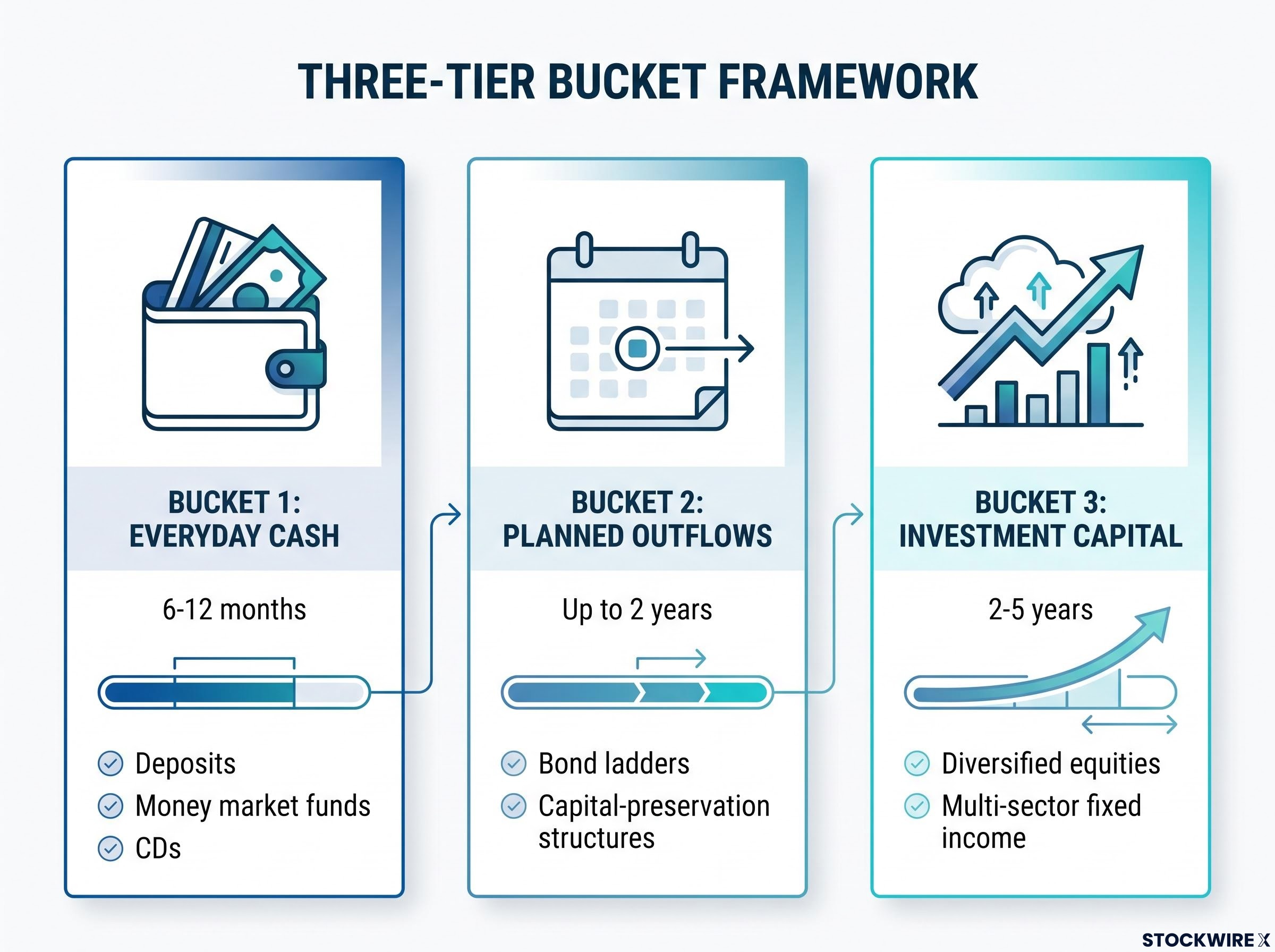
| Bucket | Timeframe | Recommended vehicles |
|---|---|---|
| 1: Everyday cash | 6-12 months | Deposits, money market funds, CDs |
| 2: Planned outflows | Up to 2 years | Bond ladders, capital-preservation structures |
| 3: Investment capital | 2-5 years | Diversified equities, multi-sector fixed income |
For most readers, applying this framework honestly will reveal that a significant portion of what they call “cash reserves” actually belongs in Bucket 3. The money is not earmarked for anything specific. It is simply sitting there because no deployment decision was ever made. That is the gap UBS is asking you to close.
Phased entry vs. lump sum: what UBS actually recommends
The question that follows the framework is mechanical: once you have identified your Bucket 3 surplus, how do you move it into markets?
UBS recommends a three-step deployment sequence:
- Optimise your liquidity strategy. Right-size Buckets 1 and 2 to documented needs. Use bond ladders and high-quality fixed income for near-term money rather than leaving it in low-return deposits.
- Phase excess cash into diversified portfolios. Invest equal amounts monthly or quarterly over 6-12 months to reduce the psychological friction of committing capital all at once.
- Consider income replacement. If you have been relying on deposit interest and face declining rates, shift toward equity income strategies and yield-generating structured strategies to maintain cash flow from your portfolio.
Here is where UBS is notably honest about the trade-off. Gradual entry into markets is primarily a tool for managing investor behaviour rather than a method for improving returns. Because markets have a long-run tendency to appreciate, investing a lump sum in one go has historically delivered stronger outcomes than spreading purchases over time. Spreading deployment across months or quarters is therefore no guarantee of a superior result compared with committing capital immediately.
Lump-sum investing outperforms phased deployment in approximately 68-73% of historical periods across every major market studied, a finding that reinforces UBS’s own acknowledgement that gradual entry is primarily a behavioural tool rather than a return-optimisation strategy.
UBS’s stated priority is acting, not finding a perfect schedule. Source: UBS strategy report, 1 August 2026
If you have been waiting for a defined reason to start, phased entry gives you a structure that removes the need for a perfect reason. That is its entire value. Either approach, lump sum or phased, beats the alternative of remaining indefinitely in cash. The choice between them is about your temperament, not about optimising returns.
Concentration risk: the hidden problem cash deployment can fix
The deployment decision carries a second, less obvious benefit that has nothing to do with market timing.
Approximately 40% of self-directed equity investors on UBS’s platform allocated more than half of their equity holdings to ten or fewer individual stocks. Source: UBS platform data, reported by Investing.com, 1 August 2026
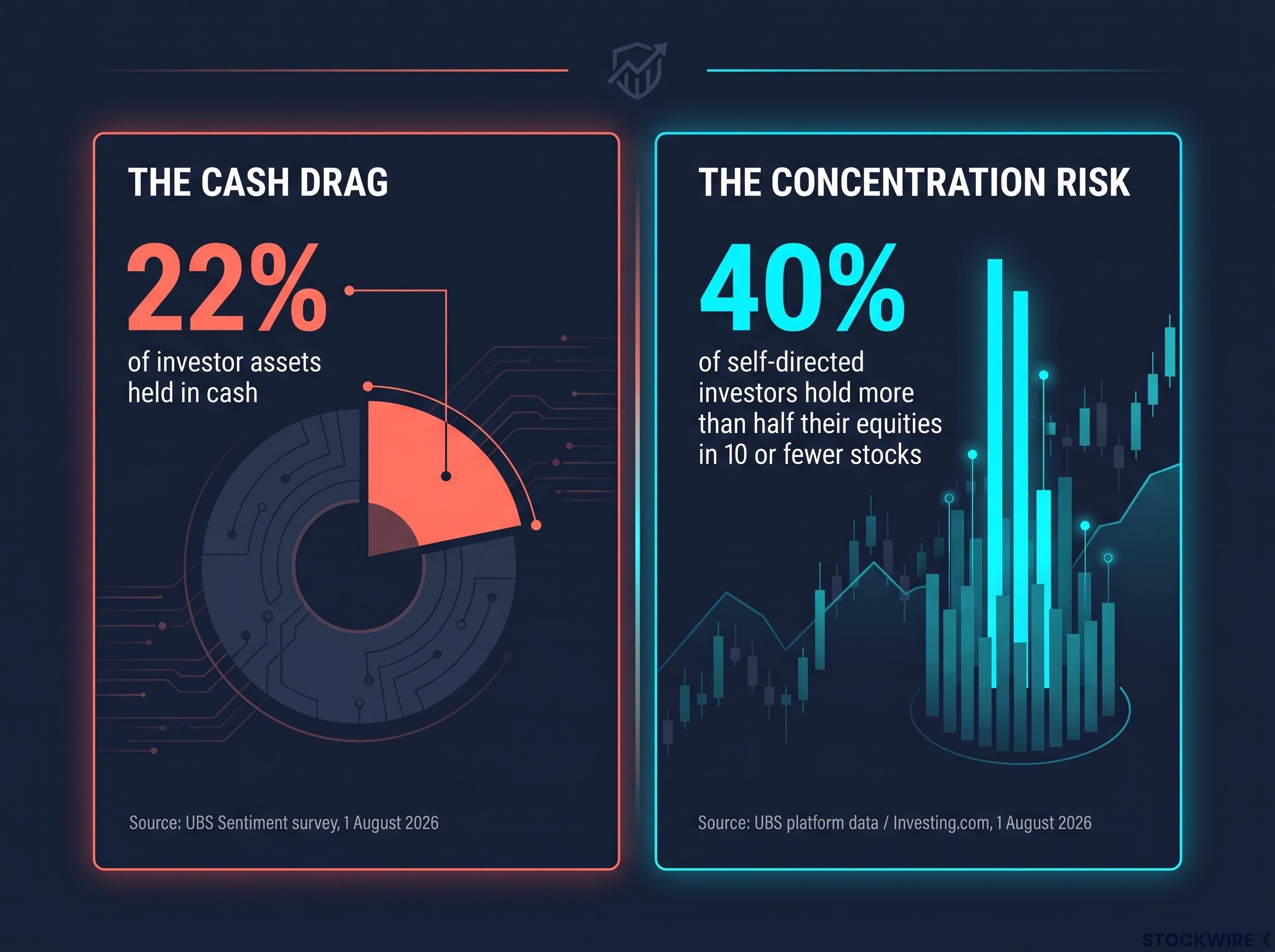
That statistic reframes what happens when idle cash moves into markets. If you deploy surplus capital into the same concentrated handful of stocks you already own, you are not solving the problem. You are compounding it. UBS frames cash deployment as an explicit opportunity to correct concentration risk, not merely to expand overall market exposure.
The recommended diversification spans several categories:
- Equities diversified across sectors and geographies
- High-quality fixed income (government bonds and investment-grade credit)
- Multi-sector fixed income and credit, calibrated to risk tolerance
- Infrastructure assets
- Selective structured and alternative strategies
UBS also notes that bonds at the shorter end of the maturity spectrum may help absorb shocks in the event of rising equity market turbulence, giving the fixed income sleeve a stabilising function within the broader portfolio.
For multi-year capital (Bucket 3 surplus), UBS identifies six long-term structural themes as preferred destination asset classes:
- Artificial intelligence and its diffusion across industries
- Energy transition and critical commodities
- Longevity and ageing-population services
- China’s structural reforms
- Japan’s equity market reforms
- Broader emerging market growth dynamics
The point is that deploying idle cash is not just a timing decision. It is a portfolio construction decision. Done deliberately, it addresses two problems at once: the opportunity cost of cash and the concentration risk that many self-directed investors have accumulated without realising it.
What changes when you stop waiting, and what does not
UBS’s argument is not a call for market optimism. UBS explicitly recognises that factors including geopolitical tensions, persistent inflation, shifting interest rate expectations, high valuations, and uncertainty over the long-term trajectory of AI investment spending all represent genuine sources of risk. They do not disappear when cash is deployed.
What changes is the response to those risks. UBS’s consistent position is that diversification is the correct answer to uncertainty, not inaction. Waiting for conditions to fully resolve produces chronic underallocation to growth assets, and uncertainty, by its nature, never fully resolves.
For investors wanting to stress-test a deployment decision against specific downside scenarios, our deep-dive into UBS’s scenario framework examines the three-path probability model in detail, including the 20% downside case that combines an energy shock with AI sentiment weakness to produce double-digit equity declines.
UBS’s central conclusion: Chronic underallocation to growth assets is the greater long-term risk, not the act of investing thoughtfully in a market near its highs. Source: UBS strategy report, 1 August 2026
The question you should take from this is not “is now a good time?” but “what is the cost of continuing to wait?” UBS’s data provides a clear answer to the second question even without resolving the first. A 22% cash allocation that lacks a documented spending rationale is not a hedge. It is a slow leak.
UBS recommends that investors work with an adviser to align any cash deployment plan with their individual financial circumstances. The framework above provides the diagnostic structure; the specific allocation should reflect your goals, timeline, and risk tolerance.
This article is for informational purposes only and should not be considered financial advice. Investors should conduct their own research and consult with financial professionals before making investment decisions. Past performance does not guarantee future results. Financial projections are subject to market conditions and various risk factors.
—