Taiwan’s consumer price index cooled to 2.33% in October, yet producer prices jumped 19.7%, the fastest pace on record. When the cost of making goods surges while shelf prices ease, the calm headline number may be hiding where the pressure is building.
There is a complication. Two sets of October figures for Taiwan inflation are in circulation, one for October 2025 and one for October 2026, and mixing them leads to wrong conclusions. The 2.33% CPI, 19.7% PPI, US$596.4bn reserves and roughly US$28bn outflow figures come from an episode cited by Commerzbank strategists and reported on 5-6 November 2026, earlier this week.
The official October 2025 data tells a quieter story: CPI of 1.48%, PPI of -3.50% and reserves of US$600.20bn. Here is how to read the gap between consumer and producer prices, judge the currency defence, and see what both mean for the central bank’s next move.
Two Octobers, two very different data sets: what the figures actually say
Search for Taiwan’s October inflation and you may find CPI at 1.48% in one place and 2.33% in another. Both figures are real. They belong to different years.
The official October 2025 baseline
The Directorate-General of Budget, Accounting and Statistics (DGBAS) released its October 2025 price indices on 6 November 2025. The consumer price index (CPI), which tracks what households pay for goods and services, rose 1.48% year on year and 0.47% month on month. Core CPI, which strips out fruit, vegetables and energy, came in at 1.84%.
Household costs did the lifting. Meat rose 5.43%, food away from home 3.56%, household operations 5.57% and residential rents 2.14%.
The producer price index (PPI), which measures prices received by domestic producers, fell 3.50% year on year. Chemicals, petroleum and coal products, basic metals and electronics dragged it lower. Nothing in this release supports a record PPI surge.
The DGBAS October 2025 price index release breaks the PPI decline into sub-index drivers, including chemical materials, basic metals and electronic parts, which shows how little of that baseline resembles the upstream cost shock now being debated.
The 2026 episode and the 2% alert threshold
The 2026 episode looks very different. CPI of 2.33% undershot Bloomberg consensus of 2.60% and slowed from an upwardly revised 2.74% in September. Core CPI of 2.23% also missed the 2.30% forecast, helped by softer food and energy prices.
Even so, CPI has now sat above the Central Bank of the Republic of China (Taiwan) (CBC) 2% alert level for six consecutive months. That run applies to 2026 only.
| Metric | 2026 episode (reported 5-6 Nov 2026) | Official October 2025 |
|---|---|---|
| CPI y/y | 2.33% (consensus 2.60%) | 1.48% |
| Core CPI y/y | 2.23% (consensus 2.30%) | 1.84% |
| PPI y/y | +19.7% (record) | -3.50% |
| FX reserves | US$596.4bn | US$600.20bn |
| Net foreign outflows | About US$28bn | Not found |
What this tells you is simple: a Taiwan inflation figure means little until you know which year it belongs to. Check the source date before you rely on it.
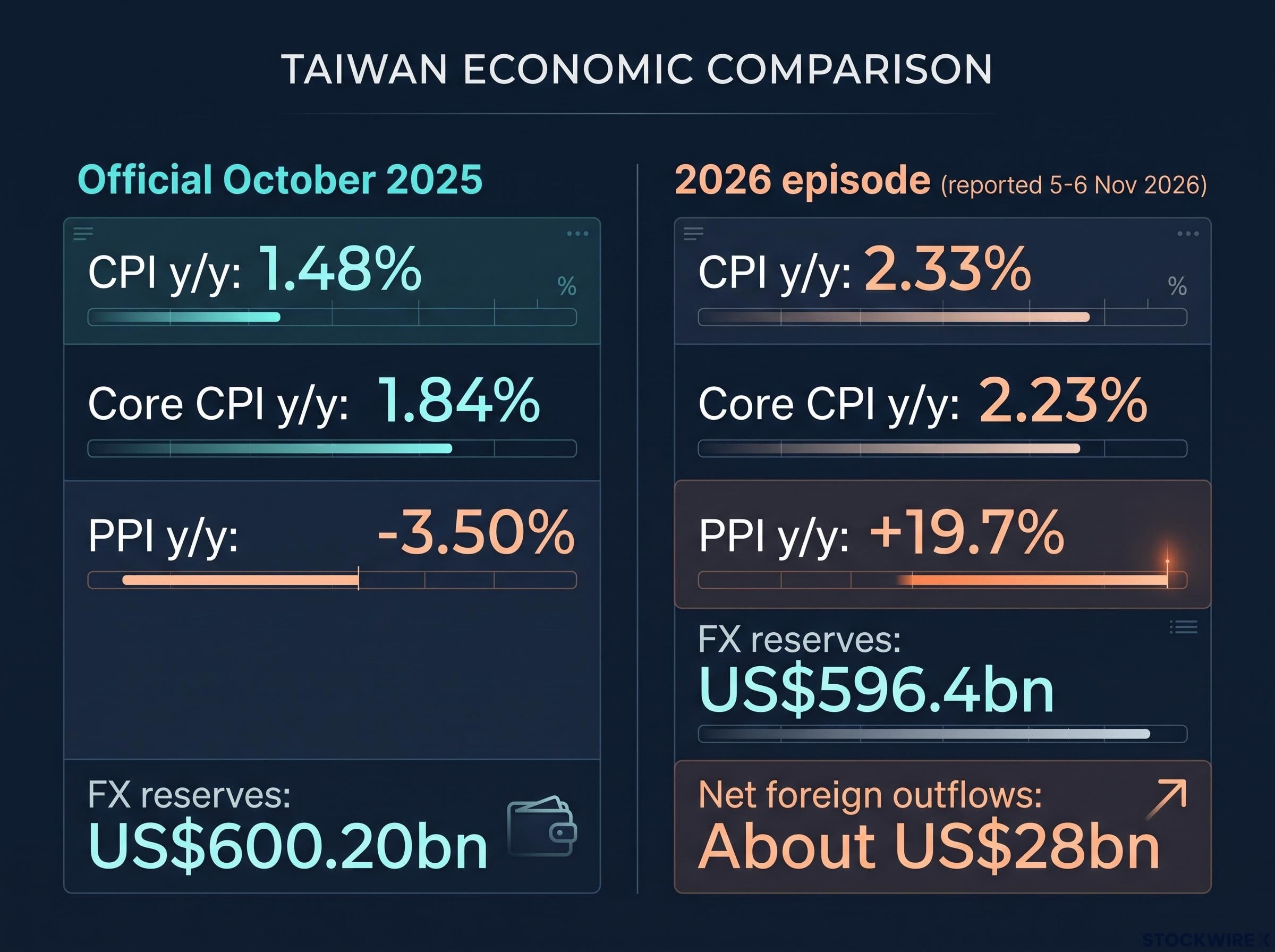
The 2026 episode data highlights a significant inflation spike with CPI at 2.33% and PPI at +19.7%, contrasting sharply with the official October 2025 figures.
When big ASX news breaks, our subscribers know first
CPI vs PPI: why producer prices can surge while consumer prices cool
On a data screen, the 2026 gap looks almost impossible: producer prices up nearly 20%, consumer prices up just over 2%. The two indices measure different things, at different points in the supply chain, on different timetables.
CPI tracks a household basket of food, rent and services. PPI leans heavily on industrial inputs such as petroleum, chemicals and electronics. In an economy built around semiconductors and electronics exports, those baskets can drift far apart. The main reasons they diverge:
- Different baskets. PPI is weighted towards industrial inputs, CPI towards household goods and services.
- Energy and chemicals. Petroleum, coal and chemical prices can swing sharply before retail prices move.
- Electronics supply chains. Upstream electronics prices can shift heavily with no immediate effect on households.
- Exchange rates. A weaker Taiwan dollar raises import costs; a stronger one suppresses them.
- Administered prices. Electricity and similar charges adjust periodically, not continuously.
- Base effects. An unusually low prior-year level can inflate the annual PPI change.
- Delayed pass-through. Contracts, competition or weak demand can lead firms to accept thinner margins first.
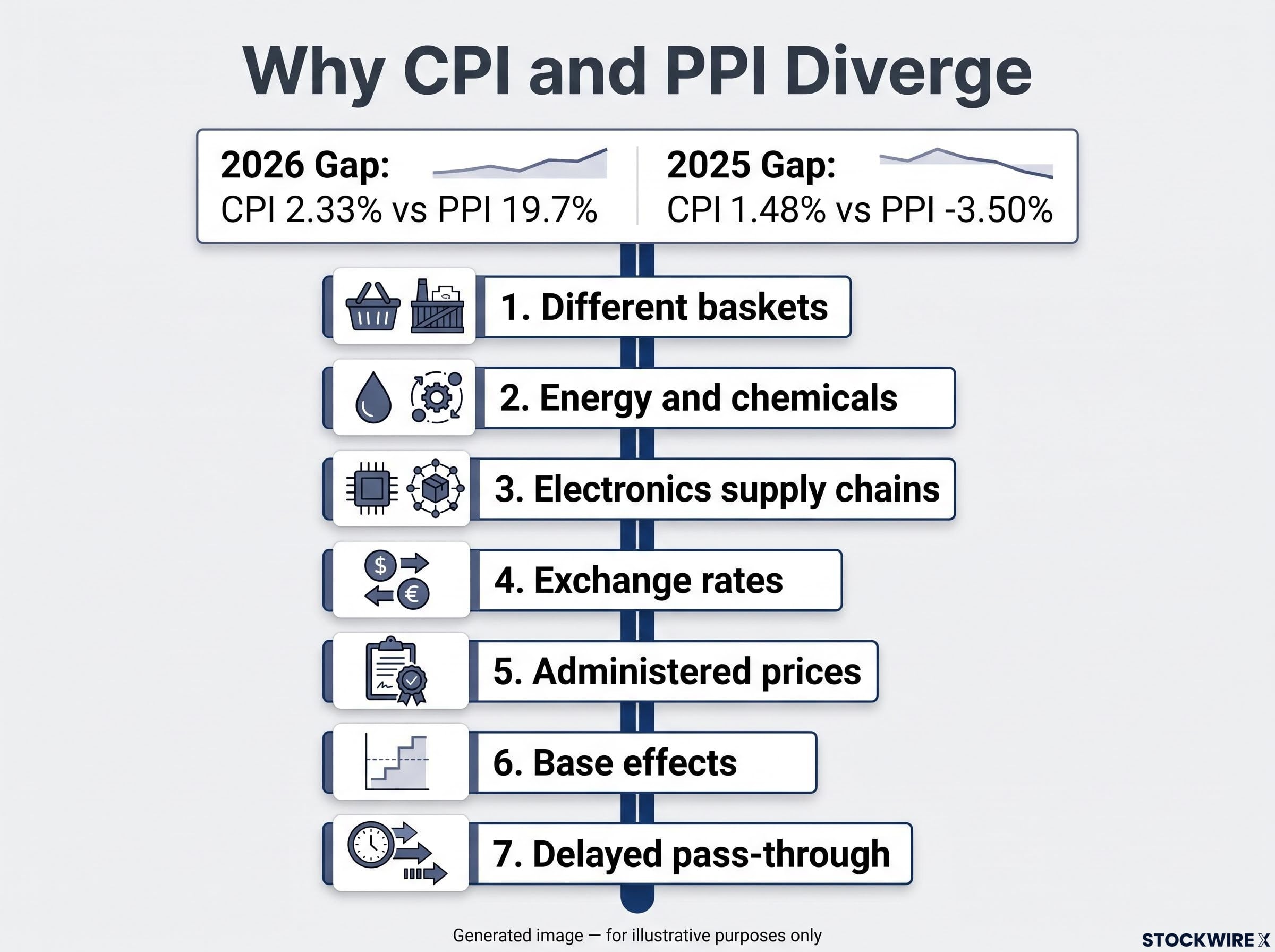
The structural divide between consumer and producer prices explains why the 2026 gap reached a massive difference with CPI at 2.33% and PPI at 19.7%.
On the currency point, DBS linked Taiwan dollar strength to lower import prices and PPI in its October 2025 outlook, though that view has not been independently confirmed.
Commerzbank read the 2026 numbers as producers absorbing the cost shock rather than passing it on straight away.
Commerzbank’s read The gap between easing consumer prices and surging upstream costs points to a severe margin squeeze for producers, and pass-through to consumer prices in coming months cannot be dismissed.
October 2025 shows the reverse: CPI up 1.48% while PPI fell 3.50%. The two measures do not have to travel together, in either direction.
The read you should take from a wide gap is that margins, not shelf prices, are taking the hit for now. Watch corporate margins and the next few CPI prints rather than assuming the inflation risk has passed.
The same margin squeeze has hit Chinese industry, where profit growth slowed sharply as firms absorbed upstream costs, a useful guide to what weaker Taiwanese producer margins could look like in practice.
How the CBC defended the Taiwan dollar and what reserves can and cannot signal
The headline number is dramatic: roughly US$28bn of net foreign outflows in a single month, according to the CBC’s foreign exchange department. The central bank’s response was far more measured.
What the intervention did
As foreign investors offloaded equities, the CBC acknowledged stepping into the market to prop up the Taiwan dollar. In October it also turned dollars raised through the swap market into purchases of US Treasuries, which kept the reserve drawdown smaller. A currency swap here means borrowing dollars against Taiwan dollars for a set period, rather than selling reserves outright.
The result: reserves fell only US$4.3bn to US$596.4bn at end-October 2026.
The October 2025 picture was similar in scale. Reserves slipped US$2.74bn to US$600.20bn from US$602.94bn, with the CBC describing intervention aimed at smoothing volatile flows. End-month interbank rates sat at NT$30.815 on 23 October and NT$30.749 on 31 October. The CBC frames its approach as two-way, seeking stability rather than a fixed rate, and reported cumulative net purchases of US$7.7bn over 2025. October 2025 foreign equity outflow data was not found.
Judging whether reserves are enough
Roughly US$600bn sounds ample, but the headline alone does not settle the question. Adequacy depends on:
- Short-term external liabilities that could fall due quickly
- Portfolio outflows, and how fast foreign investors can exit
- Contingent claims that may draw on reserves under stress
- Life-insurer hedging flows, since Taiwan’s large insurers hold sizeable foreign assets and their hedging can reinforce currency moves
A decline of a few billion dollars against a base near US$600bn tells you the CBC is smoothing, not defending a line. Read the pace of change and the funding method, not the monthly total.
What the two threads mean for the CBC’s policy options
Put the inflation and currency threads together and the CBC faces trade-offs rather than an obvious answer. The latest decision located, on 18 September 2025, held the discount rate at 2.00%, the refinancing rate at 2.375% and the temporary accommodation rate at 4.25%. At that point the bank forecast 2025 CPI of 1.75% and core of 1.67%.
| Option | Benefit | Cost | What could trigger it |
|---|---|---|---|
| Hold | Avoids adding strain amid trade uncertainty | Risks inflation expectations drifting higher | Pass-through stays limited |
| Hike | Could anchor expectations and cool demand | Capital inflows, stronger Taiwan dollar, pressure on exporters | PPI strength feeding into core CPI |
| Continued intervention | Smooths disorderly currency moves | Sterilisation and balance-sheet costs; possible US scrutiny | Persistent outflows or sharp currency swings |
Sterilisation means offsetting the effect of currency operations on domestic money supply, and it carries ongoing costs. Intervention also cannot permanently offset structural capital-flow imbalances. Persistent action against appreciation can draw US trade scrutiny, while sharp appreciation hurts exporters.
The 2% level is an alert threshold, a prompt for review rather than an automatic trigger. The six-month run above it belongs to the 2026 episode; October 2025 CPI, at 1.48%, was below it.
The bank has held its benchmark rate for ten consecutive meetings despite rapid GDP growth, and analysts have pointed to the first quarter of 2027 as the first genuinely live window for a hike.
What this means for you: sticky CPI plus a record PPI strengthens the case for tighter policy, while export exposure argues for caution. The next move likely hinges on evidence of pass-through. These assessments are speculative and subject to change based on market developments.
Three signals to watch before the CBC’s next move
The core of the story is timing. Consumer prices tend to lag producer costs, and the currency defence buys time rather than fixing the underlying imbalance.
Three signals will tell you whether the picture is shifting:
- CPI above 2%. Whether the 2026 run extends beyond six months from the latest 2.33% reading.
- PPI into core. Whether 19.7% producer inflation starts showing up in core CPI.
- Outflows and reserves. Whether reserve declines from US$596.4bn persist alongside heavy foreign selling.
And keep the baseline straight: October 2025 CPI was 1.48%, a different year and a different story. If pass-through appears in core CPI, the balance tilts towards tightening; if it does not, patience remains the CBC’s likelier path.
This article is for informational purposes only and should not be considered financial advice. Investors should conduct their own research and consult with financial professionals before making investment decisions.