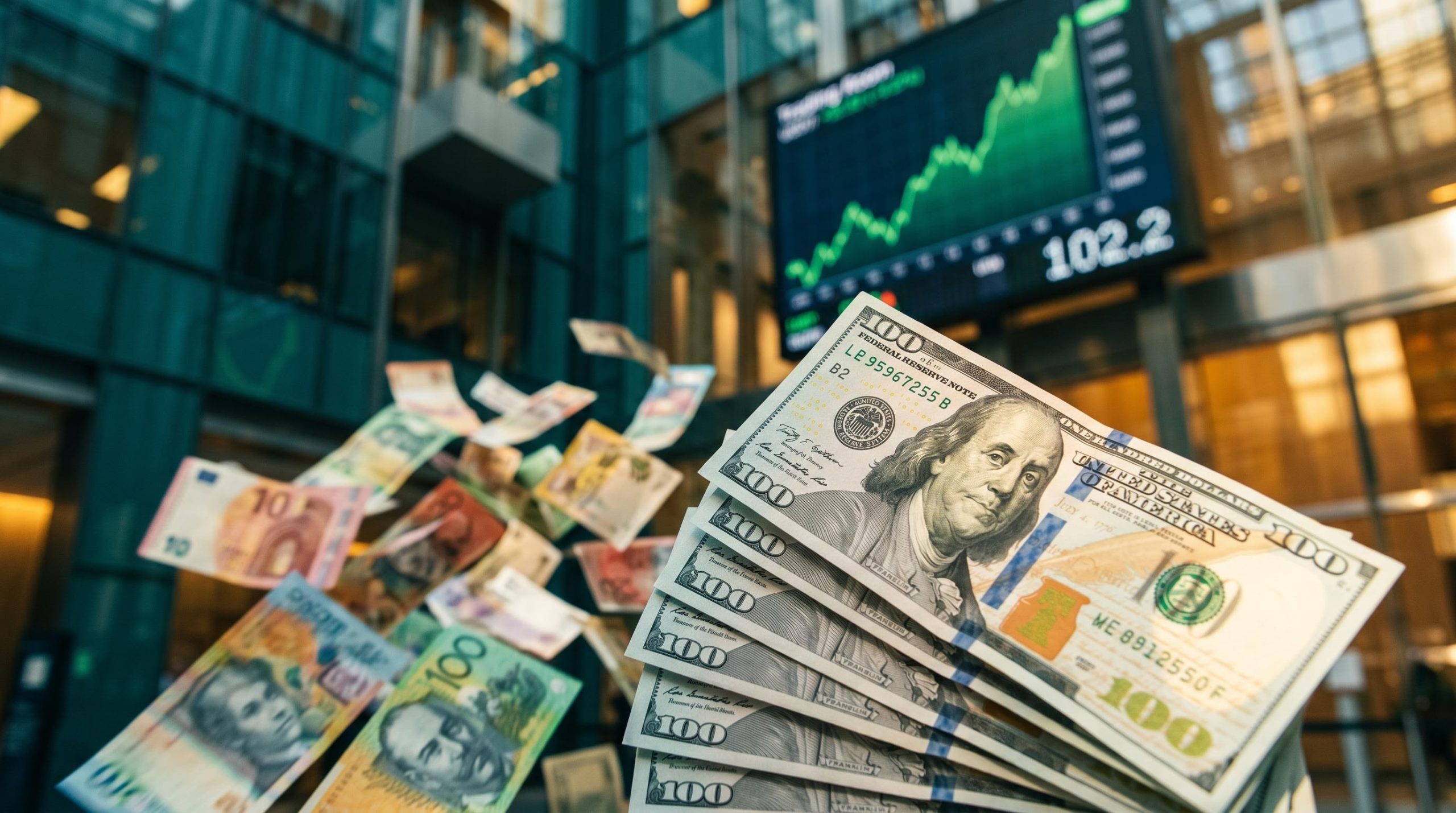
The US dollar climbed against every major currency on Friday, with the US Dollar Index (DXY) pushing to around 102.2, up roughly 0.6-0.7%. Two things drove the rally. October payrolls came in at +165,000 against roughly +65,000 expected, and San Francisco Federal Reserve President Mary Daly said the Fed will likely have to tighten policy further.
The pairing put another Fed rate hike firmly back in play, and the dollar repriced quickly. The DXY tracks the dollar against a basket of major currencies, so a move this size is felt well beyond US markets.
Fed decisions matter far beyond Wall Street. If you hold US shares or bonds, trade currencies, or pay for anything priced in dollars, such as oil or imported goods, a shift in hike expectations flows straight through to your returns and costs.
Here is what Daly said, how the dollar moved against each major currency, and how to read a rally when rate hikes, safe-haven demand and stress in tech stocks are pulling in different directions.
The dollar rallied against every major currency, and the Australian dollar took the hardest hit
The jobs report did the heavy lifting. The US Bureau of Labor Statistics figures beat consensus on all three headline measures:
- Payrolls: +165,000, against +65,000 in a Reuters survey and +59,000 in the Dow Jones consensus cited by CNBC
- Unemployment: 4.1%, against 4.2% expected
- Average hourly earnings: +0.4% month on month and +3.1% year on year
September was also revised up to +60,000 from +29,000.
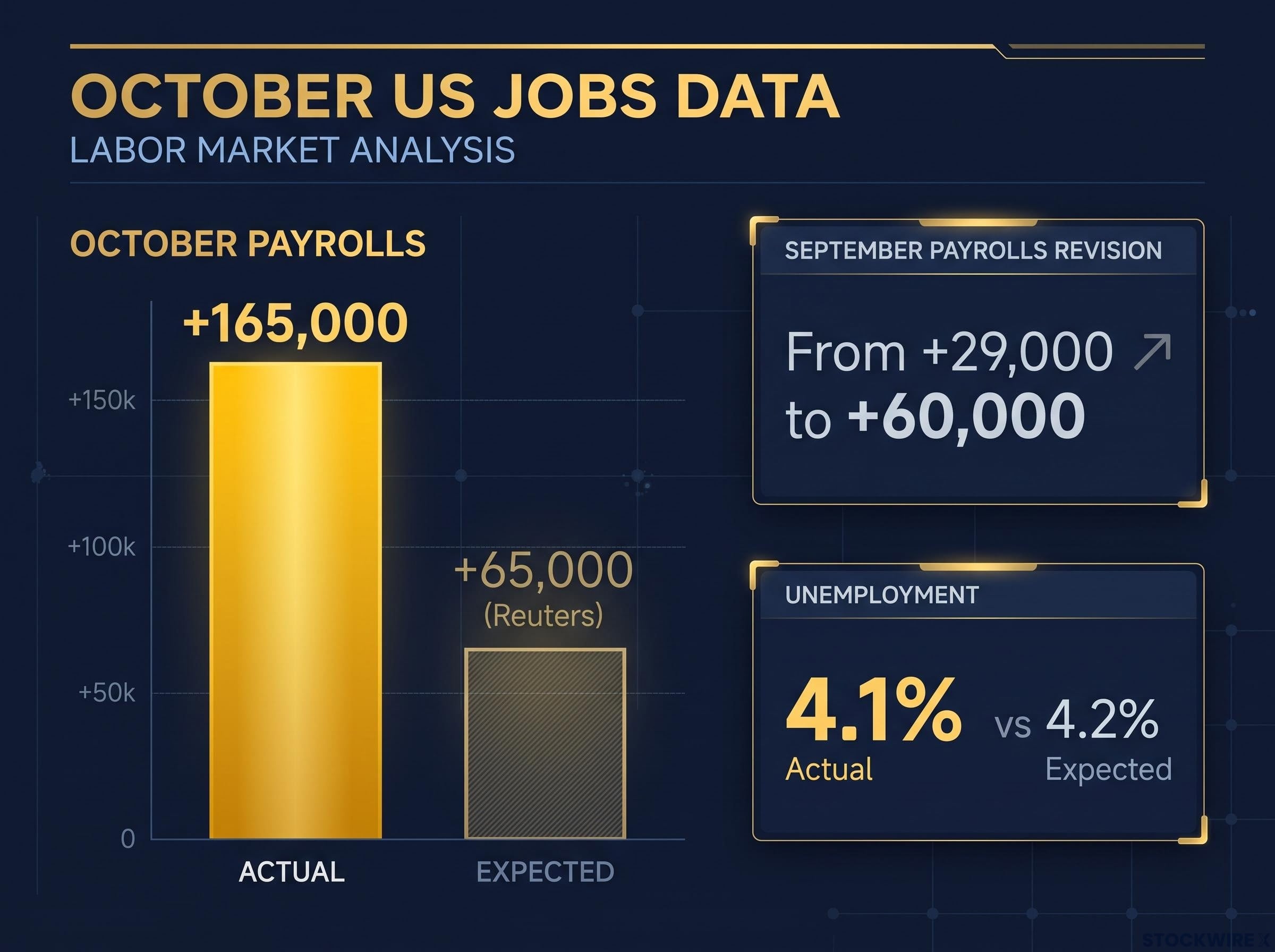
October payrolls vastly exceeded the expected +65,000 by adding +165,000 jobs, while unemployment fell to 4.1%.
Bond markets moved first. According to Reuters, the two-year Treasury yield rose 5.5 basis points to 4.532%, and the 10-year rose 3.1 basis points to 4.868%. A basis point is one-hundredth of a percentage point. The DXY readings ranged from about 102.12 to 102.33 depending on the data feed and timestamp.
The breadth of the move stands out. The dollar gained against all seven G10 currencies tracked in the FXStreet heat map.
| Currency | Approximate USD change |
|---|---|
| Euro (EUR) | +0.66% |
| British pound (GBP) | +0.71% |
| Japanese yen (JPY) | +0.32% |
| Canadian dollar (CAD) | +0.81% |
| Australian dollar (AUD) | +1.00% |
| New Zealand dollar (NZD) | +0.97% |
| Swiss franc (CHF) | +0.37% |
Source: FXStreet heat map, approximate daily moves. Other sources report different figures for some pairs.
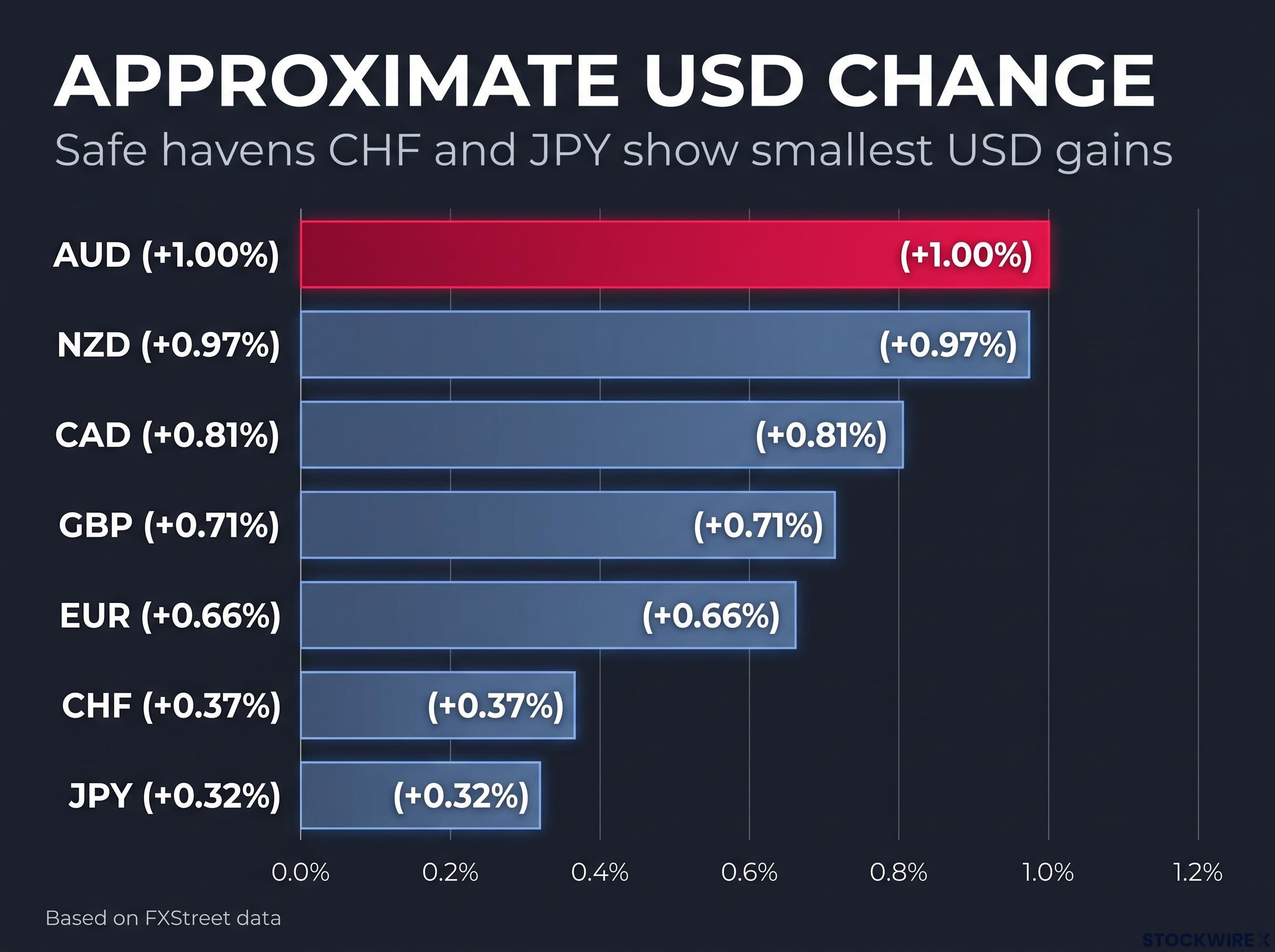
The US dollar posted its strongest gains against the AUD at +1.00%, while safe havens CHF and JPY showed the smallest USD gains.
The sources do not fully agree. Reuters had the euro down 0.55% to US$1.1157. Seeking Alpha and Standard Chartered put the Australian dollar’s fall at about 0.75%, though it still ranked as the weakest G10 currency.
A move this broad is a dollar-wide repricing, not a story about one currency pair. The smaller gains against the yen and the Swiss franc show that the dollar made the least headway against the traditional safe-haven currencies.
Analysts trace US dollar strength to three compounding forces: interest rate differentials, US growth exceptionalism and the currency’s structural reserve role, with markets already pricing substantial additional Fed tightening over the next twelve months.
What Daly said: a solid labour market gives the Fed room to finish the inflation fight
Daly on rates and jobs
Speaking to CNBC’s Steve Liesman on the day of the release, Daly left little doubt about which way she leans.
“My expectation is we’re going to have to tighten policy further.”
She added that the timing and size of any move are still to be decided and will depend on incoming data. “More is likely to be needed,” she said. She called the report good news and said a strong labour market “gives latitude to get inflation job done.”
She was careful not to overstate the economy’s strength. “The job market remains stable and solid, but not booming,” she said. She also noted that real wages are falling because pay is not keeping pace with inflation, and that services inflation is proving more stubborn than expected.
The policy backdrop:
- Fed funds target range: 3.75%-4.00%
- Last hike: 25 basis points on 16 September 2026, followed by an October hold on a 10-2 vote
- September CPI: 3.7% headline and 2.4% core, year on year
- December odds: CME FedWatch probability of at least a 25 basis point hike rising toward 80% (Reuters)
New York Fed President John Williams said markets saw a greater-than-50% chance of a December hike. Governor Christopher Waller and Cleveland Fed President Beth Hammack have both argued for further tightening. Williams described inflation as too high.
Historical cycles suggest the pace of tightening matters as much as its direction, with mild cycles delivering equity gains and aggressive ones producing losses, which is why the speed of any December move will be watched closely.
Daly on the AI repricing
The second half of the interview softened the tone. Reuters reported that Daly called the technology-stock repricing “painful” but orderly, the kind of rebalancing she would hope to see. She described businesses as cautiously optimistic. FXStreet reported her view that demand growth might come down a little.
She also flagged uncertainty around tariffs, war and artificial intelligence (AI), while stressing that inflation remains her priority.
The message for you: the Fed is leaning toward more hikes but is not committing to a set path. That makes each upcoming data release more likely than usual to move the dollar.
Why the dollar rose: rate expectations, safe-haven demand, and how hikes, QE and QT usually work
Two forces behind Friday’s move
The first force was rate differentials, meaning the gap between US interest rates and rates elsewhere. Higher expected US yields raise the return on dollar assets, which draws in foreign capital.
The second force was safe-haven demand. Dilin Wu, research strategist at Pepperstone, said a global selloff in AI stocks was sending money into the dollar for safety, though falling Treasury yields could cap its gains. Convera also pointed to safety flows, but warned that a deeper reassessment of US growth could become a significant headwind for the dollar.
The dollar’s safe-haven role is conditional rather than automatic; in mid-October the DXY slid below 102 while the S&P 500 fell 1.1%, after the Fed Chair declined to signal an October hike.
Competing drivers Eugene Epstein, head of trading and structured products at Moneycorp, described the dollar as trading on either safe-haven demand or interest-rate differentials, and noted that the two can point in opposite directions.
The Australian and New Zealand dollars took the brunt of the risk-off mood. Both are risk-sensitive currencies with close links to China and commodity prices. Standard Chartered said the Nasdaq selloff and falling copper prices were weighing on AUD/USD even before the jobs data landed.
How hikes, QE and QT usually move the dollar
Quantitative easing (QE) is when a central bank creates money to buy bonds. Quantitative tightening (QT) is the reverse: the central bank shrinks its bond holdings and withdraws money from the financial system.
| Policy | Typical dollar effect | Key caveat |
|---|---|---|
| Rate hike | Usually positive | Can turn negative if markets focus on recession risk |
| QE | Usually negative at first | Crisis-driven demand for safety can still lift the dollar |
| QT | Usually supportive | The effect depends on what is already priced in and on other central banks |
None of these effects is mechanical. The 2008-2014 QE era reduced the dollar’s yield support, yet episodes of crisis-driven safe-haven buying periodically strengthened it. The 2022-2023 hiking cycle produced a powerful dollar rally, which the energy shock and weakness in other economies amplified.
The current case also has counterweights. A single strong payroll print can be revised, as September’s jump from +29,000 to +60,000 shows. And because tariffs, energy shocks and AI investment are all feeding into prices, raising rates may not fix supply-driven inflation quickly.
The rally rests on two drivers that can reverse independently of each other. Before assuming the move will last, watch whether Treasury yields keep climbing and whether the AI selloff deepens.
What to watch after Daly: December hike odds, Treasury yields and the AI selloff
Friday’s rally came from stronger jobs data and a hawkish Fed voice. Daly’s calm but cautious read on AI-driven demand partly offset both.
Three variables will decide whether the move holds:
- The next CPI and payroll releases, which will test the case for a December hike
- Two-year Treasury yields and CME FedWatch December odds, the most direct gauges of rate expectations
- Whether the tech repricing stays orderly, or turns into the kind of growth scare Convera warned could weigh on the dollar
When you judge your dollar exposure, ask which force is in charge. A dollar lifted by rising yields behaves differently from one lifted by fear, and the two can unwind on different timelines.
Investors exploring equity exposure should read our full explainer on rate hikes and stock returns, which shows how the S&P 500 has historically behaved after the first hike.
These statements are speculative and subject to change based on market developments and policy decisions.
This article is for informational purposes only and should not be considered financial advice. Investors should conduct their own research and consult with financial professionals before making investment decisions.