
Southern Cross Media Group outlines integration priorities and FY28 target at 2026 AGM
In its addresses to the 5 November 2026 annual general meeting, Southern Cross Media Group (ASX: SXL) set out three priorities: completing the integration of the two businesses, building a more efficient cost base, and growing revenue from the integrated offering. It was the first AGM of the combined group and the first as Chair for Ryan Stokes AO.
Managing Director and Chief Executive Officer Rohan Lund pointed to FY26 revenue of $1.87 billion and EBITDA (including onerous contracts) of $200 million. He said a $150 million cost reduction program is tracking well, with the full benefit expected in FY28.
Rohan Lund, Managing Director and Chief Executive Officer
“We will deliver on that plan and the new shape we want for the group will be very apparent by FY28.”
Lund told shareholders they should judge progress by delivery: the savings achieved, the revenue share generated from audience strengths, and the improvement in earnings and cash generation over time.
When big ASX news breaks, our subscribers know first
FY26 financial performance and Q1 FY27 trading
FY26 results on a pro forma basis
The presentation detailed a year of lower revenue and earnings. All financial data was provided on a pro forma basis.
| Metric | FY26 value | Change | Driver |
|---|---|---|---|
| Revenue | $1,870M | Down $87M / 4.4% | $125M market contraction impact, offset by share growth impact of $41M |
| Total expenses | $1,678M | Down $51M / 3.0% | Variable costs lower in line with revenue; $30M merger cost synergies |
| EBITDA (excl / incl onerous contracts) | $192M / $200M | Down 15.8% / down 12.8% | Reflects market conditions; margin of 10.3%, down 1.4 ppt |
| NPAT | $10M | Down $13M / 58% | Lower operating earnings; significant items of $33M due to merger and restructuring |
| Net debt | $363M | Up $6M / 1.6% | New $569M cross-Group syndicated facility in place; FY26 cashflow available to service debt of $41M |
| Reported leverage | 1.8x | Up 0.3x | Movement primarily reflecting lower earnings |
Both the Chairman and the CEO acknowledged the result did not meet expectations. Stokes said it did not deliver on the potential the Board believes exists for the business, and that the Board and management are focused on improving performance.
First quarter FY27 trading update
Lund outlined first quarter FY27 trading by segment:
- Television: revenue tracked down year on year. Share gains from the Commonwealth Games and AFL finals partly offset a market that was down mid-single digits and lower payments by Google for news.
- Audio: revenue was broadly flat, with regional and digital performance offset by metro and other movements.
- Publishing: revenue was down year on year, mainly reflecting weaker advertising markets, schedule changes affecting events income, and lower Google payments. Higher circulation and subscription income partly offset these effects.
The cost program is progressing better than expectations, with total costs down from the prior corresponding period despite absorbing one-off sporting event costs. Lund said management expects to exceed the $150 million target.
On the outlook, he said the advertising market remains short and volatile, with consumer and advertiser sentiment variable. The cost base has been set on the assumption that the broader economy deteriorates in the second half.
Lund also noted the NBI legislation has been passed and the company will seek to recover its full share from the pool.
For readers wanting to trace how the program began, our detailed coverage of the original cost reduction announcement explains the job cut range, the restructuring charge and the onerous contract provision on legacy television content deals.
Audience strength and the integrated strategy
Audience metrics behind the strategy
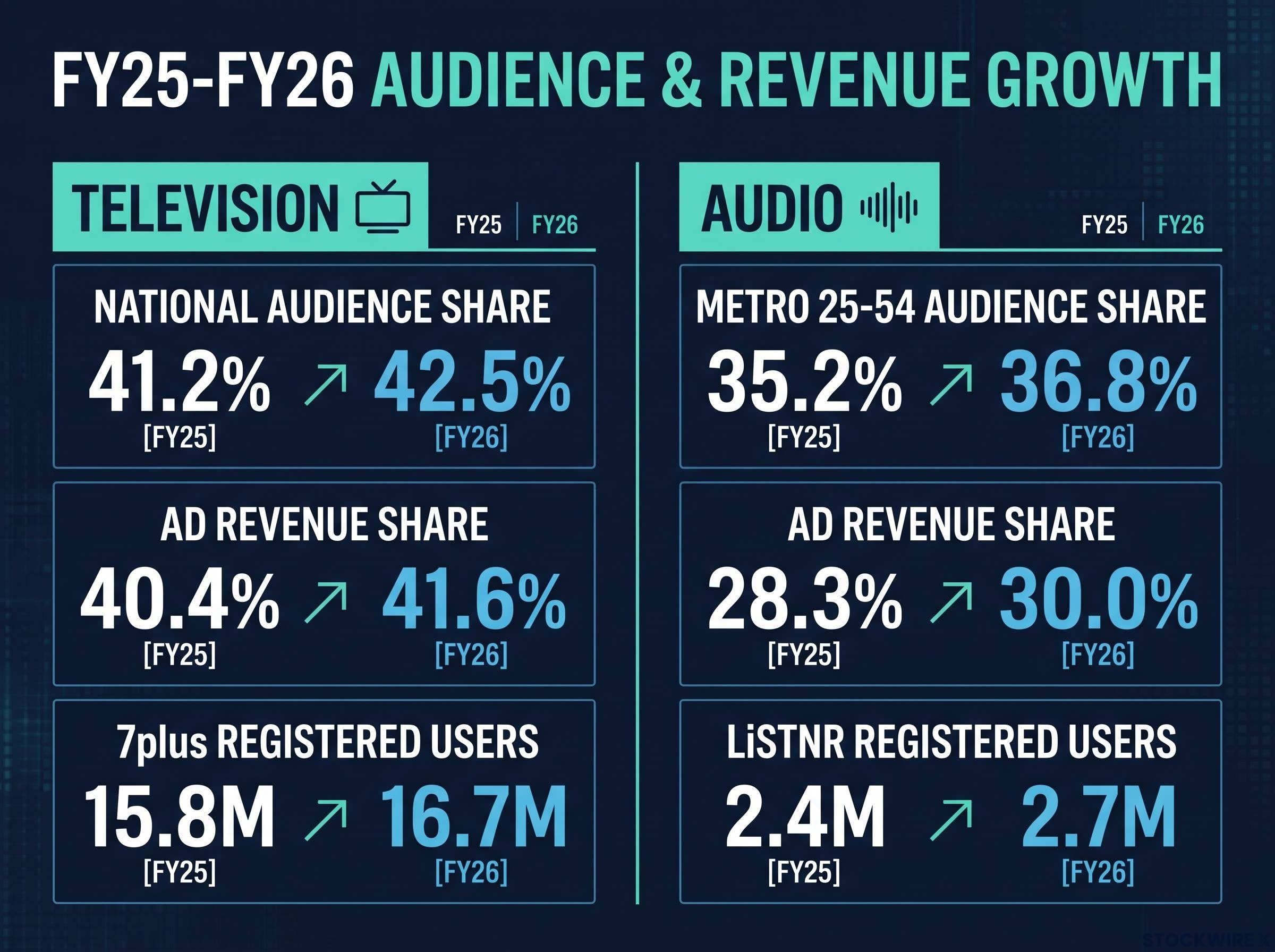
The presentation slides showed audience and revenue share gains across television and audio between FY25 and FY26.
| Metric | FY25 | FY26 |
|---|---|---|
| TV national audience share | 41.2% | 42.5% |
| TV ad revenue share | 40.4% | 41.6% |
| 7plus registered users | 15.8M | 16.7M |
| Metro 25-54 audience share (audio) | 35.2% | 36.8% |
| Audio ad revenue share | 28.3% | 30.0% |
| LiSTNR registered users | 2.4M | 2.7M |
Other audience points included:
- The group’s brands reach 20.4m Australians monthly, according to the slides, and more than 20 million according to the addresses.
- Metropolitan networks have led the 25 to 54 audience for 42 consecutive surveys.
- The West Australian’s monthly audience was 3.5M in Jun-26, up from 3.2M in Jun-25.
The Chairman’s speech cited almost 16 million 7plus registered users, while the slide table shows 16.7M for FY26.
Educational: what an integrated media platform means for investors
An integrated media platform links audience data and advertising sales across television, audio and publishing, rather than treating each as a separate business. For advertisers, that can mean one conversation instead of several.
Lund said 7iD was built to connect and enrich understanding of audiences across the group’s brands, noting that someone watching television, streaming a program and listening to audio is still the same person. Phoenix Exchange is described as a vision for a more connected trading system, building on capabilities already operating in television and audio.
Management also pointed to its expanding YouTube presence as another way for audiences to find its content and for advertisers to work with the group around it. Lund said reducing the time and effort needed to do business with the group should make its content more accessible to advertisers. For investors, the aim is to convert audience share into revenue.
Three-part strategy
Lund described the strategy as connecting Australians with what matters to them, pursued in three ways:
- Meet audiences where they are.
- Meet advertisers where they are.
- Reimagine how we work to transform the cost base.
Governance changes and what shareholders voted on
The Chairman told shareholders the Board comprises eight Directors, six of whom are Independent Non-Executive Directors. Cathy O’Connor was elected Lead Independent Director by the Independent Directors in September.
Items before the meeting included:
- A proposed change of the company’s name to Seven Media Group, which shareholders were asked to approve.
- Election of Cathy O’Connor, Sylvia Wiggins, Teresa Dyson, Mark McGowan AC and Karen Stocks, each recommended by the Board.
- Re-election of Marina Go AM, alongside a notice from a shareholder of a resolution to remove her as a Director. The Directors, other than Marina, unanimously recommend voting for her re-election and against her removal.
Stokes also outlined regulatory themes: free and universal access to sport, news and entertainment; protecting Australian content from being used by AI platforms without permission or payment; addressing competition failure in advertising technology markets; and reforming the regulation of the sector.
Stokes closed by stating the ambition to be Australia’s leading integrated media company. Lund noted Telethon’s record $101 million fundraising result in October.
Don’t Miss the Next Media Sector Mover
Join 20,000+ investors getting FREE breaking ASX news from Big News Blast within minutes of release, complete with in-depth analysis. Click the “Free Alerts” button to receive media, communications and other non-resource sector announcements the moment news breaks, and stay ahead of the market.