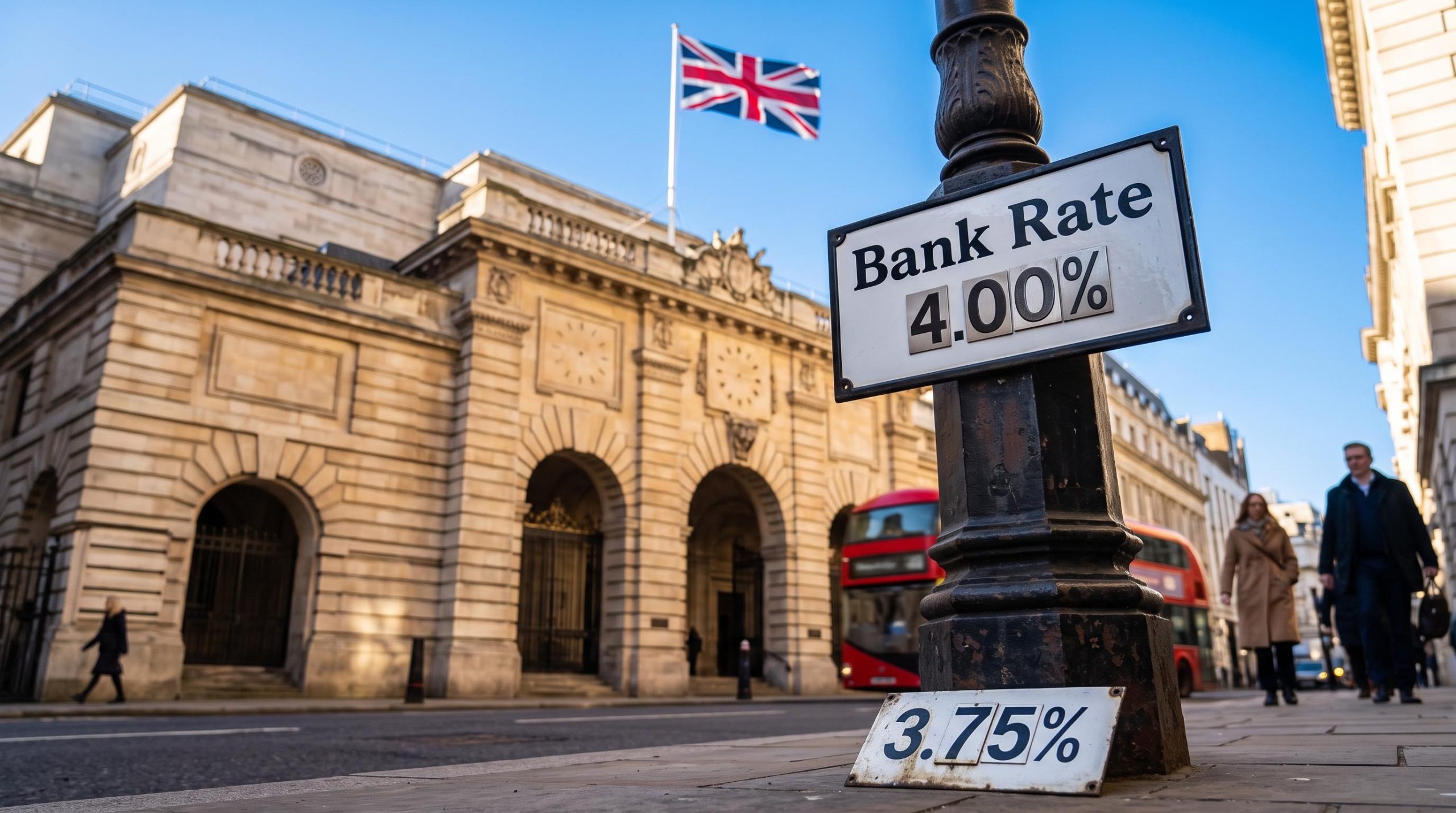
The Bank of England’s Monetary Policy Committee (MPC) announces its November decision at 12:00 GMT on Thursday 5 November. Bank Rate sits at 3.75%, and three members (Huw Pill, Catherine L Mann and Megan Greene) already voted for a hike in September.
A Reuters economist poll published on 2 November expects a 25 basis point rise to 4.00% on a 7-2 vote. A basis point is one hundredth of a percentage point. That move would be the Bank’s first hike since August 2023.
Because the hike is so widely expected, the decision alone is unlikely to drive the pound. The guidance and the Monetary Policy Report (MPR), the Bank’s quarterly set of inflation and growth forecasts, will do more of the work.
Three variables decide how the day plays out for GBP/USD: the vote split, the MPR’s inflation path and Andrew Bailey‘s tone at the press conference. Here is how to read each one, and the risk each carries.
Why a hike is expected, and why the pound may still stall
The September meeting ended 6-3 to hold, with Bank Rate unchanged since December 2025. Two months later, the open question is how far the Bank goes after Thursday, not whether it moves.
What markets price
Reuters reported on 2 November that markets price three to four further 25bp hikes during 2027, which would take Bank Rate to about 4.75%-5.00%. That figure has not been independently verified, but it shows how much tightening sterling already carries.
Bailey has said firm commitments on future rates are inappropriate. That leaves the Bank with little reason to endorse the full priced path.
What forecasters expect
Most research houses see a shallower climb. They point to energy prices easing over time, spare capacity in the economy holding back wages, and an inflation shock that is partly imported rather than self-sustaining.
| House | Expected vote | Key view |
|---|---|---|
| BBH | 7-2 hike | Roughly 100bp of tightening priced over 12 months; guidance could limit pound gains |
| Nomura | 6-3 hike | Majority now votes to hike rather than hold |
| ING | Hike | February follow-up likely; market pricing “extreme” |
| FXStreet | 7-2 hike | CPI peaks slightly above 4% in early 2027 |
The committee itself is split along the same line. The hawks fear second-round effects, where the energy shock spreads into wages and services prices. Alan Taylor and Swati Dhingra stress spare capacity as a reason to wait, and the Reuters poll expects both to dissent.
Oxford Economics Alexander Harvey said the minutes or Bailey could signal that Bank Rate will not reach the level markets have priced (Reuters).
That is the risk worth holding onto. If the Bank hikes but declines to back the priced path, you could see sterling’s 2027 tightening premium stripped out on a day that looks hawkish on paper.
For readers wanting the wider framework behind sterling’s reactions, our full explainer on what moves the British Pound covers how rate decisions, inflation data and political risk premiums interact.
What will the MPR and Bailey’s guidance reveal about the hawks and the oil backdrop?
The information arrives in two waves, and each one can shift the read.
- 12:00 GMT: the decision, minutes and MPR are published together.
- 12:30 GMT: Bailey takes questions at the press conference.
Inside the MPR and press conference
The earlier MPR projected CPI at about 3.2% late in 2026, based on much lower energy assumptions. FXStreet expects the new forecasts to show inflation peaking a little above 4% in early 2027. A profile that stays high strengthens the hawks; a short peak followed by a quick fall supports the holders.
The vote split adds a second signal. A narrow majority, as Nomura forecasts, or a rapidly falling inflation forecast could push markets to remove priced hikes.
Bailey’s language is the third. He has reportedly said the Bank cannot wait for conclusive evidence of second-round effects, but also that firms appear to be absorbing costs better than in 2022 (both unverified). Rabobank’s Stefan Koopman reportedly said the MPC is being forced to deliver part of what markets priced (also unverified).
Treat the inflation peak and Bailey’s tone as the deciding inputs. Together they tell you whether Thursday marks the start of a cycle or a one-off move.
Oil, US data and the Fed
UK CPI rose to 3.5% in September from 3.1%, with CPIH at 3.6% and petrol averaging 169.5p a litre (ONS, 20 October). Energy drove much of that rise, so oil matters directly.
Services inflation, private rents and catering prices have been re-accelerating independently of energy costs, which is the evidence the hawks cite when they argue the shock may not be purely imported.
- Oil: Brent fell 2% to US$103.14 on 3 November on peace-talk headlines (Reuters), far above the lower assumptions in older material.
- US data: ADP, ISM services and jobless claims can move the dollar on their own.
- The Fed: it held at 3.75%-4.00% on 28 October by 10-2, with Lisa Cook and Beth Hammack preferring a hike.
The Bank’s first read on the budget is a secondary item; economists reportedly judge its inflation effect modest (unverified).
Which GBP/USD levels and scenarios matter around the announcement?
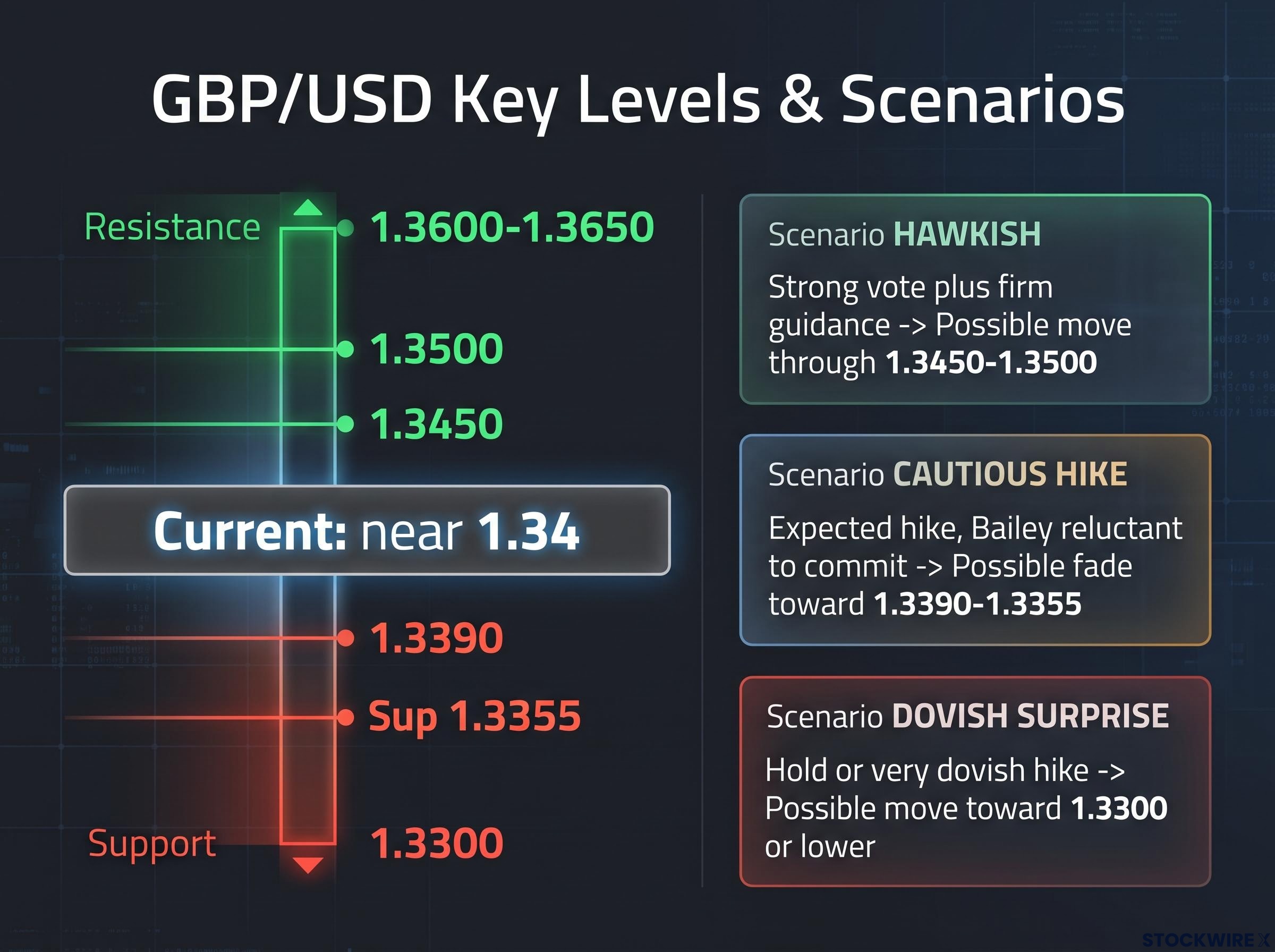
GBP/USD trades near 1.34, close to its 200-day exponential moving average (EMA), a trend line that gives more weight to recent prices.
Key levels
- Resistance: just under 1.3450 (StoneX flagged 1.3450 on 3 November), then 1.3500, then 1.3600-1.3650; Forex.com cites a 1.3435-1.3475 band.
- Support: 200-day EMA near 1.3390, 50-day EMA near 1.3355, then 1.3300; other analysis cites 1.3385, 1.3320 and 1.3184.
A daily close under the 200-day EMA or above 1.3450 is your practical marker of whether a move has direction or is fading.
Rising US Treasury yields and gilt stress have already pushed GBP/USD lower in recent weeks despite hike odds, a reminder that rate expectations are only one input into the pair.
Three scenarios
| Scenario | Trigger | Likely GBP/USD reaction |
|---|---|---|
| Hawkish | Strong vote plus firm guidance | Possible move through 1.3450-1.3500 |
| Cautious hike | Expected hike, Bailey reluctant to commit | Possible fade toward 1.3390-1.3355 |
| Dovish surprise | Hold or very dovish hike | Possible move toward 1.3300 or lower |
These levels are conditional, not predictive, and a policy, oil or US data shock can invalidate them quickly. These statements are speculative and subject to change based on market developments.
Calendar for the week
| Event | Timing (UK) | Consensus |
|---|---|---|
| US ADP employment | Wed 4 Nov, 13:15 GMT | 68,000 (prior 90,000) |
| US ISM services | Wed 4 Nov, 15:00 GMT | 54.8 (prior 54.9) |
| BoE decision, minutes, MPR | Thu 5 Nov, 12:00 GMT | Hike to 4.00% |
| Bailey press conference | Thu 5 Nov, 12:30 GMT | n/a |
| US jobless claims | Thu 5 Nov, 13:30 GMT | 197,000 (prior 194,000) |
| Fed’s Barkin speaks | Thu 5 Nov, 14:10 GMT | n/a |
| Fed’s Logan speaks | Fri 6 Nov, 00:00 GMT | n/a |
Published calendars showed no Friday non-farm payrolls release this week.
What the decision settles, and the signals still to come
Thursday’s hike is largely priced, so the decision itself settles little. The vote split, the MPR’s inflation peak and Bailey’s tone will decide whether sterling keeps its 2027 tightening premium or gives part of it back.
After Thursday, the February meeting becomes the next test of whether a follow-up hike arrives. Oil’s direction and the Fed’s December decision will shape GBP/USD alongside it.
This article is for informational purposes only and should not be considered financial advice. Investors should conduct their own research and consult with financial professionals before making investment decisions.