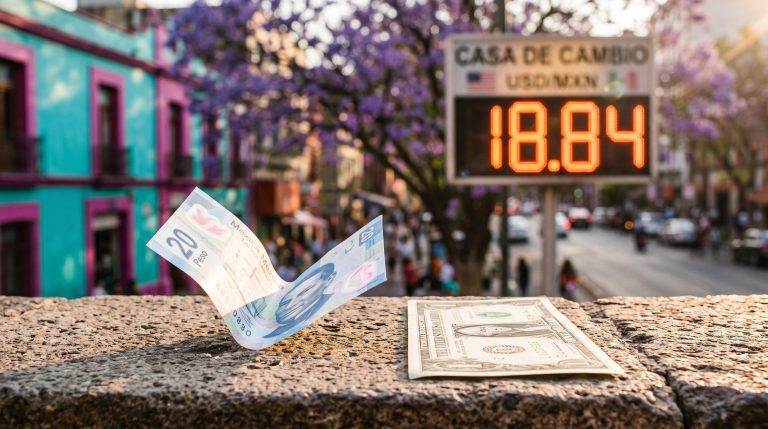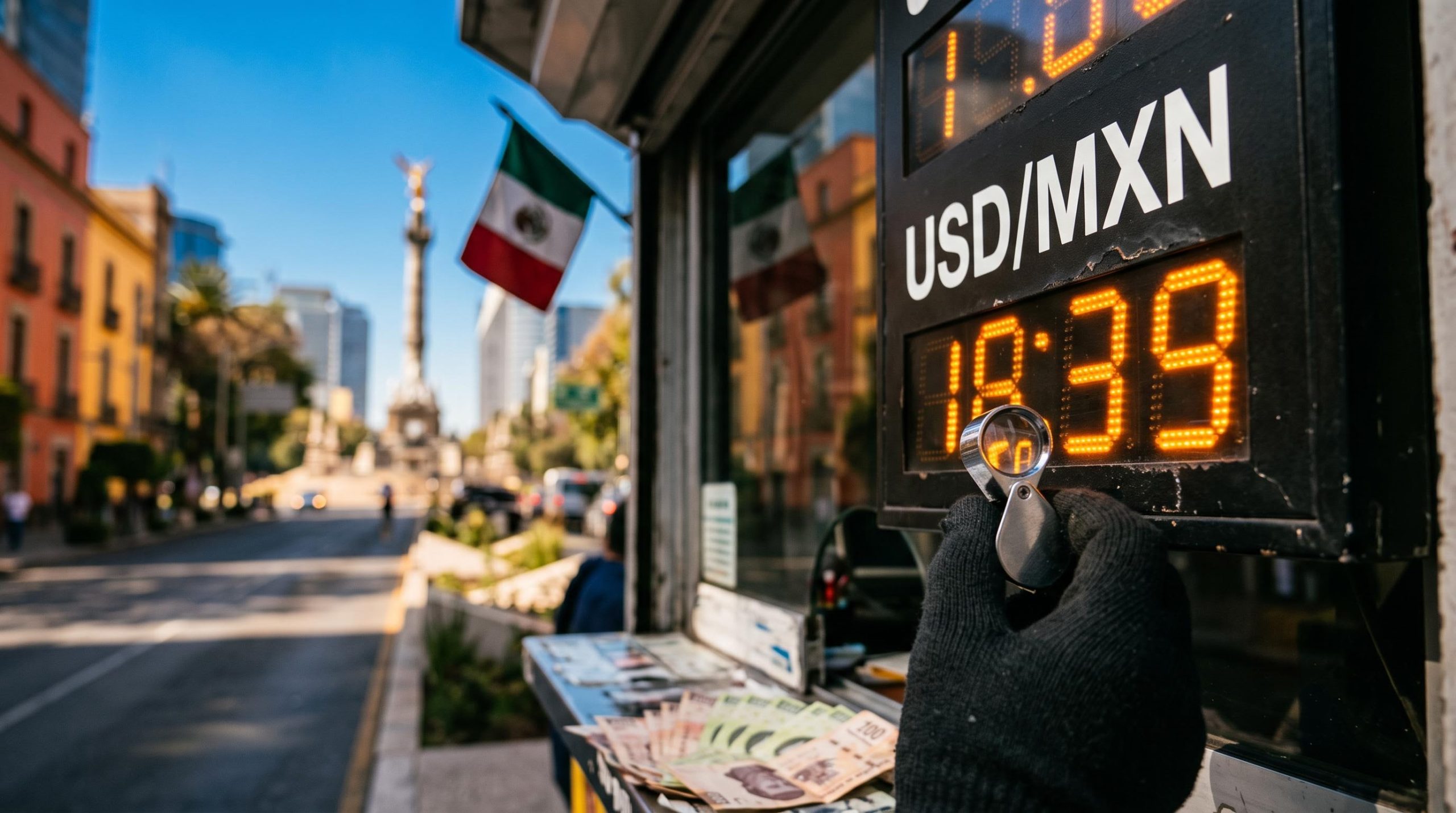
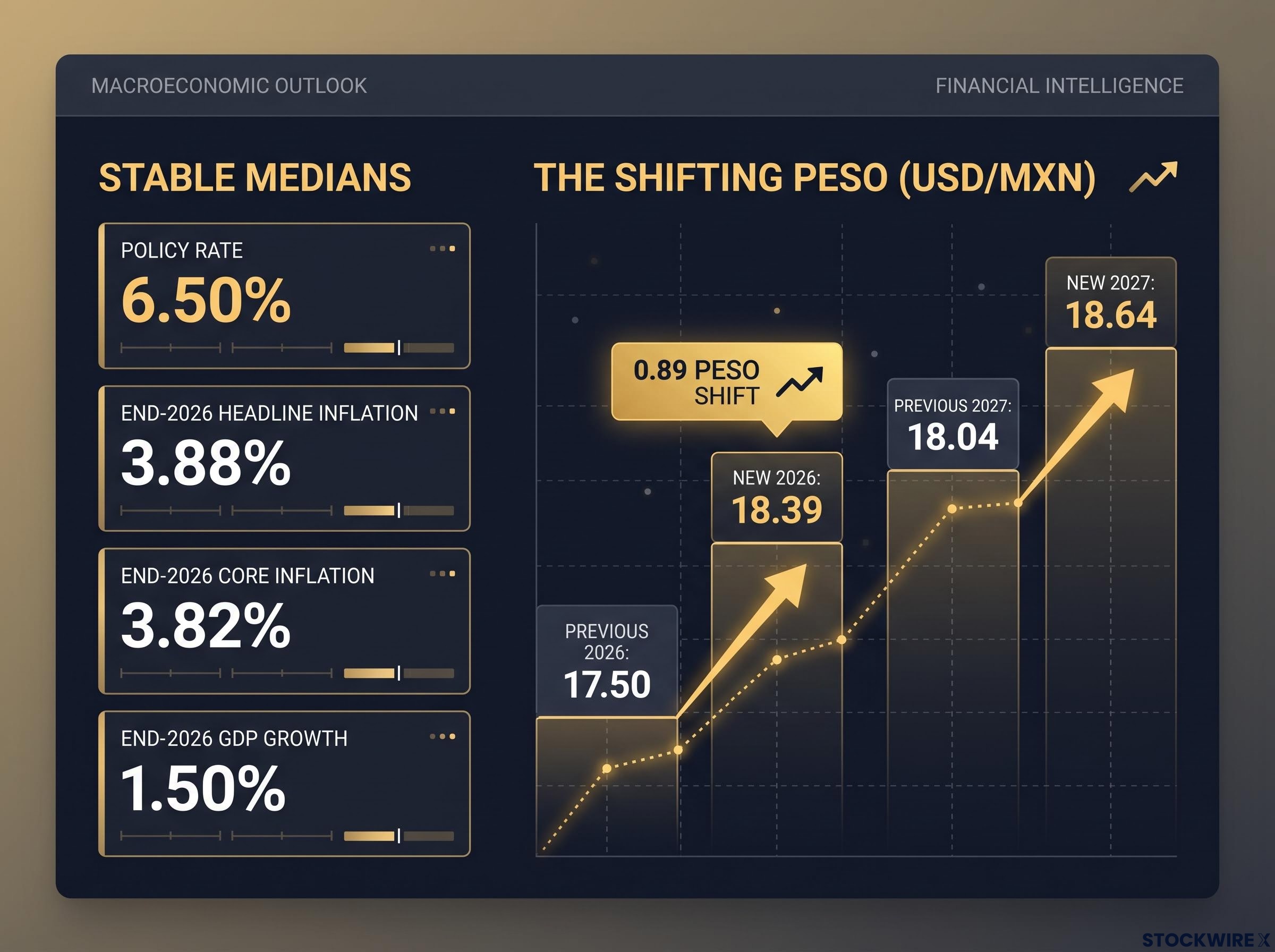
Economists expect the Banco de México (Banxico) policy rate to stay at 6.50% through the end of 2027. In the same survey, their year-end forecast for the peso slid from 17.50 to 18.39 per US dollar in a single month.
A flat rate path and a sharply weaker currency forecast do not usually sit side by side. The calm headline is not the real story.
Banxico released its October survey of 40 analyst groups on 3 November 2026. It landed less than a week after the US Federal Reserve kept rates higher than many expected, and after a stretch in which the peso lost more than 9%. If you hold emerging-market currencies, Mexican bonds or US-listed companies with Mexican revenue, the gap between those two forecasts affects your exposure.
This piece sets out the current numbers. It then explains the mechanics you need to judge whether those numbers hold up: the inflation target, the rate gap with the Fed and the carry trade that links them.
What the October survey actually says about inflation, rates and the peso
The survey polled 40 local and foreign analyst groups between 19 and 29 October 2026. Its medians cover year-end 2026 and year-end 2027.
| Indicator | End-2026 median | End-2027 median | September revision |
|---|---|---|---|
| Headline inflation | 3.88% | 3.85% | 2026 up from 3.87% |
| Core inflation | 3.82% | 3.82% | 2026 down from 3.90% |
| GDP growth | 1.50% | 1.83% | 2026 up from 1.40% |
| Policy rate | 6.50% | 6.50% | No change projected through 2027 |
| USD/MXN | 18.39 | 18.64 | From 17.50 and 18.04 |
On a first read, the table looks settled. Inflation sits just under the top of Banxico’s tolerance band, growth edged up and the rate does not move.
The revisions tell a different story. Headline inflation moved by a single basis point, and most analysts nudged their outlook higher. Core inflation, which strips out volatile items such as food and energy, fell 8 basis points. Neither figure suggests a central bank under pressure.
The revision that matters The end-2026 USD/MXN median moved from 17.50 to 18.39 in one month, a shift of 0.89 pesos. The end-2027 median moved from 18.04 to 18.64.
Media coverage has rounded these figures. FXStreet’s Christian Borjon Valencia described the peso as ending 2026 near the psychological 18.50 level, but the actual medians are 18.39 and 18.64. Use the precise numbers.
What this tells you is that analysts are comfortable with the rate but no longer comfortable with the peso. The uncertainty sits in the currency forecast.
Some analysts frame the slide as a structural peso repricing rather than a passing wobble, noting the differential has fallen from roughly 700 basis points at the 2022 peak as markets priced further Fed tightening.
Past performance does not guarantee future results. Financial projections are subject to market conditions and various risk factors.
When big ASX news breaks, our subscribers know first
How Banxico’s 3% target, rate decisions and the Fed gap move the peso
On your screen, the sequence looks simple. Banxico held at 6.50% on 24 September 2026 with a 5-0 vote, and the peso weakened anyway. To see why a high rate failed to protect the currency, start with what Banxico is trying to do.
The 3% target and what it triggers
Banxico’s permanent inflation target is 3%, with a variability interval of plus or minus 1 percentage point. A variability interval is the range around the target that the bank tolerates before it needs to act, here 2% to 4%.
The logic runs in both directions. When inflation overshoots, Banxico raises rates to lift borrowing costs and cool demand. When inflation eases, it has room to cut. Higher rates generally support the peso by offering better yields, and lower rates tend to weaken it.
Banxico holds eight scheduled decisions a year. It usually announces about a week after the Fed, so it reacts to US moves rather than the other way round.
The rate gap and the carry trade
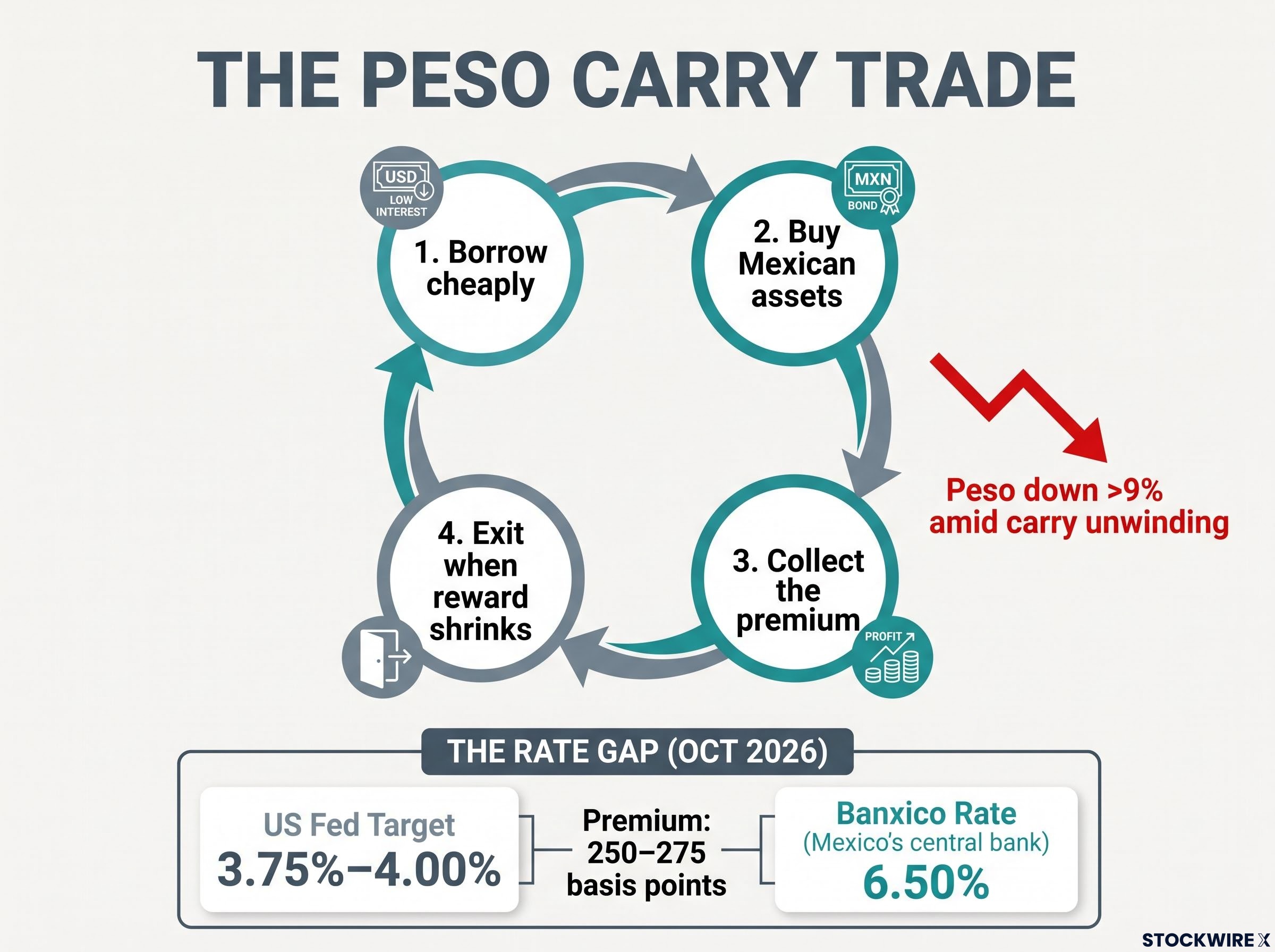
A carry trade is a strategy in which investors borrow in a low-interest currency and invest in a higher-yielding one to earn the difference. The peso is one of the most popular carry currencies because its yields are high and its markets are liquid. The trade works in four steps:
- Borrow cheaply. Investors borrow in a low-yield currency, usually US dollars or yen.
- Buy Mexican assets. They put that money into higher-yielding peso investments.
- Collect the premium. The yield difference pays them for holding the peso, as long as the currency does not fall too far.
- Exit when the reward shrinks. Inflows support the peso, but a narrowing gap cuts the payoff and can trigger unwinds, where investors sell pesos to close their positions.
After the Fed’s 28 October 2026 decision, the US target range sits at 3.75%-4.00%. That leaves Mexico’s premium at 250-275 basis points, or about 262.5 at the midpoint. When Banxico peaked at 11.25% in 2023, the gap was far wider. Trading Economics describes today’s spread as a historical low and links the peso’s fall of more than 9% since early September to carry unwinding.
Carry trade unwinds tend to follow a recognisable sequence: inflows slow first, then positioning thins, and the currency drops fast once the spread stops compensating for exchange rate risk, a pattern seen in earlier emerging-market episodes.
The Fed vote was 10-2, and both dissenters, Lisa D. Cook and Beth M. Hammack, wanted another hike. History shows how quickly policy moves feed into the peso:
- 24 June 2021: a surprise Banxico hike lifted the peso by as much as 2%, according to Reuters.
- June 2021: a hawkish Fed surprise pushed the peso down roughly 5% in the following days.
Carry investors price the size of the premium, not the 6.50% level itself. A Banxico hold can still hurt the peso if the Fed moves.
Why analysts expect a hold, and where the disagreement sits
The consensus case is straightforward. In the Citi Mexico survey (21 October, updated 31 October), the median expects no change through 2027, and few respondents expect any move. Inflation sits near target and the rate is already restrictive, meaning high enough to slow the economy.
Banorte makes a similar call. It points to a still-restrictive real rate (the policy rate minus inflation), the need to keep inflation converging and uncertainty around the peso. Deputy governor Galia Borja said on 28 October that 6.50% still looked like a good position.
The latest data gave that camp more support. INEGI’s 22 October release showed headline inflation at 3.62%, up from 3.49%, and core at 3.78%, up from 3.71%. That ended four straight fortnights of core deceleration.
The disagreement sits in the minutes.
From the September minutes Three Board members thought conditions could exist to consider a rate cut at the next meeting, although the Board made no commitment to cut.
The two camps line up like this:
- Hold camp: Citi survey respondents, Banorte and Galia Borja, plus market commentary reported by Reuters that cites stronger Q3 activity and the core rebound as reasons for patience. Some expect a hold at least through the first half of 2027.
- Cut-door-open camp: Scotiabank, which read the removal of explicit hold guidance as leaving room for cuts given inflation near target and slack in the economy, and the three Board members named in the minutes.
The argument is not about today’s rate. It is about whether the next move is a cut once disinflation resumes or a long pause through 2027. Banxico’s guidance is data-dependent, not a promise to hold.
Banxico’s dropped forward guidance matters here because state-contingent language replaced date-based messaging, which lets swap markets reprice the rate path more freely and keeps the hold-versus-cut debate open.
Individual 2027 forecasts in the Citi survey run from about 6.00% to 7.25%. A median of 6.50% hides that spread, so treating it as certain overstates what the survey shows. The next core inflation prints are the data most likely to shift that balance.
What could break the forecast: tariffs, the Fed, fiscal strain and growth
The base case assumes the premium holds and nothing breaks. Four pressure points could change that.
| Risk | Channel to peso | Effect on Banxico room to cut | Direction |
|---|---|---|---|
| US tariffs and 2026 USMCA review | Export, supply chain and investment uncertainty | Raises caution about the currency | Peso-negative |
| Fed higher for longer | Stronger dollar, narrower premium | Limits room | Peso-negative |
| Faster Fed easing | Wider relative premium | Makes cuts easier to absorb | Peso-supportive |
| Fiscal slippage and Pemex support | Higher country risk premium | Adds pressure to keep rates high | Peso-negative |
| Weak growth, sticky core | Outflows on negative surprises | Growth supports cuts; core at 3.78% resists them | Mixed |
The trade risk comes first. The 2026 USMCA review and US tariffs cloud Mexico’s export and investment outlook, which can delay corporate spending and weigh on the currency.
The Fed works in both directions. If US rates stay high, the premium narrows and Banxico loses room to cut. If the Fed eases faster, both pressures lift.
Fiscal strain is quieter but matters. Rising debt costs or extra support for state oil company Pemex could raise Mexico’s risk premium, the extra return investors demand to hold Mexican assets. The peso responds to risk-adjusted returns, not the nominal gap alone, so a high rate does not guarantee a stable currency.
Growth of 1.50% argues for cuts, while core inflation at 3.78% argues against them. Rabobank warned on 12 October that a large carry unwind was not yet fully priced into the peso or positioning.
USD/MXN traded around 18.6 in late October and early November, already above the 18.39 year-end median. The median moved 0.89 pesos in a month. Treat both forecasts as a snapshot with a wide error band, and test your exposure against that range rather than one number.
These statements are speculative and subject to change based on market developments and company performance.
Reading the Banxico rate outlook: three signals to track from here
The survey supports a long hold at 6.50%. The peso’s path depends on something else: whether a premium of roughly 250-275 basis points stays wide enough to pay investors for tariff, fiscal and growth risk.
Three signals will tell you which way that balance tips:
- Core inflation prints. Renewed deceleration reopens the cut debate, while another rise strengthens the hold camp.
- The Fed versus Banxico’s next decision. Banxico usually announces about a week after the Fed, and any change in the gap feeds straight into carry positioning.
- USMCA review headlines. Trade friction is the most direct route to a higher risk premium.
If these signals point the same way, the medians will likely move again. Judge your exposure on the gap and the risks around it, not on the rate alone.
For investors weighing Mexican exposure against alternatives, our deep-dive into EM debt versus equities compares local-currency bond carry with equity exposure when the dollar moves.
This article is for informational purposes only and should not be considered financial advice. Investors should conduct their own research and consult with financial professionals before making investment decisions.