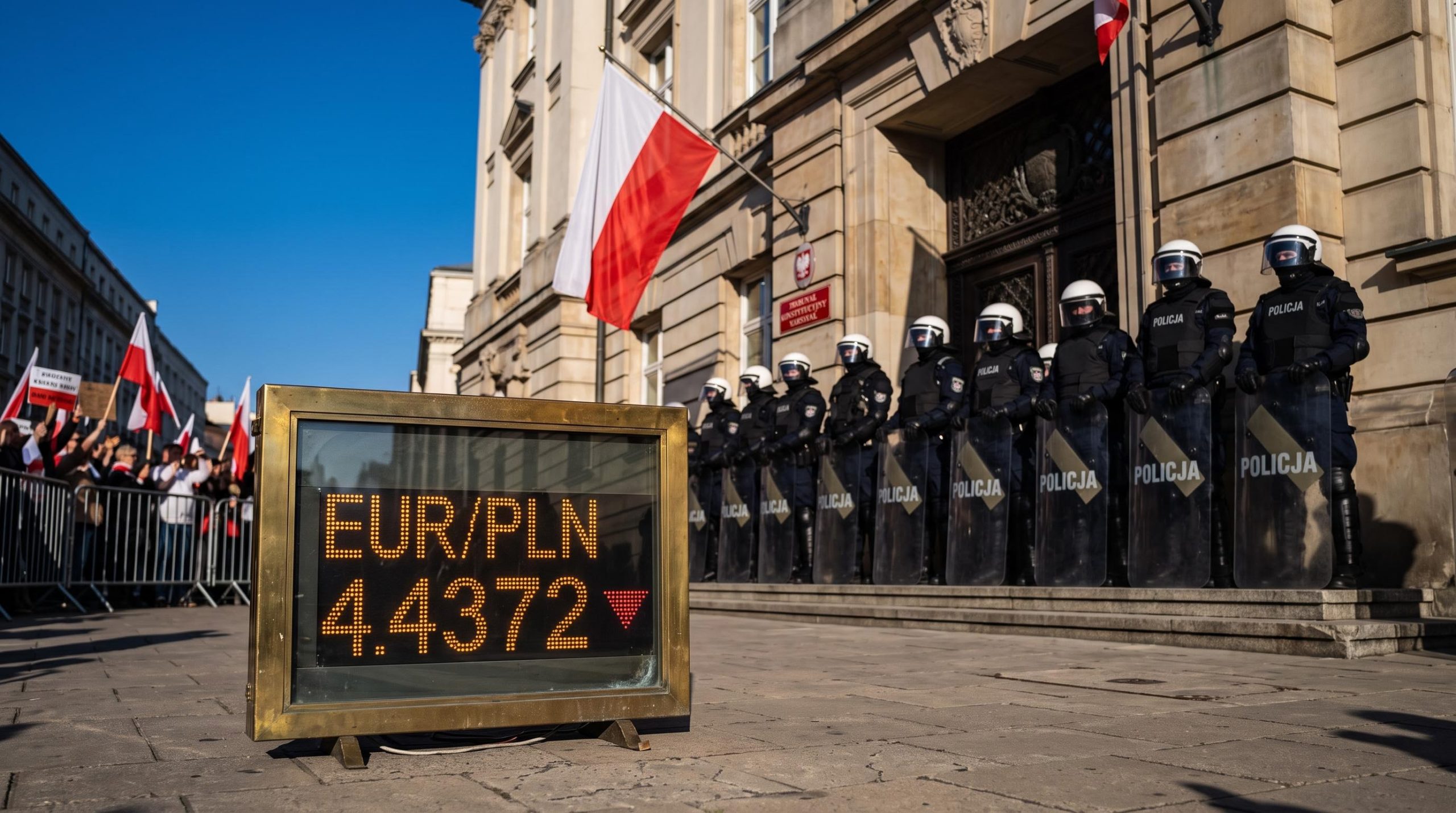
A currency is usually assumed to move on inflation prints and rate decisions. Poland’s zloty is showing something else: the brief spike in EUR/PLN to 4.4372 drew attention, but the more lasting signal is that the zloty is now trailing both the Czech koruna and the Hungarian forint. That gap is where the zloty outlook is being set.
The trigger was not economic. Riot police stood guard outside Poland’s Constitutional Tribunal after a judge announced on 30 October 2026 a one-month suspension of the Tribunal’s president and vice-president. Rival institutions now claim authority, and a general election is about a year away.
Commerzbank’s Tatha Ghose wrote on 3 November 2026 that the bank is now the most bearish on the zloty (PLN) among the CE3 currencies. The CE3 are the Polish zloty, Czech koruna (CZK) and Hungarian forint (HUF).
Here is a way to read how institutional and political risk gets priced into a currency. It also sets out what is holding the zloty up and what could push it lower from here.
What happened at the Constitutional Tribunal, and how did the zloty react?
The incident
On Friday 30 October 2026, coalition-backed judge Anna Korwin-Piotrowska announced the suspension of Tribunal President Bogdan Święczkowski, who is aligned with the opposition Law and Justice party (PiS), and Vice-President Bartłomiej Sochański. She said she would run the court herself. Prime Minister Donald Tusk then sent riot police to guard the building, citing reported threats to judges and staff.
PiS supporters protested over the weekend. Police detained three people after the security perimeter was breached and objects were thrown at officers. President Karol Nawrocki turned his aircraft around mid-trip to Senegal and flew home to join the standoff.
PiS figures called the move a “coup”. Tusk argued the suspension was needed to address the Tribunal’s institutional crisis.
The optics problem Ghose argues that it hardly matters who is legally right. Competing institutional claims and police at the court doors look like a constitutional crisis, and they arrive roughly a year before Poles vote.
The market reaction
The price move itself was contained. EUR/PLN briefly touched 4.4372 before settling at 4.4179 on 3 November, according to Commerzbank commentary carried by TradingKey and other outlets. The European Central Bank (ECB) reference rate on 2 November was 4.4185.
| Pair | Level (3 November 2026) | Context |
|---|---|---|
| EUR/PLN | 4.4179 | Still under pressure after briefly reaching 4.4372 |
| EUR/CZK | 24.3160 | Materially more stable than the zloty |
| EUR/HUF | 364.3200 | Also steadier than the zloty |
Ghose notes that the zloty’s lag behind its neighbours widened after the weekend protests. Commerzbank sees a growing chance of a sharper move.
The small absolute move tells you the market is not panicking. The widening gap against CZK and HUF tells you investors are already charging Poland a premium of its own.
Energy exposure and policy divergence already separated the koruna, zloty and forint in September, so the CEE currency outlook was uneven before the Tribunal dispute added a political layer to the zloty’s side.
When big ASX news breaks, our subscribers know first
Why is political risk landing on top of a weakening fiscal and policy backdrop?
A single court dispute would not normally shift a currency of Poland’s size. This one arrives at a time when the public finances, the credit ratings and the central bank were already leaning against the zloty.
Fiscal and EDP position
Poland has been under the European Union’s Excessive Deficit Procedure (EDP) since 2024. The EDP is the EU process that requires member states with deficits above 3% of GDP to correct them. The EU Council recommended correcting Poland’s excessive deficit by 2028, an update dated 10 July 2026.
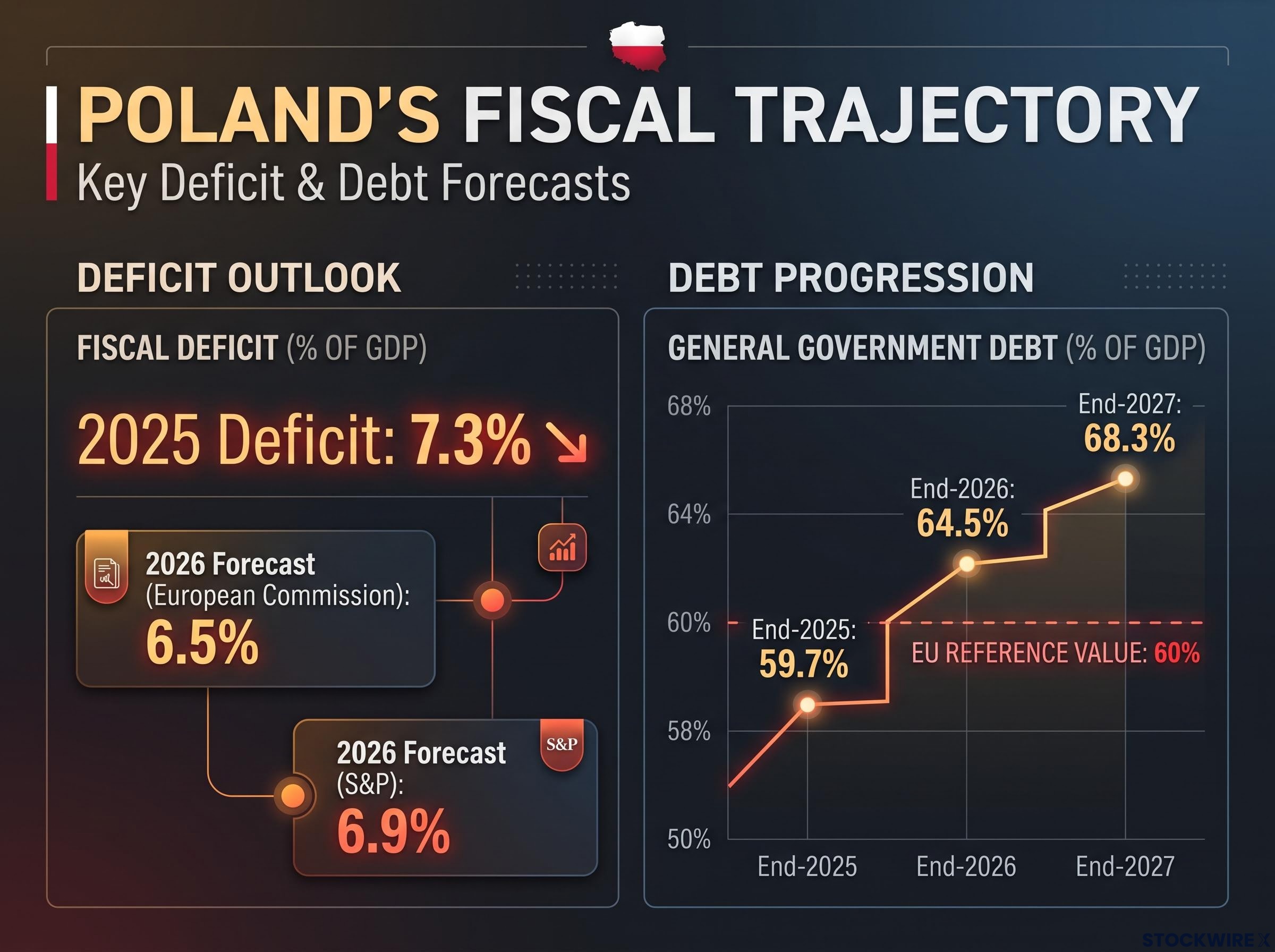
- 2025 deficit: 7.3% of GDP (Eurostat)
- 2026 deficit forecast: 6.5% of GDP (European Commission, Spring 2026)
- 2026 deficit forecast: 6.9% of GDP (S&P, 8 May 2026)
- Debt, end-2025: 59.7% of GDP (Eurostat)
- Debt, end-2026 forecast: 64.5% of GDP (Commission)
- Debt, end-2027 forecast: 68.3% of GDP (Commission)
The two 2026 deficit forecasts disagree, and the gap matters. Either way, debt is projected to cross the EU’s 60% reference value this year.
Ratings
| Agency | Action | Rating | Outlook | Date |
|---|---|---|---|---|
| S&P | Affirmed | A- | Stable | 8 May 2026 |
| Fitch | Affirmed | A- | Negative | 21 August 2026 |
| Moody’s | Downgraded from A2 | A3 | Stable (from negative) | 18 September 2026 |
Moody’s blamed a lasting deterioration in public finances. Fitch’s negative outlook points to political limits on budget repair and the risk of pre-election fiscal easing, which is exactly where the Tribunal clash adds pressure.
The NBP
The National Bank of Poland (NBP) held its reference rate at 3.75% and its Lombard rate at 4.25% on 7 October 2026. Its guidance leans dovish, meaning it is tilted towards easier policy, though it is not committed to a cut. The next decision is due on 4 November.
ING’s Frantisek Taborsky expects EUR/PLN to settle above 4.420 and the zloty to remain the weakest currency in Central and Eastern Europe (CEE). When deficits, ratings and a soft-leaning central bank all point the same way, a political shock has fewer buffers to absorb it. That is why the same headline would hurt the koruna less.
How does institutional risk feed into FX pricing?
The puzzle is simple to state. The zloty weakened without a new inflation surprise or a rate cut, so something else changed. The answer lies in a set of channels that link politics to the price of a currency.
- Risk premium: A risk premium is the extra return investors demand for holding a riskier asset. A contested Tribunal raises doubts about whether official decisions will stick, so investors may ask more to hold PLN even with unchanged data.
- Portfolio and bond flows: Foreign investors may buy fewer Polish government bonds or shorten their holdings. That pushes yields higher and weakens the zloty as money is hedged or brought home.
- Fiscal credibility: A 7.3% deficit and debt heading above 64% of GDP mean heavy borrowing. Political gridlock makes it harder to cut that borrowing.
- Ratings: Downgrades and negative outlooks raise borrowing costs and reduce demand for Polish assets. Fitch has already flagged pre-election easing as a risk.
- EU funds: Rule-of-law disputes can delay EU cohesion and recovery money. In 2023, Bank Millennium said the release of frozen recovery funds could create room for zloty appreciation.
- Central bank: If the NBP stays soft while fiscal risk rises, the interest-rate support for the zloty fades.
Where this differs from inflation and rate differentials
| Driver type | How it works | Needs new data? |
|---|---|---|
| Mechanical (inflation, rates) | Lower expected rates cut the return on holding PLN | Yes |
| Institutional | Changes the compensation investors require | No |
The danger is amplification. Investors may demand higher yields while the NBP, focused on growth or seeing inflation ease, declines to lift rates. The currency then carries the adjustment.
When a political headline breaks, check the EU-funds and fiscal-credibility channels first. Those are the ones that turned past episodes from noise into lasting damage.
Commerzbank’s Ghose took a similar view of Prague’s public-media funding dispute last month, expecting any koruna risk premium to build only gradually, which helps explain why Czech assets have been steadier than Polish ones.
What could limit the zloty’s downside?
Commerzbank’s caution is not the only reading. A strong case for resilience exists, and it rests on figures the bears cannot dismiss.
Supporting factors
- Carry: A 3.75% reference rate still pays more than euro-area rates, which rewards holding PLN, especially when global volatility falls.
- Growth: S&P forecasts 3.3% growth in 2026 and 2.9% in 2027.
- External position: Fitch lists a large, diversified economy, credible monetary and exchange-rate policy and solid external finances as strengths.
- EU funds: Continued access supports investment and the balance of payments.
- Containment: If the clash stays legally and politically contained, markets may treat it as temporary.
- Possible intervention: The NBP could step in, though no new intervention announcement has been found.
| Institution | Date | View | Reasoning |
|---|---|---|---|
| Commerzbank (Tatha Ghose) | 3 Nov 2026 | Most bearish on PLN in CE3 | Institutional conflict, fiscal and rating strain, dovish NBP |
| ING (Frantisek Taborsky) | 3 Nov 2026 | EUR/PLN above 4.420 | Politics, global conditions, fiscal concerns |
| S&P | 8 May 2026 | Relatively constructive (not an FX call) | Strong growth against rising debt |
| Moody’s | 18 Sep 2026 | Credit-negative, not unconditionally bearish | Downgrade with stable outlook |
| Fitch | 21 Aug 2026 | Negative bias | Deficits, politics, pre-election easing |
S&P and Moody’s imply that growth and possible fiscal stabilisation could prevent a disorderly decline, while Fitch sits closer to Commerzbank. No recent attributable zloty views were found from Pekao, PKO BP or Morgan Stanley, which leaves a gap in the domestic perspective.
Escalation triggers
- Competing institutional claims harden, street protests drag on, or the government and presidency clash directly.
- Pre-election spending pushes deficits and debt above forecasts, raising the odds of another rating action.
- EU institutions see renewed rule-of-law slippage and delay or attach conditions to funds.
- The NBP signals further easing as borrowing climbs.
- A global risk-off move, stronger US dollar or higher energy prices magnifies the domestic shock, as ING warns.
A sharp move is a conditional risk, not a certainty. Watch these triggers rather than assume the bearish case is already priced in.
What do Poland’s and Hungary’s earlier rule-of-law episodes suggest?
The region has run this experiment before. The outcomes were not symmetric.
| Episode | Relevance |
|---|---|
| Poland, 2015-2023 | Repeated disputes with Brussels left a persistent discount; before the October 2023 vote, Reuters reported investors focused on EU relations |
| Poland, 2023 election | Hopes of better Brussels ties and released recovery funds supported the zloty |
| Hungary, 2022 | Forint hit a record low as investors pushed for a deal on roughly €15.5 billion in recovery grants and loans |
| Hungary, late 2022 | A proposed €7.5 billion EU suspension weighed on the forint and bonds |
| Hungary, 2023 | Fitch warned that missing EU funds could hurt policy credibility and the forint |
Poland’s years of friction produced a steady discount rather than a collapse. Hungary’s crisis turned acute because money was on the line.
Part of the forint’s resilience against the zloty comes from the forint’s real-rate buffer, with a 5.50% policy rate set against inflation near 1.3%, a cushion that Poland’s thinner positive real rate does not match.
The asymmetry Political noise alone rarely drives a lasting sell-off when growth and carry hold up. Threats to EU funding, fiscal credibility or central bank independence can.
Poland’s episode is so far less economically severe than Hungary’s 2022 funding crisis. The real question is whether this clash reaches EU funds and the budget, not how loud the protests become.
Reading the zloty outlook: three signals that will decide whether Ghose is right
The Tribunal standoff matters less for the 4.4372 spike than for what it compounds. Fiscal strain, rating pressure and a soft-leaning NBP had already thinned the zloty’s buffers, and politics has now been added on top.
Three signals will show which way this breaks:
- Escalation or containment: Does the confrontation spread across institutions, or settle inside the courts?
- EU and agency reactions: Any sign that Brussels links funds to the dispute, or that Fitch moves, would confirm the bearish case.
- The NBP’s tone: Watch the 4 November decision and how the bank responds as pre-election fiscal pressure builds.
If you hold or are weighing PLN against CZK or HUF, these signals matter more than the next inflation print. Containment favours the carry case; an EU-funds link favours Commerzbank’s.
Analyst views cited here are forward-looking and subject to change based on market developments and policy decisions.
This article is for informational purposes only and should not be considered financial advice. Investors should conduct their own research and consult with financial professionals before making investment decisions.