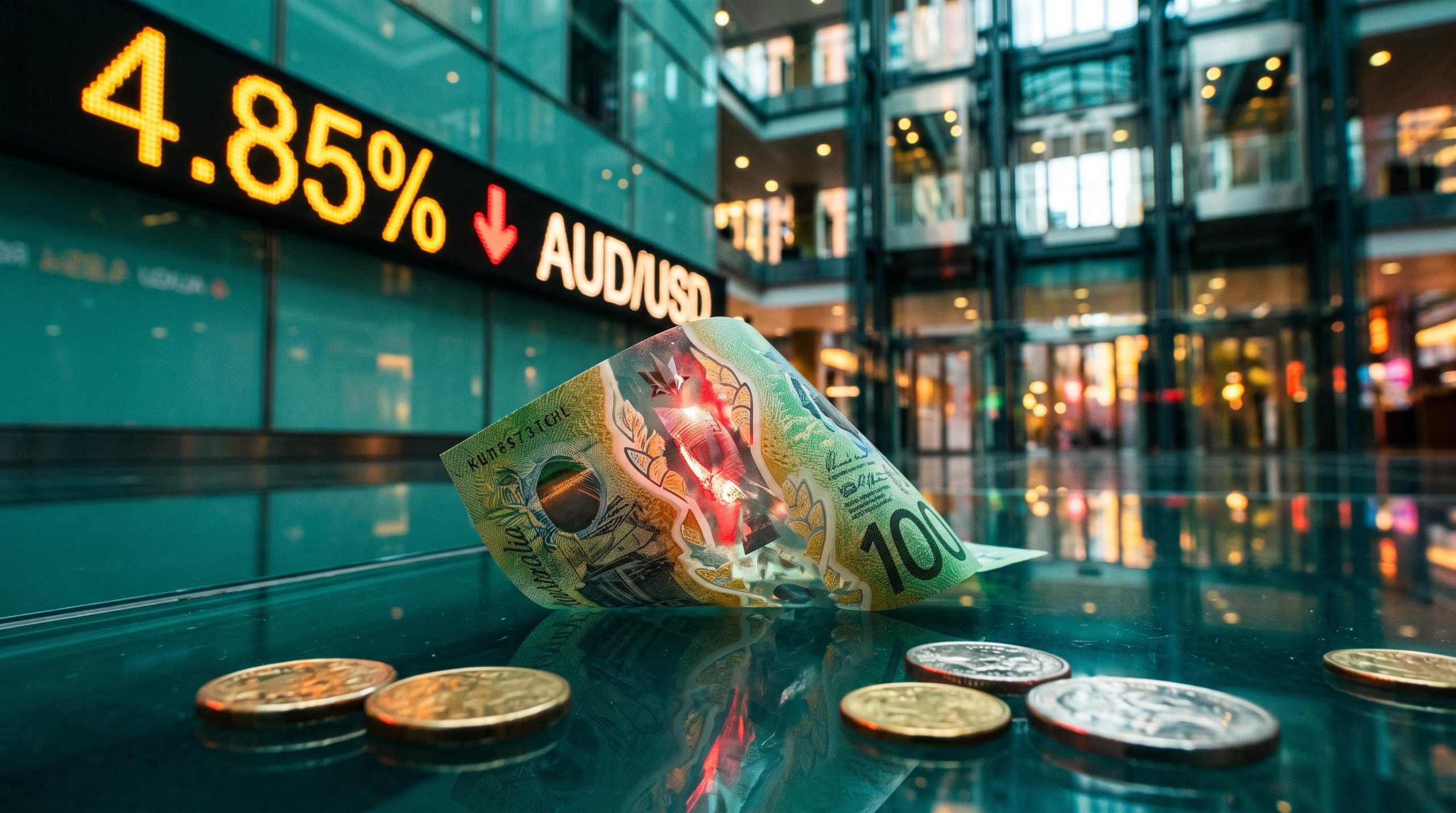
The Reserve Bank of Australia (RBA) lifted the cash rate to an 18-year high of 4.85% on 3 November 2026, and the ASX 200 still closed higher today, up 0.34% to 8,886.8. Beneath that calm headline, real estate jumped 2.88% while energy sank 3.45%.
That split was not an accident. The hike itself was widely expected, so traders looked past the decision to the wording around it.
The RBA dropped its earlier explicit signal that more tightening might be required, and the Board was divided 6-3. Markets read the change as a hint that the cycle is close to its end. At the same time, a sharp overnight fall in oil after a diplomacy signal from Iran stripped the risk premium out of energy and coal stocks.
Here is how one policy statement and one oil headline flowed through to specific sectors and stocks, and which dates and levels matter for the rest of the week.
Real estate and retailers surge while energy sinks: how the ASX 200 split on the day
The S&P/ASX 200 gained 30.3 points. The All Ordinaries rose 0.35% to 9,008.9, and breadth was firm, with 176 advancers against 114 decliners across the ASX 300. The Australian dollar slipped 0.19% to US$0.6984.
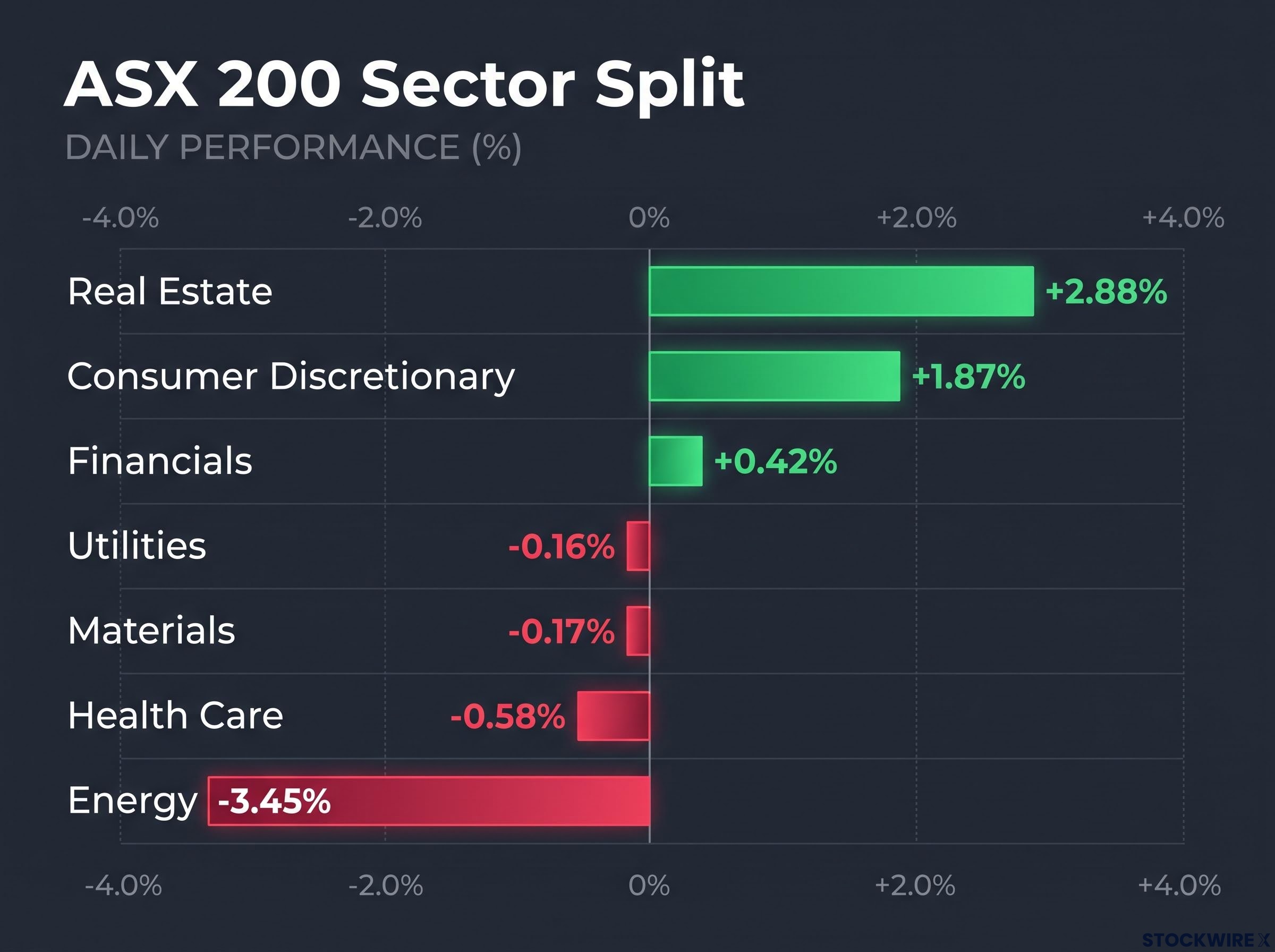
Capital left commodity-exposed sectors and moved into rate-sensitive ones. Most of the real estate gains arrived in the roughly 90 minutes after the announcement, led by Lendlease (+5.5%) and Stockland (+4.0%). Retailers had traded flat beforehand, then Myer rose 7.5%, Temple & Webster 7.0% and JB Hi-Fi 3.1%, while CBA added 1.3%.
| Sector | Move |
|---|---|
| Real Estate | +2.88% |
| Consumer Discretionary | +1.87% |
| Communication Services | +1.72% |
| Consumer Staples | +1.22% |
| IT | +0.77% |
| Industrials | +0.67% |
| Financials | +0.42% |
| Utilities | -0.16% |
| Materials | -0.17% |
| Health Care | -0.58% |
| Energy | -3.45% |
One other report put the energy fall at 3.9%. The full-session figure in the table is the more reliable of the two.
Materials missed the bounce, with copper down 2.7% and iron ore down 0.7%. Gold miners managed only 0.3%.
A gap of more than six percentage points between the best and worst sectors tells you the market was trading the direction of rates and oil, not the index. A flat-looking day can still leave your portfolio well up or well down, depending on where your weights sit.
Top movers
- Gainers: Virgin Australia +8.9% to $2.70, Netwealth +6.9%, Qantas +6.4%, Barrenjoey +6.1%, Harvey Norman +5.8%
- Losers: AMP -9.4% to $2.13, Smartgroup -8.0%, 4DMedical -7.3%, Viva Energy -6.6%, Yancoal -6.4%
Among small caps, Canterbury Resources soared 33.33% while 333D fell 25.71%.
When big ASX news breaks, our subscribers know first
Why did the RBA’s hike lift property and retail stocks?
A rate rise producing a property rally looks backwards until you see what the market was actually pricing. The Board raised the cash rate by 25 basis points (a basis point is one-hundredth of a percentage point) from 4.60%, effective 4 November. Before the decision, overnight index swap pricing (a market measure of expected cash rates) put the odds of a hike at about 85%, so the move itself held little surprise.
The change in wording did. The sequence ran like this:
- Language change: the explicit tightening signal disappeared, and three Board members voted to hold.
- Rate expectation: traders leaned toward a December pause, trimming expected future rates.
- Sector repricing: lower expected rates cut the discount rate applied to rental income and retail earnings, ease funding costs and make A-REIT (listed property trust) yields more competitive against bonds.
Banks gained for a different reason: loan rates tend to reprice faster than deposit costs, which supports margins.
The removal of the explicit tightening bias matters because earlier RBA statements had kept rate-sensitive equities, the Australian dollar and short-duration bonds under pressure, so any softening in that language reprices real estate, utilities and consumer discretionary first.
Governor Michele Bullock framed the hike around domestic demand rather than oil, citing construction activity including data-centre investment, while still flagging oil as a further inflation source.
Michele Bullock, RBA Governor Capacity pressures were “a little tighter than we had previously judged.”
The RBA’s own forecast assumes rates rise about 35 basis points more by mid-2027 before stabilising near 4.8% in 2028. ANZ sees a material risk of 5.10% in December or February 2027, and Janus Henderson assigns a 25% chance to a 5.35% peak. CreditorWatch and Westpac reportedly do not see further hikes as their base case.
What would reverse the rally
If you hold property or retail names, this rally rests on the RBA being near the end of its cycle. A hot inflation print, rising bond yields or falling property values would test that view quickly.
Retailers also face mortgage stress. CommBank expects household spending growth to slow from 1.8% to 0.7% by mid-2027, and AMP chief economist Shane Oliver puts the probability of recession at 30-40%.
How an Iran diplomacy signal knocked energy and coal stocks
The second shock started in Tehran. Iran’s supreme leader signalled openness to diplomacy, reports of US-Iran contacts followed, and Brent crude fell 7.6% overnight, its sharpest drop in three months, to below US$105 a barrel. It then recovered 1.1% to US$105.87.
Coal is not crude, yet coal miners fell hardest. The same geopolitical premium had propped up sentiment across fossil fuels, so when it faded, it faded everywhere. Newcastle thermal coal slid 3.0% to US$151.70 a tonne and coking coal 1.3% to US$260.50.
- Woodside: -3.5%
- Santos: -1.8%
- Yancoal: -6.4%
- New Hope: -5.4%
- Whitehaven: -5.1%
- Viva Energy: -6.6%
Earlier reports showed different moves, likely from earlier in the session; these are full-session figures.
Gold took a smaller detour. COMEX gold rose 1.8% overnight, then fell 1.0% to US$3,930 an ounce in Asian trade, while Newmont added 1.2%.
Cheaper oil eases inflation pressure, which links back to the RBA, although its outlook still assumes elevated oil prices for longer. Airlines were the clearest winners, with Virgin Australia and Qantas among the day’s best performers.
Reversal risk
This move came from headlines, not from weaker demand. If talks stall, the premium can return as quickly as it left, so energy holders should treat the drop as provisional.
AMP’s slide, broker rating changes and the technical picture
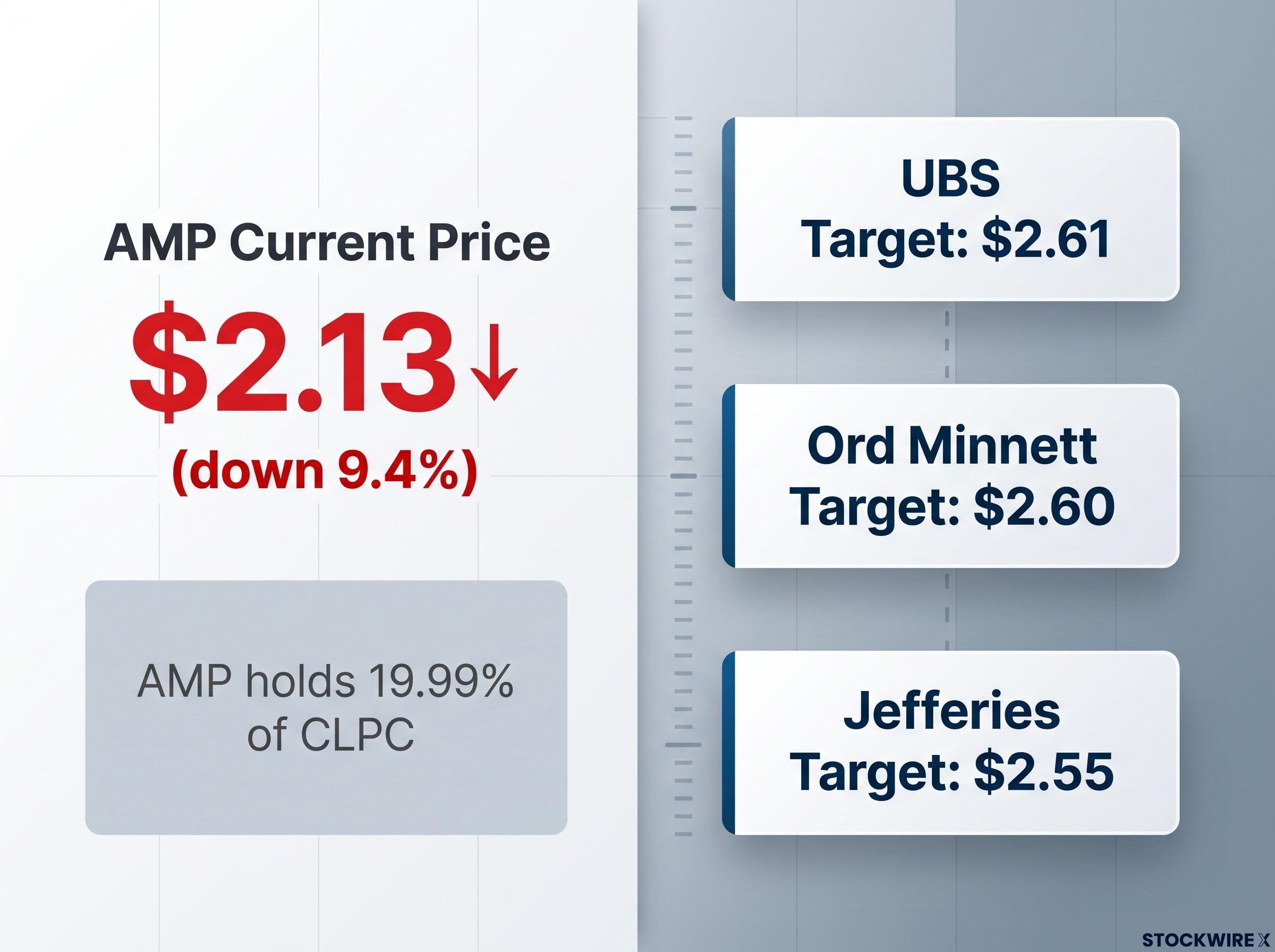
AMP posted the session’s steepest fall, down 9.4% to $2.13, its second straight decline. On 2 November, AMP told the ASX that unusual trading may have been linked to China Life Pension Company’s (CLPC) third-quarter solvency report, which showed lower year-on-year net profit. AMP holds 19.99% of CLPC and said its FY26 partnerships guidance was unchanged.
Broker moves
- AMP: Ord Minnett cut to Hold, target $2.60 (from $2.80); UBS Neutral, target about $2.61; Jefferies target $2.55
- Arena REIT: reports conflict; one has UBS upgrading to Buy with a $2.92 target, another has Ord Minnett downgrading to Hold
- Boss Energy: Morgans upgraded from Sell to Trim, target $1.35; Citi was also reported upgrading to Buy
- ResMed: Morgans downgraded to Accumulate, target $40.00
- Westpac: UBS Buy, target cut to $41.50 (from $45.00)
The cluster of AMP targets between $2.55 and $2.60 gives you a concrete reference point above the current price.
Week ahead
| Event | Date or timing | Forecast |
|---|---|---|
| Australian consumer spending | This week | Market: +0.2% m/m (October); Westpac: -0.5% m/m (September indicator) |
| US ISM manufacturing | This week | About 54.5-54.7 |
| US midterm elections | This week | Not applicable |
| Bank of England decision | 5 November | 25bp hike to 4.00% |
| US payrolls | This week | About 63,000-65,000 (prior 29,000) |
Consensus figures vary slightly across sources, and the two spending forecasts may cover different months.
On the chart, ChartWatch’s Carl Capolingua flagged a large bearish candle on the Nasdaq, places ASX 200 supply (resistance) at 8,935-8,940 and critical demand (support) at 8,613-8,641.
Where the rate-cut hopes and oil risk go from here
Today’s session rewarded the RBA’s softer signal and punished the oil risk premium. Both moves rest on facts that can change within days: an inflation surprise could revive hike expectations, and a breakdown in Iran talks could restore energy’s premium.
Your checklist is short. Watch the Australian spending data, oil and Iran headlines, the RBA’s December meeting and whether the ASX 200 can clear 8,935-8,940. Measure your sector weights against those variables rather than the index’s modest gain.
This article is for informational purposes only and should not be considered financial advice. Investors should conduct their own research and consult with financial professionals before making investment decisions.
These statements are speculative and subject to change based on market developments and company performance.