Meta priced a $25 billion common stock offering at $625 per share in the past week. Months earlier, Allianz Research estimated that about half of the 12 GW of U.S. data centre capacity planned for 2026 is delayed or cancelled. If you assumed chip supply was what limited AI spending, those two facts suggest the real limits are AI data centre financing and electricity.
Money and megawatts have become the tests of whether AI expectations hold up. The largest spenders are leaning less on bonds and more on stock as the extra yield demanded on their debt widens. Vendor financing ties the balance sheets of chipmakers, cloud providers and AI labs more tightly together.
The evidence runs to late October 2026, including Anthropic’s newly filed IPO document. Here is how the buildout is being paid for, where that funding is under strain, and which signals will show whether the spending earns its keep.
Why are hyperscalers shifting from bonds to stock?
The strain showed up first in the bond market. Goldman Sachs data cited by Reuters on 22 September 2026 put AI-related spreads at about 115 basis points, against 78 bp for broader investment-grade debt. A spread is the extra yield investors demand over a benchmark to hold a company’s bonds, and a basis point is one hundredth of a percentage point.
J.P. Morgan Asset Management reported on 20 August 2026 that hyperscaler spreads had widened about 30 bp year-to-date, versus 2 bp for the broad index. Hyperscalers are the giant cloud operators such as Meta, Microsoft, Amazon and Google. J.P. Morgan said the AI capex cycle had moved from balance-sheet funding to capital markets because free cash flow could no longer keep pace.
Supply is set to keep rising. J.P. Morgan estimated $279 billion of hyperscaler issuance in 2026, while Goldman forecast $420 billion of gross issuance for 2027, 60% above its 2026 estimate. Those figures give weight to Chris Whalen’s argument that heavy AI fundraising is part of what is unsettling bond markets.
What Meta’s equity programme actually contains
Meta’s response shows how far the shift can go.
| Instrument | Amount | Timing |
|---|---|---|
| Class A common stock (upsized from $22.5B) | $25B at $625 | Priced around 26-27 October 2026 |
| Convertible preferred | About $12.5B | Priced alongside common offering |
| At-the-market (ATM) programme | Up to $60B | After Class C trading starts, Q1 2027 |
| Bond filing | Up to $30B | Reuters, 6 August 2026 |
An ATM programme lets a company sell new shares gradually at prevailing market prices. The immediate offerings total about $37.5 billion, but the announced equity capacity reaches roughly $97.5 billion.
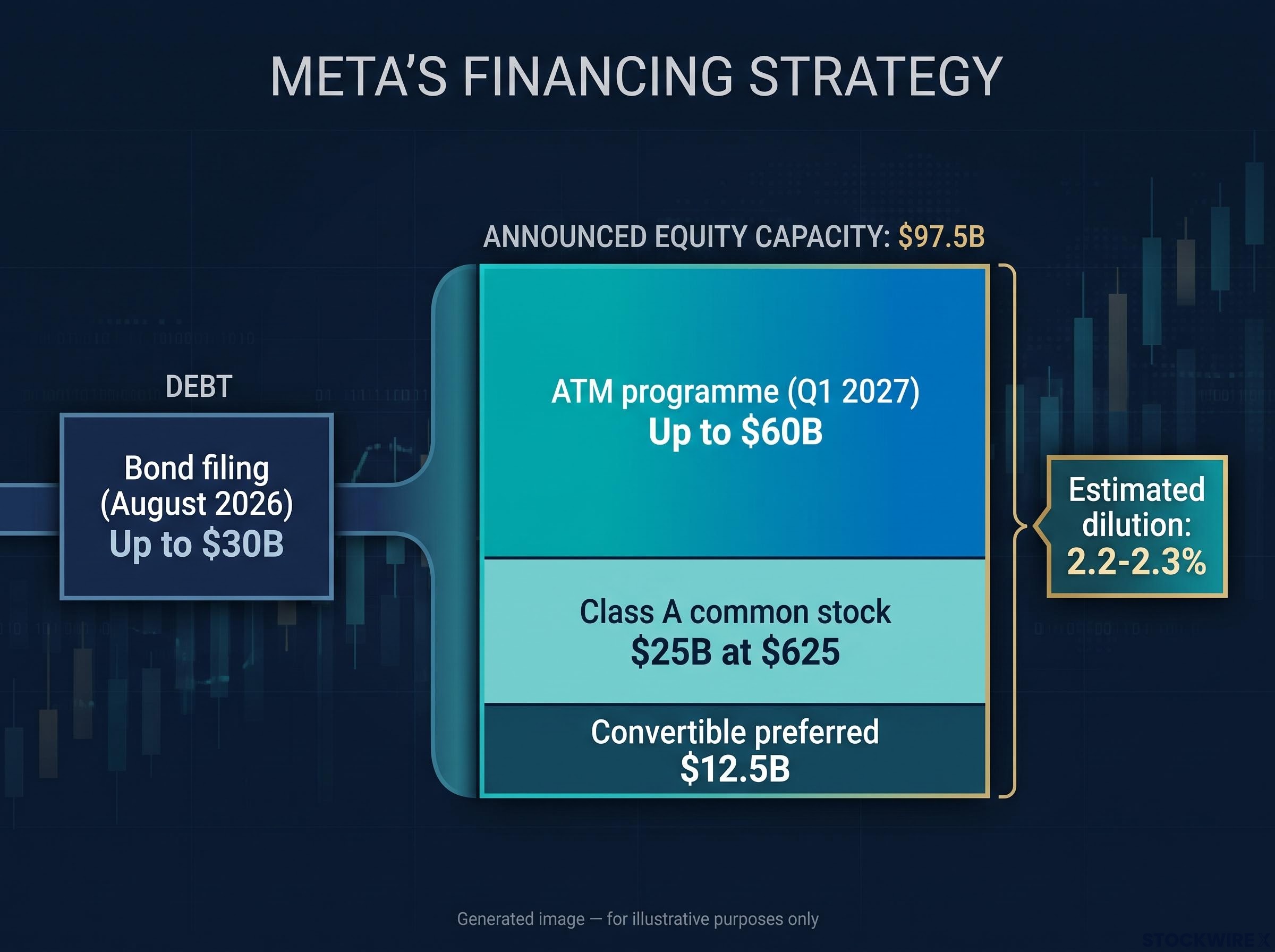
For you as a shareholder, the cost of the buildout is moving from the credit market to your own stake. The estimated 2.2-2.3% dilution from the immediate offerings is the first instalment of a potentially much larger programme.
Why debt is losing its edge
- Leverage and ratings: Large bond programmes raise debt relative to cash flow, which can weigh on credit metrics even for strong issuers.
- Spreads: AI-heavy borrowers already pay a premium over the wider market.
- Absorption limits: Cloud firms, chipmakers, developers and utilities are all issuing at once, and Reuters reported investors struggling to digest the supply.
- Long-dated asset risk: Chips and data centres have uncertain useful lives, while bonds require fixed repayment.
PIMCO described the shift as a repricing, not hyperscalers being pushed out of credit markets. The stock issuance is a signal about how much more debt investors will absorb at acceptable prices, not a sign of distress.
Big Tech credit risk is also visible in long-dated bonds trading well below par and in lease obligations that sit off balance sheet, which is part of why debt investors have grown more selective than equity buyers.
When big ASX news breaks, our subscribers know first
Is vendor financing and the Anthropic filing a circular-deal risk?
If debt markets are approaching their limits, vendor financing fills part of the gap. That is where critics see a loop forming.
How the loop works
Follow the money step by step. Nvidia finances or guarantees customers. Those cloud operators build GPU capacity with the funds, AI labs commit to renting that capacity, and the providers then order more Nvidia chips.
Add equity stakes, warrants and guarantees, and one stream of expected AI revenue can support several balance sheets at once. Reuters reported on 10 August 2026 that six institutions planned to mobilise more than $500 billion through Nvidia’s financing platform, with a potential Nvidia backstop of up to $125 billion. A week later, Reuters reported a guarantee of up to $105 billion for OpenAI’s lease of an Ohio data centre.
A backstop becomes a real contingent liability that may not show on the face of a balance sheet until triggered, which makes disclosure language in future filings a key monitoring point for investors.
Whalen’s criticism is that Nvidia funds customers who buy chips they cannot yet use. In his view, ageing hardware sitting in warehouses amounts to a serious misallocation of capital.
What the Anthropic filing shows
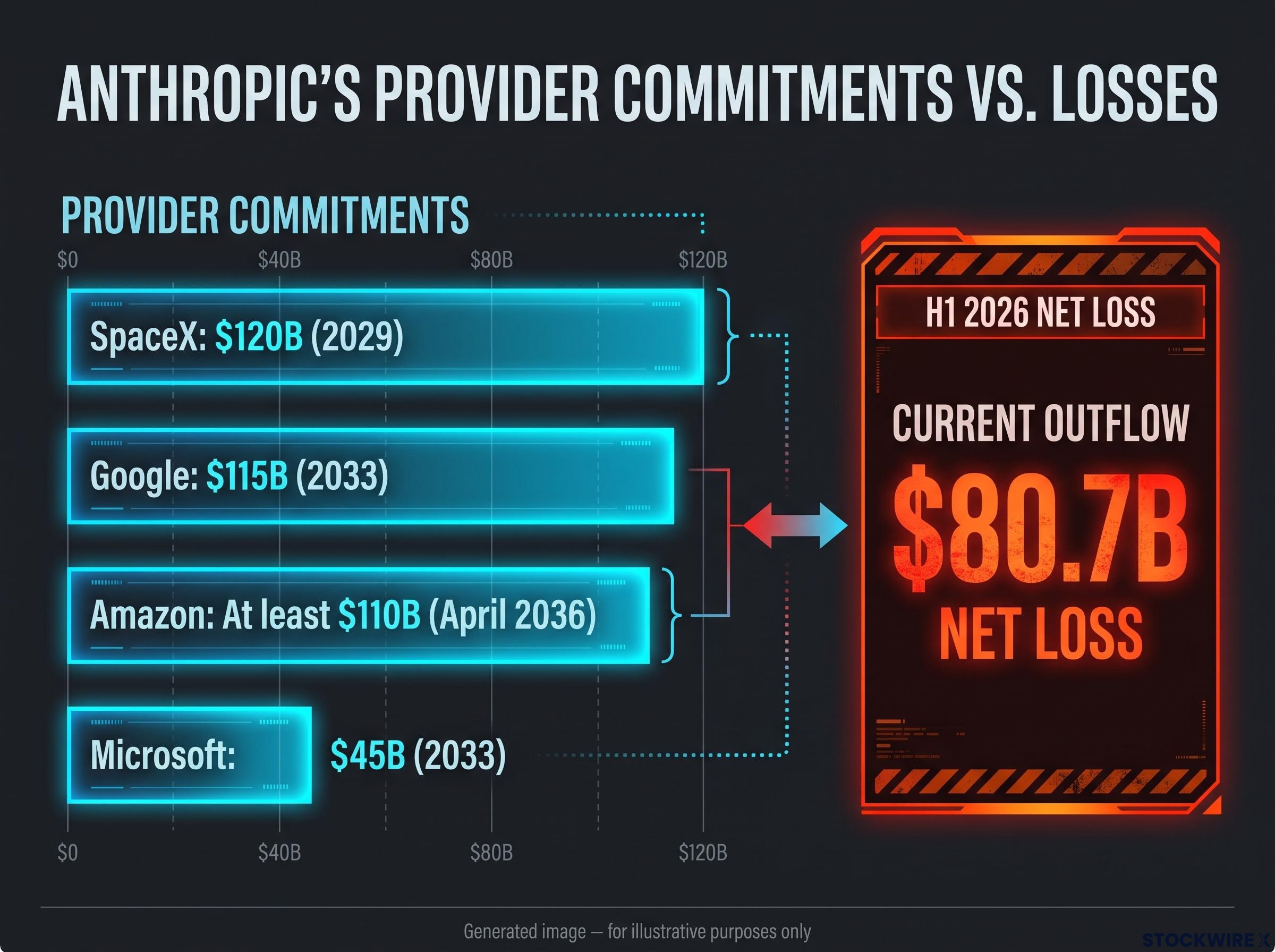
Anthropic’s S-1, filed around 26 October 2026 for a Nasdaq listing under the ticker ANT, makes the scale of these commitments concrete. It discloses about $417 billion of provider obligations, plus a further $125-150 billion ordered for delivery between 2028 and 2031 with pricing not yet finalised.
| Counterparty | Commitment | End date |
|---|---|---|
| Amazon | At least $110B | April 2036 |
| SpaceX | $120B | 2029 |
| $115B | 2033 | |
| Microsoft | $45B | 2033 |
Set those commitments against an H1 2026 net loss of $80.7 billion, largely non-cash, and the mismatch is plain. The filing states no share count, price or definitive raise. Media reports of roughly $100 billion in proceeds and a $1.5-2 trillion valuation are estimates, not filed figures.
The main risks of the structure are:
- Demand: tenants may not use enough compute to cover their leases.
- Residual value: GPUs can lose value quickly as newer generations arrive.
- Concentration: chipmakers, clouds and labs depend on one another.
- Guarantees: a backstop becomes a real liability if a customer cannot pay.
- Disclosure: reciprocal deals can make gross revenue look stronger than net external cash.
- Refinancing: projects that work while capital is cheap can fail if spreads widen.
The closest historical parallel is late-1990s telecom vendor financing, which left customers with excess capacity and debt. GPU collateral may lose its value faster than that era’s network equipment did.
The case against calling it circular
The defence deserves full weight. Nvidia’s chips are scarce, productive assets, and its major customers have deep revenue and capital. Nvidia argued the Ohio backstop was not circular because OpenAI pays the lease and the site will house chips for decades, and Reuters reported that lenders regard Nvidia silicon as dependable collateral.
The decisive test Do these projects generate independent external cash flow once subsidies, guarantees, investments and reciprocal purchases are stripped out?
That is the lens to apply when you see headline commitments. Look past revenue and pledge totals to the net external cash being created.
Why is power the constraint that financing cannot fix?
Even well-funded capacity has to be plugged in. This is where money stops being enough.
The grid queue
A shortage of power sounds like a national problem, but the bottleneck is mostly local. Connecting a site means waiting for transmission capacity, transformers and switchgear, interconnection studies, permits and community approval. Interconnection is the formal process of linking a new facility to the electricity grid.
Allianz notes that a data centre can be built in under two years, while grid connection in congested markets such as Northern Virginia can take up to seven. PJM, the largest U.S. grid operator, reports that the average path from application to operation stretched from under two years in 2008 to more than eight years by 2025. Carbon Direct found only 24% of PJM projects submitted in 2020 had reached an interconnection agreement or begun operating.
Grid connection queues are not unique to the U.S.; the UK’s Gate 2 reform cut its queue from above 738 GW to about 283 GW, a reminder that access, not generation, often decides what gets built.
| Estimate | Measure | Source and date |
|---|---|---|
| About 50% of 12 GW planned for 2026 delayed or cancelled | Capacity | Allianz, 12 May 2026 |
| At least 75 U.S. projects delayed or cancelled in Q1 2026 | Project count | MSCI, 17 October 2026 |
| 45 projects worth $68B blocked or delayed in Q2 2026 | Project value | Bloomberg/Data Center Watch, 21 September 2026 |
| About $198B of projects facing delays in H1 2026 | Project value | Brown Advisory citing Data Center Watch |
These are different measures. Gigawatts and dollar values cannot be combined or converted into each other, but every row points the same way. MSCI’s Q1 count alone matched the total for all of 2025.
Self-built power and local pushback
On-site generation can shorten the wait but adds gas turbines, fuel supply, batteries and exposure to emissions rules. That supports Whalen’s point that building your own power raises costs and can still delay projects.
Local opposition is now a measurable risk, driven by electricity prices, water use, noise and land use. The Ohio SB Energy and OpenAI project needed state support and an $80 million community commitment, which shows what siting now takes.
A financed GPU cluster earns nothing until it is energised. Treat announced megawatts and capex pledges as intentions, and executed interconnection agreements as the evidence.
Do AI expectations need resetting, or is this a normal infrastructure cycle?
Funding strain and slow grid connections bring the debate to its sharpest point. Whalen argues that the AI expectations set early this year must adjust to political reality.
The case for a reset
Capex is outrunning free cash flow, spreads are wider and some capacity cannot get power. Under this view, several assumptions need revisiting: how fast AI revenue turns profitable, GPU useful lives, utilisation, whether power costs can be passed on, bond investors’ appetite, and the odds that every announced site is built.
The bullish rebuttal
The counterargument is serious. Hyperscalers retain strong cash generation and high-quality balance sheets. AI infrastructure is productive capital, long-term contracts give visibility, and current compute scarcity may justify building ahead of demand.
| Reset case | Bullish rebuttal |
|---|---|
| Capex ahead of free cash flow | Hyperscalers still generate substantial cash |
| AI-related spreads wider than peers | GPU-backed loans seen as dependable collateral (Reuters) |
| Capacity waiting on power | Compute scarcity supports building early |
| Commitments signed before revenue | Long-term contracts provide visibility |
| Reciprocal deals blur real demand | Nvidia says the Ohio backstop is not circular |
Signals that settle it
Rather than picking a side on instinct, you can track evidence that would confirm or undercut the thesis:
- Externally paid revenue: AI income from outside customers versus related-party support.
- Free cash flow after capex: whether spending is self-funding.
- AI-heavy spreads: compared with similarly rated non-tech issuers.
- Utilisation and contract terms: lease rates, take-or-pay clauses, customer concentration.
- Interconnection and energisation: signed agreements and live power, not announcements.
- Cancellations versus reschedules: delayed projects versus abandoned ones.
- Guarantee disclosures: maximum exposure and the triggers that would make it real.
On balance, the evidence does not show that all AI financing is unsound. It suggests the boom is becoming a leveraged infrastructure cycle in which power, independent cash flow and credit-market absorption decide the outcome.
For readers wanting a live credit-market gauge, our full explainer on hyperscaler credit default swaps shows what Oracle’s 295 basis point spread says about risk that equities have not priced.
This article is for informational purposes only and should not be considered financial advice. Investors should conduct their own research and consult with financial professionals before making investment decisions. Forward-looking statements are speculative and subject to change based on market developments and company performance.
What the financing and power evidence means for your read of AI spending
The pattern is now visible. Funding is moving from bonds towards shareholder dilution, vendor financing is binding balance sheets together, and power sets the pace no matter how much capital is raised.
That leaves you with a short list of signals to watch over the next year. First, Meta’s Class C listing and ATM activity from Q1 2027 will show how much of the $97.5 billion capacity is actually used, and at what dilution. Second, Anthropic’s pricing details, when disclosed, will reveal what public investors will pay for large commitments set against current losses.
Third, follow executed interconnection agreements rather than announced gigawatts. If those three line up, the spending case strengthens. If they diverge, expectations will likely need to come down.