
The euro fell to 1.1105, its weakest level in 17 months, minutes after the European Central Bank (ECB) held rates at 2.50% on 29 October 2026. Within a day it was trading back above 1.1200. That rebound came even though the ECB had refused to back the market’s bets on aggressive tightening, which raises the question of which signal matters more for the EUR/USD outlook.
Three forces are pulling on the currency pair at once. A hold that leaves a December hike open is pulling one way. A third-quarter growth split across the euro area’s largest economies is pulling another, and a fiscal problem specific to France sits underneath both.
These forces do not cancel neatly. Some support the euro, some weigh on it, and their relative strength is still shifting. All data here reflects reporting through 31 October 2026.
Here is why a December hike to 2.75% looks likely, why it may lift the euro less than you might expect, and what would have to go wrong for 1.1000 to come into view.
Why is a December ECB hike to 2.75% still the base case?
What the ECB actually said on 29 October
The Governing Council kept the deposit rate at 2.50% in a unanimous decision. The deposit rate is the interest the ECB pays banks on overnight deposits, and it is the bank’s main policy signal. The main refinancing rate stayed at 2.65% and the marginal lending rate at 2.90%.
The statement carried two messages that pull in opposite directions. Financing conditions had tightened since the last meeting, which would weigh on growth and inflation. Rising energy prices, meanwhile, created upside risks to inflation.
Markets had priced nearly 75 basis points of tightening over the next twelve months (a basis point is one hundredth of a percentage point). The ECB pushed back on that figure. It objected to the pace of tightening, not the direction.
The currency traced that reading in real time. According to MUFG, EUR/USD slid to 1.1105, then recovered to roughly 1.1165-1.1170 before climbing back above 1.1200 on 30 October, once traders saw that December remained live.
A three-speed growth picture
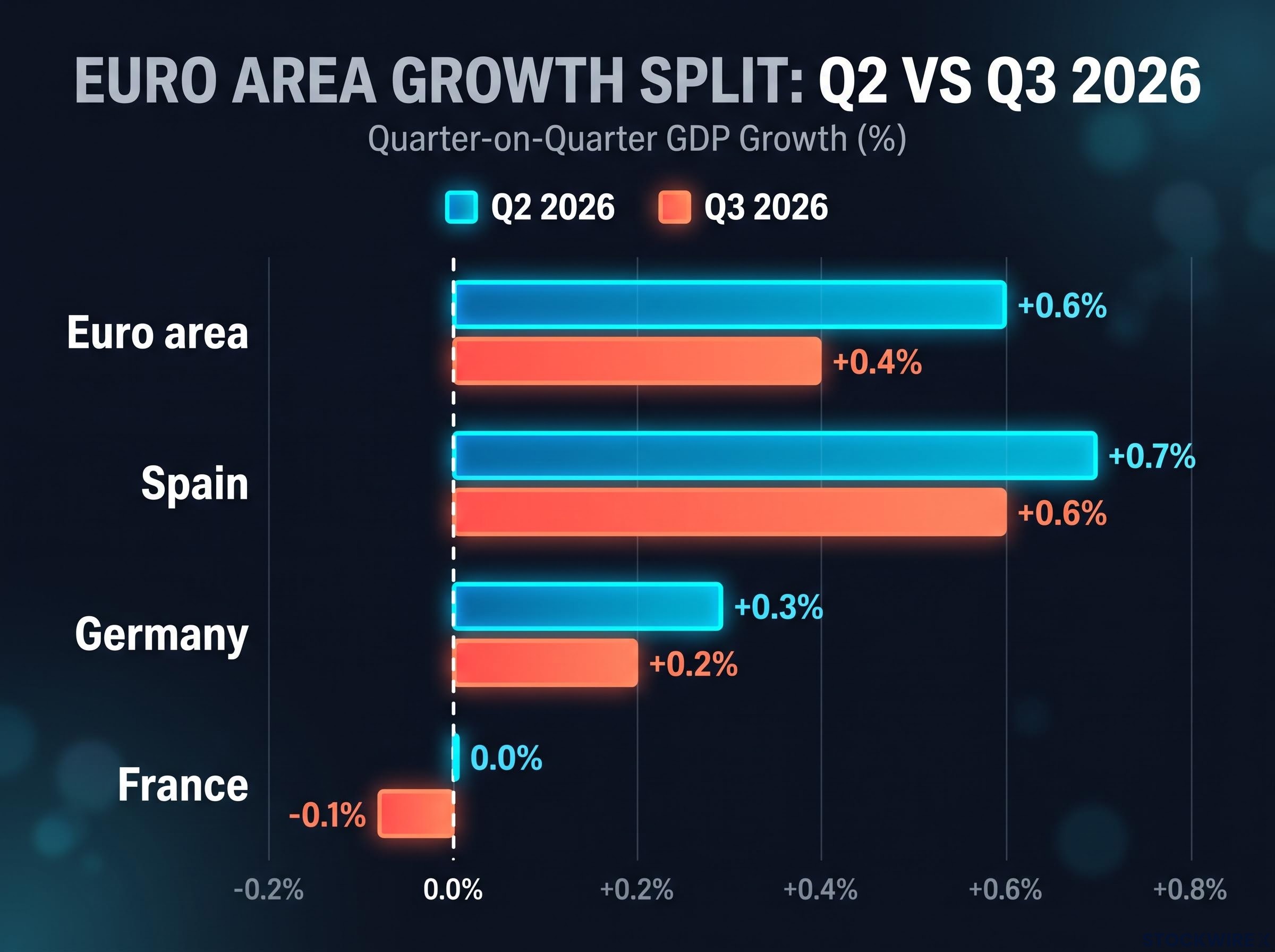
The growth data arrived a day later and helped the hawkish case. Eurostat’s flash estimate showed the euro area expanding 0.4% quarter on quarter in Q3. That was slower than Q2 but double the 0.2% Reuters consensus.
| Economy | Q3 2026 q/q | Q2 2026 q/q |
|---|---|---|
| Euro area | +0.4% | +0.6% |
| Spain | +0.6% | +0.7% |
| Germany | +0.2% | +0.3% |
| France | -0.1% | 0.0% |
Spain and Germany carried the bloc while France contracted. Overall activity is resilient enough to justify a hike, while French weakness gives the ECB a reason to stay cautious.
Estimates of the December probability depend on who measured it and when. Brown Brothers Harriman (BBH) put it at about 80% on 28 October. LSEG data cited by CNBC showed 67% just after the decision, and FXStreet coverage of BBH research had it near 86% on 30 October. A Reuters poll found 64 of 73 economists expecting a 25 basis point move.
Economist expectations for December rest on inflation near 3.8% and elevated oil prices, which explains why a Reuters poll showing 64 of 73 economists backing a 25 basis point move sits comfortably alongside the cautious language in the ECB’s October statement.
| Institution | View | Key reasoning | Date |
|---|---|---|---|
| Morgan Stanley | December the “natural” point | Higher yields already tightened conditions in October | 26 Oct |
| Scotiabank | 25 bp to 2.75% | Energy-driven inflation risk | 29 Oct |
| BBVA Research | Hike increasingly likely | Pause favoured by tighter financing | 29 Oct |
| UBS Global Research | 2.75%, possibly 3.00% in March 2027 | Stop energy effects becoming embedded | 30 Oct |
| UBS CIO | Likely the last hike, hold through 2027 | More dovish than market pricing | 30 Oct |
The spread of views tells you where the real uncertainty lies. December itself is largely priced. The open question is whether it marks one final move or the start of a cycle, so the surprise risk for the euro sits in the guidance after December rather than in the hike.
When big ASX news breaks, our subscribers know first
Does limited ECB-Fed divergence really support EUR/USD?
The reassuring version of the argument goes like this. The ECB and the US Federal Reserve both look close to the end of their tightening, so the gap between their rates should not widen sharply against the euro.
The numbers make that argument harder to sustain. The Fed held its target range at 3.75%-4.00% at its 27-28 October meeting, according to Reuters. Markets give a December Fed hike roughly 80% odds, and CME FedWatch showed 85% immediately after the meeting.
| Item | ECB | Fed | Comment |
|---|---|---|---|
| Current rate | 2.50% deposit | 3.75%-4.00% | Both held in late October |
| December hike pricing | 67%-86% | 80%-85% | Both banks likely to move |
| After a December hike | 2.75% | US rate still higher | Gap of about 1 percentage point |
The gap that stays Even after a December ECB hike, the US policy rate would sit about 1 percentage point above the ECB deposit rate.
If both banks hike, any lift the euro gets from the ECB is partly absorbed by the dollar’s existing yield advantage. The picture changes only if the Fed delays while the ECB moves and French risk stays contained.
That gives you a simple test for the rate side of any EUR/USD view. A December ECB hike alone narrows the gap only slightly. For rates to become a real tailwind for the euro, you need the Fed to pause.
Crowded dollar positioning adds another wrinkle, because a near-certain Fed hike can already be reflected in prices, so a hold or dovish dot plot could weaken the dollar and give EUR/USD room that rate differentials alone would not suggest.
How could French fiscal risk push EUR/USD toward 1.1000?
The French fiscal backdrop
France is expected to run a deficit of about 5.4% of GDP in 2026, according to the Straits Times. The government is targeting roughly 5.0% in 2027 after a €54 billion savings package, as Reuters reported on 21 October.
Fitch projects public debt reaching about 124% of GDP by 2028, up from 115.7% in 2025. On 30 October it kept France at A+ but moved the outlook to negative. Prime Minister Sébastien Lecornu lacks a parliamentary majority, so nothing guarantees the budget passes.
France’s fiscal crisis has pushed 10-year OAT yields to their highest level since 2002, and the budget’s reliance on minority government support makes a rollover more probable than intact passage, a risk that bears directly on the euro.
From spreads to the euro
The OAT-Bund spread is the extra yield investors demand to hold French government bonds (OATs) instead of German ones (Bunds). Lombard Odier put it near 147 basis points in early October, the widest since 2012. J.P. Morgan described it on 28 October as the highest since the 2011 crisis.
A French budget problem can travel to the currency in six steps:
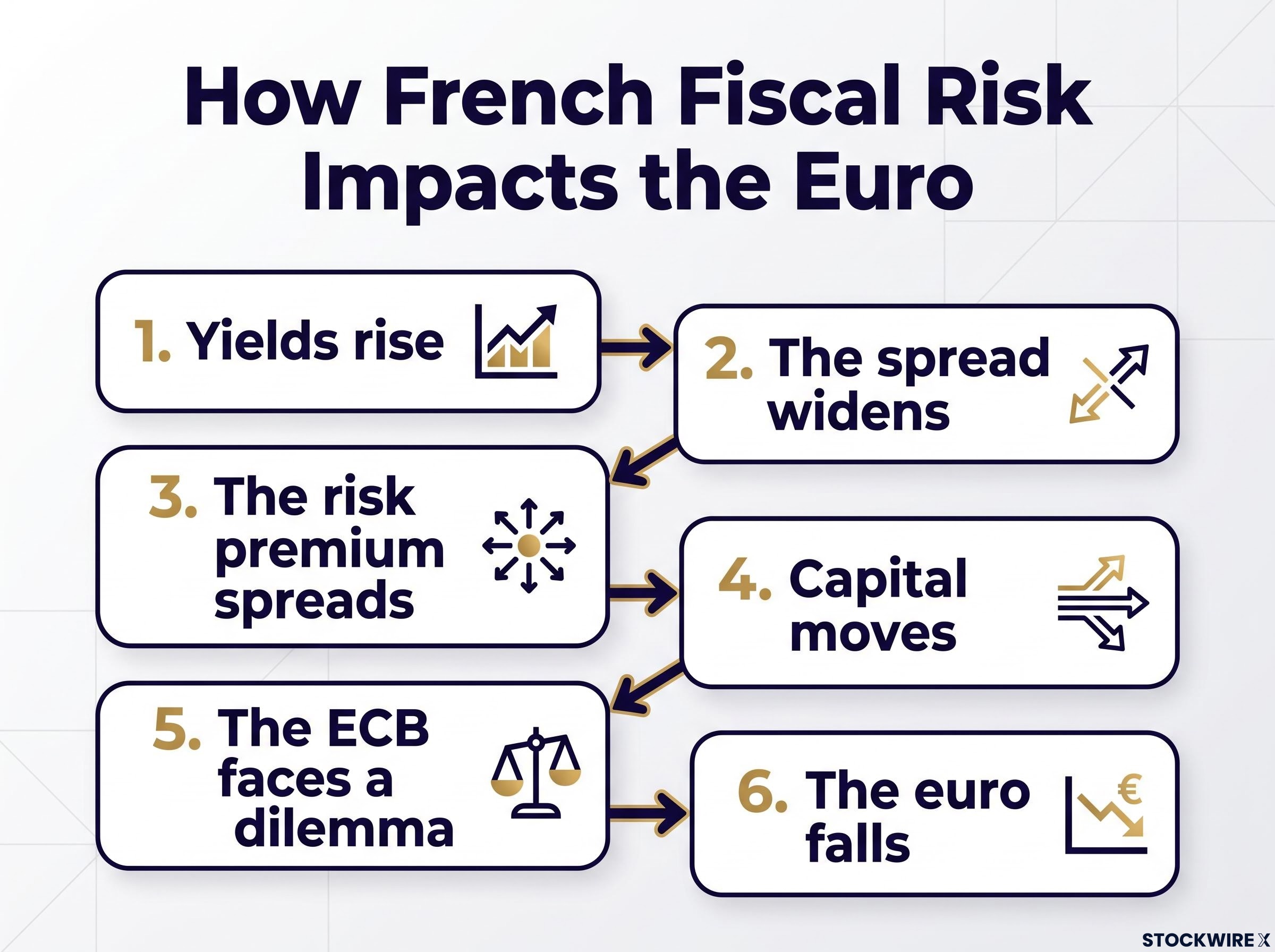
- Yields rise. Fiscal worries push OAT yields higher.
- The spread widens. The OAT-Bund gap becomes the market’s gauge of French risk.
- The risk premium spreads. Investors may trim exposure to euro-area assets generally.
- Capital moves. Money flows toward the dollar, US Treasuries and Bunds.
- The ECB faces a dilemma. Hiking raises French debt costs, while holding back on inflation risks its credibility.
- The euro falls. EUR/USD drops if the fiscal premium outweighs the rate benefit.
| Source | EUR/USD view | Basis | Date |
|---|---|---|---|
| Brown Brothers Harriman | Vulnerable toward 1.1000 | Continuing French fiscal troubles | 30 Oct |
| Lombard Odier | 1.09 in 12 months (range 1.07-1.12) | French risk, stronger dollar | 13 Oct |
| MUFG | Base case 1.08-1.14 | Continued French fiscal drift | 22 Oct |
Past performance does not guarantee future results. Financial projections are subject to market conditions and various risk factors.
There are solid reasons the chain may not complete. ABN AMRO views the widening as mainly France-specific, which makes immediate ECB intervention unlikely. France is large, diversified and investment grade, the spread move has not turned disorderly, and the ECB holds tools to protect the transmission of its policy.
What the 2024 precedent shows, and how today differs
After the snap election was called in June 2024, EUR/USD fell to about 1.0733 as French bonds and equities sold off. No ECB decision was needed for that move.
Today’s pressure is different in kind. It centres on debt sustainability and budget passage rather than a sudden political shock. For you, that means the 1.1000 scenario depends on the fiscal premium outrunning December’s rate benefit, so budget votes and spread behaviour matter more than the ECB decision itself.
How does the ECB Governing Council vote, and does Lagarde’s exit change the path?
Christine Lagarde announced on 29 October that she will leave the presidency on 7 February 2027. It is natural to assume a new president means a new policy. The ECB’s structure makes that unlikely.
The Governing Council is the body that sets euro-area interest rates. Its composition looks like this:
- 27 members in total, all of whom join the discussion
- 6 Executive Board members, including the president
- 21 national central bank governors
- Governors share votes through a rotation introduced after Lithuania joined in 2015
Who actually votes At any meeting, 21 members hold voting rights: the six Executive Board members plus 15 rotating governors.
The ECB generally seeks consensus rather than publishing vote tallies, and the October hold was reported as unanimous. One departing voice, even the president’s, shifts a collective body only at the margin.
What a new president could and could not change
Reuters named Pablo Hernández de Cos and Klaas Knot among the leading candidates, and it judged that personnel changes alone are unlikely to alter the policy path. The real difference would show up in a crisis. That is where crisis-management tools, and the question of whether the ECB would support French debt in a severe sell-off, come into play.
For December and near-term euro moves, the leadership change is a weak driver. It matters mainly if the French stress described above turns into something that needs a backstop.
Weighing a December hike against French risk for the euro
A December hike to 2.75% remains the most likely path. The October communication, however, rejected an automatic multi-hike cycle, and that limits how much support the euro can draw from the ECB.
EUR/USD sits between that modest support and heavier counterweights: a US policy rate still about a point higher, French fiscal risk, and the chance that tighter market conditions make further hikes unnecessary.
Your checklist is short. Watch French budget passage and the OAT-Bund spread first, then the Fed’s December decision, energy prices and the ECB’s December meeting. Those variables will decide whether the pair builds on its rebound or drifts toward 1.1000.
These statements are speculative and subject to change based on market developments and central bank decisions.
This article is for informational purposes only and should not be considered financial advice. Investors should conduct their own research and consult with financial professionals before making investment decisions.