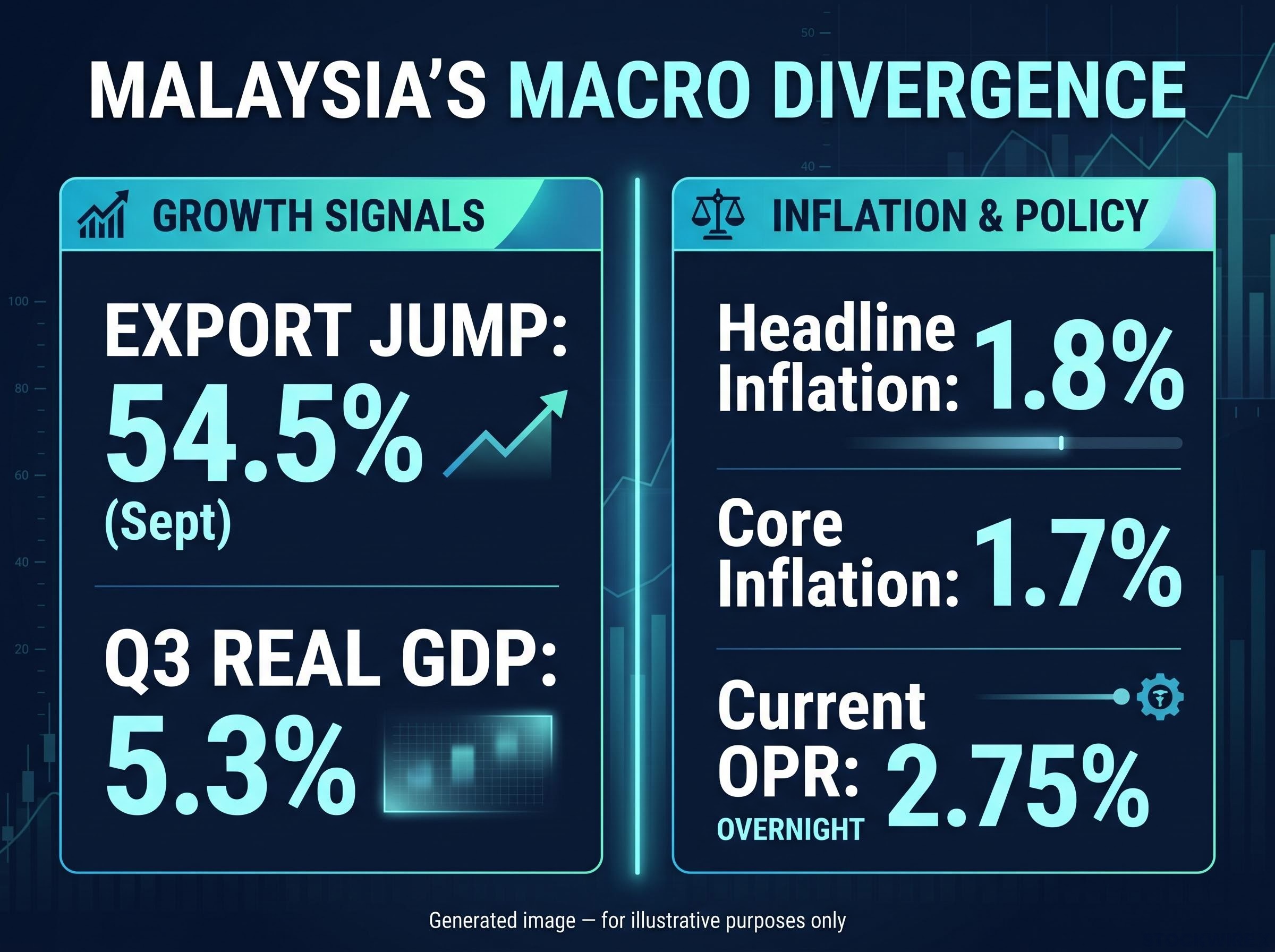
A 54.5% jump in exports and growth above 5% would normally push a central bank towards raising interest rates. Malaysia has both, yet the case for tightening is weaker than it looks, because headline inflation is sitting at just 1.8%.
That tension sets up Bank Negara Malaysia (BNM)‘s final policy meeting of 2026, next Thursday, 5 November. The Overnight Policy Rate (OPR), the benchmark rate that guides what banks charge each other and, in turn, what they charge you, stands at 2.75%.
DBS Group Research calls the decision a “close call”. Its economists still expect a hold, with the next tightening pushed into the first half of 2027. Most of the major banks agree, but one prominent house does not.
Here is how to judge why a hold is the base case and what could overturn it. It also covers what a delayed hike would mean for your borrowing costs, your bond exposure and the ringgit.
Why does DBS expect Bank Negara Malaysia to hold the OPR at 2.75% on 5 November?
DBS’s verdict comes with an honest caveat. In a note dated 21 October 2026, economist Chua Han Teng expects BNM to keep the OPR at 2.75%, followed by a 25 basis point hike (a quarter of a percentage point) in the first half of 2027.
DBS Group Research, 21 October 2026 The November meeting is “live and a close call”, but the data allow BNM to stay patient until 1H27.
The inflation evidence carries the argument. Headline inflation eased to 1.8% year-on-year in September, down from 1.9% in August. Core inflation strips out volatile items such as fresh food and administered prices, and it held at 1.7%.
Both readings sit comfortably inside BNM’s official 2026 forecast range of 1.5%-2.5%. Over the first seven months of the year, headline and core averaged 1.8% and 2.0%.
Growth is a different story. The economy expanded 5.7% in the first half, and the advance estimate released today shows 5.3% growth in Q3 2026. BNM expects roughly 5% for the full year.
| Indicator | Latest reading | Date or source | What it implies |
|---|---|---|---|
| OPR | 2.75% | BNM, held 3 September 2026 | Policy unchanged all year |
| Headline inflation | 1.8% y/y | DOSM, September 2026 | Lower half of official range |
| Core inflation | 1.7% y/y | September 2026 | No broad price pressure |
| Real GDP | 5.3% y/y | DOSM advance estimate, Q3 2026 | Strong but not accelerating |
The final piece is BNM’s own wording. At its 3 September meeting, the central bank held the rate but dropped its description of the policy stance as “appropriate”. That edit keeps a hike on the table without committing to one.
With inflation in the lower half of the range, BNM has no data-driven reason to hurry. A hold next week would signal patience, not complacency.
When big ASX news breaks, our subscribers know first
How can growth be this strong while inflation stays this low?
If strong growth usually feeds rising prices, Malaysia’s numbers look contradictory. The answer lies in where the growth is coming from.
Central banks raise rates when demand outruns what the economy can supply and prices start climbing across the board. Growth driven by households spending more tends to do that quickly. Growth driven by factories shipping goods overseas often does not.
Malaysia’s boom is the second kind. Exports rose 54.5% in September to RM215.1 billion, a five-year high, and total trade climbed 53.7% to RM396.5 billion. The World Bank has linked this year’s acceleration to net exports and AI-related electronics demand.
Four forces are keeping that output from turning into consumer inflation:
- The AI export boom: Electronics and electrical exports are growing about 60% year-on-year on a three-month average, lifting factory output rather than shop prices.
- Fuel subsidies: According to HSBC, subsidised RON95 petrol at RM1.99 per litre, under a monthly quota, is holding down measured inflation.
- Steady domestic demand: Spending is resilient, but core inflation at 1.7% shows no sign of overheating.
- A firmer ringgit: The currency gained for a 10th straight session today, trading near RM4.0555-RM4.0600 per US dollar and touching about RM4.0460 intraday, which cuts the cost of imported fuel and components.
Because the boom is concentrated in factories and trade, you should read headline GDP as a weaker tightening signal in Malaysia than in a consumption-led economy.
Why subsidy reform is the delayed inflation risk
The subsidies that are suppressing inflation today could reverse that effect later. If the government narrows or retargets fuel support, headline inflation could jump even if demand stays moderate.
The damage would not stop at the petrol pump. Higher fuel costs flow into transport and food prices, creating second-round effects that are harder to contain. That is why several analysts describe a 2027 hike as precautionary rather than reactive.
Where do analysts disagree, and what could change BNM’s mind?
On next week’s decision, the consensus is broad. Where the banks split is on how long the hold lasts.
| Institution | November call | Hike timing |
|---|---|---|
| DBS | Hold at 2.75% | First half of 2027 |
| HSBC | Hold | To 3.0% in Q1 2027 |
| CIMB | Hold | To 3.0% in March 2027 |
| RHB | Hold | First half of 2027 |
| Pantheon Macroeconomics | Hold | Prolonged hold |
| UOB | Hike to 3.0% | As early as 5 November |
HSBC has lifted its 2026 growth forecast to 5.5%, yet still sees underlying inflation as too soft to force an immediate move. CIMB expects core inflation to rise from about 2.0% in Q1 2027 to 2.5% in Q3 2027, and wants BNM to act before that happens.
The dissent deserves serious weight. UOB economists Julia Goh and Loke Siew Ting argue for a move to 3.0% as early as next week. They point to stronger-than-expected third-quarter growth, resilient domestic demand and an expansionary Budget 2027, with cash transfers, tax cuts and relief measures supporting spending into next year.
BNM’s own signals leave room for that outcome. Speaking to Bloomberg on 15 October, Governor Abdul Rasheed Ghaffour said the central bank is “very vigilant” about price increases and that its decisions are data-dependent.
Governor Abdul Rasheed Ghaffour, 15 October 2026 BNM has “space … to act accordingly” if inflation pressures intensify.
Several risks could bring a hike forward:
- Energy prices tied to the Middle East conflict, which Rasheed flagged directly
- Subsidy reform producing a one-off jump in headline inflation
- A higher-for-longer Federal Reserve, strengthening the US dollar and pressuring the ringgit
- Fiscal support from Budget 2027 keeping demand firmer than expected
There is also a risk running the other way. Growth is heavily concentrated in electronics, so a reversal in the tech cycle or new trade restrictions could quickly weaken the case for any hike.
The spread of hike dates from Q1 2027 to the first half of 2027, plus one November dissent, tells you the debate is about timing rather than direction. Expect the next hike, just not necessarily this week.
What would a delayed tightening cycle mean for the ringgit, bonds and borrowers?
A hold is neither simply good nor bad news. Its effect depends on what you own or owe.
A hold does not automatically weaken the ringgit. Strong exports, the external surplus and recent gains give the currency its own support. The pressure point is US yields: if they rise, Malaysia’s rate gap narrows and the ringgit could soften.
Malaysian Government Securities (MGS), the government’s own bonds, would likely see short-dated issues supported by a hold. DBS warns that a surprise hike would lift short-dated yields and flatten the yield curve, meaning the gap between short and long-term rates would shrink. The 10-year/3-year spread has already narrowed to about 40bp from 60bp in mid-September.
| Asset or group | Effect of a hold | Effect of a surprise hike |
|---|---|---|
| Ringgit | Not automatically bearish; exposed if US yields rise | Added interest-rate support |
| Short-dated MGS | Supported | Yields rise, curve flattens |
| Property and consumer shares | Favoured | Pressure on leveraged, domestic-demand names |
| Banks | Margins steady | Net interest margins benefit (MIDF) |
| Floating-rate borrowers | A few more months at 2.75% | Higher instalments sooner |
The bigger danger is not the decision itself but a sudden shift in expectations from “hold” to “normalisation”. That repricing would hit two- and three-year yields first.
If you hold floating-rate debt or short-dated MGS, the delay buys time but not immunity. The sensible reading is to plan for 3.0% in the first half of 2027 rather than assume it will not come, particularly if subsidy reform also raises living costs.
Three signals to watch before BNM’s first 2027 move
The argument comes down to three facts. Growth is strong but narrow, inflation is contained but cushioned by subsidies, and BNM has deliberately kept its options open.
These three signals will tell you when patience turns into action:
- Core inflation: Watch whether it tracks the roughly 2.0% to 2.5% path analysts expect through 2027.
- Subsidy reform: Any detail on narrowing fuel support could bring the timeline forward.
- The ringgit and the Fed: A weakening currency under a higher-for-longer US path would add pressure.
If all three stay quiet, a long hold holds. If two move together, a first-quarter hike becomes the more likely path, so position your borrowing and bond exposure with that in mind.
These statements are speculative and subject to change based on market developments and economic data.
This article is for informational purposes only and should not be considered financial advice. Investors should conduct their own research and consult with financial professionals before making investment decisions.