
Virgin Australia releases FY26 Impact Report with 6.3% emissions intensity cut
Virgin Australia (ASX:VGN) has released its Impact Report for the year ended 30 June 2026, authorised for release by the Board, showing net Scope 1 emissions intensity of 6.3% below the FY24 baseline. The report is dated 30 October 2026 and was renamed from the Sustainability Report this year.
The company describes itself in the report as the second largest airline group operating in the Australian aviation market, with more than 100 aircraft on 72 routes to 41 destinations.
Dave Emerson, CEO
“Fleet renewal and operational efficiency remain our key short- to medium-term levers to reduce emissions intensity.”
The result points to progress on fleet renewal, which the report names as the core lever behind its FY30 target.
When big ASX news breaks, our subscribers know first
Fleet renewal and fuel efficiency drive the numbers
Fleet and efficiency gains
The report details several fleet and operational measures delivered during FY26:
- 21 Boeing 737-8 (MAX) aircraft and four Embraer 190-E2s in the fleet by year end
- The 737-8 (MAX) is 20% more fuel efficient than the Boeing 737-800NGs
- The Embraer E190-E2 is expected to reduce emissions by approximately 30%
- Operational initiatives delivered estimated annual fuel savings of approximately 62,300 barrels, equivalent to an estimated 25,600 tCO₂e
- 39% of the aircraft tow tractor and baggage tractor fleet was electric at the end of FY26
Operational initiatives included route optimisation, weight reduction, single-engine taxiing and data-enabled flight planning.
| Fact | Impact |
|---|---|
| **21** Boeing 737-8 (MAX) aircraft in fleet by 30 June 2026 | **20%** more fuel efficient than Boeing 737-800NGs |
| **Four** Embraer 190-E2s in fleet | Expected to reduce emissions by approximately **30%** |
| Operational fuel-efficiency initiatives | Estimated **62,300 barrels** a year, about **25,600 tCO₂e** |
| Electric tow and baggage tractors | **39%** of the fleet |
The FY30 target explained
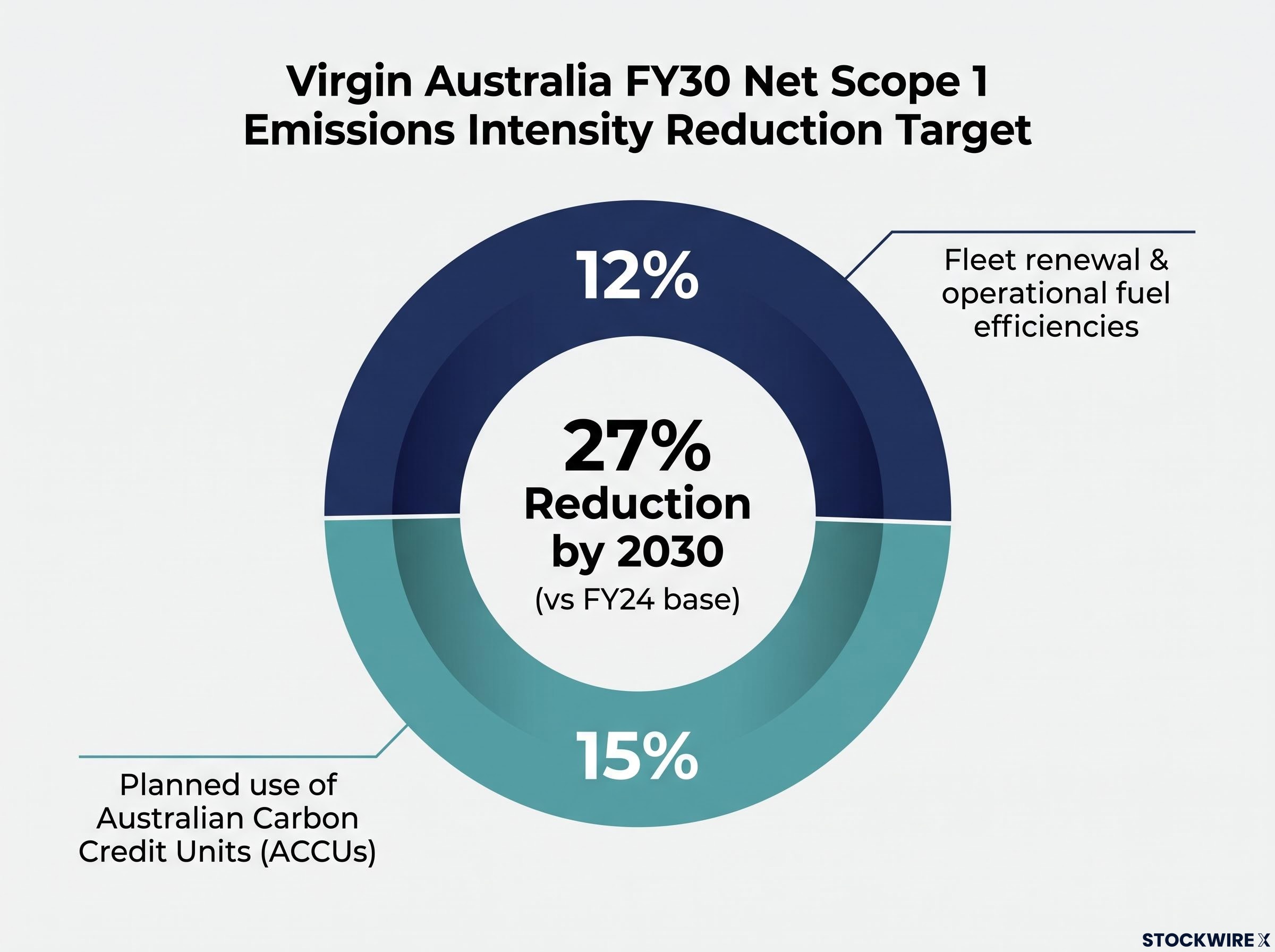
Virgin Australia’s target is a 27% net Scope 1 emissions intensity reduction by 2030 from an FY24 base year, with an ambition of net zero carbon emissions by 2050. Of the 27%, 12% is expected to come from fleet renewal and operational fuel efficiencies, and 15% from the planned use of Australian Carbon Credit Units (ACCUs).
The target replaces a previous 22% target for net Scope 1 and 2 emissions intensity from an adjusted FY19 baseline. The report states the change in percentage does not reflect an increase in underlying strategic ambition.
Scope 3 emissions rose 75% to 1,811,100 tCO₂e, from a restated FY25 figure of 1,033,561 tCO₂e. The report attributes the rise primarily to the inclusion of well-to-wake emissions from jet fuel consumed on Qatar Airways wet lease flights. Sustainable aviation fuel (SAF) is not part of the strategy to achieve the FY30 target.
How airline emissions targets work
Scope 1 emissions are direct emissions from operations, and the report identifies jet fuel combustion as the airline’s most significant source. Scope 3 emissions sit beyond direct operations and control. Intensity measures emissions relative to activity, here grams of CO₂-e per revenue-tonne-kilometre, rather than total emissions.
Gross Scope 1 emissions were 2,558,146 tCO₂e, while market-based Scope 2 emissions were 3,809 tCO₂e.
For investors, the report states Virgin Australia expects to begin surrendering carbon credits under the Safeguard Mechanism (SGM) from FY27, subject to emissions exceeding the applicable baseline. It says fleet and efficiency measures alone are not expected to be sufficient to meet regulatory emissions requirements.
Waste, safety and people results
On waste, the report records:
- Organic waste separation and composting rolled out across all seven lounges
- More than 350,000 pieces of plastic removed from napkins and approximately 800,000 plastic crew meal containers removed each year
- More than 390,000 containers diverted from landfill in Queensland, with over $38,000 donated to OzHarvest
Lost Time Injury Frequency Rate (LTIFR) fell to 8.8 from 9.5 in FY25. Total Recordable Injury Frequency Rate (TRIFR) was unchanged at 13.5.
Virgin Australia had 8,274 employees, with 77% of the workforce covered by enterprise agreements. The median gender pay gap was 35.34% and the average was 44.8%.
Velocity active members rose 9.0% compared with FY25, with approximately 800,000 new members joining. Cabin Crew were named world’s best for the eighth consecutive year, and the company was named Australia’s Most Trusted Travel & Tourism Brand in the Roy Morgan awards for the fourth consecutive year.
Operating statistics included a passenger load factor of 84%, 35,340 million available seat kilometres (excluding wet lease) and an average fleet age of 11.5 years.
What Virgin Australia has flagged for FY27
The report sets out the following forward items:
- Waste: repurposing old uniforms, an Adelaide lounge circular pilot and recycling streams at key managed sites are the FY27 focus.
- Enterprise agreements: eight are being renegotiated in FY27, covering Cabin Crew, Flight Crew, Guest Services, Guest Contact Centre, Ramp, VTech Engineers, Integrated Operations Centre (IOC) and VTech Stores.
- Take-off Grant: vesting is scheduled for June 2027.
- Materiality assessment: an update is planned in FY27.
- Modern Slavery Statement: the FY26 statement will be available on the Virgin Australia website in late 2026.
- Culture and privacy: an enterprise-wide culture and engagement plan is planned for FY27, alongside privacy and cybersecurity priorities.
The report also notes Virgin Australia published its first mandatory Sustainability Report containing climate-related financial disclosures under AASB S2, available in the Annual Report.
Don’t Miss the Next Airline and Industrials Mover
Get FREE breaking ASX news on non-resource sectors delivered to your inbox within minutes of release, with in-depth analysis already done. Join 20,000+ investors using Big News Blast to stay ahead of the market. Click the “Free Alerts” button to start receiving alerts the moment news breaks.