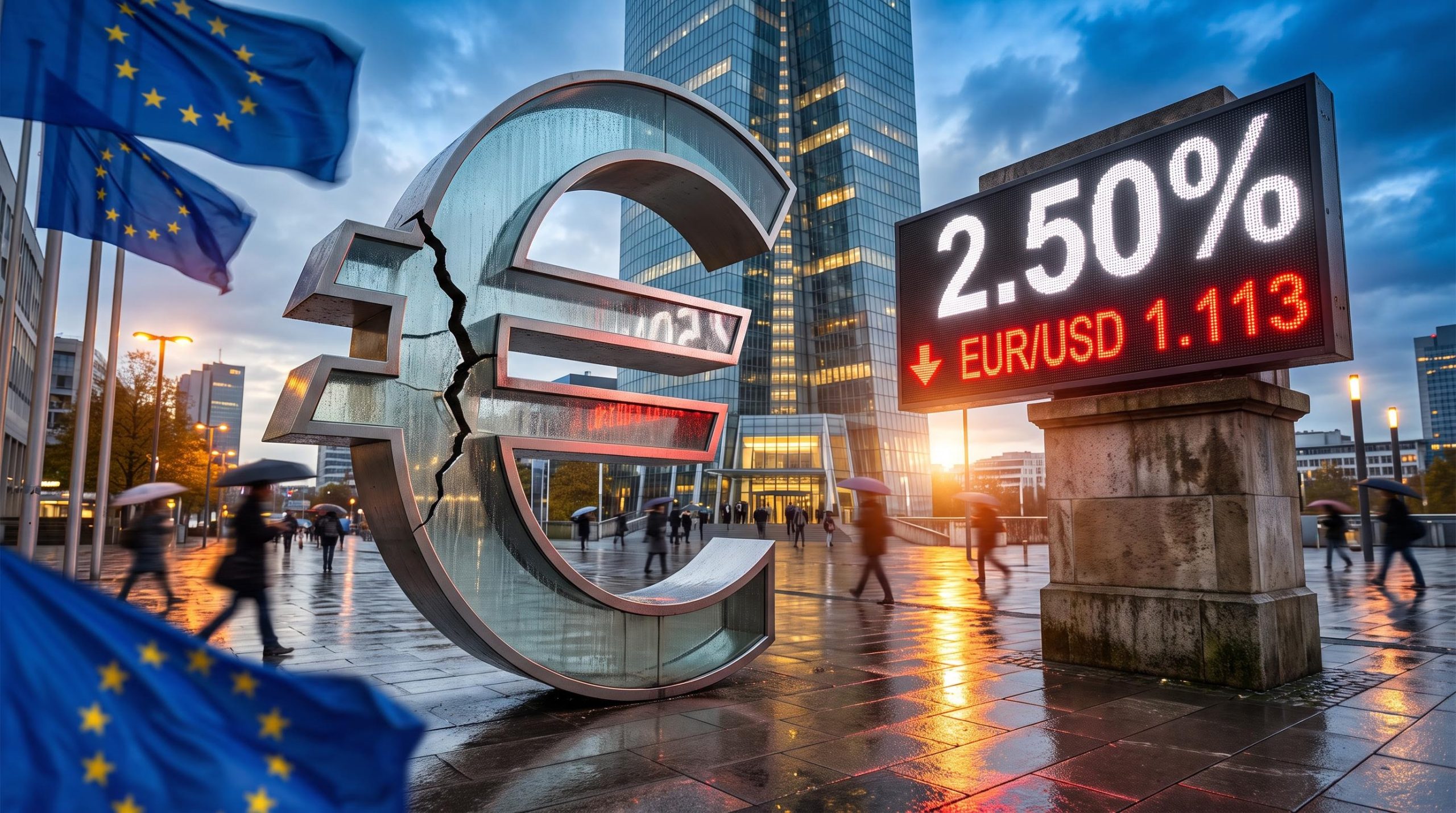
The European Central Bank (ECB) left its deposit facility rate at 2.50% on Thursday, a decision almost every economist expected. The euro fell anyway, sliding to its lowest level since May at around $1.11 as traders weighed what the ECB interest rate decision left unsaid.
That gap between an expected outcome and an unexpected currency move is the story. President Christine Lagarde warned that the energy shock is now larger and longer-lasting, that financing conditions have tightened, and that wages have not yet responded in any material way.
She also refused to commit to a path, keeping the bank on a meeting-by-meeting footing. That leaves the December hike debate wide open.
If you hold or trade anything priced in euros, here is why the currency fell on a no-surprise hold, which data points are likely to decide December, and how to read the next ECB signal before the market does.
Why did the euro fall on a hold that markets expected?
Currencies rarely drop on decisions everyone saw coming. This one did.
Reuters reported the euro down about 0.3% at around $1.11 after the announcement, while two-year government bond yields also fell. FXStreet’s Eren Sengezer later had EUR/USD recovering modestly from its session lows after Lagarde spoke, last trading about 0.2% lower near 1.113. The two readings likely capture different moments in the same session.
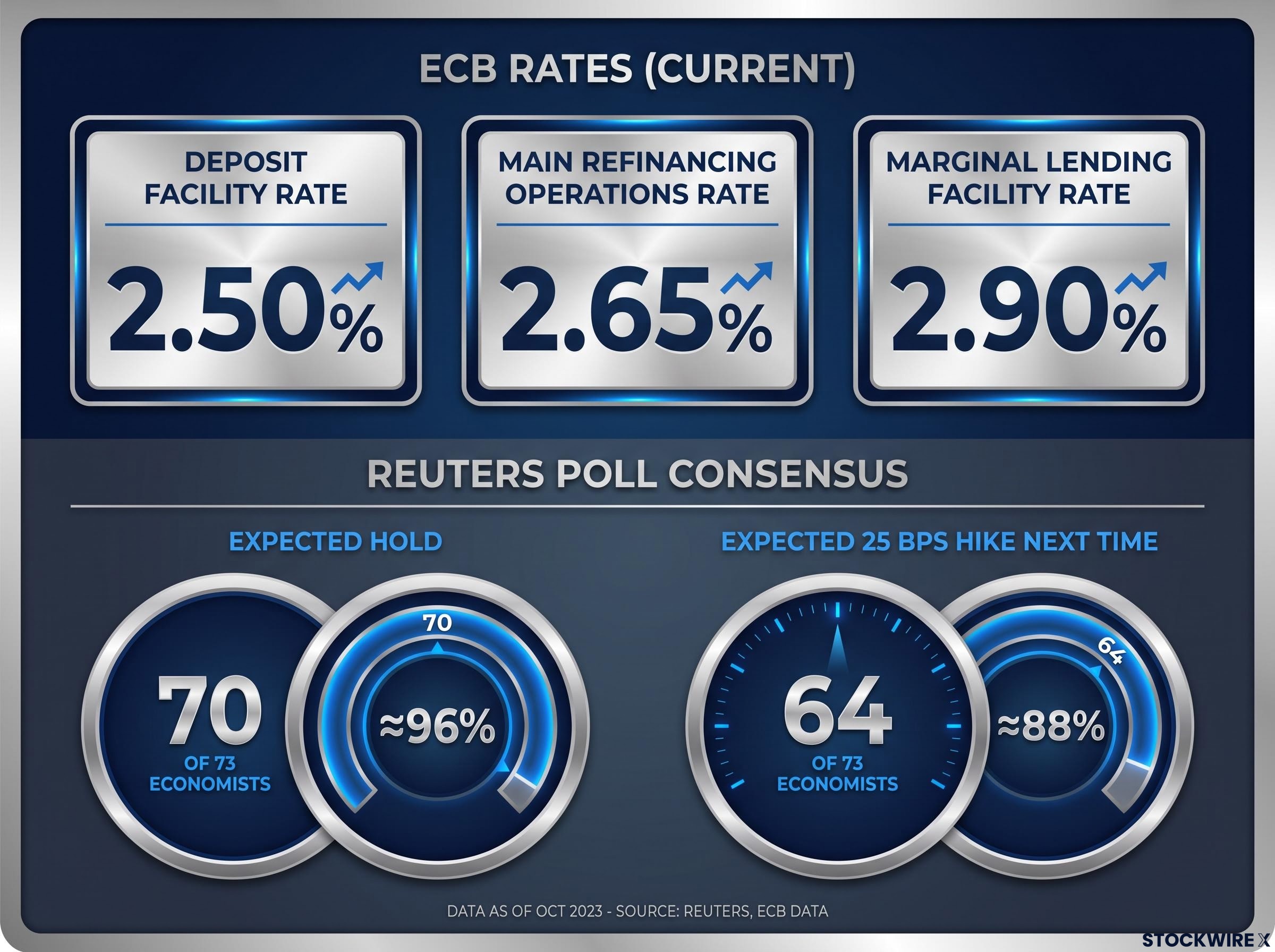
The decision itself left all three key rates untouched:
- Deposit facility rate: 2.50% (the rate banks earn on overnight deposits with the ECB, and the main signal of policy)
- Main refinancing operations rate: 2.65%
- Marginal lending facility rate: 2.90%
A Reuters poll had 70 of 73 economists forecasting exactly that. What moved the euro was the wording. The statement described rising energy prices as creating:
“upside risks to the inflation outlook and downside risks to the growth outlook”
Lagarde said indirect effects from energy have grown, underlying inflation has stayed stable and the ECB is “well positioned” to handle elevated uncertainty. Traders heard caution, not conviction. The door to a December hike stayed open, but nobody walked through it, even with 64 of 73 economists expecting a 25 basis point (0.25 percentage point) increase next time.
No vote count or dissent was published. For you, the takeaway is simple: judge ECB meetings by the guidance, not the rate level, because a hold that leaves a hike unpromised can weigh on the euro.
Hike or hold in December: how large is the energy shock for inflation and growth?
The case for tightening starts with the numbers. Eurostat’s flash estimate put September headline inflation, measured by the Harmonised Index of Consumer Prices (HICP), at 3.8%, up from 3.2% in August.
| Indicator | September 2026 | August 2026 |
|---|---|---|
| Headline HICP | 3.8% | 3.2% |
| Energy | 18.9% | 14.3% |
| Excluding energy | 2.3% | 2.1% |
| Services | 3.2% | 3.0% |
| Food | 1.3% | 1.1% |
The ECB’s 10 September staff projections, still the latest, put headline inflation at 3.0% in 2026, 2.5% in 2027 and 2.1% in 2028. Energy prices have since climbed above the path those forecasts assumed.
Those staff projections were revised upward in September, with core inflation staying above 2% across the full 2026-2028 horizon, which means price pressure is not confined to the energy component.
The shock travels in three stages:
- Direct: pump and heating bills rise, lifting the energy component of inflation.
- Indirect: businesses pass higher fuel and transport costs into food, goods and services.
- Second-round: workers demand higher pay and firms reset prices, making inflation stickier.
Stage three is where the ECB is drawing its line. Compensation per employee slowed to 3.3% in Q2 from 3.6% in Q1, and the ECB wage tracker points to roughly 2.5-2.8% for the rest of 2026. The ECB found no material wage response so far.
Growth argues for patience. ECB analysis estimates a 10% rise in real oil prices from a geopolitical supply shock could trim euro-area GDP growth by about 0.2-0.3 percentage points in each of the first three years. Morgan Stanley saw no urgency in October, framing December, with fresh projections, as the natural reassessment point.
Risks cut both ways: a cold winter with low gas storage, delayed wage effects, or a policy error in either direction. Watch wages and inflation expectations; they are likelier to decide December than the next headline print.
How ECB policy moves the euro, and where the currency sits in global FX
Thursday’s screen showed a euro falling despite hike talk. The channels behind that move explain why.
The ECB monetary policy tools behind these channels extend beyond the deposit rate; forward guidance, balance sheet runoff and market pricing of future meetings can each move the euro even when headline rates stay unchanged.
How the channels work
- Rate differentials: higher expected ECB rates lift returns on euro assets. Thursday’s hold delayed that support.
- Expectations and guidance: an ambiguous hold weighs on the currency, as it did here.
- Growth and trade: the euro area imports energy, so costlier fuel worsens its terms of trade (export prices relative to import prices) and sends income abroad.
- Risk sentiment: growth worries can push investors to trim euro exposure.
- Fed-ECB divergence: if the Federal Reserve stays tighter than the ECB, the dollar benefits.
The 2022 energy shock shows how this plays out. Russian gas disruption pushed the ECB into rapid tightening, yet EUR/USD fell sharply because energy dependence damaged the trade balance and lifted recession risk. A hawkish ECB, then and now, does not guarantee a stronger euro when growth and trade are pulling the other way.
The euro in global FX
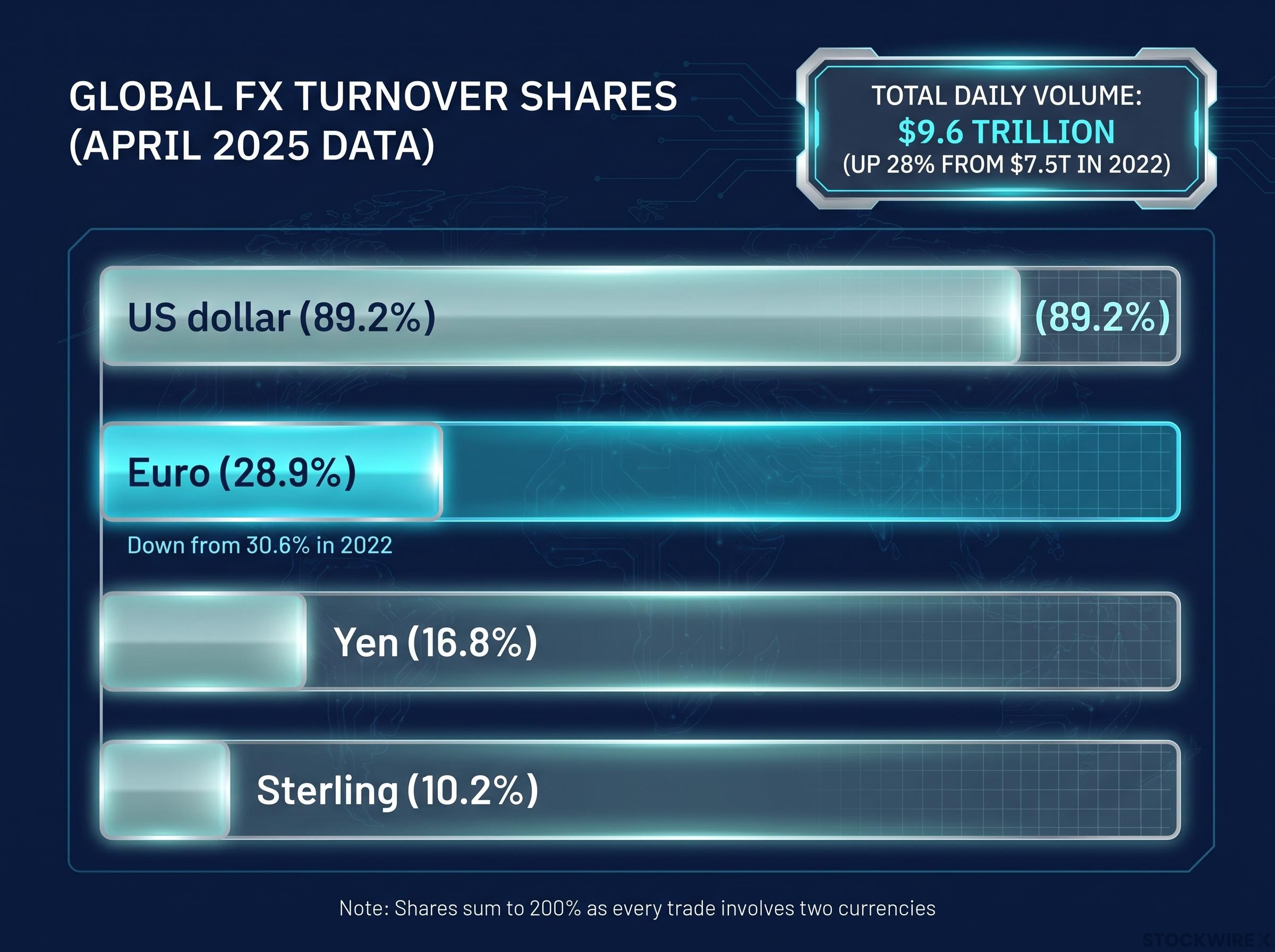
According to the Bank for International Settlements (BIS) Triennial Survey of April 2025, global currency trading reached $9.6 trillion a day, up 28% from $7.5 trillion in 2022.
| Currency | Share of turnover | Note |
|---|---|---|
| US dollar | 89.2% | Dominant on one side of most trades |
| Euro | 28.9% | Down from 30.6% in 2022; still second |
| Yen | 16.8% | Third most traded |
| Sterling | 10.2% | Fourth most traded |
Shares sum to about 200% because every trade involves two currencies. EUR/USD is the euro’s largest pair, ahead of EUR/JPY, EUR/GBP and EUR/AUD, so ECB signals ripple well beyond the 21 countries that use the currency.
What to watch between now and December’s ECB meeting
The hold preserved the ECB’s options, energy remains the swing factor, and the euro’s slide showed that guidance and growth effects can outweigh rate support.
Three variables matter most: energy and gas prices into winter, wage and inflation-expectation data, and the December staff projections. Without a published vote split, any Governing Council disagreement remains unverified, so treat claims of a divided bench with caution.
The decision for you is how far to trust December hike odds when a hike may not rescue the euro if growth weakens.
This article is for informational purposes only and should not be considered financial advice. Investors should conduct their own research and consult with financial professionals before making investment decisions. Past performance does not guarantee future results. Financial projections are subject to market conditions and various risk factors.