
Orbital signs Japan distribution and in-service support agreements targeting new sales and aftermarket revenue
Orbital Corporation Limited (ASX: OEC) has appointed Fusoh Shoji Co., Ltd. as its exclusive distributor in Japan and signed an In-Service Support (ISS) agreement with Insitu Pacific Pty Ltd. The two agreements target new propulsion system sales and potential aftermarket revenue in the Japanese unmanned aerial vehicle (UAV) market.
The ISS agreement covers 70 Orbital 50HFE propulsion systems installed across the ScanEagle fleet operated by the Japan Ground Self-Defense Force (JGSDF). Together, the agreements cover both new sales and potential aftermarket revenue from the existing installed engine base.
The headline points:
- Fusoh Shoji appointed exclusive Japanese distributor for Orbital’s heavy fuel engines, power management systems and associated products and services
- ISS agreement signed with Insitu Pacific, covering 70 Orbital 50HFE propulsion systems
- No minimum order commitments under the ISS agreement
When big ASX news breaks, our subscribers know first
Fusoh appointed as exclusive Japanese distributor
The appointment is for an initial 2-year term, with pre-existing opportunities retained by Orbital for direct engagement. The agreement has minimum performance targets in Year 2, and Orbital has termination rights if these targets are not achieved.
Those terms give Orbital a measure of accountability from its distribution partner. Fusoh will market Orbital’s propulsion technology, develop new opportunities and support customer engagement across Japan’s aerospace and defence markets.
Orbital selected Fusoh based on its 23-person sales engineering team, established logistics and inspection capability, and a disclosed customer base. Fusoh is a Tokyo-based technical trading company founded in November 1963, and its disclosed customers include Mitsubishi Heavy Industries, Kawasaki Heavy Industries, IHI, Subaru, Mitsubishi Electric and NEC.
The agreement covers Orbital’s full product range:
- 50HFE, 75HFE, 150HFE and 350HFE engines
- Gen II Power Management System
- Diagnostic technology
- Spare parts and consumables
- Engineering integration and technical support services
Insitu Pacific agreement opens a path to recurring revenue
Insitu Pacific, based in Brisbane, now has overall responsibility for maintenance of the JGSDF UAV fleet, which was previously managed by Boeing Insitu from the US. Orbital has supplied over 1,100 HFE propulsion systems globally to Boeing Insitu since 2016.
The agreement has an initial one-year term, with the parties able to extend by mutual agreement. Orbital will principally deliver services from its Balcatta facility in Western Australia, with the ability to provide support at end-user locations where required.
The agreement does not include minimum order commitments, and the timing and value of future orders will depend on Insitu Pacific’s requirements. Revenue generated from Insitu Pacific over the past 12 months has been A$216,000, and the agreement establishes a framework under which this may grow, although future orders are not committed.
Orbital will provide the following services:
- Maintenance and repair
- Depot-level overhaul
- Fault diagnosis and troubleshooting
- Engine health monitoring
- Engineering support
- Spare parts and consumables
- Fleet configuration and obsolescence management
- Remote and deployed technical support
The agreement also provides a framework to explore further opportunities arising from the pending Archer Aviation acquisition of Insitu.
Stephen Pearce, CEO
“At the same time, our agreement with Fusoh provides a dedicated pathway to pursue new engine sales, engineering and integration opportunities across the broader Japanese market.”
Why in-service support matters: the aftermarket explained
In-service support refers to work done on engines that are already operating, such as maintenance, overhaul and the supply of spare parts. It generates revenue beyond the initial engine sale.
Orbital has already tested the aftermarket upgrade business with Textron Systems, where a A$475,000 order for Aerosonde engine upgrade kits targets a much larger installed base and shows how service work can extend revenue beyond the original engine sale.
According to the announcement, the ISS agreement gives Orbital an opportunity to generate recurring revenue from its existing installed engine base in Japan. That revenue is not committed, as the agreement carries no minimum orders.
The table below contrasts the two pathways.
| Item | Fusoh agreement | Insitu Pacific ISS agreement |
|---|---|---|
| Focus | New propulsion system sales through a dedicated local sales channel | Potential aftermarket revenue from the installed base of 70 50HFE engines |
| Initial term | 2 years | One year, extendable by mutual agreement |
| Commitments | Minimum performance targets in Year 2; Orbital termination rights if not achieved | No minimum order commitments |
| Scope | 50HFE, 75HFE, 150HFE and 350HFE engines, Gen II Power Management System, diagnostics, spare parts and consumables, engineering integration and technical support | Maintenance, overhaul, engineering, technical support and spare parts |
Japan’s defence spending backdrop and Orbital’s strategy
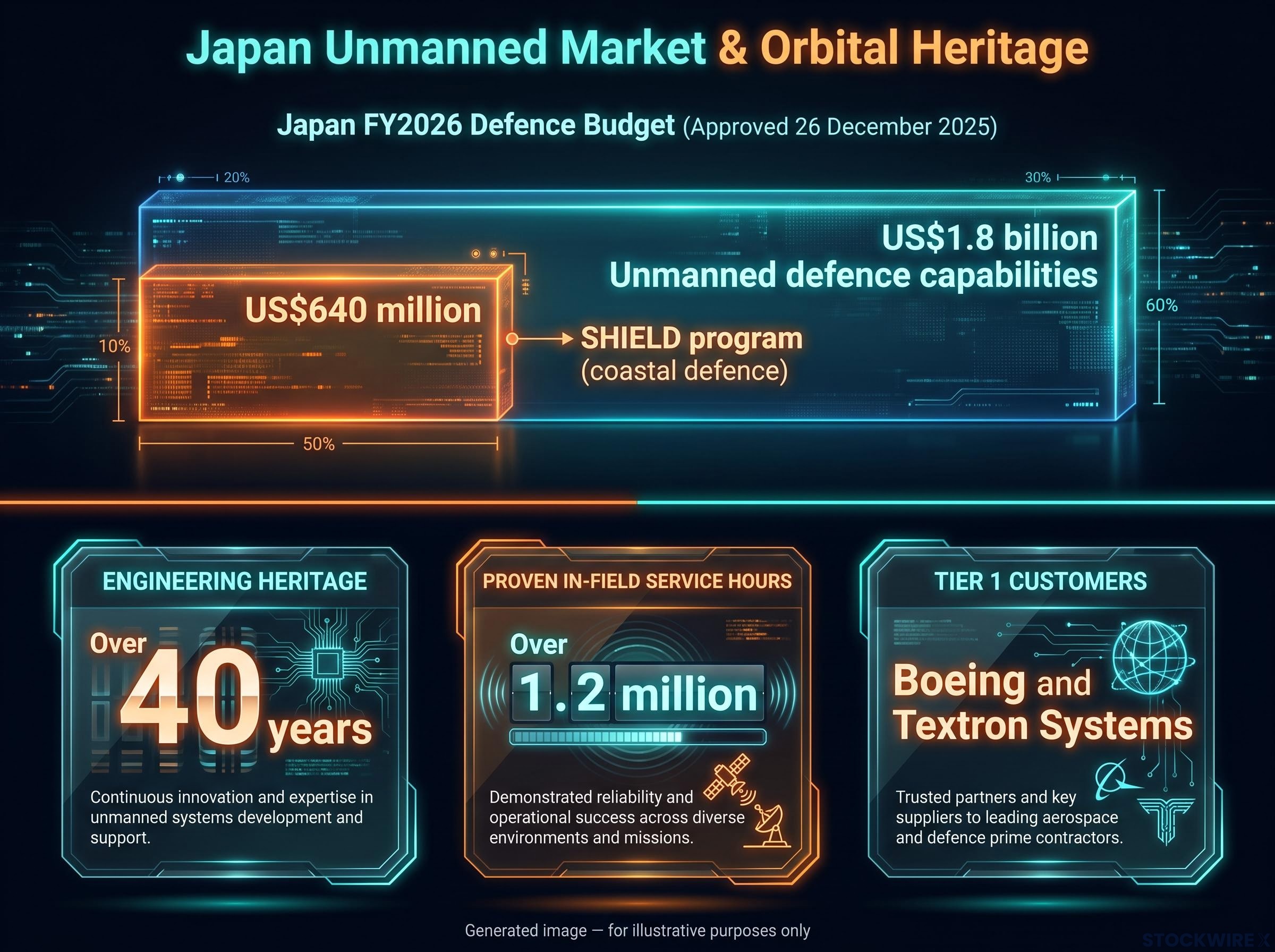
Chief Executive Officer Stephen Pearce pointed to Japan’s FY2026 defence budget, approved on 26 December 2025. According to the Japan Ministry of Defense, it provides for approximately US$1.8 billion for unmanned defence capabilities, including approximately US$640 million for the SHIELD program, a new coastal defence program.
“This level of investment indicates the increasingly important role unmanned systems are expected to play in Japan’s future defence capability,” Pearce said.
Pearce said the two agreements “position Orbital to support both the existing installed base and the next generation of unmanned platforms being developed and acquired in Japan.” Orbital said it will continue to target opportunities to supply new propulsion systems while expanding its involvement throughout the operational life of customer fleets.
Orbital is a Perth, Western Australia-based designer and manufacturer of integrated heavy fuel propulsion systems for Group 2 and Group 3 UAVs. The company cites over 40 years of engineering heritage and more than 1.2 million proven in-field service hours across multiple Tier 1 defence customers including Boeing and Textron Systems.
Investors exploring how these agreements fit into the company’s wider financial position can read our full explainer on Orbital’s FY2026 results and recurring revenue pivot, which covers the 14-customer base, the fall in revenue after the FTUAS cancellation and the push toward aftermarket income.
Don’t Miss the Next Defence Tech Breakout
Join 20,000+ investors getting FREE breaking ASX news delivered to their inbox within minutes of release, complete with in-depth analysis. Click the “Free Alerts” button at Big News Blast to receive real-time alerts the moment market-moving news breaks in industrials and beyond.