

CETO Buoyant Actuator fabrication complete as ocean deployment nears
Fabrication of the ACHIEVE Programme’s CETO Buoyant Actuator (BA), the prime mover of the CETO system, has been completed, Carnegie Clean Energy (ASX: CCE) advised on 29 October 2026. The first stage of ocean deployment under the ACHIEVE Programme will commence in November at the Biscay Marine Energy Platform (BiMEP).
The step moves years of CETO development into physical ocean deployment, a key point on the technology’s commercialisation pathway. The BA was built locally in the Basque Country using a modular design intended to simplify road transport.
The sequence ahead is as follows:
- The modular BA is transported by road to the Port of Bilbao.
- The three modular sections are re-assembled on the quayside, with finishing elements such as fenders attached.
- The BA is lifted into the water portside and towed to Carnegie’s berth at BiMEP.
- An initial mooring system is deployed at the BiMEP berth in parallel.
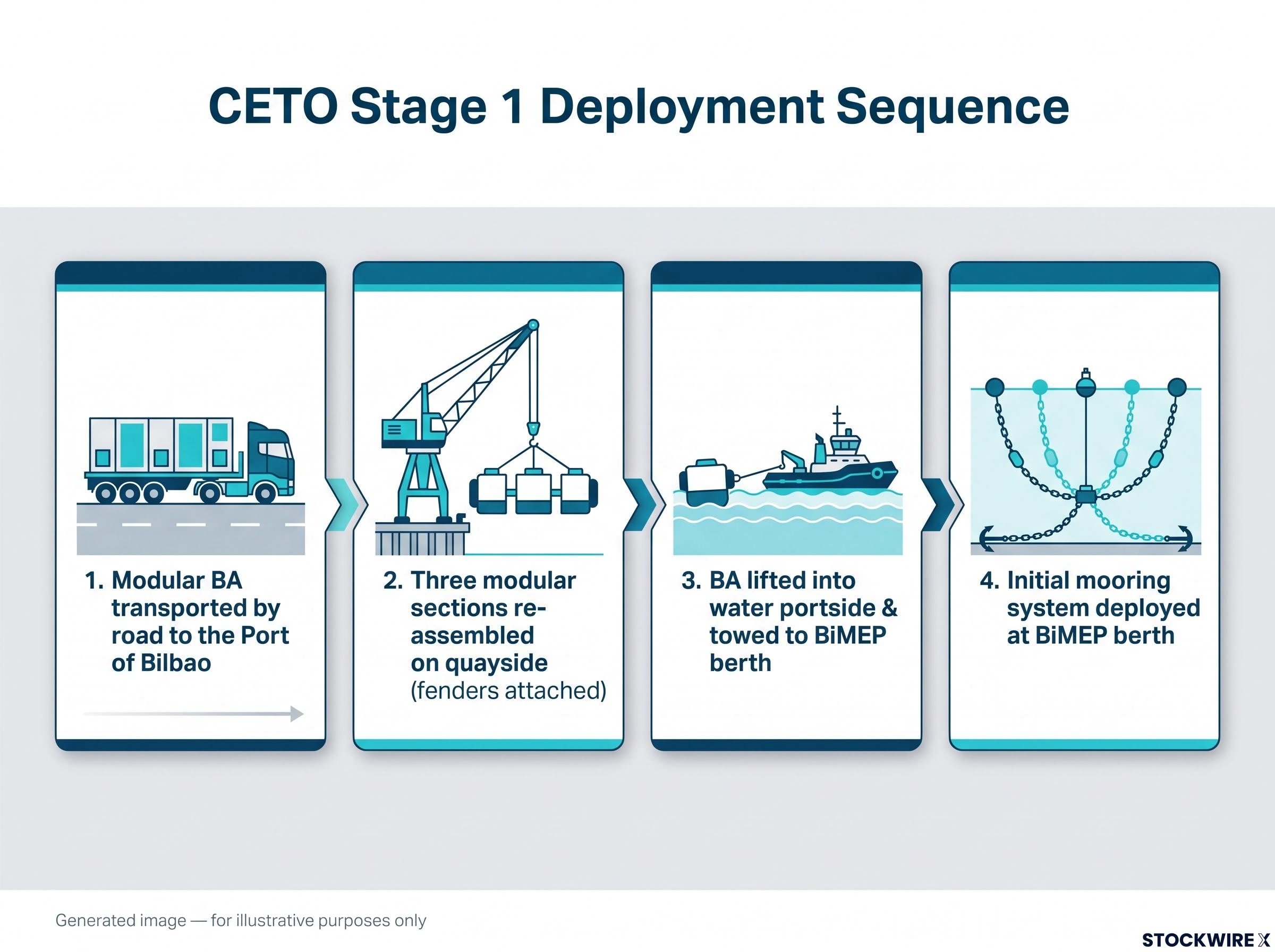
The first stage is designed to validate CETO hydrostatic characteristics, towing performance and the local offshore supply chain.
Technology being validated
- 80 kW rated scaled ACHIEVE CETO demonstrator unit
- Described by the Company as its next-generation CETO technology
When big ASX news breaks, our subscribers know first
Two-stage deployment and the modular advantage
Stage two: full system and grid connection in Spring 2027
Power take-off (PTO) assembly has been progressing at SKF, where mechanical and electrical components are being fitted within each module, including generator, cooling and tensioner systems. A final onshore testing programme of the PTO modules and electrical module will follow, to validate the PTO architecture, electrical and control system in a controlled environment.
The modules will then be brought to the port for integration into the BA. The second stage, when the full CETO system will be deployed and grid connected, is due to commence in Spring 2027, following the Basque winter months so that initial grid connection can occur during more favourable weather windows.
Why modularity matters
Physical fit tests during fabrication validated that the three PTO modules and the electrical module can be quickly inserted and removed from the BA. Any module can be lifted out so work is completed onshore, and swapped with a spare to enable a quick turnaround during maintenance and reduce downtime.
Carnegie states that demonstrating this process will support CETO’s long-term commercialisation pathway by reducing costs and improving performance of future CETO arrays.
Schedule candour
The Board acknowledged the project has progressed beyond the original schedule. The Company cited first-of-a-kind manufacturing issues and supply chain delays, alongside additional time invested in engineering validation, operational readiness, installation planning and integration.
The Board believes the additional engineering and testing has strengthened the programme and enhanced the opportunity to evaluate several proprietary technologies under real-world offshore operating conditions.
What is wave energy and why capacity factor matters
Wave energy converters capture the motion of ocean waves and convert it into electricity. CETO is designed to operate completely submerged during normal operation, which the Company says is intended to enhance safety and minimise visual impact from shore, avoiding the key social licence impediment seen by offshore wind and other ocean developments.
Capacity factor is the ratio between a generation unit’s actual output over a period of time and its maximum output (rated capacity). Carnegie cautions that rated capacity conditions are defined differently for various technologies and companies, so comparisons across generation technologies should be treated carefully.
ACHIEVE data will be used to assess whether future commercial deployments can achieve capacity factors consistent with the Company’s pre-deployment modelling.
| Metric | Company modelling or claim | Why it matters |
|---|---|---|
| Capacity factor | Modelling indicates future deployments at selected sites in Spain, Scotland, Ireland, Australia, the United States and other locations with comparable wave resources may be capable of 30% to 50%, with higher possible depending on how unit capacity is rated | ACHIEVE data will help assess whether results are consistent with pre-deployment modelling |
| Spatial density | CETO is expected to achieve 30 MW per square kilometre of seabed, versus offshore wind typically 6 MW / km2 | Energy production data will support validation of the spatial density forecasts |
Objectives the ACHIEVE Programme will measure
ACHIEVE has been structured around measurable commercial, technical and operational objectives established under the EuropeWave Pre-Commercial Procurement Programme framework:
- Commercial: a modular architecture aimed at using existing industrial supply chains and port infrastructure, with design features intended to reduce lifecycle costs.
- Advanced control: algorithms developed with Hewlett Packard Enterprise (HPE), incorporating Artificial Intelligence (AI) and machine learning techniques to optimise power capture.
- Survivability and reliability: active and passive strategies, including adjusting operational position within the water column in adverse weather while continuing to generate electricity.
- Operations and maintenance: PTO module swaps from the quayside with the BA left in the water, aiming to reduce reliance on divers and specialised offshore vessels.
- Levelised cost of energy (LCOE): data to support future assessments, with the Company’s LCOE modelling reviewed by an independent expert and forming part of the EuropeWave evaluation.
Earlier CETO deployments in 2011 and 2015 achieved Technology Readiness Level (TRL) 7. The Company’s 2019 Digital Development pathway was a strategic step back in TRL that delivered improvements such as multiple moorings, rotary PTO and advanced control, which are now being demonstrated through ACHIEVE.
According to the Company, it was the Digital Development Pathway’s incorporation of these advancements that unlocked CETO’s top ranked position in the EuropeWave Programme and the funding for ACHIEVE.
Funding backers and market context
ACHIEVE is delivered by Carnegie’s subsidiaries CETO Wave Energy Ireland, under contract by the EuropeWave Buyers Group (ACHIEVE Project), and Carnegie Technologies Spain. The latter is supported by funding from the Spanish Government through the RENMARINAS Demos Programme (AGUAMARINA Project) and the Basque Government through a grant from the Ente Vasco de la Energia (ACHIEVE+ Project).
EuropeWave is a Pre-Commercial Procurement programme running from 2022 to 2026 that combines over €22.5m of national, regional and EU funding.
Because these public funders pay retrospectively against milestones, Carnegie has relied on a bridging loan facility, since lifted to $3.5 million, to cover procurement costs while payments catch up.
The European Union has established objectives of at least 1 GW of installed ocean energy capacity by 2030 and 40 GW by 2050. Europe remains the Company’s primary target market, while management continues to monitor opportunities in other jurisdictions with suitable wave resources, energy market conditions and customer requirements.
Beyond Europe, management is watching other jurisdictions where wave resource is strong, and the United States has emerged as a focus, with the PacWave South test facility off Oregon offering a potential validation pathway for CETO.
What happens next for Carnegie
The announcement points to the following milestones:
- November 2026: mooring installation and deployment of the CETO BA at BiMEP for the first stage, following transport to the Port of Bilbao. Carnegie is responsible.
- November 2026: further updates to be provided by the Company as the ACHIEVE CETO unit advances towards its first stage of ocean deployment.
- Spring 2027: second stage deployment of the full CETO system and initial grid connection, following PTO assembly and onshore testing, and after the Basque winter months.
The ACHIEVE deployment is intended to generate operational and performance data to support future assessments of energy production, reliability, survivability, maintainability and commercial viability on CETO’s commercialisation pathway.
Want the Next Clean Energy Breakout in Your Inbox?
Get FREE breaking ASX news delivered within minutes of release, with in-depth analysis already done. Join 20,000+ investors who stay ahead of the market with Big News Blast. Click the “Free Alerts” button to receive real-time updates the moment market-moving announcements break.