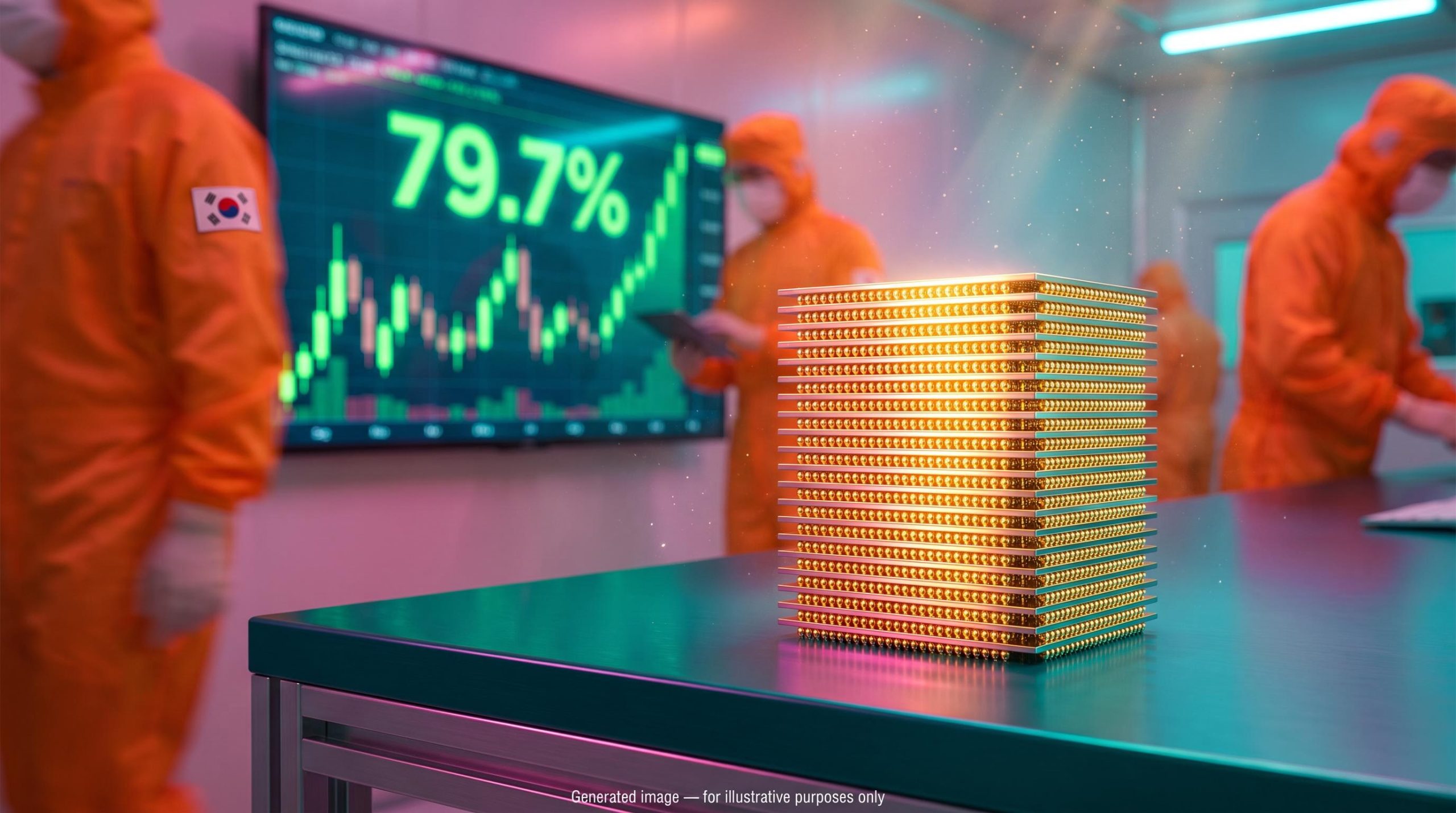
SK Hynix has reported a quarter that most companies could not imagine: an operating margin of about 80% on KRW 104.62 trillion of revenue. Yet Morningstar left its fair value for the Korean shares unchanged at KRW 2,200,000 and cut its long-run margin assumption, a split verdict now hanging over SK Hynix stock.
The shares jumped after the release on 28 October 2026. One market report put the Seoul gain at about 7.76% during the session, while Morningstar cited 9% after the earnings call; the two figures were measured at different points.
For investors watching the rally, the question is whether that strength is already in the price.
The answer turns on three things: what the quarter proves, what it does not, and which risk Morningstar thinks starts to matter from 2029.
Why did the quarter beat expectations, and how much of it will last?
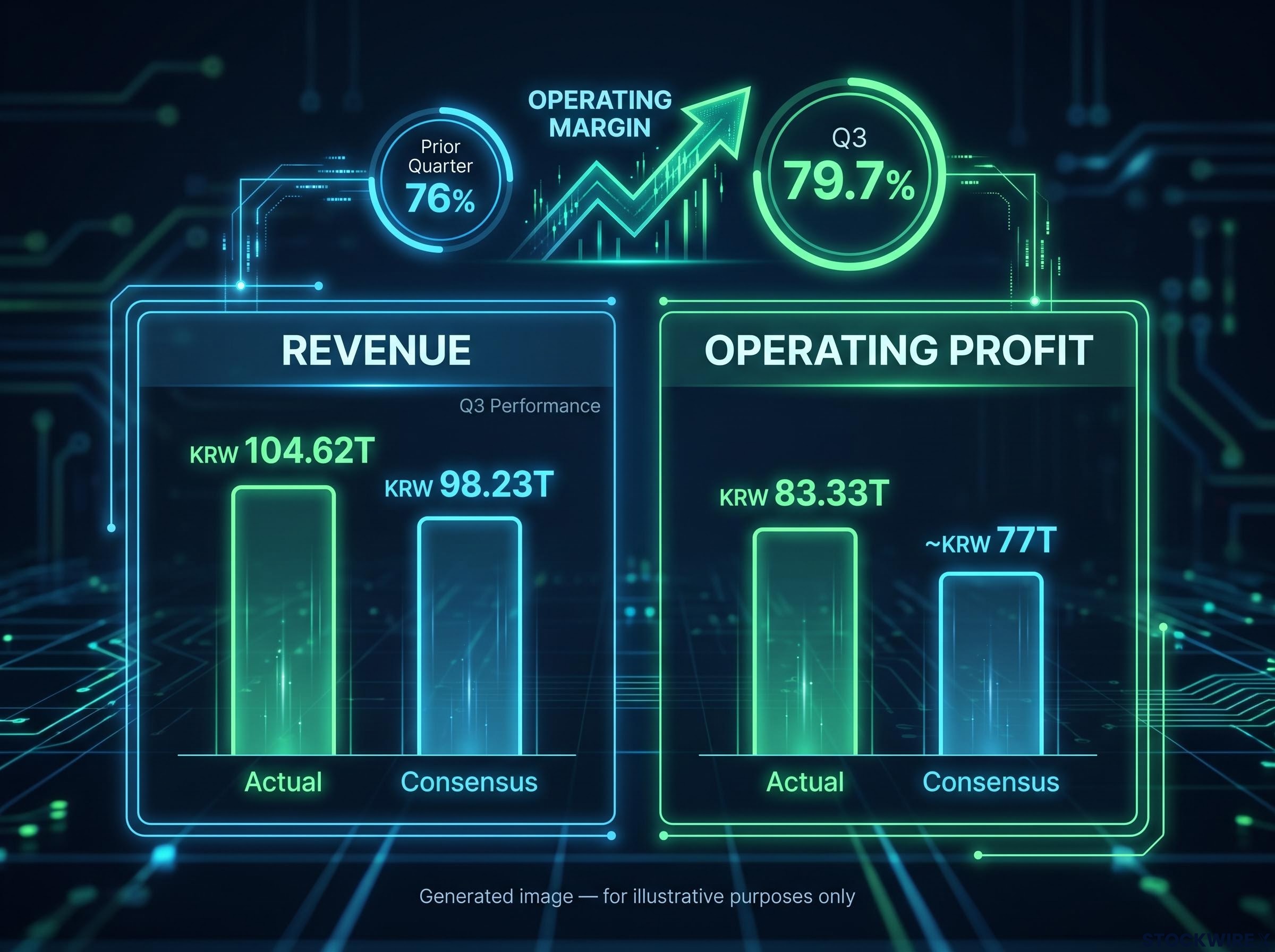
The beat was wide. According to Korea JoongAng Daily, consensus sat at about KRW 77 trillion in operating profit and KRW 98.23 trillion in revenue.
- Revenue: KRW 104.62 trillion, up 327.9% year on year and 32% on the prior quarter
- Operating profit: KRW 83.33 trillion, against roughly KRW 77 trillion expected
- Operating margin: 79.7%, up from 76% in the prior quarter
- Revenue consensus: KRW 98.23 trillion
The driver was HBM4. High-bandwidth memory (HBM) is stacked memory chips built to feed data to AI processors, and HBM4 is its newest generation. Morningstar analyst Jing Jie Yu said HBM prices ran 10% above forecast because the HBM4 ramp came faster than expected. Morningstar estimates HBM4 is priced about 50% above the older HBM3E.
HBM demand is being lifted by two forces at once: per-chip memory content has risen 3.6x from the NVIDIA H100 to the Rubin, while scale-out AI systems multiply the number of accelerators, which helps explain why customer requests run at roughly twice available supply.
SK Hynix said HBM4 will overtake HBM3E in both bit shipments and revenue share in Q4 2026, with yields “fairly stable”. Morningstar reads the 2027 contract talks as pointing toward roughly doubled pricing, though that is its estimate rather than a settled price.
What “sold out” actually covers
The headline claim needs a closer look.
The precise wording: SK Hynix said DRAM and HBM volumes for the next three years were “effectively sold out”, based on signed contracts plus demand still under discussion with existing customers.
The company has long-term agreements (LTAs), meaning multi-year supply contracts, with 14 customers, mostly on five-year terms. These cover more than half of 2027 and 2028 capacity. Part of the 2029 visibility rests on talks, not signed deals, even though customer HBM requests run about twice what SK Hynix can supply.
The Korea Herald also reported that earlier LTAs capped upside from the latest price rally because prices were fixed in advance. The earnings power is real today, but the visibility you can read into “sold out” is narrower than the phrase suggests.
Is the share price asking for too much, and what does KRW 100 trillion change?
The confident part of the story is the payout.
How the KRW 100 trillion is built
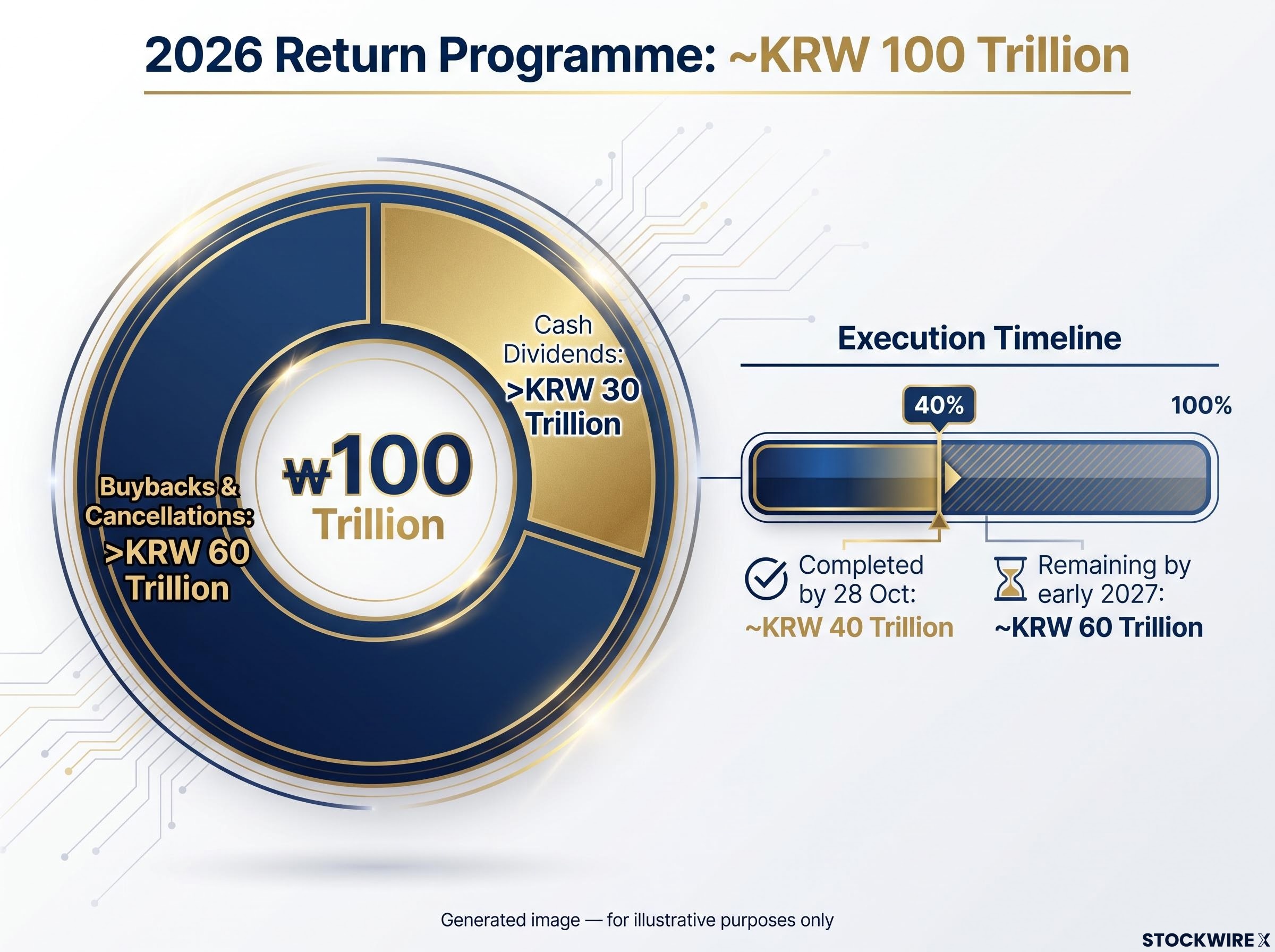
SK Hynix’s 2026 return programme totals roughly KRW 100 trillion, which Morningstar views favourably.
| Component | Detail |
|---|---|
| Cash dividends | More than KRW 30 trillion for fiscal 2026 |
| Buybacks and cancellations | More than KRW 60 trillion |
| Completed by 28 October | About KRW 40 trillion |
| Q3 dividend | KRW 20,000 per share (KRW 10,000 regular plus KRW 10,000 special) |
| Kioxia funding | About KRW 7 trillion of Kioxia investment gains funds the special dividend |
| Remaining | About KRW 60 trillion by early 2027 |
Part of that special dividend comes from a one-off gain on SK Hynix’s stake in Japan’s Kioxia Holdings, not from operating cash flow, so it should not be read as a repeatable payout.
Two listings, two fair values
Morningstar’s view tempers the confidence:
- Rating: 3 stars, no economic moat, Very High uncertainty
- Korean shares: fair value held at KRW 2,200,000, down from KRW 2,400,000 on 2 July, and seen as undervalued
- American depositary receipt (ADR), the US-traded version of the shares: fair value raised 8% to US$164, partly on a stronger won
- 2026-2028 revenue estimates raised 10%-28%; operating margin estimates raised 90-131 bps
- Midcycle operating margin cut 137 bps for long-term commoditisation risk
The ADR closed at US$145.36 yesterday and was last listed at US$164.70, up 13.30%. If you hold or are weighing the ADR, that price now sits roughly at Morningstar’s fair value, so much of the upside it sees there is already reflected. The Korean line is the one it calls undervalued.
The market’s shift toward valuation discipline has been visible across the sector, with TSMC and ASML both falling on strong results because the good news was already priced in, which is the same question now hanging over SK Hynix after its own beat.
Can Chinese competition really erode pricing from 2029?
Where China is still behind
On HBM, the gap looks wide. Reuters reported on 28 October that CXMT, China’s No. 4 DRAM maker, is preparing limited HBM3E production within about two months, with yields of only 20%-30%. Yield is the share of chips that come out usable. Expansion is planned for 2027, and US export controls, tightened in December 2024 for certain HBM products, limit access to advanced equipment.
That is reassuring, but only on HBM.
Where the risk actually sits
Morningstar’s concern runs through commodity DRAM, the standard memory used in phones and servers. It pointed to CXMT bringing LPDDR6 mobile memory into production sooner than anticipated and to YMTC winning market share at pace, and it argues that the near-term benefit is largely cancelled out by growing threats from 2029. More Chinese supply could pressure conventional DRAM prices and lower the premium investors place on SK Hynix’s wider franchise.
Controls slow China but also encourage subsidies and alternative supply chains, with reports of restricted memory reaching Chinese AI firms at several times normal prices.
The cycle precedent: In Q4 2022, DRAM revenue fell 32.5% quarter on quarter and SK Hynix revenue fell 35.2%. TrendForce’s 2023 outlook had demand bits growing 8.3% against supply bits of about 14.1%.
| Issue | Bear case | Bull case |
|---|---|---|
| LTAs | Untested in a downturn; fixed prices cap upside | Over half of 2027-28 capacity covered |
| Oversupply | Samsung and Micron expanding alongside China | Qualification and packaging limit commoditisation |
| China | LPDDR6 and capacity growth hit conventional DRAM | HBM yields poor; equipment access limited |
| AI spending | Hyperscaler capex slowdown exposes excess capacity | Demand about 2x supply |
The 2029 question is whether memory’s old boom-and-bust pattern returns. Conventional DRAM pricing and Chinese capacity additions will tell you more than HBM yield headlines.
What the beat settles, and what it leaves open
The quarter confirms HBM4-driven earnings power and a large return programme. Morningstar’s unchanged Korean fair value and lower midcycle margin show the long-run debate is not settled.
Three variables will shape the next read:
- Finalised 2027 HBM contract pricing
- Conventional DRAM prices as Chinese capacity grows
- LTA renegotiation and hyperscaler capex trends
Whether the current price fits your view depends on how much weight you give the 2029 risk against today’s margins.
This article is for informational purposes only and should not be considered financial advice. Investors should conduct their own research and consult with financial professionals before making investment decisions. Past performance does not guarantee future results. Financial projections are subject to market conditions and various risk factors.
—