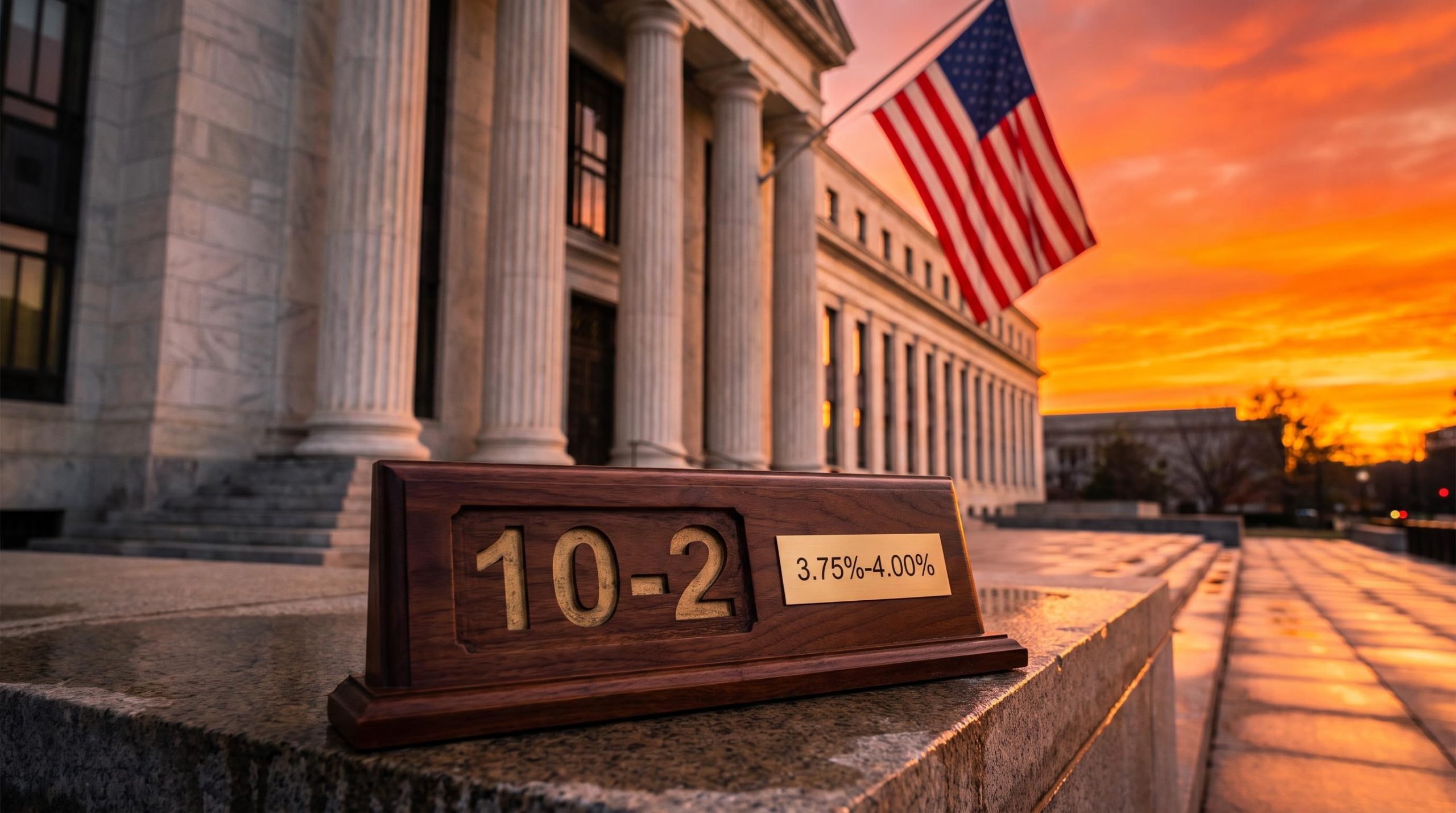
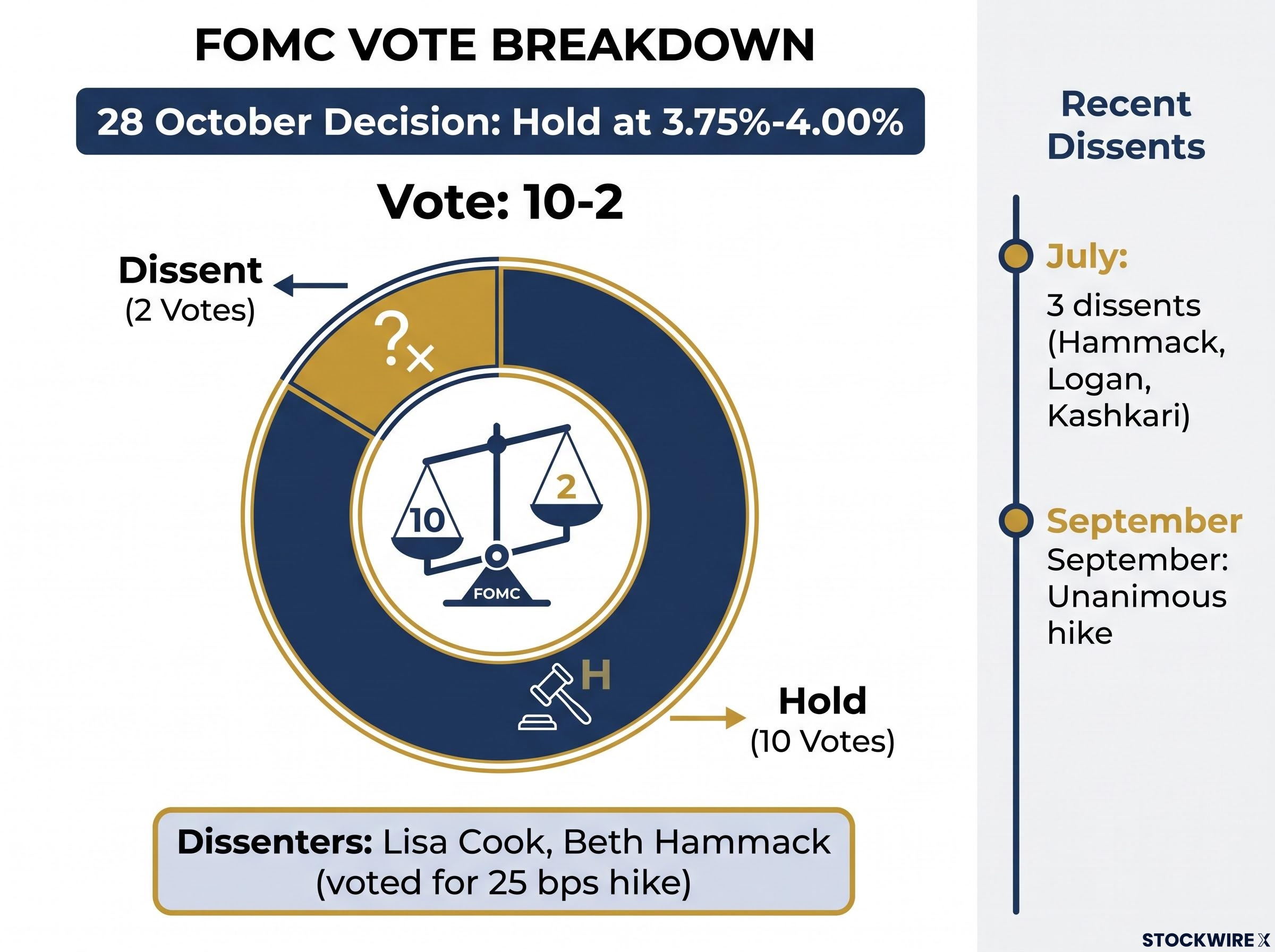
The Federal Reserve held the federal funds target range at 3.75%-4.00% on Wednesday 28 October, but two policymakers wanted something else. Governor Lisa Cook and Cleveland Fed President Beth Hammack both voted for a 25 basis point hike, leaving the decision split 10-2.
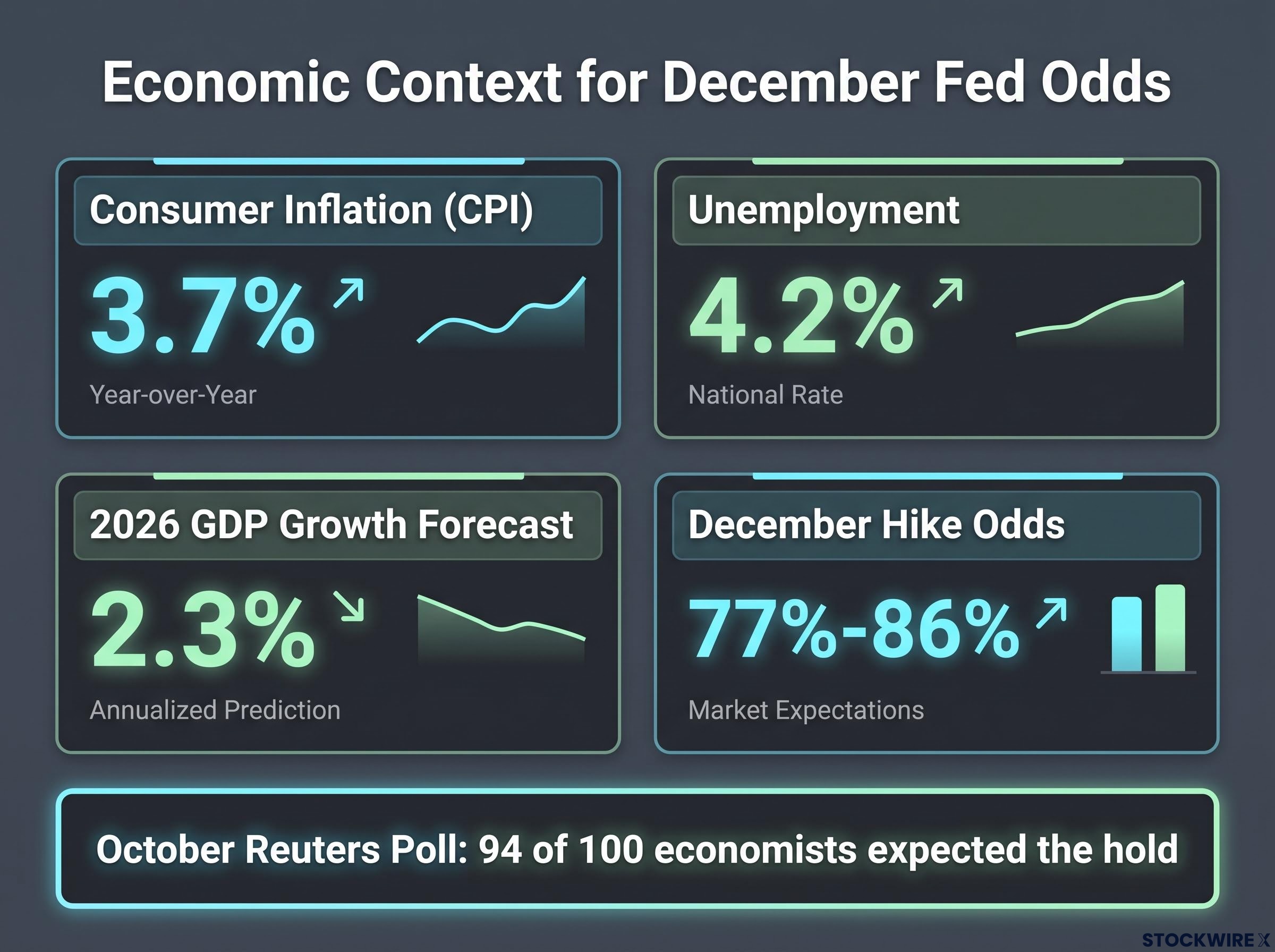
The hold itself surprised almost no one. The more useful signal is what the dissents and the statement suggest about December, with consumer inflation running at 3.7% and futures pricing roughly 77%-86% odds of another hike.
Here is a single read on what the split signals. After that, you can see how sterling, the dollar, gold, the yen, the Australian dollar and Bitcoin responded, and why each moved for its own reasons.
Why the market treated a hold as a hawkish signal
On paper, nothing changed. In a Reuters poll taken 16-20 October, 94 of 100 economists expected exactly this outcome, followed by a December hike. No new dot plot or Summary of Economic Projections was released, so the Fed’s existing forecasts stand, including 2.3% GDP growth for 2026.
The statement explained the pause as a chance to gather more information before choosing the right stance. It also kept the door to further tightening open.
From the Fed statement The Committee is seeking “a timely return of inflation to the Committee’s 2 percent goal.”
That phrase carries weight against the backdrop. CPI, the consumer price index that tracks what households pay for goods and services, rose 3.7% year on year through September. Producer prices posted their largest gain in 4½ years, according to Reuters, while unemployment sits at 4.2%.
What the dissents signal
The hawkish bloc has shrunk, but it has not gone away. At the July hold, three members dissented: Hammack, Dallas Fed President Lorie Logan and Minneapolis Fed President Neel Kashkari. A unanimous hike followed in September. October brought two dissents.
The July 9-3 split was the widest same-direction dissent since September 2016, with Kashkari warning that acting modestly now beats being forced into aggressive tightening later.
Axios placed Hammack in an increasingly vocal hawkish wing that sees price pressure as broad and entrenched. KPMG named Hammack, Logan and Kashkari as the most ardent voting hawks, and Governor Christopher Waller said earlier this month that more hikes would probably be needed. Chase strategists hold a base case of one more quarter-point hike before the end of 2026.
There are three ways to read the split:
- Hawkish: Cook and Hammack wanted to act before price pressures embed themselves.
- Pause-and-assess: the majority believes September’s hike needs time to work before a likely December move.
- Institutional dynamics: fewer dissents than July may point to a narrower hawkish bloc, or acceptance of the sequencing.
Markets priced the result accordingly. December hike odds sat between about 77% (Nexo, pre-decision) and 86% (Axios), against roughly 7% for an October move. Two votes for a hike tell you rate cuts are not the near-term risk. December is the date to watch.
How GBP/USD, the dollar and other majors reacted
Because the hold was expected, the reaction was muted. What movement there was came from the dollar side of the trade, not from anything happening in Britain.
The US Dollar Index (DXY), which measures the greenback against a basket of major currencies, traded near 102.40, close to a two-week high. Sterling drifted with it, pressured by a less favourable US-UK interest rate gap and broad dollar strength.
The exact direction depends on when you looked. One snapshot showed GBP/USD at about 1.3281-1.3285, down roughly 0.16%. FXStreet described a modest recovery to around 1.3300-1.3305. The gap most likely reflects different intraday timestamps.
The pound’s daily crosses show where it held up and where it slipped:
| Currency pair | GBP daily move |
|---|---|
| GBP/USD | -0.02% |
| GBP/EUR | -0.13% |
| GBP/JPY | +0.19% |
| GBP/CAD | -0.10% |
| GBP/AUD | -0.18% |
| GBP/NZD | +1.08% |
| GBP/CHF | +0.08% |
Sterling was strongest against the New Zealand dollar and weakest against the Australian dollar. FXStreet flagged two levels for GBP/USD:
- Support: 1.3272, the pre-announcement low
- Resistance: 1.3312, the day’s high
If you hold sterling exposure or pay costs in dollars, the dollar’s support rests on December hike odds rather than on today’s decision. A shift in those odds would matter more than anything the Fed did this afternoon.
Gold, yen, Aussie and Bitcoin: four reactions, four different drivers
Outside the pound, the pattern breaks apart. Each asset answered to a different force.
Gold slipped to about $4,036-$4,045 an ounce, below the $4,050 it held before the decision. A hawkish path lifts real yields (bond returns after inflation), which raises the cost of holding a metal that pays no income. A firmer dollar and higher oil added to the pressure, and BNY Markets expects December expectations to stay firm.
The yen weakened as USD/JPY traded at 157.86-158.23, its third straight daily gain. The US-Japan yield gap is doing the work, with the Bank of Japan update due Friday.
The Australian dollar and Bitcoin come with conflicting explanations.
| Asset | Reported level | Move | Main driver | Caveat |
|---|---|---|---|---|
| Gold | $4,036-$4,045/oz | Below $4,050 pre-decision | Real yields, firmer dollar, higher oil | Intraday snapshot |
| USD/JPY | 157.86-158.23 | Third straight daily gain | US-Japan yield gap | BoJ update pending Friday |
| AUD/USD | 0.7027-0.7050 | Highest since 23 September in one report | RBA hike expectations after hot Australian CPI | Other research cites risk appetite offsetting USD strength |
| Bitcoin | $81,400-$81,500 | Up about 2% | Second day of spot ETF inflows | Other research points to risk appetite and a tech rally |
All figures are intraday snapshots, not closing prices. The read for your portfolio is that these moves are not one trade. A hawkish Fed weighs on gold and helps the dollar against the yen, but has little to do with Bitcoin’s rise. The Fed was the common backdrop, not the single cause.
What the hold changes for December, and what it does not
The hold confirmed the Fed’s tightening bias rather than ending it. December hike odds are now the variable that matters.
Four swing factors will shape them: incoming inflation data, a low-hire, low-fire labour market, oil-driven supply effects that may not justify repeated hikes, and the 10-year Treasury yield, which has fallen substantially from its October peak and eased financial conditions.
An energy supply shock tied to Middle East conflict has pushed gasoline prices sharply higher, widening the gap between headline and core inflation and leaving the Fed weighing whether to look through the spike.
Chair Kevin Warsh‘s press conference remarks were not available at the time of writing. With no new dot plot released, the next round of data carries the burden of deciding whether the Fed moves in December. These outlooks are speculative and may change as market conditions develop.
This article is for informational purposes only and should not be considered financial advice. Investors should conduct their own research and consult with financial professionals before making investment decisions.