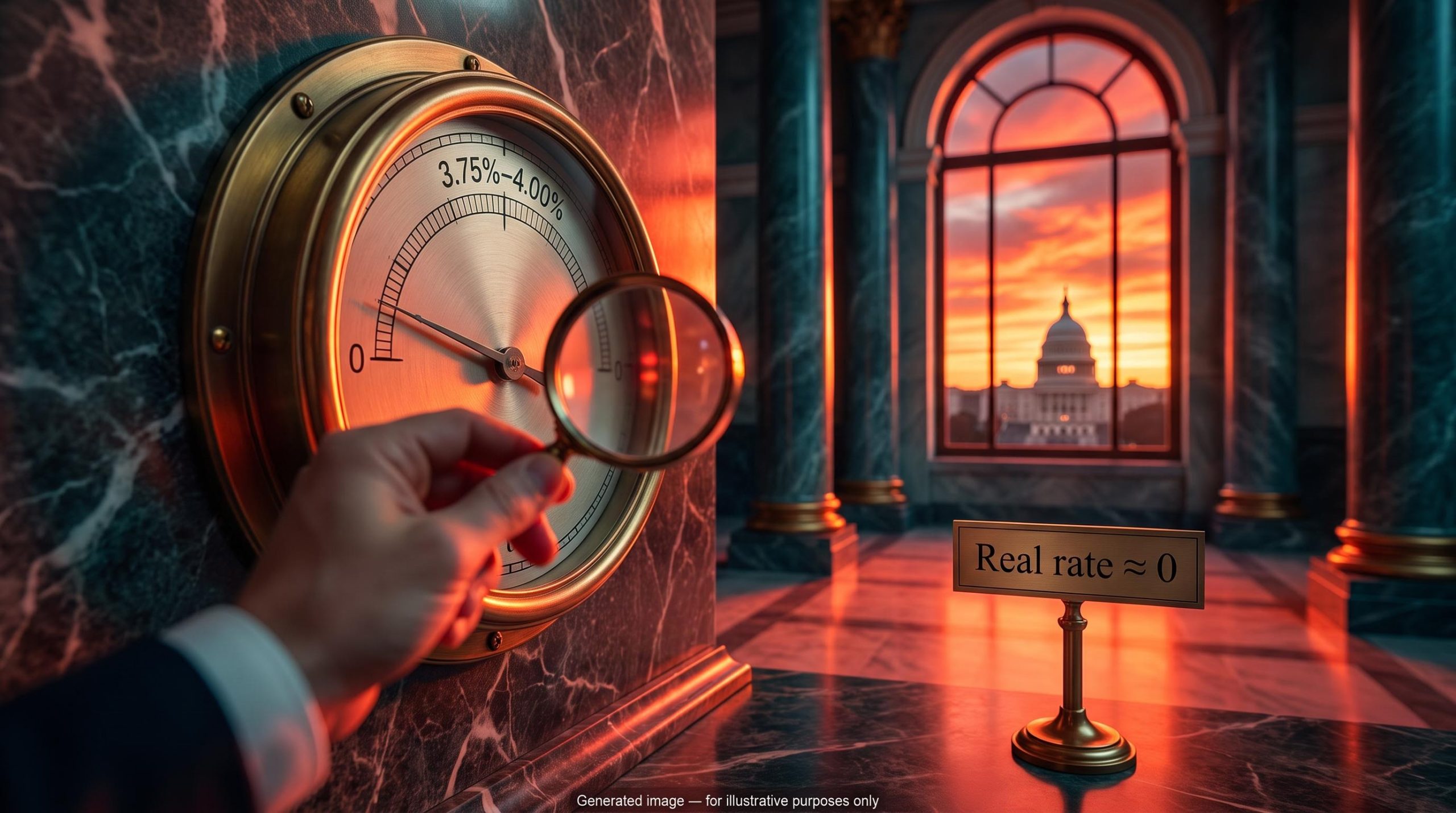
A 25 basis point hike in September put the federal funds rate at 3.75%-4.00%. Headline inflation is running close to 4%. Subtract one from the other and the real policy rate, the interest rate after inflation, sits barely above zero. That is not what most people picture when they hear the Fed is tightening.
The Federal Open Market Committee (FOMC) began its 27-28 October meeting with markets expecting a hold. CNBC reported roughly 10% odds of an October hike and more than 80% odds of a December increase. As of today, no October decision has been published.
Thomas Hoenig, former Kansas City Fed president and FDIC vice chairman, is among those arguing that policy under Chair Kevin Warsh is still too loose. He says the September move did not settle the question.
Here is what the evidence tells you: why a December hike has become the base case, how Warsh’s Fed differs from Powell’s, and what Hoenig’s 2010 dissents suggest about the cost of waiting.
Is a near-zero real rate really “tight” after the September hike?
On paper, the Fed looks firm. On 16 September, the FOMC raised rates to 3.75%-4.00% on a unanimous 12-0 vote, its first increase since July 2023, according to Reuters.
The Federal Reserve press release confirmed the 12-0 vote to lift the target range to 3.75%-4.00% and restated the committee’s commitment to maintaining ample reserves, the framework that leaves long-end yields to do more of the tightening work.
Then the inflation data arrived.
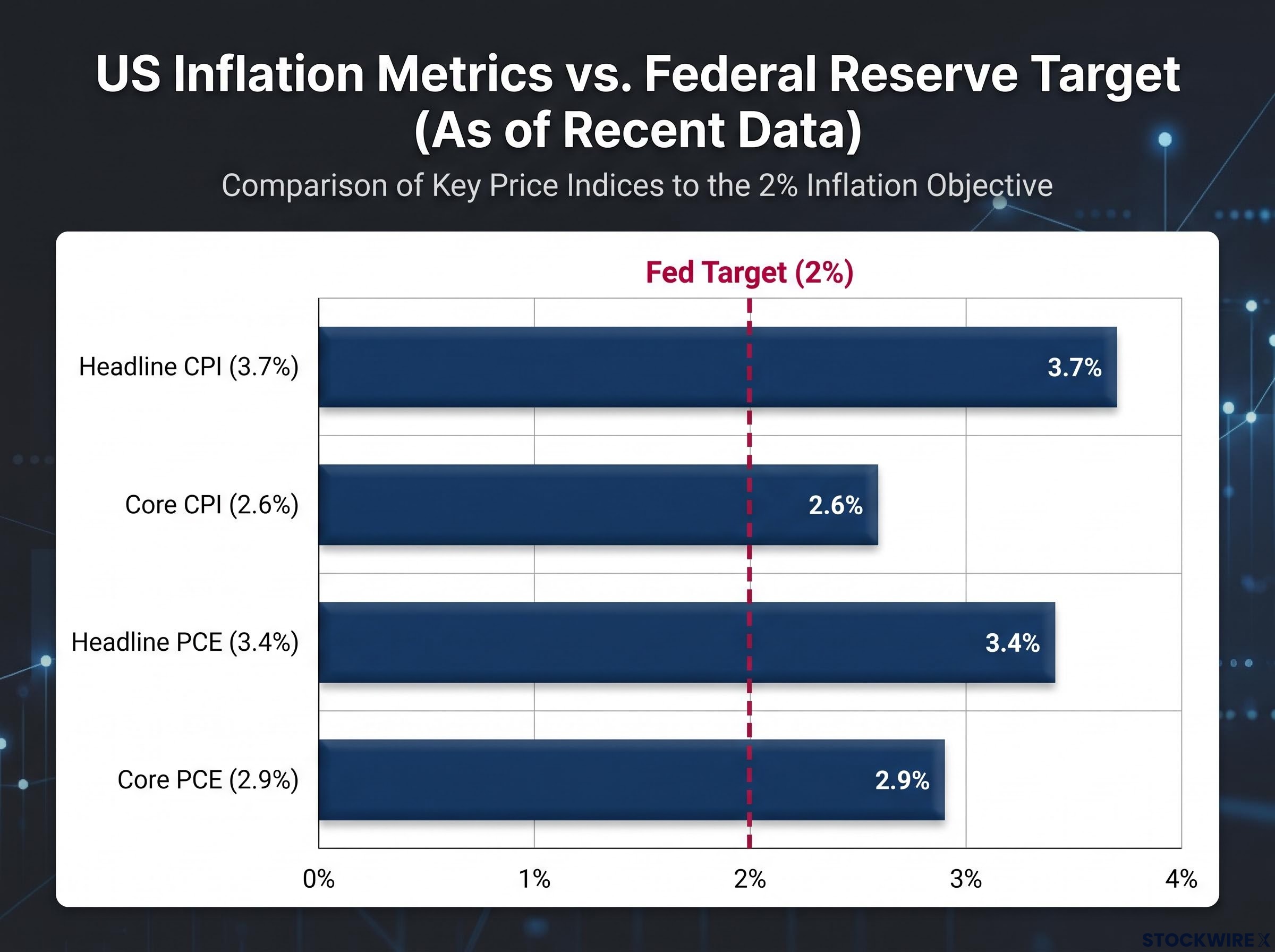
| Measure | Latest reading | Source/date |
|---|---|---|
| Headline CPI, 12-month | 3.7% (from 3.4% in August) | BLS, 14 October 2026 |
| Core CPI, 12-month | 2.6% (from 2.4%) | BLS, 14 October 2026 |
| Headline / core CPI, monthly | 0.6% / 0.3% | BLS, 14 October 2026 |
| Headline PCE, y/y (August) | 3.4% | BEA, 30 September 2026 |
| Core PCE, y/y (August) | 2.9% | BEA, 30 September 2026 |
Inflation is accelerating, not cooling. PCE, the Personal Consumption Expenditures price index and the Fed’s preferred gauge, updates for September on 29 October. Reuters reported markets expect it to stay more than a point above the 2% target for several quarters, not returning until at least 2028.
Hoenig on the real rate With the funds rate around 3.5%-4% and inflation near 4%, Hoenig argues the real policy rate is close to zero, and that moderately restrictive policy would suit the economy better. (Paraphrased from his interview with David Lin.)
Hoenig’s “3.5% to 4%” is a rounded figure; the documented range is 3.75%-4.00%. Likewise, his claim that inflation has exceeded target for over 60 months differs from other research putting the current stretch at about 17 months, since early 2025. The gap is likely definitional: a cumulative overshoot versus the latest unbroken run.
Hoenig also calls growth near 2% unimpressive, while citing an Atlanta Fed projection of Q4 growth above 2%. He sees little risk of overtightening given low real rates and a still-large balance sheet.
A real rate near zero means borrowing is barely being priced against inflation. That is why Hoenig calls the stance accommodative despite the hike. The real dispute is not whether inflation is too high; it is whether enough tightening is already in the system. You can run this check yourself: take the funds rate, subtract current inflation, and judge the result.
When big ASX news breaks, our subscribers know first
How do long-end yields tighten policy, and does the Warsh approach change the picture?
That “already in the system” question points somewhere the Fed does not directly control. Policy can tighten even when the FOMC sits still.
How a bond-market move becomes a rate hike in effect
On 21 October, the 10-year Treasury yield stood at 4.52% and the 30-year at 5.42%. A Treasury yield is the annual return investors earn for lending to the US government. When long yields rise, the effect spreads in four steps:
- Mortgage, corporate and municipal borrowing costs climb.
- Discount rates on equities and other assets rise, lowering their present value.
- Housing, business investment and hiring slow.
- Demand cools, even with the overnight rate unchanged.
Hoenig adds that the Fed’s balance sheet, about $6.75 trillion with reserves near $2.96 trillion, is no longer growing. The Fed is in a passive runoff and reserve-management phase under an ample-reserves framework, confirmed in the September minutes. With no fresh buying to absorb bonds, rising long yields work as genuine tightening. The effect bites hardest when it reflects higher real yields or term premium (the extra return investors demand for holding longer-dated bonds) rather than stronger growth expectations.
Warsh has acknowledged that market-driven tightening is already working on the Fed’s behalf, which reduces the urgency for immediate hikes while leaving future ones on the table, provided term premia stay elevated.
What changes under Warsh
| Dimension | Powell | Warsh |
|---|---|---|
| Forward guidance | Explicit, routine | Reserved for crises |
| Communication | Projections shape expectations in advance | Quieter; declines to prejudge meetings |
| Expectations | Led by the Fed | Markets infer the reaction function |
| Balance sheet | Larger footprint | Favours tighter control (per Hoenig) |
Reuters reported on 16 October that Warsh gave no signal on October, and on 26 October that higher yields were one reason some policymakers favour a pause. A Brookings Hutchins Center proposal would shrink holdings from about $6.8 trillion toward $4.5 trillion and reserves from $3 trillion toward $1 trillion, with a backstop repo facility. It is a proposal, not Fed policy.
Hoenig credits Powell with sincerely seeking a soft landing, undone by fiscal stimulus and reshoring spending. Under Warsh, the bond market becomes the Fed’s main message board. Long-yield moves deserve as much of your attention as any FOMC statement.
Why does Hoenig see a December hike as nearly necessary, and what could change it?
If yields are doing some of the work, the next question is whether the Fed needs to do more itself.
The case for hiking
Hoenig says he would be somewhat disappointed, though not surprised, by an October hold. He favours careful, deliberate increases rather than a 100 basis point jump, and sees December as nearly necessary unless the Iran war ends and energy prices fall sharply. Economists largely agree: in a Reuters poll, 94 of 100 expected an October hold and a December hike.
| Person/institution | Position | Reasoning |
|---|---|---|
| Thomas Hoenig | Too loose | Real rate near zero risks entrenched expectations |
| Christopher Waller, Fed governor | More tightening probably needed | Resilient economy, Iran energy shock, AI-buildout demand (Reuters, 8 October) |
| John Williams, New York Fed | No urgency | Time to assess earlier tightening (Reuters, 1 October) |
| Warsh and pause-leaning officials | Possibly restrictive enough | Higher long yields; risk to jobs (Reuters, 26 October) |
The case for waiting
Oil complicates everything. OCBC put Brent at $113.88 and WTI at $99.90 on 28 October. Monetary policy cannot create oil supply, so hiking hard against a temporary shock risks overtightening. Ignoring it risks the shock spreading into wages, services and expectations. Three paths stand out:
- Oil falls sharply: headline inflation eases and the case for hiking weakens.
- Oil holds above $100: costs feed into gasoline, transport and inflation expectations.
- The shock drags on: stagflation, meaning weak growth alongside high inflation, becomes a live risk.
The read you should take: a December hike is a conditional base case tied to oil, not a certainty. Energy prices and the Iran conflict are the variables that should shape any rate-sensitive decision you make.
Analyst estimates suggest 40-60% of oil price inflation feeds into core CPI over 3-6 months, which is why a sustained move above $100 matters more for the Fed than any single monthly print.
What did Hoenig’s eight dissents in 2010 teach about keeping rates near zero?
Hoenig has argued this before. In 2010, he dissented at all eight FOMC meetings, as industrial production, GDP and employment recovered. He argued zero rates distorted markets, favoured debtors over savers, encouraged speculation and sat below the neutral rate. He proposed lifting rates to 1% and releasing mortgage-backed securities.
The minutes from the time record his case:
- January 2010: He opposed “extended period” language, warning that prolonged low rates could lift inflation expectations and build financial imbalances.
- September 2010: He preferred moving toward about 1% before reassessing.
- November 2010: He opposed further Treasury purchases, seeing limited benefits and substantial risk of misallocation.
September 2010 minutes (paraphrased) Hoenig argued unemployment was not mainly caused by rates being too high, and that very low rates earlier in the decade had helped fuel the housing bubble and its collapse.
Two other episodes frame the debate:
- The 1970s: shocks spread into wages and expectations, forcing far harsher tightening later.
- 2021-22: inflation treated as temporary, tightening delayed, then rapid hikes.
His core warning is that near-zero real rates during an expansion can feed leverage, asset distortions and stubborn inflation. The patience camp counters that the oil shock may fade and long yields have already tightened conditions. The 2010 record shows the cost of waiting builds quietly. The question for you is whether acting too early now costs more than acting too late, without treating Hoenig’s long-held stance as either vindicated or infallible.
Weighing a December move: what holds up and what remains uncertain
Inflation near 4% against a near-zero real rate gives Hoenig’s argument its weight. Oil’s possible retreat and yield-driven tightening give the patience camp theirs. Both cases are credible, which is why December remains conditional.
Before the December meeting, three variables matter most:
- Oil prices and the course of the Iran conflict
- The September PCE print due 29 October
- The 10-year and 30-year Treasury yields
Warsh’s Fed will offer fewer signposts than Powell’s did, so incoming data and bond-market moves will carry more of the message. Watching those signals directly puts you closer to the Fed’s thinking than waiting for guidance that may never come.
For investors weighing portfolio exposure ahead of December, our full explainer on Fed hike positioning covers shortening bond duration into T-bills.
This article is for informational purposes only and should not be considered financial advice. Investors should conduct their own research and consult with financial professionals before making investment decisions. Past performance does not guarantee future results. Forward-looking statements and projections are speculative and subject to change based on market developments.