The rupee started 28 October 2026 on the front foot, then gave it all back. By early trade it had slipped to around 95.16 per US dollar. The trigger was a missile claim that no one has yet confirmed destroyed a single barrel of Saudi refining capacity.
If an unverified claim can move a currency used by more than a billion people, it is fair to ask what is actually driving Indian rupee pressure. The answer has more layers than the headline suggests.
Three forces are hitting the rupee at once: oil, US bond yields and a pending US Federal Reserve decision. Yemen’s Houthis made their missile claim on 27 October, and the Fed announcement lands later today.
Here is a working model you can use for any future USD/INR move. It separates the one-day trigger from the drivers that will still matter next month. USD/INR is the number of rupees one US dollar buys, so a rising figure means a weaker rupee.
Why did an unconfirmed missile claim push the rupee lower?
On a trading screen, the story looked simple. The rupee faded and oil bounced. FXStreet linked the move to the oil recovery and to caution ahead of the Fed. The gap between what was claimed and what is known tells a more useful story.
What was claimed and what is confirmed
On 27 October, Houthi military spokesperson Yahya Saree said the group had fired a ballistic missile at Ras Tanura, Saudi Arabia’s largest refinery, and that it caused a fire. Reuters reported the claim the same day.
As of this morning, neither Saudi authorities nor Aramco have confirmed it. A Reuters-syndicated report said Saudi Arabia had contained a fire near the Ras Tanura export terminal after an attack. That is a different statement from an official confirmation that the refinery itself was hit.
How oil and the rupee reacted
Oil had fallen the day before the claim, then reversed:
- 27 October settlement: Brent fell 1.67% to US$113.88 a barrel, and West Texas Intermediate (WTI), the US benchmark, fell 1.83% to US$99.90, as diplomatic hopes eased supply fears.
- 28 October, about 0140 GMT (Reuters data): Brent rose US$1.48 (1.3%) to US$115.36, and WTI rose US$1.22 (1.22%) to US$101.12.
- India’s MCX crude: The contract on the Multi Commodity Exchange gained 1.82% to about Rs. 9,671.
What oil actually priced The rebound was a risk premium on Gulf energy infrastructure. It was not a measured loss of refinery capacity.
A risk premium is the extra price traders pay to protect themselves against something that might happen. History shows how it works. In March 2021, Houthis targeted the Ras Tanura area, Saudi authorities reported no damage, and Brent still climbed above US$70.
The 27 October session proves the reverse is also true: a premium can disappear within a day. When oil spikes on a headline, ask one question before assuming the rupee move will last: is the damage confirmed?
Goldman Sachs has estimated that just over US$20 of Brent’s recent level reflects a geopolitical fear premium, which helps explain why oil can reverse within a single session once diplomacy improves.
When big ASX news breaks, our subscribers know first
How does expensive oil turn into rupee weakness?
It starts with a simple fact. India imports a large share of its crude, and it pays for most of that trade in US dollars.
Research quantifies the rupee’s oil sensitivity at roughly 0.28 rupee of depreciation for every dollar rise in Brent, a coefficient that operates regardless of what the RBI does in the spot market.
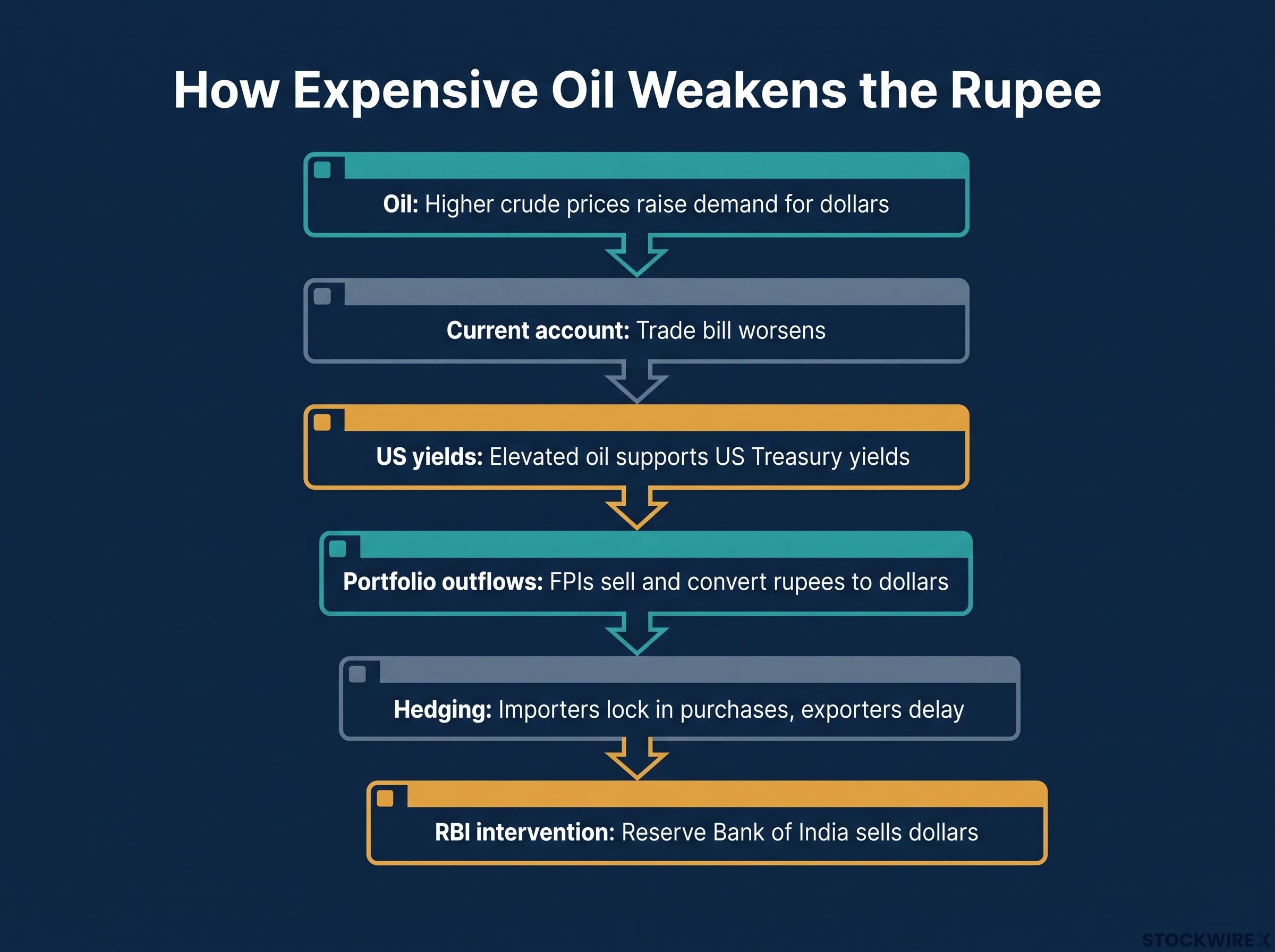
When oil gets more expensive, Indian refiners need more dollars to buy the same barrels. They sell rupees to get them, and that selling pushes the rupee down. From there, the pressure travels through a chain where each link tightens the next:
- Oil: Higher crude prices raise India’s demand for dollars.
- Current account: The trade bill worsens unless exports or capital inflows make up the difference.
- US yields: Elevated oil supports US Treasury yields, which strengthens the dollar and makes Indian assets less appealing.
- Portfolio outflows: Foreign portfolio investors (FPIs), meaning overseas funds buying Indian shares and bonds, sell and convert rupees back to dollars.
- Hedging: Importers lock in future dollar purchases now, and exporters may delay converting their dollar earnings, adding to spot pressure.
- RBI intervention: The Reserve Bank of India (RBI) sells dollars to slow the fall, but it cannot permanently offset a lasting balance-of-payments shock.
Hedging deserves a plain definition. It means buying protection today against a price move tomorrow. For an importer, that means buying dollars early in case the rupee weakens further.
Bank economists point to the same links. Aditya Bagree of Citi cited high oil, FPI outflows and shifting importer and exporter hedging behaviour, according to Business Standard.
The hedging habit Arup Rakshit of HDFC Bank said RBI measures cut speculative positions, but importers kept hedging because the cost of hedging did not necessarily outweigh the benefit of rupee appreciation.
There is good news in the chain. India’s current account deficit has narrowed to about 0.5% of GDP, from about 2.5% three years earlier (Business Standard, 21 October). The current account measures the money flowing in and out of a country through trade, income and transfers.
That improvement helps, but it does not make India immune. Capital flows and global yields can move far faster and in far larger amounts than a trade gap. That is why economists still expect weakness despite the better headline number.
What is the Fed signalling, and what does the USD/INR chart say?
Markets expect the Fed to stand still today. That sounds like relief for the rupee, but it may not be.
The hawkish hold and US yields
The Fed funds target range sits at 3.75%-4.00% after a 25 basis point hike in September. A basis point is one hundredth of a percentage point. CME FedWatch, a tool that converts futures prices into rate odds, shows about 90%-90.6% odds of a hold and about 9.4%-10% odds of a hike. A December hike remains possible.
Fed Governor Christopher Waller told Reuters on 8 October that more hikes are needed, though not necessarily at back-to-back meetings. He warned of de-anchored inflation expectations after nearly 5.5 years of above-target inflation.
That combination is what traders call a “hawkish hold”. It means the Fed pauses while signalling it is ready to tighten again. FXStreet’s Fed Sentiment Index reads 138.34, well above the neutral 100, which suggests Fed language leans firmly toward tightening.
A hawkish hold keeps US yields high. FXStreet puts the 10-year Treasury yield at about 5.02%, a figure not independently confirmed elsewhere. Higher yields draw money into dollars and make rupee assets look less rewarding, even without a hike.
A hawkish hold keeps US yields high, and you can see the same squeeze across emerging market currencies, where reserve buffers and export profiles decide how much damage a stronger dollar does to each one.
Reading the 20-period EMA and RSI
An exponential moving average (EMA) is an average price that gives more weight to recent sessions, used to show trend direction. The relative strength index (RSI) is a 0-100 gauge of how fast and how far prices have moved. Readings above 70 suggest overbought conditions, and readings below 30 suggest oversold conditions.
| Indicator | Reading | Plain-language meaning |
|---|---|---|
| Fed funds range | 3.75%-4.00% | US rates are high, which supports the dollar |
| FedWatch hold odds | about 90% | A pause is expected, so guidance matters more than the decision |
| 20-period EMA | 95.3253 vs spot 95.1355 | USD/INR sits below its trend line, a soft short-term tone |
| RSI | about 44 | Momentum is weak, but the pair is not oversold |
The chart shows the same tension as the Fed backdrop. The dollar’s short-term momentum has cooled, yet nothing on the chart suggests the pressure on the rupee has broken. FXStreet’s technical commentary was produced with an AI tool, which is another reason to hold it loosely.
These indicators describe momentum, not the next shock. A sudden oil reversal, RBI action or Fed surprise could invalidate the setup within hours.
Which drivers will still matter after today’s headlines fade?
The missile claim and the Fed decision will fade from the news. The slower forces underneath will not.
The four lasting drivers
- RBI policy and intervention: The repo rate, the RBI’s main lending rate, is 5.50% after a 25 bp hike on 7 October. Reserves fell US$5.01bn to US$721.02bn, after an estimated US$75-80bn of intervention and about US$150bn of inflow measures.
- Carry trade: This means borrowing in a low-yield currency to invest in a higher-yield one. Higher Indian rates can attract this money, but high US yields shrink the advantage.
- Capital flows: FPI selling can overwhelm a healthier current account quickly.
- Inflation: September CPI hit 5.54%, inside the RBI’s 2%-6% band around a 4% target but near the top. A weaker rupee raises fuel and transport costs, which risks feeding back into prices.
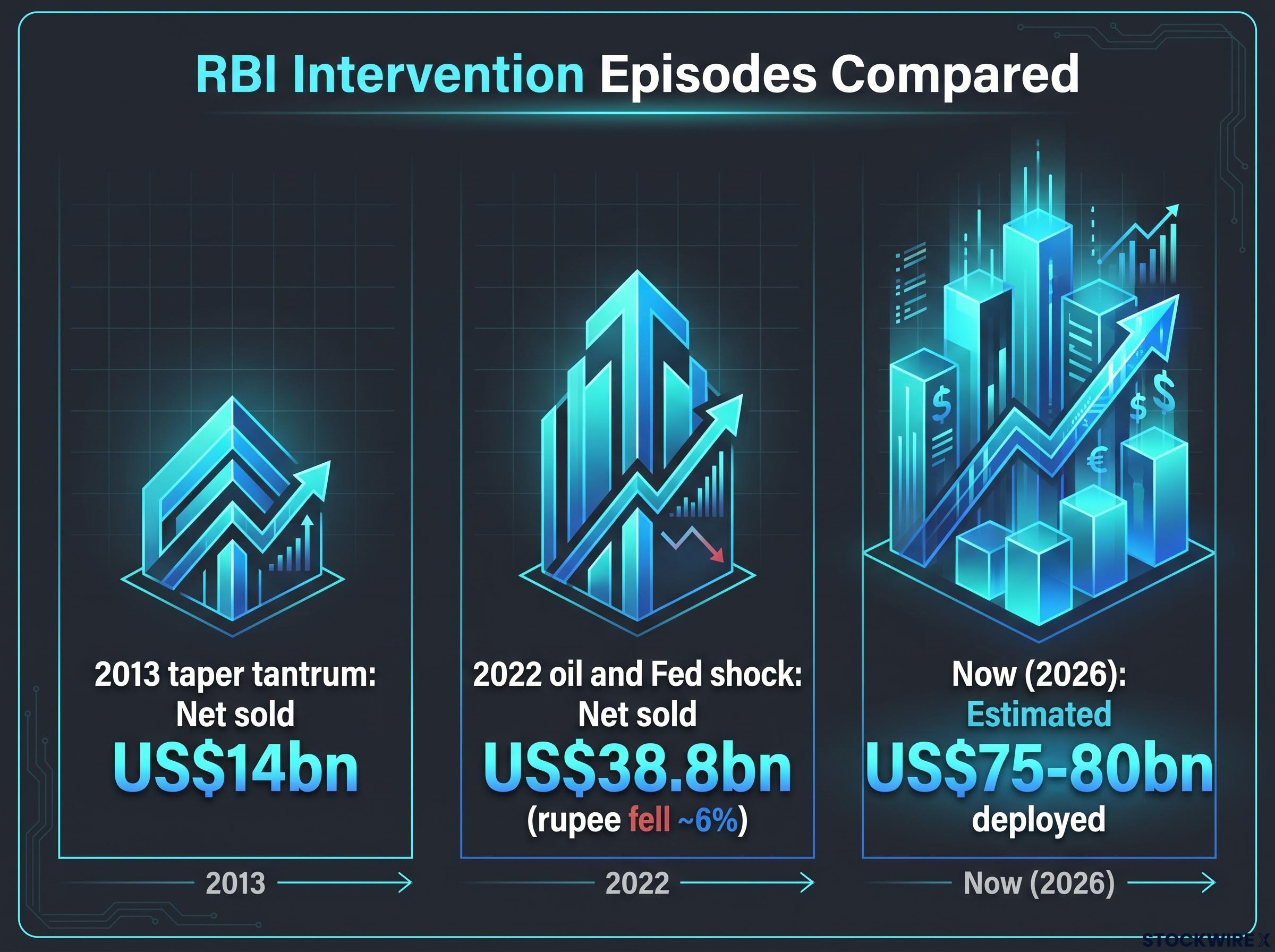
The past shows how reserves shape these episodes:
| Episode | Trigger | RBI response | Relevance |
|---|---|---|---|
| 2013 taper tantrum | Fed signalled slower bond buying; US yields rose | Net sold US$14bn (June-September) | Clearest yield and capital-flow precedent |
| 2022 oil and Fed shock | High oil plus Fed tightening | Net sold US$38.8bn (January-July); rupee still fell about 6% | Intervention smoothed the move but did not stop it |
| Now (2026) | Gulf risk, high oil, hawkish Fed | Estimated US$75-80bn deployed | A larger cushion buys time, not immunity |
Cyclical shock or structural weakness?
The cyclical view says the rupee could recover if oil falls, diplomacy holds or the Fed softens. The structural view says India’s dependence on imported energy and its exposure to fast-moving portfolio money leave it vulnerable each time.
The same split runs through the policy debate. One camp argues the RBI must smooth the fall to contain imported inflation. The other warns that heavy defence drains reserves and invites one-way speculation. The evidence points to managed flexibility, where the RBI slows the move without trying to stop it.
For you, the useful read is that future rupee weakness is likely to be a temporary shock acting on a standing vulnerability. Oil, US yields, flows and RBI behaviour tell you which one is dominating.
A checklist for reading the next USD/INR move
When the rupee moves sharply, work through these variables before deciding what the move means:
- Gulf damage: Has any loss of capacity been officially confirmed?
- Brent direction: Is the premium holding or fading?
- US 10-year yield and Fed guidance: Is the dollar’s yield advantage widening?
- FPI flows: Is foreign money leaving?
- RBI intervention and CPI: Is the central bank defending, and is inflation climbing?
If only the headline and oil have moved, you are probably looking at a reaction that can unwind. If yields, outflows and inflation are moving with it, the repricing has deeper roots. No single indicator will warn you about the next shock.
Readers interested in where this goes next can use our full explainer on the rupee’s path toward 97, which covers the compressed India-US yield spread and the October policy catalysts.
This article is for informational purposes only and should not be considered financial advice. Investors should conduct their own research and consult with financial professionals before making investment decisions. Past performance does not guarantee future results. Financial projections are subject to market conditions and various risk factors.