
Most investors assume that when a listed company breaches its disclosure duties, its board must share the blame. The Regional Express Holdings (Rex) case shows otherwise. The NSW Supreme Court found Rex liable for breaching its continuous disclosure obligations and cleared all three non-executive directors.
The Australian Securities and Investments Commission (ASIC) is not accepting that split. It filed a Notice of Intention to Appeal on 20 August 2026, aimed squarely at the directors’ clearance.
The case is still moving. On 20 October 2026, former CEO and executive chairman Lim Kim Hai was penalised after admitting his involvement. The question of the non-executives remains open.
If you rely on timely market disclosure, or you sit on a board, the stakes are personal. Here is a framework for why a company can breach disclosure rules while its directors walk free, and what the appeal could change.
How do continuous disclosure obligations and directors’ duties actually work?
The starting rule is simple: tell the market immediately. The complexity comes from what happens when that rule is broken, because the law asks two separate questions about two separate parties.
The company’s duty
ASX Listing Rule 3.1 requires a listed entity to notify the ASX immediately once it becomes aware of information that a reasonable person would expect to have a material effect on its share price. Section 674A of the Corporations Act gives that rule legal force.
Since 2021, the provision has included a fault element, meaning ASIC must show a mental state, not just a failure to disclose. According to law firm JWS, s 674A raises two questions: did the company hold information requiring disclosure, and did it know, or was it reckless or negligent about, whether that information would materially affect its price?
The director’s duty
Section 180(1) imposes a duty of care and diligence on each director personally. It is an objective standard, judged by what a reasonable director in that position would do.
The duty of care and diligence has recently been applied to a CEO who failed to act on adverse information held for fifteen days, showing that inaction alone can ground personal liability under section 180(1).
The Australian Institute of Company Directors (AICD) notes that s 180 does not require directors to run operations themselves, but they must respond to a significant increase in risk. Directors may rely on management and advisers, although that reliance becomes unreasonable where they know, or ordinary care should reveal, facts that undermine it.
That leaves ASIC with two distinct burdens:
- Against the company: that it held material, undisclosed information and had the required fault.
- Against a director: what that individual knew or should reasonably have understood, and what they did or failed to do.
The point to carry forward is that corporate disclosure failure and personal director liability are separate legal questions. Read the Rex outcome through that lens and it stops looking contradictory.
When big ASX news breaks, our subscribers know first
Why was Rex liable while three non-executive directors were cleared?
The story begins with a forecast. On 28 February 2023, Rex told the market:
Rex forecast, 28 February 2023 The company was “optimistic the Group will have positive operating profits for the full FY23 barring any further external shocks.”
ASIC never proved that statement lacked reasonable grounds when it was made, so its misleading conduct claim failed. The trouble came later.
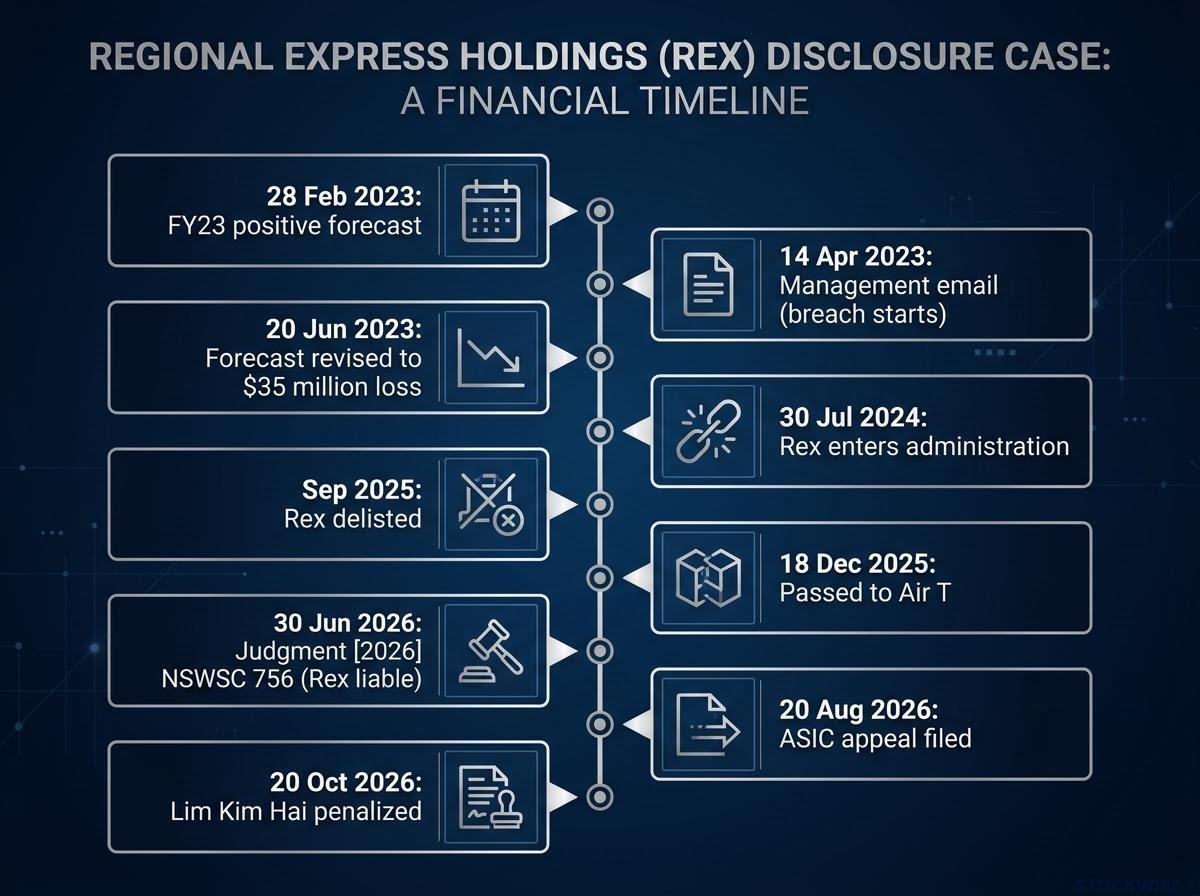
| Date | Event | Legal significance |
|---|---|---|
| 28 Feb 2023 | Positive FY23 operating-profit forecast | Not proven to lack reasonable grounds when issued |
| 14 Apr 2023 | Management email circulates | Start of disclosure breach period |
| 20 Jun 2023 | Forecast revised to $35 million operational loss | Breach period ends |
| 30 Jun 2026 | Judgment in [2026] NSWSC 756 | Rex liable; directors cleared |
In his 30 June 2026 judgment, Justice Black found Rex breached its disclosure obligation from about 14 April to 20 June 2023, because it no longer had reasonable grounds for the forecast. The claims against John Sharp AM, Siddharth Khotkar and Lincoln Pan followed a different path:
- Corporate obligation: Rex held information that undercut its optimism, so it had to correct the market.
- Individual inquiry: ASIC then had to prove what each director knew or should have understood.
- Evidentiary threshold: The email and reports created concern but did not prove actual knowledge, and ASIC offered no expert evidence on what a reasonable non-executive should have concluded from complex material.
- No derivative liability: The company’s breach did not automatically become the directors’ breach.
McCullough Robertson frames this as the line between corporate and individual liability. Bellrock Advisory describes the gap ASIC failed to bridge: adverse information circulating inside Rex was not the same as the directors’ personal knowledge.
The ruling is not a shield, though. JWS reports Justice Black considered that, had knowledge been proved, the contraventions would have been serious, and the s 189 reliance defence (a statutory protection for directors who rely on others in good faith) would have failed because the directors did not give evidence. What this tells you is that information buried in a company does not automatically land on its board, but non-executives remain exposed where proof exists.
What is ASIC challenging, and how might the appeal play out?
The confirmed facts are narrow. ASIC’s appeal, filed on 20 August 2026, targets only the dismissal of claims against the three directors, not the finding against Rex. In releases 26-140MR and 26-250MR, ASIC said it is concerned the primary judge erred in findings about these directors.
Beyond that, the record goes quiet. Detailed grounds are not public, no leave hearing date has been set and no leave decision has been reported. Leave is the court’s permission to bring the appeal at all.
Everything below is inference from the judgment and published commentary, not prediction.
What ASIC may argue
- The court may have set the knowledge bar too high, demanding something close to awareness of the precise legal conclusion rather than what a reasonable director should have inferred from weakening results and management emails.
- The appeal could test whether s 180 imposes a positive duty on non-executives to interrogate management information when warning signs appear.
What the directors can point to
- A company’s breach is not automatically a director’s breach.
- Concern, complexity and access to adverse material do not prove knowledge or a failure of reasonable care.
Precedent gives both sides material:
| Case | Court | What it held | Relevance to Rex |
|---|---|---|---|
| ASIC v Vocation [2019] FCA 807 | Federal Court | Directors breached s 180 even though accessory liability was not proved | Shows s 180 as a separate route to personal liability |
| Cassimatis v ASIC [2020] FCAFC 52 | Full Federal Court | s 180 liability is direct and personal, not derivative | Supports separating corporate and personal liability |
Vocation suggests ASIC’s path is not far-fetched; Cassimatis supports the reasoning the directors rely on. For you, the read is that this appeal could set how hard non-executives must press on management reporting, which makes its outcome a live governance signal rather than a legal footnote.
A closely parallel outcome came in ASIC v Bekier, where executives who controlled information flows to the board were held personally liable while all seven non-executive directors were cleared over inadequate reporting.
What does Lim Kim Hai’s penalty signal about enforcement?
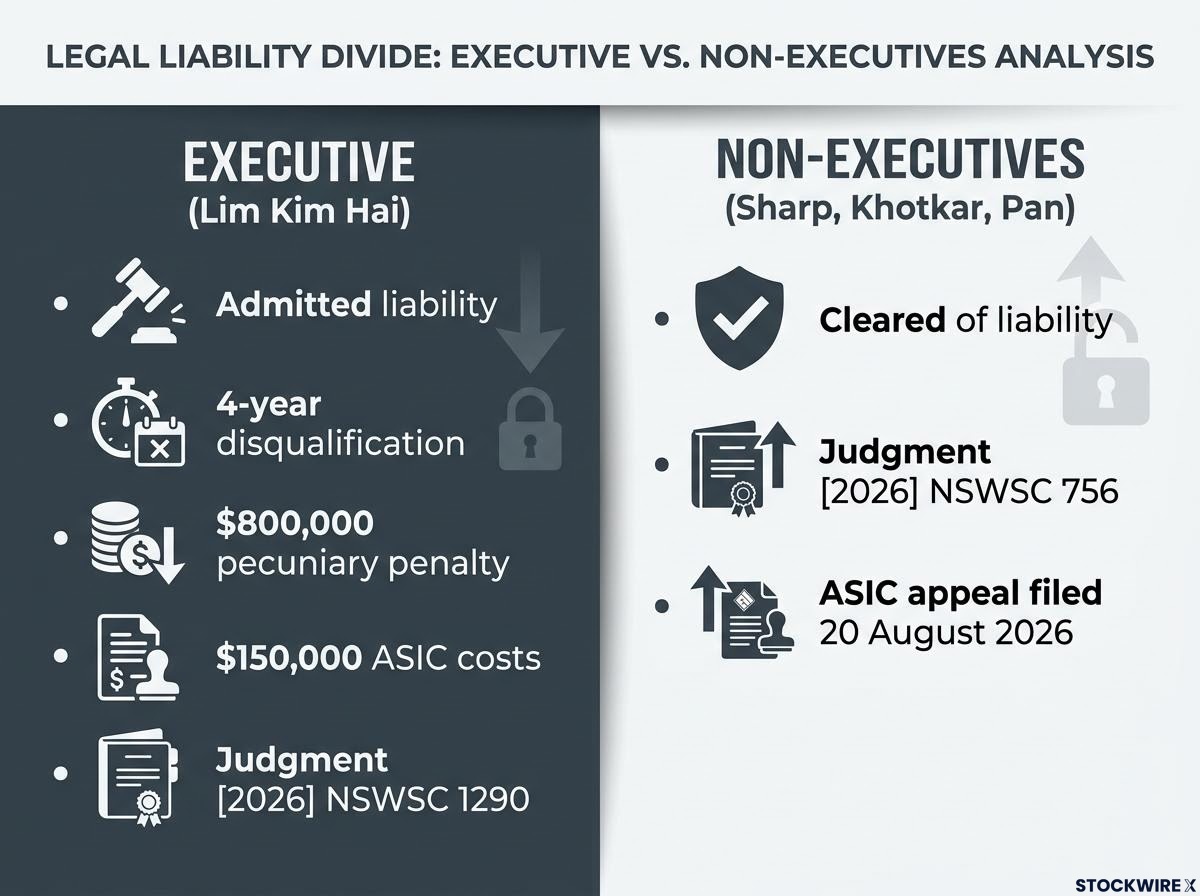
The contrast with the non-executives is stark. Lim admitted liability on 20 May 2026, and on 20 October 2026 Justice Black made orders in [2026] NSWSC 1290:
- Disqualification from managing corporations for four years
- A $800,000 pecuniary penalty (a civil fine)
- $150,000 towards ASIC’s costs
The penalty in brief $800,000 and a four-year ban for the executive who admitted involvement. No liability for the three non-executives.
The court accepted the jointly proposed orders as within an appropriate range, citing the seriousness of the contraventions and Lim’s senior role. Coverage from Australian Aviation and the ABC highlighted the asymmetry.
The lesson is about where proof is easiest to find. Personal consequences land hardest where an admission or clear evidence of involvement exists, which leaves executives carrying the most direct exposure under current enforcement.
What should boards and investors take from the Rex case?
For boards
A broad appeal outcome could push non-executives towards more verification, independent advice and documented challenge of management. That may tighten disclosure controls, but it could add cost, slow decisions and deter qualified candidates. A narrow standard carries the reverse risk: boards treating complex warning signs as management’s problem.
Commentary on Vocation flags when reliance on management stops being reasonable:
- Reports that are inconsistent or unsupported
- Later correspondence that contradicts earlier information
- Assumptions behind financial estimates that go untested
- Information central to a market announcement
For investors
Rex entered administration on 30 July 2024, delisted in September 2025 and passed to Air T on 18 December 2025. Its shareholders learned the cost of slow disclosure the hard way.
A corporate finding does not close the matter for individuals, as ASIC’s separate proceedings against the former CEO of Electro Optic Systems after its $4 million penalty demonstrate.
Watch how companies handle disclosure when forecasts weaken, and whether boards visibly escalate concerns. Disclosure quality depends on board challenge as much as management reporting, and the leave decision is the next indicator of where that bar sits.
What the Rex ruling settles, and what the appeal could still change
Some of this is settled. Rex breached its continuous disclosure duty from April to June 2023, and Lim’s penalty is final.
The liability of Sharp, Khotkar and Pan remains open pending leave and any appeal. The grounds and hearing date are still unknown, so those are the developments to watch.
A ruling for ASIC could require non-executives to actively test management’s numbers when warning signs emerge; a ruling for the directors would confirm that company knowledge and personal knowledge remain distinct.
This article is for informational purposes only and should not be considered financial advice. Investors should conduct their own research and consult with financial professionals before making investment decisions. Commentary on the appeal is speculative and subject to change based on court developments.