
Japanese core inflation is back above 2%, and the Bank of Japan (BoJ) has just lifted its policy rate to 1.25%. Yet on 23 October, Economy Minister Minoru Kiuchi said the conditions for formally declaring deflation over have not been met. On the same day, USD/JPY slipped 1% to around 156.55.
Many readers will treat that as a contradiction, or as noise. It is neither. It is a signal about pace, and pace is what matters most for any USD/JPY forecast.
The formal declaration matters because it shapes how much political room the BoJ has to keep raising rates, and that room feeds directly into the yen. The next test arrives quickly: the BoJ announces its next decision on 30 October.
This piece covers which signals actually move the yen, how the dollar’s yield advantage works against them, and what range of outcomes the current data supports.
Why won’t Tokyo declare deflation over when inflation is above target?
The natural assumption is simple. If prices are rising faster than the 2% target, deflation must be finished.
Tokyo does not see it that way, and the reason is durability rather than today’s prices. Kiuchi’s own wording has shifted over three weeks:
- 2 October: Japan was no longer experiencing deflation and did not need excessively loose policy aimed at creating inflation.
- 23 October: the requirements for formally declaring the end of deflation have not yet been met.
The first statement describes the present. The second is a formal judgement that deflation, meaning a sustained fall in the general price level, has ended for good. Governments set a higher bar for that call because reversing it would be politically costly.
Kiuchi, 23 October (as reported by FXStreet) The government will review CPI, the GDP deflator and the drivers behind price trends to make sure Japan does not slip back into prolonged price declines.
Kiuchi also said he hoped the BoJ would conduct policy appropriately under the joint government-BoJ statement, which commits both sides to stable and sustainable price stability. That statement is the anchor. It ties the BoJ to a goal framed around sustainability, not speed.
Finance Minister Satsuki Katayama has reportedly said Japan is approaching sustained, wage-driven inflation and sees no conflict with the BoJ. That remark has not been independently confirmed, so treat it with caution.
The politics add another layer. The two board members who dissented in September’s 7-2 vote were appointed by Prime Minister Sanae Takaichi, even as the government publicly stresses BoJ independence.
What this tells you is that Tokyo wants the BoJ to move gradually. That caps how aggressive the hiking path is likely to be and, by extension, how much support rate rises can give the yen.
When big ASX news breaks, our subscribers know first
What do the inflation numbers actually say?
The headline evidence builds first. September core CPI, which strips out volatile fresh food, rose 2.1% year on year, the first reading above target in nine months.
Core-core CPI, which also removes energy, rose 2.4%, according to Reuters (Investing.com reported 2.5%). Reuters read that as a sign of broader, more demand-sensitive price pressure. Then there is the GDP deflator, a gauge of prices across everything the economy produces domestically. It captures home-grown price pressure that CPI, a basket of consumer goods, can miss.
| Measure | Latest reading | Period | What it signals |
|---|---|---|---|
| Core CPI (ex fresh food) | +2.1% y/y | September 2026 | Headline inflation back above target |
| Core-core CPI (ex fresh food and energy) | +2.4% y/y | September 2026 | Broader, demand-sensitive pressure |
| GDP deflator | +2.6% y/y (index 116.2) | Q2 2026 | Domestic price pressure across the economy |
On paper, three indicators all point above 2%. So why the hesitation?
Imported inflation or demand-led?
Because quality matters as much as level. Energy, food and import costs helped lift September’s reading, and a weak yen makes all three more expensive in local terms, which then seeps into wider prices.
Much of the current pressure looks like cost-push inflation, with import prices and fuel running far ahead of money supply growth of just 1.2%, which supports Tokyo’s caution about calling deflation over.
Brown Brothers Harriman (BBH) strategist Ellias Haddad argued that underlying inflation remains below the BoJ’s own projection. The IMF and Governor Kazuo Ueda both support tightening if inflation proves persistent, which is precisely the open question.
If imported costs fade, the BoJ has less reason to keep hiking. If they spread into wages and services, the case strengthens. For your purposes, wage and services data deserve more attention than the headline figure.
How does the yen actually move? The yield gap, carry trades and the ¥160 line
The number on the screen is 156.55, down 1.00% on the day. The pair has traded roughly between 156 and 158, with support at 156.90, 156.45 and 156.25, according to Investing.com.
Behind that number sit several forces pulling in different directions.
| Driver | Effect on USD/JPY | Structural or cyclical |
|---|---|---|
| US-Japan rate differential | Encourages dollar buying and yen-funded carry trades (pushes higher) | Both |
| Fed policy | Falling US yields support the yen; delayed easing supports the dollar | Mainly cyclical |
| BoJ normalisation | Raises the cost of betting against the yen (pushes lower) | Cyclical, potentially structural |
| Wage growth | Supports further hikes (pushes lower) | Potentially structural |
| Safe-haven flows | Risk aversion lifts the yen (pushes lower) | Cyclical |
| Carry trades | Sudden unwinds force yen buying (pushes lower, fast) | Cyclical, highly nonlinear |
The yield gap and carry trades
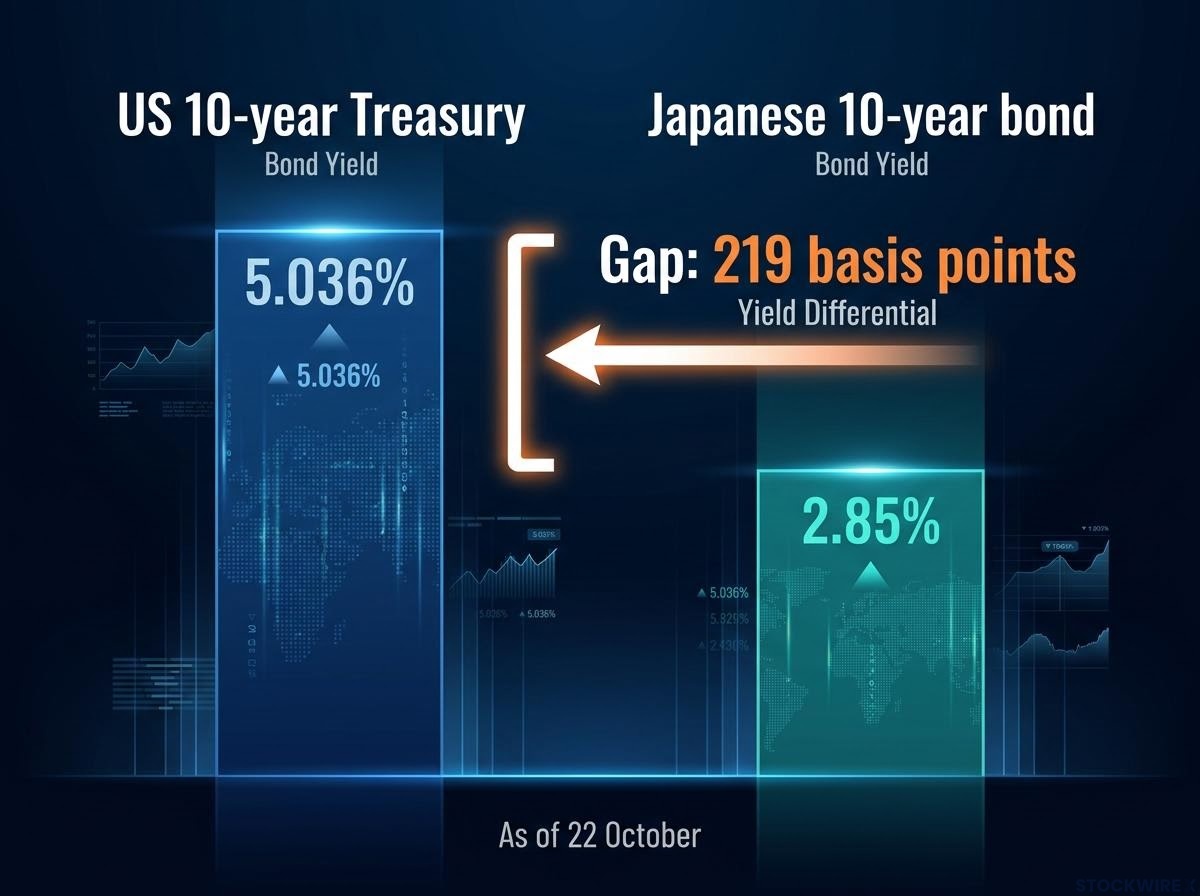
The US 10-year Treasury yielded 5.036% on 22 October, against 2.85% for the Japanese 10-year bond, a gap of about 219 basis points (a basis point is one-hundredth of a percentage point). From 2013 to 2024, ultra-loose BoJ policy widened that kind of divergence and weakened the yen.
The 219-basis-point gap is also narrower than it once was, and that shrinking carry advantage, once hedging costs are counted, has pushed Japanese investors to sell about ¥4.74 trillion of US bonds this year.
A carry trade means borrowing in a low-yielding currency to invest in a higher-yielding one. While the gap stays wide, holding dollars funded by yen pays, which keeps steady pressure on USD/JPY. That is also why a BoJ hike is not automatically yen-positive: September’s move was not hawkish enough to trigger a major repricing, according to Reuters, because guidance and US yields still dominated.
Intervention near ¥160
Market commentary identifies ¥160 as the level the Ministry of Finance would defend. No new intervention had been found through 23 October. Lower US yields, expectations of a December hike and intervention worries all helped the yen this month.
The 2024 record shows both capacity and limits. Authorities spent roughly ¥9.8 trillion in April-May and about ¥5.53 trillion in July, according to Reuters. Intervention works as a speed limit on depreciation, not a fix for the yield gap.
So test any forecast you read against what it assumes about US yields, not the BoJ alone.
Which USD/JPY scenarios does the BoJ calendar support?
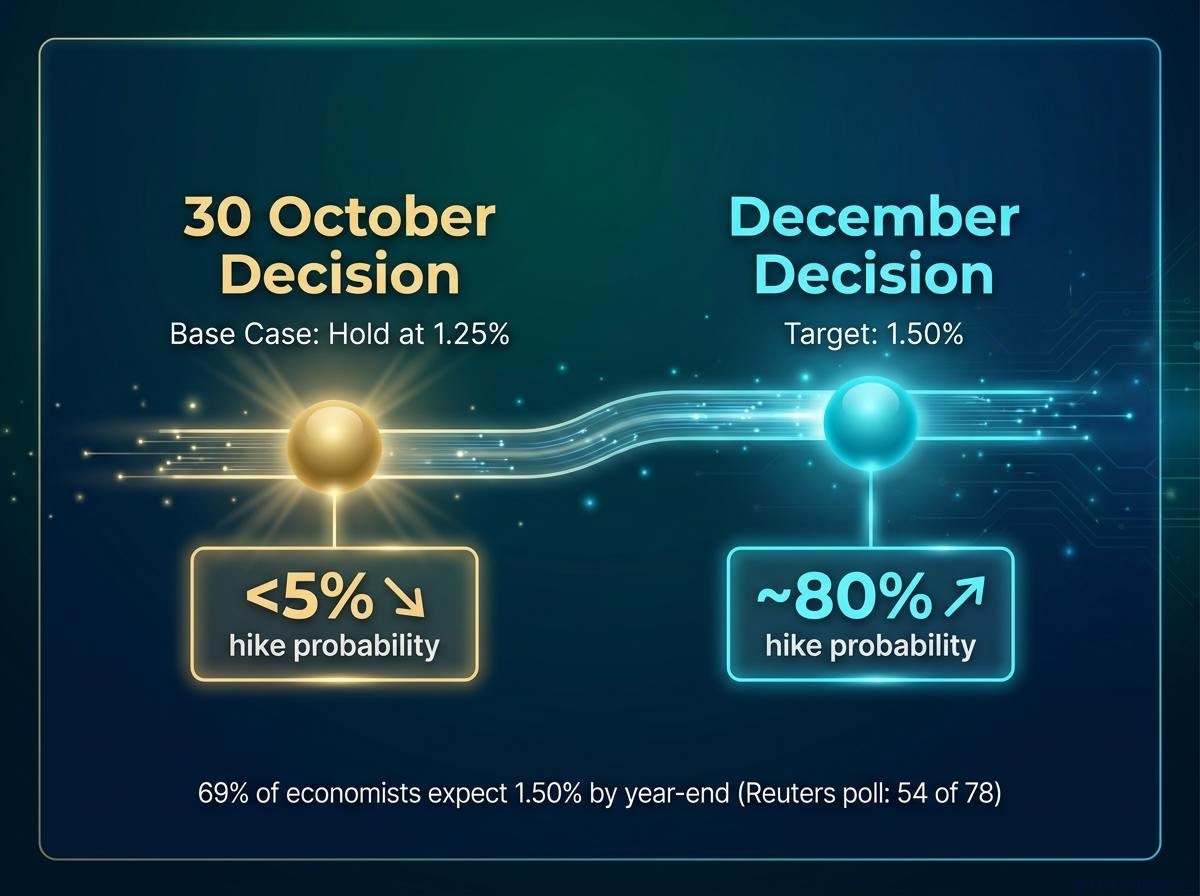
The base case is a hold at 1.25% on 30 October, followed by a move toward 1.50% in December. A Reuters poll found 54 of 78 economists (69%) expect 1.50% by year-end, mostly in December. BBH puts the market-implied probability of an October hike below 5%, against roughly 80% for December, and MUFG also sees December as the most likely timing.
Dissenting views lean hawkish. A former BoJ policymaker told Reuters hikes could come as often as quarterly, while board member Junko Koeda has said the neutral rate, the level that neither stimulates nor restrains growth, sits considerably above 1%.
| Scenario | Trigger | Likely USD/JPY direction | Key risk |
|---|---|---|---|
| Range-bound | October hold, December hike signalled, US yields steady | Sideways near recent range | Yield gap keeps dollar supported |
| Yen-strengthening | Hawkish guidance, falling US yields or risk-off | Lower, possibly sharply | Carry-trade unwind accelerates the move |
| Dollar-strengthening | Dovish BoJ, imported inflation fades, US yields hold up | Higher, toward ¥160 | Intervention near ¥160 |
History warns against assuming moves stay orderly. The BoJ’s hike to 0.25% on 31 July 2024, combined with intervention and weaker US data, set off a carry unwind in which the yen rebounded sharply and global equities sold off.
Distinguishing a genuine carry-trade unwind from a simple repricing matters, since forced liquidation shows up in collapsing speculative positions and equity stress, while repricing leaves positioning largely intact.
A single forecast number matters less to you than the triggers behind it. Three signposts carry the most weight:
- The 30 October decision and its guidance on December.
- The direction of US yields.
- Any approach toward ¥160.
This is analysis, not personal investment advice. Past performance does not guarantee future results, and projections are subject to market conditions and various risk factors.
What the deflation debate changes for the yen, and what it does not
Tokyo’s refusal to declare deflation over changes the likely pace of BoJ tightening. It signals gradualism, which limits how much rate rises alone can lift the yen. It does not change the structural pull of a 219-basis-point yield gap and the carry demand that comes with it.
The declaration itself is not the trigger. Evidence that inflation is durable, visible in wages and services, matters more, alongside the path of US yields.
Your next decision points are close. The 30 October meeting will show whether December remains the plan, and any drift toward ¥160 will test the government’s resolve to cap the dollar.
This article is for informational purposes only and should not be considered financial advice. Investors should conduct their own research and consult with financial professionals before making investment decisions.