A central bank that sounds hawkish is supposed to lift its currency. Canada’s September inflation report complicates that idea: headline CPI rose to 3.1%, just below the 3.2% consensus, the Bank of Canada has been talking tough, and TD Securities still doubts the Canadian dollar can hold a rally.
Statistics Canada published the September figures today, 19 October 2026. The Bank’s next rate decision and Monetary Policy Report arrive on 28 October, nine days from now. That timing makes this print one of the last inputs before policymakers set their direction.
The headline number is what reached the newsfeeds. The more useful information sits underneath it, and that gap is where currency forecasts hold up or fall apart. Here is how a rates strategist reads a CPI release, and why that reading leads TD to set its USD/CAD outlook with a ceiling near 1.43.
What September’s CPI actually showed beneath the headline
At first glance the report looks mildly hawkish. Annual inflation rose from 3.0% in August to 3.1%, moving further from the Bank’s 2% target. A central bank already weighing a hike would not welcome that direction.
The details tell a different story. Headline CPI came in 0.1 percentage point below both the consensus and TD’s own forecast, according to Statistics Canada data and Reuters reporting. On a monthly basis prices rose 0.1% (0.118% unrounded), against the 0.2% markets expected.
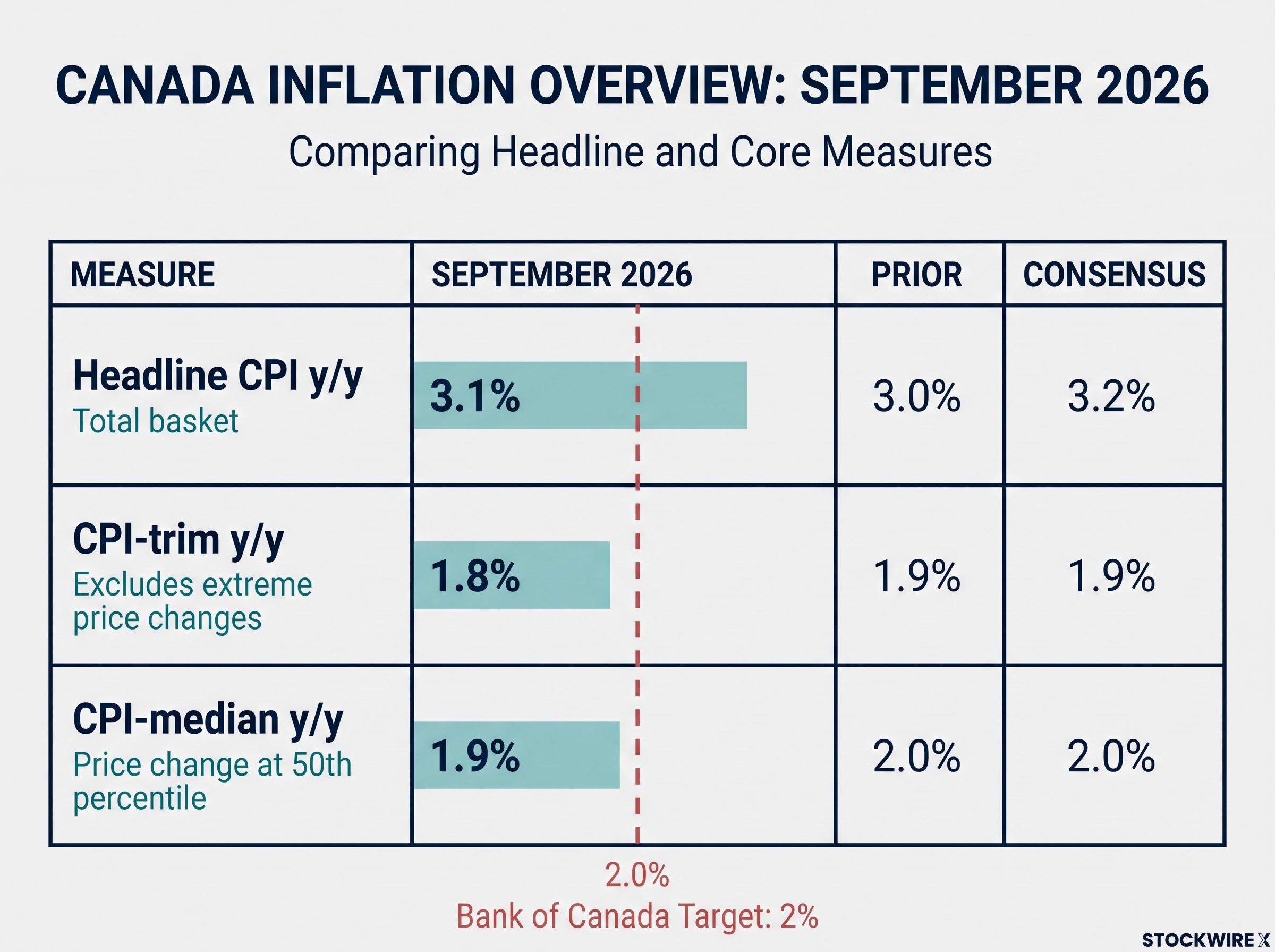
The more important readings come from the core measures. Both eased by a tenth of a point, and both landed below consensus.
| Measure | September 2026 | Prior month | Consensus |
|---|---|---|---|
| Headline CPI, y/y | 3.1% | 3.0% | 3.2% |
| Headline CPI, m/m | 0.1% | Not available | 0.2% |
| CPI-trim, y/y | 1.8% | 1.9% | 1.9% |
| CPI-median, y/y | 1.9% | 2.0% | 2.0% |
Why gasoline flattered the headline
The rise in headline inflation came mostly from energy. Gasoline and energy inflation accelerated sharply, while food inflation moderated. In this report, what drove the number mattered more than how high it went.
That composition is the distinction everything else rests on. When a single volatile component lifts the headline while the centre of the price distribution sits near 2%, the inflation problem looks concentrated rather than broad. Keep that pattern in mind, because the Bank will read the report the same way.
When big ASX news breaks, our subscribers know first
How core measures work and why central bankers trust them
Headline CPI is noisy. Gasoline, weather-sensitive food and tax changes can move it sharply in a single month without saying much about where inflation is settling. Central banks need a way to filter out that noise, and core measures are built for the job.
CPI-trim versus CPI-median in plain terms
Each month, Statistics Canada records price changes across hundreds of basket items, weighted by how much households spend on them. The two core measures handle that spread of price changes differently:
- CPI-trim removes the most extreme price movements, cutting 20% of weighted price changes from each end of the distribution. That leaves 40% of the basket excluded in any given month, and the excluded items change from month to month.
- CPI-median takes the single price change at the 50th percentile of the weighted distribution, the point where half the basket rose faster and half rose slower.
Neither measure decides in advance which category is volatile. They let each month’s data reveal its own outliers, which is why a gasoline spike gets filtered out without anyone having to label it temporary.
Canada’s core inflation has run below 2% for several months, with diffusion indicators showing no meaningful broadening of price pressure, which is why an energy-led headline rarely forces a central bank’s hand.
What the Bank looks at besides core
The Bank of Canada says underlying inflation cannot be captured by one formula. It reads core measures alongside the breadth of price increases (how many items are rising quickly), individual categories, labour-market conditions and the balance between supply and demand. Governor Tiff Macklem set out the question in an interview reported on 17-18 October:
“Is inflation likely to come back down towards our target on its own, or are we going to have to raise interest rates to influence the path?”
September’s mix of a 3.1% headline, 1.8% trim and 1.9% median gives a fairly reassuring answer to that question. Robert Both of TD Securities had expected both core measures near 1.9%. TD argued that weak underlying inflation and limited broadening of price pressure should constrain the Bank’s response, even if it raises its headline forecast.
There is a counterweight. TD flagged three-month core momentum of about 2.7%, which is warmer than the year-on-year readings but not enough by itself to justify aggressive tightening.
This is the skill you can carry to every future release. When headline inflation climbs on one volatile component while trim and median hold near target, you can reasonably expect a central bank to hesitate before tightening, and you can position your expectations around that hesitation.
Why TD sees USD/CAD capped near 1.43, and what the CAD/MXN fade means
The 1.43 figure is not the current exchange rate. USD/CAD traded around 1.4088-1.4100 just before the release, according to FXStreet, after nearly reaching 1.4300 last week. The 1.43 area is the resistance zone, a level the pair recently tested and failed to break.
Canadian dollar drivers extend well beyond rate expectations, and the Bank’s tone alone has moved the currency in recent weeks without any change in the policy rate, which is why hawkish rhetoric can lift CAD before the data confirms it.
TD’s strategists, as relayed by FXStreet, build their view in four steps:
- The softer core readings leave little room for a lasting Canadian dollar rally, despite the Bank’s hawkish tone.
- The US dollar has probably peaked, but no strong catalyst exists for an immediate selloff.
- TD expects the next Bank of Canada hike in Q1 2027, well behind market pricing.
- Markets may instead have to scale back what they still expect in 2026 rate increases, a shift TD thinks today’s inflation and growth data do not justify.
That third step matters most. Bloomberg data cited by The Globe and Mail in mid-October, before today’s release, put the odds of a hike on 28 October at about 35% and the odds of a hike by December at about 95%. If TD is right, much of that tightening is priced too early.
The 1.43 ceiling and the Liberation Day contrast
TD doubts USD/CAD can stay above 1.43 by year-end partly because of how the pair reached that level before. The earlier move happened around Liberation Day in April 2025, when conditions were very different.
| Factor | Liberation Day 2025 | October 2026 |
|---|---|---|
| Driver of the shock | US tariff announcements threatening Canadian exports | Oil and gasoline-driven inflation |
| Direction of USD pressure | Supportive of USD, weighing on CAD | Mixed: safe-haven demand versus expected US easing |
In 2025, tariffs hit Canada directly and pushed investors toward the US dollar. Today the shock comes through energy, and the US dollar’s direction is less clear. The 1.43 ceiling reflects a judgement that the forces which carried the pair there once are no longer lined up the same way.
How the CAD/MXN fade works
TD recommends fading Canadian dollar strength through the CAD/MXN cross. A relative-value trade means betting on one currency against another rather than against the US dollar. The reasoning is that Canada may lack the inflation pressure to support a hawkish repricing, while Mexico keeps comparatively high interest rates. Those higher rates provide carry, the income earned from holding a higher-yielding currency.
The trade profits if CAD weakens against the peso, even while CAD/USD swings around.
The practical read is this. If the market is pricing more tightening than the data supports, any Canadian dollar strength built on hawkish rhetoric looks vulnerable. The cross trade gives you a way to express that view without making a direct call on the US dollar.
Where the soft-CPI case could break: risks and rival views
A thesis is only as useful as your understanding of where it fails. Economists disagree on one central question: does the energy shock stay contained, or does it spread into inflation expectations, wages and services?
Macklem has kept both doors open. He said that if oil stays near US$100 a barrel, inflation could gradually rise from about 3%, and a hike remains possible but not committed. The policy rate has been held at 2.25% since 2 September 2026, with the Bank Rate at 2.50% and the deposit rate at 2.20%.
| Institution | Stance | Core reasoning |
|---|---|---|
| TD Securities | Limited BoC reaction; next hike Q1 2027 | Energy lifted headline without broadening |
| RBC | Core softer | Food disinflation and diffusion measures suggest limited pass-through |
| CIBC | Favoured a hold | Core contained; tariff uncertainty weakens case for tightening |
| Desjardins | Hikes delayed to early 2027 | Underlying inflation contained; growth uncertain |
| Scotiabank | Supports an October hike | Sees core inflation strengthening |
The specific risks to a capped USD/CAD view include:
- Oil persistence: prices near US$100 could spread into transport, goods and services.
- Tariff pass-through: higher input costs alongside weaker growth.
- USD reversal: a stronger US dollar could push the pair back to 1.43 without any change in Canadian data.
- Oil-CAD correlation breakdown: safe-haven US dollar buying during a geopolitical shock can overwhelm the commodity boost.
- Hawkish BoC surprise: a hike on 28 October with a new forecast.
History offers TD some support. When a currency has rallied on expected tightening, a downside inflation surprise tends to trigger profit-taking. Because the same data supports both a hawkish and a patient reading, treat the 1.43 ceiling as a probability-weighted view to test against the 28 October outcome, not a certainty.
Past performance does not guarantee future results. Forecasts are subject to market conditions and can change quickly.
For readers wanting to see why oil no longer guides CAD, our full explainer on why $100 oil is not lifting the Canadian dollar covers the tariff drag on the trade balance.
What the October 28 decision will settle, and what it will not
The chain runs like this: soft core, an energy-driven headline, a Bank that is hawkish in tone but uncommitted, and a currency view that depends on whether rate expectations get repriced.
Next week’s decision will answer part of the question. Four things are worth watching:
- The Bank’s revised inflation forecast in the Monetary Policy Report
- Its language on the breadth of price pressures
- Whether oil holds near US$100
- Whether USD/CAD retests the 1.43 area
The lesson carries beyond this release. Read the core measures and the central bank’s signalling together before you trust a currency rally.
This article is for informational purposes only and should not be considered financial advice. Investors should conduct their own research and consult with financial professionals before making investment decisions.