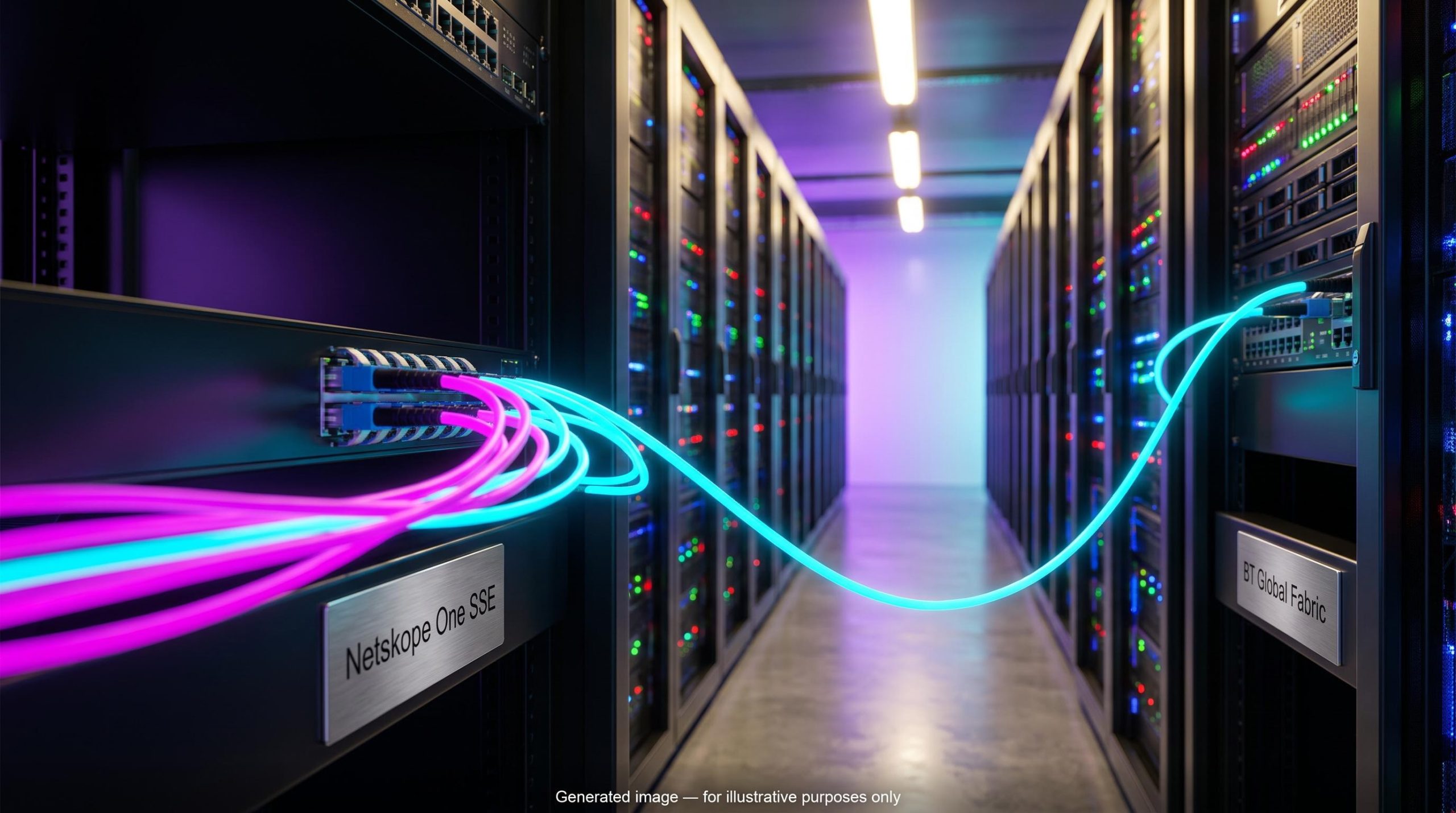
BT International has expanded its partnership with Netskope, giving customers direct access to Netskope One SSE over BT’s Global Fabric network-as-a-service platform. The arrangement, announced on 14 October 2026, is pitched as a way to deploy AI agents, cloud applications and autonomous digital workflows at scale while keeping them secure.
The timing reflects a wider problem. Growing numbers of users, AI agents and devices are putting pressure on network and security setups built for a simpler era, and carriers and security vendors are increasingly teaming up to address it.
For investors and technology buyers, three questions matter: what the connection changes in practice, how much weight the deal deserves, and what it says about Netskope’s position against well-funded rivals.
How does the Netskope and BT tie-up actually route AI and cloud traffic?
The offer is simple. Organisations can now reach Netskope One SSE through BT Global Fabric. Security Service Edge (SSE) is a cloud-delivered service that inspects internet and application traffic and applies security rules. Network-as-a-service (NaaS) means a company rents managed network capacity instead of building its own.
The key mechanism is direct Internet Exchange Point (IXP) peering. An IXP is a physical location where networks connect to swap traffic directly. Without it, traffic can pass through several third-party networks before reaching a security checkpoint.
The traffic path runs in five steps:
- User, branch or AI-agent traffic enters BT Global Fabric.
- The network routes it to a nearby or suitable point of presence (PoP), a regional access site.
- Traffic crosses direct peering into Netskope’s network, skipping unnecessary transit hops.
- Netskope One SSE inspects the traffic and enforces policy.
- Secured traffic continues to its SaaS, cloud or AI-agent destination.
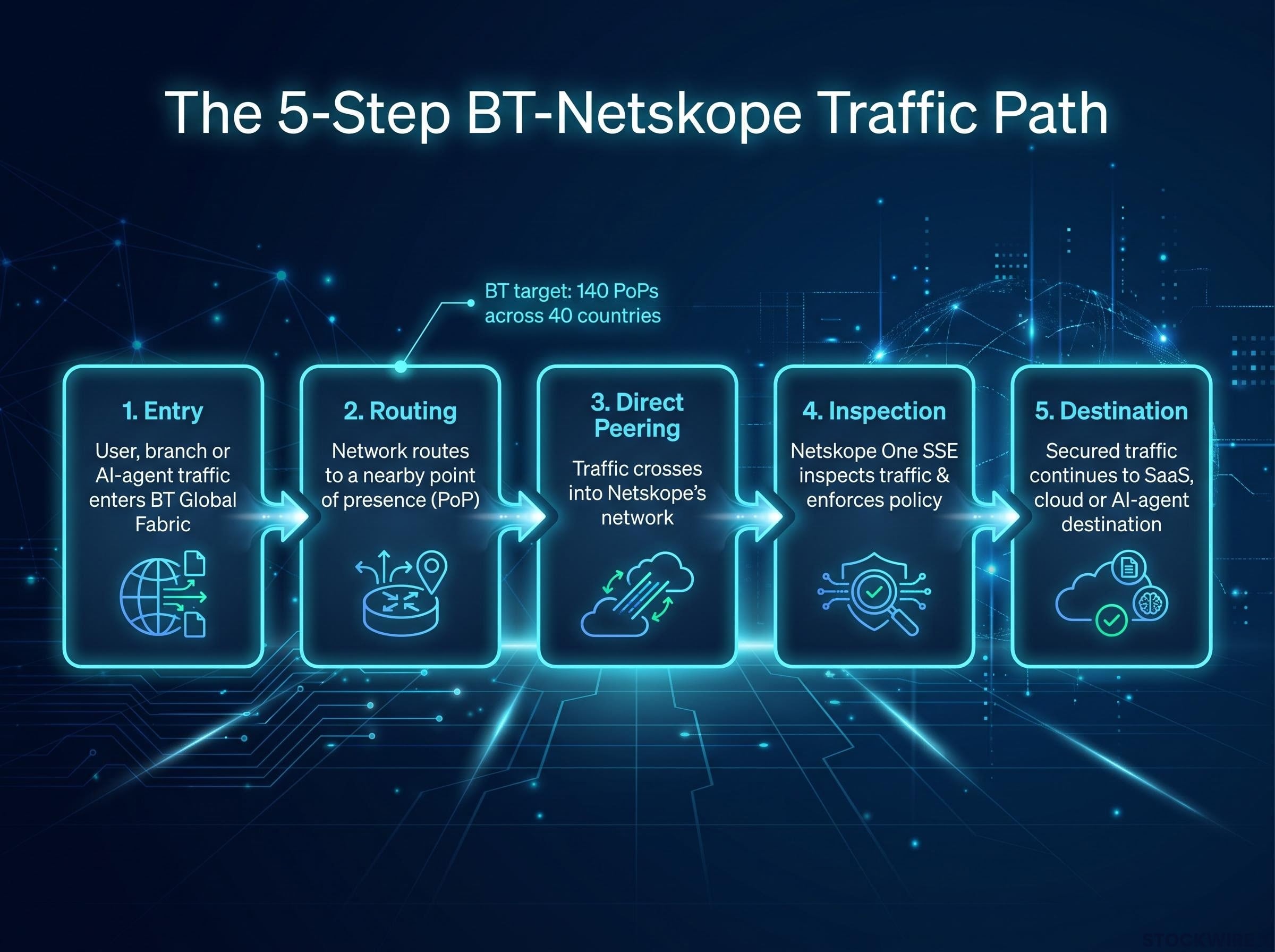
Global Fabric’s planned footprint BT plans 140 PoPs across 40 countries at full build. That is a target, not confirmed as the number operating today.
The split of responsibilities is clear. BT provides the network underlay and runs the managed service; Netskope provides the security layer. For you, the headline benefit is a shorter, more controlled route to security inspection, which matters most to organisations running latency-sensitive cloud and AI workloads across many regions.
What customers are told they will gain
According to the companies, customers can expect:
- Low-latency routing between users and AI agents
- Uniform security policy enforcement worldwide
- More predictable performance and faster application response
- Quicker, safer scaling of agentic AI and cloud adoption
- A single BT-managed secure access service edge (SASE) package with path diversity
These are vendor-stated claims, not independently verified results.
Netskope’s announcement sets out the vendor-stated benefits of the arrangement, including low-latency routing through direct IXP peering and consistent policy enforcement, though these remain company claims until customer adoption data emerges.
Where does Netskope stand against rivals BT also sells?
On the surface, this looks like a clear win for Netskope. A major global carrier is putting its platform directly on the network.
The detail is more nuanced. BT’s Global Fabric offers a choice of SSE providers: Cisco, Fortinet, Netskope and Zscaler. Netskope sits on the menu alongside its fiercest competitors.
Netskope sits on BT’s menu beside its fiercest competitors, and Zscaler’s ARR deceleration, alongside Palo Alto competitive pressure, shows how closely contested the SSE market has become for every vendor on that list.
The model is spreading. Carriers want security revenue that bandwidth alone cannot deliver, and Forrester said in September 2025 that more than 20 vendors offered all-in-one SASE platforms, with standalone SSE having “largely disappeared.”
| Partner arrangement | Carrier or provider | Security vendor | Model |
|---|---|---|---|
| Global Fabric SSE (Oct 2026) | BT International | Cisco, Fortinet, Netskope, Zscaler | Managed, multi-vendor |
| Managed Cisco SASE (Nov 2025) | AT&T Business | Cisco | Managed, single-vendor |
| Prisma SASE with connectivity | AT&T | Palo Alto Networks | Managed, single-vendor |
| Managed SSE (Aug 2024) | SoftBank | Netskope | Managed, single-vendor |
| Hosted SASE (Jun 2024) | Tata Communications | Versa Networks | Managed, single-vendor |
Netskope’s numbers and analyst standing
Netskope (Nasdaq: NTSK) was named a Leader in the 2026 Gartner Magic Quadrant for Security Service Edge for a fifth consecutive year, and a Leader in the SASE Platforms Magic Quadrant for a third consecutive year. Its latest reported metrics:
- Annual recurring revenue (ARR), the yearly value of subscription contracts: US$899 million, up 27% as at 31 July 2026
- Fiscal Q2 2027 revenue: US$220.5 million
- Fiscal 2026 revenue: US$709.0 million, up 32%
- 1,686 customers above US$100,000 ARR, up 23%, making up 87% of ARR
- 59% of customers use at least four Netskope One products
A total customer count could not be verified. For investors, the deal widens Netskope’s reach through a carrier channel, but with competitors listed alongside it, it signals market access rather than market share gain.
What should buyers and investors weigh before reading too much into it?
Partnership announcements tend to arrive polished. The questions worth asking come after.
IDC noted in September 2025 that consolidating with one vendor can bring integration and pricing benefits, yet some buyers still prefer best-of-breed tools. Juniper and Zscaler explicitly market their pairing as a way to avoid single-vendor lock-in.
On the labels Omdia’s Fernando Montenegro describes SASE as a framework, not a single product, and marketing terms can blur what a bundle actually contains.
| Risk | What it means for buyers |
|---|---|
| Vendor lock-in | One managed package can make replacing the carrier, the SSE vendor or both harder |
| Single-vendor vs best-of-breed | Tighter integration may trade off against flexibility some buyers want |
| Integration complexity | “Managed” reduces customer effort but not the technical dependencies |
| Sovereignty and jurisdiction | Traffic and logs may be inspected or stored in another legal jurisdiction |
| Centralised outage risk | Path diversity and self-healing design reduce, but do not remove, the risk |
| Latency limits | Peering improves the path between networks but cannot remove distance or congestion |
The shift toward this architecture looks structural, driven by cloud, hybrid work and AI agents. Spending on it is cyclical, rising and falling with IT budgets and economic conditions. The practical takeaway: treat the deal as a credible distribution and architecture signal, not proof of revenue impact, until customer adoption or financial disclosure follows.
What the expansion signals, and what still needs proof
Carrier-controlled connectivity, direct peering and managed security are converging, and Netskope now has a seat inside that shift through BT’s multi-vendor channel. Whether the seat becomes meaningful revenue is still open.
Three variables are worth tracking: evidence of customer adoption through BT, progress in Global Fabric’s rollout toward 140 PoPs, and whether Netskope’s 27% ARR growth holds in coming quarters. If those move in the right direction, the partnership earns more weight in your assessment of the company.
Past performance does not guarantee future results. Forward-looking statements are speculative and subject to change based on market developments and company performance.
This article is for informational purposes only and should not be considered financial advice. Investors should conduct their own research and consult with financial professionals before making investment decisions.
—